
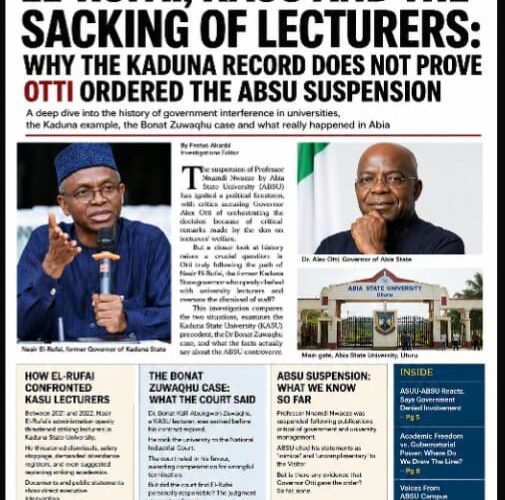
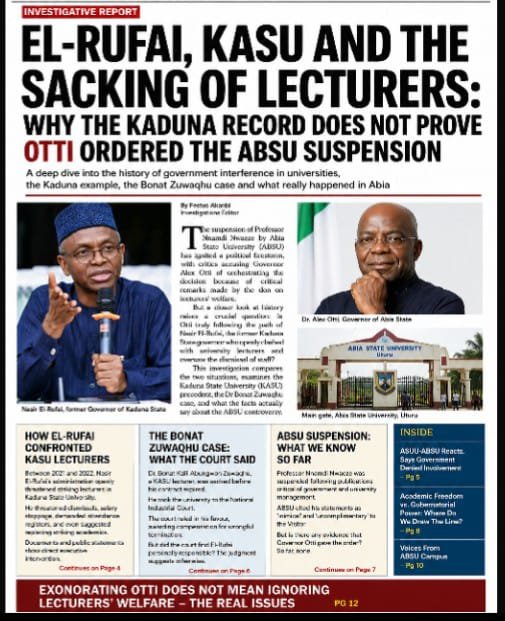
EL-RUFAI, KASU AND THE SACKING OF LECTURERS: WHY THE KADUNA RECORD DOES NOT PROVE OTTI ORDERED THE ABSU SUSPENSION
The Difference Between Evidence, Institutional Responsibility and Political Attribution
The controversy surrounding the suspension of Professor Nnamdi Nwaeze by Abia State University has increasingly been dragged into a wider political argument about Governor Alex Otti. The argument being circulated in some quarters is straightforward: because Otti is Governor of Abia State and Visitor to ABSU, and because the university suspended a professor whose public comments were critical of the welfare conditions of lecturers, the suspension must therefore have been ordered by Otti. It is an attractive political conclusion, but attraction is not evidence. Once the controversy is examined against the historical experience of Kaduna State University under former Governor Nasir El-Rufai, a much clearer distinction emerges between a governor who openly intervenes in university labour matters and a governor who is merely being associated with an administrative decision because of his position as Visitor.
The Kaduna example is useful precisely because it demonstrates what direct executive intervention looks like when it actually occurs. Under El-Rufai, Nigerians did not have to speculate about whether the Governor wanted striking lecturers punished. There were public pronouncements, threats of dismissal, demands for attendance records, salary stoppages and explicit statements about replacing striking academics. The evidential trail was visible. The Governor publicly entered the dispute and identified himself with the contemplated sanctions. That is substantially different from the present ABSU controversy, where the publicly available decision suspending Professor Nwaeze was issued by the university management and where no documentary evidence has so far emerged showing an instruction from Governor Otti ordering that suspension.
The comparison therefore deserves careful analysis, not political shouting.
When El-Rufai Confronted Kaduna State University Lecturers
The relationship between the El-Rufai administration and organised labour in Kaduna State became particularly confrontational during the industrial disputes of 2021. During the Nigeria Labour Congress action in Kaduna, the state government adopted an openly combative position against workers who participated in the strike. Kaduna State University lecturers were not treated as detached actors in an autonomous academic institution. The government publicly threatened consequences for academic staff who failed to report for duty.
Reports from that period indicated that the Kaduna State Government directed KASU authorities to monitor attendance and provide information on lecturers who stayed away from work. The significance of this cannot be overstated. Once the state executive begins demanding attendance registers from a university for the purpose of determining which lecturers should be sanctioned for industrial action, it has moved beyond general oversight into direct intervention in the employment dispute.
El-Rufai’s own subsequent pronouncements removed whatever ambiguity remained. During the prolonged ASUU strike in 2022, he publicly threatened to dismiss KASU lecturers who continued participating in the industrial action. He spoke about withholding salaries and suggested that positions could be advertised so that replacement lecturers could be recruited. Those statements made the political chain of responsibility visible. Nobody needed to invent a theory that El-Rufai wanted sanctions against KASU academics. He was publicly saying so himself.
This is what evidence of gubernatorial involvement looks like.
It consists of identifiable statements, directives, administrative demands and publicly expressed intentions. It does not depend merely on the fact that the Governor is Visitor to the university.
The Dismissal of KASU Lecturers
The confrontation eventually moved beyond threats. Reports from 2021 indicated that a number of Kaduna State University workers, including academic staff, were dismissed following participation in the industrial action involving organised labour. ASUU condemned those dismissals and challenged the propriety of punishing lecturers for participation in a labour dispute.
The historical importance of that episode is not simply that lecturers lost their jobs. It is that the dismissals occurred in an environment where the state government had already publicly articulated a punitive position toward workers who participated in the strike. The executive rhetoric and the subsequent employment consequences existed within the same political and institutional atmosphere.
This is why comparisons must be made carefully. If somebody wishes to argue that Governor Otti personally ordered the suspension of Professor Nwaeze, the evidential standard should not suddenly be lowered simply because Otti is politically controversial to the person making the allegation. The same questions should be asked. Where is the instruction? Where is the public statement? Where is the directive to the Vice-Chancellor? Where is the communication demanding that the professor be disciplined? Where is the equivalent of El-Rufai’s openly stated threat to sack lecturers?
Without such evidence, political suspicion cannot be promoted into established fact.
The Strange and Important Case of Dr Bonat Zuwaqhu
The history of Kaduna State University also contains the important case of Dr Bonat Kalli Abungwon Zuwaqhu, a senior lecturer whose appointment was terminated before the expiration of his contract. His case eventually reached the National Industrial Court.
Dr Bonat had been employed under a fixed-term arrangement that had been renewed. Before the contract expired, however, Kaduna State University terminated his appointment. He challenged the decision in court, arguing that the termination violated the conditions governing his employment.
The National Industrial Court subsequently found that the university had breached the terms of his contract by bringing the appointment to an end prematurely. He was awarded financial compensation representing the unexpired portion of the contractual period.
The significance of that judgment should nevertheless be stated with precision. The court found fault with the conduct of Kaduna State University as an employer. It did not make a judicial finding that El-Rufai personally ordered Dr Bonat’s termination because of his political views or advocacy.
There were public allegations, particularly from human-rights voices, that Dr Bonat’s troubles were connected to his advocacy regarding Southern Kaduna and his criticism of the political authorities. Those allegations formed part of the wider political discussion around the case. But an investigative analysis must distinguish what commentators alleged from what the court actually established.
The court established wrongful premature termination of the contract.
It did not establish, as a judicial fact, that El-Rufai personally ordered the termination because Dr Bonat criticised him.
That distinction is important because the same intellectual discipline must now be applied to Abia.
Why the El-Rufai Example Actually Strengthens Otti’s Defence
Paradoxically, the Kaduna experience makes the allegation against Otti more difficult to sustain rather than easier.
Under El-Rufai, there are examples of the Governor personally and publicly speaking about the employment consequences that should be imposed on university lecturers. He threatened dismissal. He spoke about stopping salaries. His administration required monitoring of attendance during labour action. He discussed replacing striking lecturers.
The political footprint was obvious.
In the present Abia controversy, there is no comparable public statement from Otti saying that Professor Nwaeze should be suspended. There is no known letter from Government House directing the Vice-Chancellor to discipline him. There is no publicly available minute showing that Otti instructed university management to act. There is no statement from the Governor threatening lecturers who criticise his administration with dismissal or suspension.
Instead, what entered the public domain was a statement from Abia State University management announcing the suspension and the constitution of an investigative panel.
That difference is fundamental.
A university management decision cannot automatically be converted into a gubernatorial decision merely because the Governor is Visitor.
The Problematic ABSU Statement
None of this means that Abia State University management handled the controversy well.
The wording reportedly used by the university in explaining Professor Nwaeze’s suspension deserves serious criticism. The suggestion that his publications were objectionable because they were “uncomplimentary” to the Visitor creates a serious academic-freedom problem.
Universities are not praise-singing institutions. Professors are not employed to ensure that their public commentary is complimentary to political officeholders. A university worthy of its name must tolerate criticism, including criticism that is embarrassing, uncomfortable or politically inconvenient.
If Professor Nwaeze published inaccurate figures about remuneration, management can publish the correct figures. If he made defamatory allegations, the affected parties have appropriate remedies. If he violated a clearly stated provision of the university’s conditions of service, management should identify that provision and demonstrate compliance with due process.
But merely describing criticism as uncomplimentary to the Visitor is not a persuasive academic justification for punishment.
Indeed, that wording may have done more damage to Governor Otti than anything the professor himself said because it created the impression that the university was acting protectively on behalf of the Governor.
That impression, however, is still not proof that the Governor ordered the action.
Visitor Does Not Mean Author of Every University Decision
One of the weakest arguments in the controversy is the claim that because Governor Otti is Visitor to ABSU, every significant administrative decision taken by the university must necessarily have originated from him.
That reasoning misunderstands institutional governance.
A state university has management structures. It has a Vice-Chancellor. It has a Registrar. It has a Governing Council. It has Senate. It has administrative officers. These bodies and officials exercise different powers under the university’s enabling law, statutes and conditions of service.
The Governor’s position as Visitor does not automatically convert him into the person who signs every query, approves every suspension, determines every promotion, processes every salary or initiates every disciplinary proceeding.
If that principle were accepted, then every disciplinary decision in every state university in Nigeria would automatically become the personal act of the Governor of that state.
That would be institutionally absurd.
The correct approach is to trace the decision.
Who initiated the complaint?
Who drafted the query?
Who recommended suspension?
Who approved it?
Which university organ acted?
Was the Governing Council involved?
Was the Visitor consulted?
Was a directive issued from Government House?
Those are investigative questions.
Simply shouting the name of the Governor is not investigation.
ASUU’s Own Account Complicates the Anti-Otti Narrative
There is an additional difficulty for those insisting that Otti personally engineered Professor Nwaeze’s suspension.
According to the public account attributed to the leadership of ASUU-ABSU following discussions involving the government and the university, the state government denied directing the Vice-Chancellor to suspend the lecturer.
That denial is important.
It does not automatically prove that no political influence of any kind existed. Governments deny allegations every day, and serious journalism should never treat a denial as the final word merely because it was issued officially.
But where the accuser has not produced documentary evidence linking the Governor to the decision, and the government has expressly denied issuing the instruction, the burden remains on those alleging direct gubernatorial involvement to produce evidence.
The standard cannot be that Otti must prove that he did not secretly give an instruction for which nobody has produced evidence.
That reverses the burden of proof.
The person making the allegation must establish it.
What Would Actually Implicate Otti?
The question can be made extremely simple.
If tomorrow a memorandum emerges showing that Governor Otti directed the Vice-Chancellor to suspend Professor Nwaeze because of his criticism, the argument changes immediately.
If a credible witness produces minutes of a meeting where such an instruction was given, that evidence should be investigated.
If correspondence from Government House instructed ABSU management to sanction the professor, it should be published.
If the Vice-Chancellor publicly states that the suspension followed a directive from the Visitor, Otti would have serious questions to answer.
That is how evidence works.
Until such material exists, one cannot move from suspicion to certainty merely because the university’s statement mentioned the Visitor.
The distinction between inference and proof is precisely what separates investigation from propaganda.
The Greater Responsibility May Rest With ABSU Management
There is also an irony in the relentless effort to place the suspension at Otti’s doorstep.
It may actually be helping the people who should presently be answering the most immediate questions.
ABSU management announced the suspension.
ABSU management constituted the investigative panel.
ABSU management used the language concerning publications being inimical to the university’s interests and uncomplimentary to the Visitor.
Therefore, ABSU management should explain the legal and administrative basis of its decision.
The public deserves to know whether Professor Nwaeze was queried before he was suspended. It deserves to know the specific regulation allegedly violated. It deserves to know whether suspension before the completion of investigation is provided for under the relevant conditions of service. It deserves to know whether he continues to receive salary during suspension. It deserves to know the composition of the investigative panel and whether its members are sufficiently independent to guarantee procedural fairness.
These are far more serious questions than simply shouting “Otti suspended a professor.”
Exonerating Otti Does Not Require Defending Everything ABSU Has Done
There is another trap that should be avoided.
One does not need to defend ABSU management in order to defend Otti against an allegation that has not been proved.
It is perfectly consistent to argue that management may have acted unwisely while simultaneously maintaining that no evidence has been produced showing that the Governor personally ordered the suspension.
Indeed, that is the more intellectually credible position.
If the university’s action undermines academic freedom, criticise the university.
If the conditions of service were violated, challenge the procedure.
If the professor’s welfare claims are accurate, address them.
If the university’s financial management is defective, investigate it.
But if somebody wants to accuse Otti personally of ordering the suspension, then evidence linking Otti personally to that decision must be produced.
The Governor cannot become guilty by institutional proximity.
Where Otti Can Still Be Held Accountable
Exoneration from one allegation does not mean immunity from accountability.
Governor Otti remains Visitor to ABSU. His administration has responsibilities toward the general health of the institution. He can legitimately be questioned about subvention, infrastructure, salary policy, inherited liabilities, academic welfare and the overall stability of the university.
If lecturers have genuine outstanding entitlements, government should engage constructively toward their resolution.
If ABSU management has created a crisis through an unnecessary disciplinary decision, the Visitor can encourage lawful resolution without converting the university into an extension of Government House.
Otti can therefore be held accountable for the quality of his response to the controversy without falsely attributing the origin of every university decision to him.
That is the proper distinction.
The Kaduna Test
The Kaduna precedent gives us an unusually useful test.
When El-Rufai wanted to confront KASU lecturers, the public record contained his voice.
He spoke.
He threatened.
He explained what he intended to do.
He talked about salary stoppage.
He discussed dismissal.
He discussed replacements.
His administration demanded information regarding workers participating in industrial action.
Nobody needed to discover El-Rufai’s intentions through political divination.
The evidence was visible.
Apply that same test to Otti.
Where is his statement threatening Professor Nwaeze?
Where is his directive ordering the suspension?
Where is his warning that lecturers who criticise him will be punished?
Where is his instruction to the Vice-Chancellor?
Where is the correspondence?
Where is the witness?
Where is the document?
Until those questions are answered with evidence, the assertion that Otti personally suspended the professor remains precisely that—an assertion.
The Historical Irony
There is a final irony in the present debate.
Some of those portraying the ABSU suspension as unprecedented political interference appear remarkably forgetful of Nigeria’s recent history.
State universities have experienced executive pressure, labour confrontations, dismissals and controversial disciplinary actions under several administrations.
Kaduna provides one of the clearest examples because El-Rufai’s confrontational approach to public-sector labour relations was openly articulated.
The KASU experience therefore teaches an important lesson.
When a Governor personally enters an academic labour dispute, evidence can usually be found in his pronouncements and executive actions.
When such evidence is absent, responsible analysts should resist filling the vacuum with partisan assumptions.
The Verdict
The El-Rufai-KASU history does not prove that every Governor personally controls every disciplinary action in a state university.
It proves something almost opposite.
It demonstrates how identifiable direct gubernatorial involvement can be when it actually exists.
In Kaduna, El-Rufai left an unmistakable public record of confrontation with university lecturers. He threatened sanctions, discussed salary stoppage and spoke openly about replacing striking academics.
In Abia, no equivalent evidential chain presently connects Governor Alex Otti directly to Professor Nwaeze’s suspension.
What presently exists is an ABSU management decision containing an unfortunate reference to the Visitor.
That reference deserves scrutiny.
The suspension deserves scrutiny.
The treatment of academic freedom deserves scrutiny.
The welfare claims of ABSU lecturers deserve scrutiny.
The actions of the Vice-Chancellor and management deserve scrutiny.
But scrutiny is not licence to manufacture causation.
The fairest conclusion from the evidence presently available is therefore straightforward: Governor Alex Otti has not been shown to have ordered Professor Nwaeze’s suspension.
If anyone possesses contrary evidence, let it be produced.
Not insinuation.
Not political association.
Not Facebook arithmetic.
Not the assumption that because a Governor is Visitor, every decision taken inside a university bears his fingerprints.
Produce the memo.
Produce the directive.
Produce the minutes.
Produce the communication.
Until then, the proper subject of interrogation remains the institution that publicly announced the suspension—Abia State University management.
That is where the documentary trail presently leads.
And in serious investigation, the trail of evidence matters more than the convenience of the accusation.