
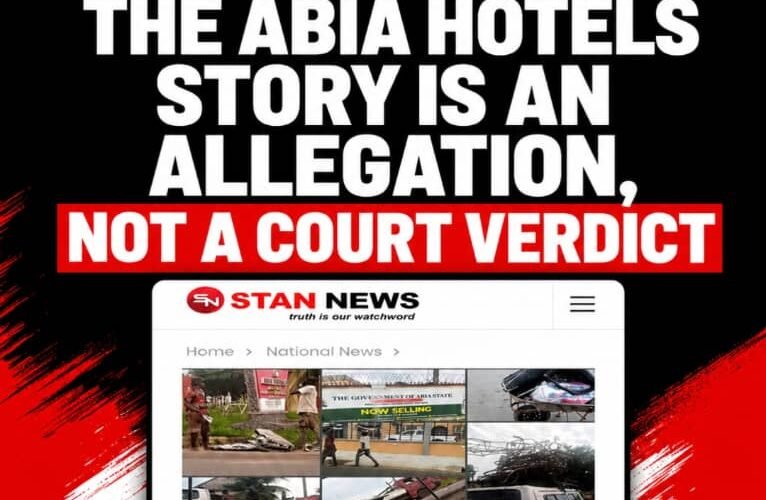
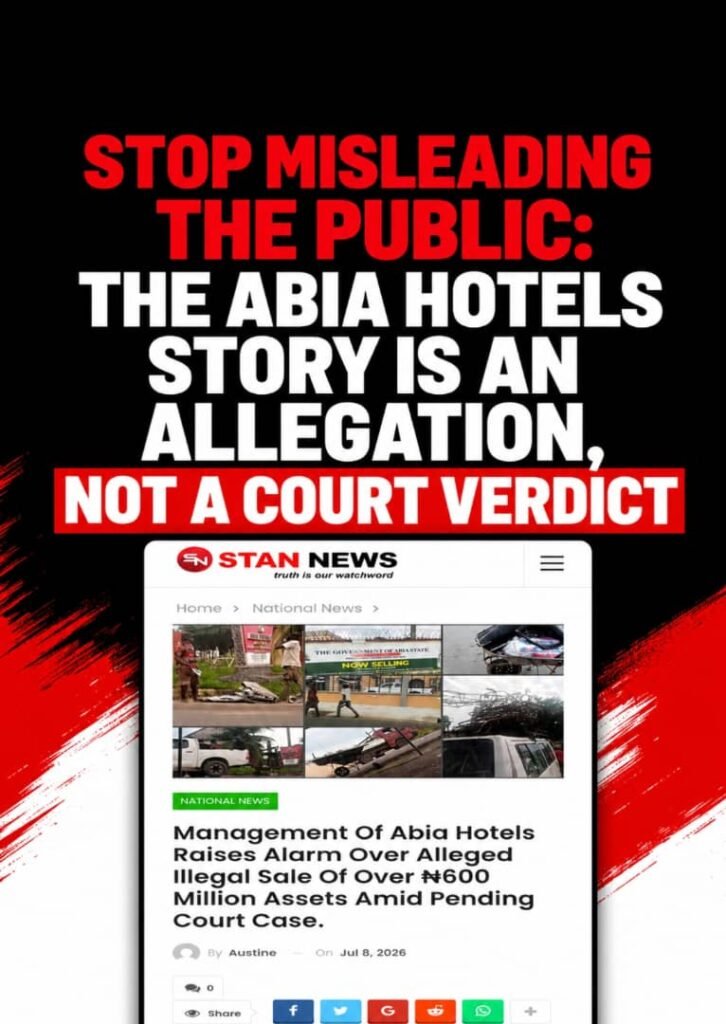
STOP MISLEADING THE PUBLIC: THE ABIA HOTELS STORY IS AN ALLEGATION, NOT A COURT VERDICT
The report on Abia Hotels is presented as though illegality has already been established. It has not. What the publication contains is largely the account and accusations of Investment Guarantee Limited. No judgment, restraining order, inventory report, valuation certificate, police report or documentary evidence establishing the alleged “illegal sale of over ₦600 million assets” was reproduced.
Here are the major holes and half-truths:
- IT CONCEALS THE CENTRAL ISSUE: THE HOTEL IS AN ABIA STATE ASSET
Investment Guarantee Limited was not the original owner of Abia Hotels. It entered into a development lease agreement with the Abia State Government in 2013. Under that agreement, the company was expected to redevelop the property into a three-star Protea-standard hotel and manage it for 25 years.
The government’s stated position is that, after approximately 12 years, the lessee had failed to deliver the agreed redevelopment and had breached other terms of the agreement. That crucial background is almost completely buried in the alarmist narrative.
A lease does not automatically convert a state-owned property into the permanent private property of the lessee.
- “PENDING IN COURT” DOES NOT MEAN THE COMPANY HAS WON
The report repeatedly invokes pending litigation as though filing a lawsuit automatically proves the claimant’s allegations. It does not.
A pending case means that competing claims remain unresolved. The publication fails to provide:
The suit number;
The court before which the matter is pending;
The exact reliefs being sought;
Any order restraining the government;
Any injunction prohibiting redevelopment or disposal;
Any judgment declaring the revocation unlawful.
Without those documents, the public cannot honestly be told that the government has disobeyed a court order.
Nigerian law recognises that transactions involving property under litigation may remain subject to the final outcome of the case. However, the exact legal effect depends on the claims, parties, property involved and any existing court orders.
Mere repetition of “the matter is in court” is not a substitute for producing the relevant order.
- THE HEADLINE CONFUSES LAND WITH MOVABLE EQUIPMENT
The headline alleges the sale of “over ₦600 million assets.” Yet the report later says the government advertised the premises for housing development.
These are two different matters:
The land and hotel premises;
Generators, televisions, refrigerators, documents and other alleged movable belongings.
Where is the advertisement offering the three generators, televisions, certificates or industrial machines for sale?
Where are the auction documents?
Where is the list of items allegedly sold?
Where are the buyers, receipts, prices and dates of sale?
The story jumps from an alleged housing-estate advertisement to the conclusion that movable assets worth ₦600 million are being sold. That is an unsupported leap.
- THE ₦600 MILLION FIGURE IS UNVERIFIED
The report gives a sensational valuation exceeding ₦600 million but provides no:
Professional valuation report;
Asset register;
Audited financial statement;
Purchase receipts;
Depreciation schedule;
Insurance record;
Independent inspection report.
A party cannot simply list used air conditioners, televisions, generators and kitchen equipment, attach a huge figure and expect the public to accept it as established fact.
The ₦600 million figure is presently a claim—not proof.
- IT OMITS THE GOVERNMENT’S CLAIM THAT COMPENSATION WAS OFFERED AND PAID
The government stated publicly that compensation was offered and paid to Investment Guarantee Limited to cover costs incurred in developing the complex.
Whether the company disputes the amount or legal effect is a matter for evidence and judicial determination. But a balanced report should have disclosed this material fact instead of presenting a one-sided story of uncompensated confiscation.
- THE APC-RALLY NARRATIVE IS POLITICAL SPECULATION PRESENTED AS FACT
The article attempts to connect the government’s action to the hosting of an APC event associated with the Deputy Speaker, Benjamin Kalu.
But timing alone does not prove retaliation.
The government’s documented reason was alleged non-performance and breach of the 2013 development lease—not the political identity of people who used the premises.
Anyone alleging political retaliation must establish it with correspondence, official directives, admissions or credible documentary evidence.
The report provides none.
It simply inserts a political motive at the end of a contractual and property dispute.
- THERE IS NO CONTRADICTION BETWEEN REDEVELOPMENT AND A CHANGE IN DEVELOPMENT MODEL
The report claims that advertising the premises for housing contradicts an earlier statement about developing a Radisson Blu-type hotel there.
Plans for public assets can be reviewed because of feasibility studies, litigation, urban planning, investment proposals, costs or changes in government policy.
To establish deception, the authors must first produce:
The complete current development plan;
The exact advertisement;
The parcel of land covered;
Evidence that the entire hotel site is being permanently sold;
Proof that the proposed housing project and hospitality development cannot coexist;
An official statement cancelling the hotel-development plan.
Without these, “contradiction” remains an inference.
- THE REPORT USES LOADED LANGUAGE IN PLACE OF INVESTIGATION
Words such as “looting,” “stealing,” “illegal sale,” “pretentious,” “bad faith” and “bending the law” are accusations from an interested party.
They are not findings of a court, police investigation or independent audit.
Responsible journalism should clearly distinguish among:
What the company alleges;
What the government says;
What documents establish;
What a court has decided.
This publication largely repeats the claimant’s accusations and then gives them the appearance of settled fact.
THE VERIFIED POSITION
What is presently established publicly is that:
Abia Hotels is a state-owned asset that was placed under a development lease in 2013.
The private lessee was expected to redevelop it into a three-star Protea-standard hotel.
The Abia State Government says the company failed to deliver the agreed standard after about 12 years and breached other contractual conditions.
The government revoked the arrangement, retook possession and said compensation had been offered and paid for development costs.
The company disputes the government’s actions and says litigation is pending.
That is a dispute—not a judicial finding that Governor Alex Otti’s administration acted illegally.
CONCLUSION
Members of the public should not be stampeded by sensational headlines.
Let Investment Guarantee Limited publish the lease agreement, the alleged subsisting injunction, the full asset register, the independent ₦600 million valuation, proof of ownership of each item, evidence of the alleged auction and the precise court processes.
Let the government equally disclose the breach notices, revocation documents, compensation records and current redevelopment plan.
Until then, the truthful headline should be:
“Former Abia Hotels Lessee Makes Allegations Against State Government Amid Unresolved Contractual Litigation.”
Anything stronger risks converting an interested party’s claims into misinformation.