
WHO IS AFRAID OF AI-ASSISTED FACT-CHECKING?
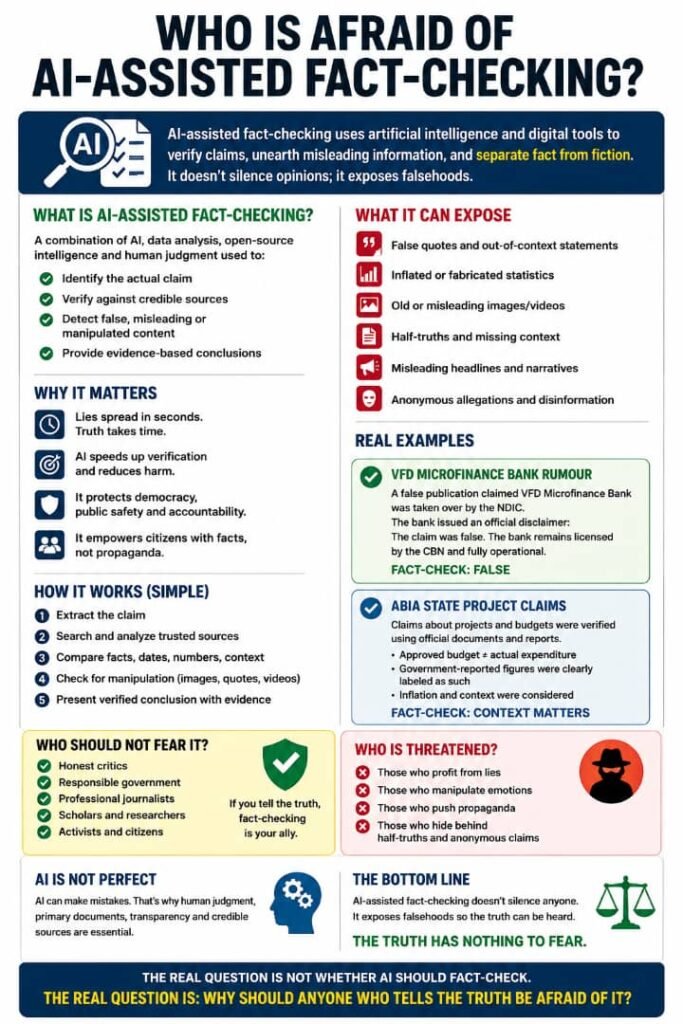
A new discipline is quietly changing public debate: AI-assisted digital verification, also called computational fact-checking. It combines artificial intelligence, internet search, document analysis, data comparison, image examination and source tracing to test claims against available evidence.
For decades, misinformation prospered because verification was slow. A person could manufacture a quotation, remove a statement from context, confuse a proposed budget with actual expenditure, recycle an old photograph or present an allegation as an established fact. Before the truth travelled through libraries, archives and government records, the lie had already toured WhatsApp, Facebook and political meetings.
AI has changed that imbalance.
Within minutes, modern tools can extract the central claim from a lengthy article, identify dates and figures, compare them with budgets and official reports, detect contradictions, locate earlier versions of photographs and distinguish what was approved, released, spent, completed, proposed or merely claimed.
That distinction is crucial. A budget allocation is not automatically evidence that the money was spent. A project described as ongoing cannot honestly be reported as completed. The absence of a project from one person’s neighbourhood does not prove that no project exists anywhere in the state.
This is why careful digital verification does not merely gather figures; it labels them correctly.
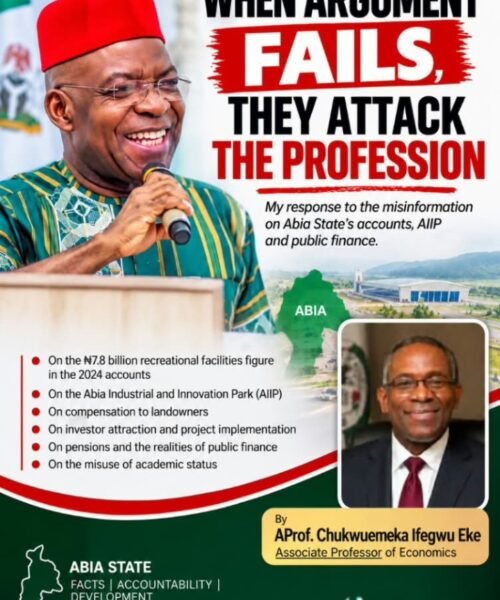
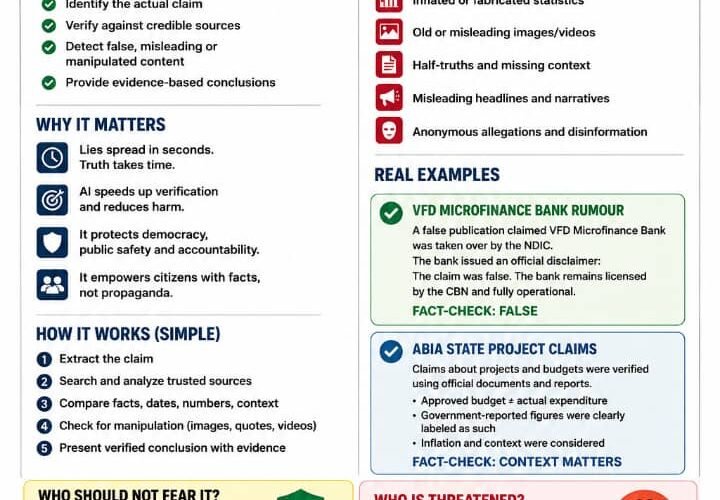
In our own fact-checking work on Abia State, we have repeatedly separated approved budget allocations from actual expenditure, distinguished government-reported figures from independently verified figures, and identified when statistics were nominal rather than adjusted for inflation.
Technology also helps expose misleading statistics, cropped documents, recycled photographs, false quotations and emotionally framed headlines.
A practical example appeared in my email when a false publication claimed that VFD Microfinance Bank had been taken over by the Nigeria Deposit Insurance Corporation. The bank issued a direct disclaimer, stating that the claim was false, that it remained licensed by the Central Bank of Nigeria and that its operations continued normally.
The lesson is simple: before forwarding a frightening claim, check the regulator, the institution concerned and its official communication channels.
So, who is afraid of AI-assisted fact-checking?
The honest critic should not be afraid. The responsible government should not be afraid. The professional journalist should not be afraid. The scholar, activist and ordinary citizen should welcome any process that separates evidence from propaganda.
Those most threatened are people whose influence depends on emotional manipulation, cropped documents, anonymous allegations, imaginary statistics, misleading headlines and carefully constructed half-truths.
They are comfortable when arguments are driven by anger, party loyalty and repetition. They become uncomfortable when somebody asks:
What exactly is the claim?
What is the original source?
What date does it cover?
Is the quotation complete?
Is the figure an allocation or actual expenditure?
Is the project proposed, ongoing or completed?
AI itself is not an infallible judge. It can misunderstand documents, reproduce inaccurate information or rely on weak sources. It must therefore be supervised by human reasoning and supported by primary documents, credible journalism, official statistics, photographs, maps, budgets and direct statements.
The proper formula is not AI instead of human judgment.
It is AI plus evidence, transparency and human judgment.
Fact-checking is also not the defence of any particular government or political party. The same technology that disproves an opposition falsehood must also be permitted to expose an exaggerated government claim. Otherwise, it becomes propaganda dressed in digital clothing.
The age of unchallenged misinformation is gradually ending. A smartphone can now become a library, archive, calculator, newsroom and verification laboratory.
The real question is no longer whether AI should participate in fact-checking.
The question is:
WHY SHOULD ANYBODY WHO IS TELLING THE TRUTH BE AFRAID OF IT?