

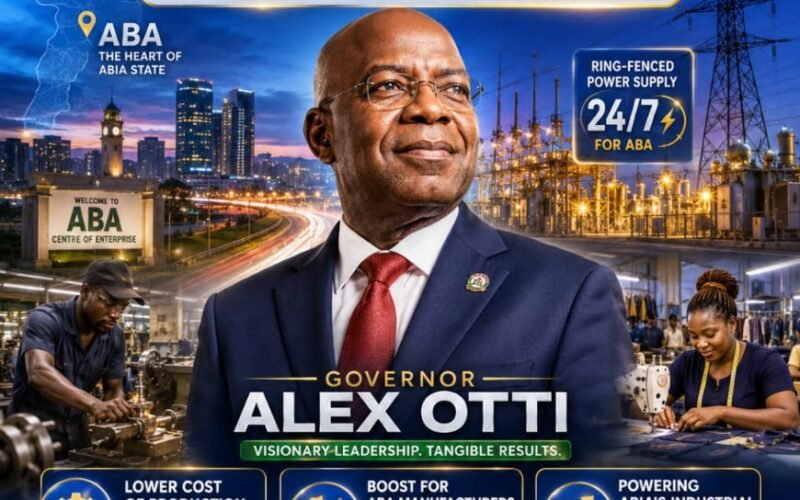

ABA HAS BEEN RING-FENCED FROM DARKNESS: OTTI’S QUIET INDUSTRIAL REVOLUTION HAS STARTED
There is a new economic story rising from Abia State, and it is not the usual noise of politics.
It is not about who shouted the loudest.
It is not about who abused whom.
It is not even about another ceremonial promise of “industrialization” that dies immediately after the microphone is dropped.
This one is different.
This one is about power.
Not political power.
Electric power.
The real power that keeps machines running, tailors sewing, welders producing, shoemakers finishing orders, cold rooms preserving goods, hospitals working, small factories expanding, and young entrepreneurs staying awake at night because there is light to dream, work and produce.
Aba, the industrial heart of Abia State, has been strategically ring-fenced for electricity.
That phrase may sound technical, but its meaning is simple and powerful: Aba and its surrounding industrial communities are no longer being treated like ordinary victims of Nigeria’s unstable national grid. They are being placed inside a special power economy where generation, distribution and industrial consumption can be planned together.
That is the real meaning of development.
For decades, Aba did not lack talent.
Aba did not lack energy.
Aba did not lack business sense.
Aba did not lack markets.
Aba did not lack young people willing to work.
What Aba lacked was the one thing every industrial city needs to breathe: steady electricity.
The tragedy of Aba was that its artisans were producing under punishment. A shoemaker was not only making shoes; he was also buying diesel. A welder was not only fabricating gates; he was also fighting generator costs. A tailor was not only sewing clothes; she was also calculating fuel before profit. A small factory was not only producing goods; it was also running a private power station at its own expense.
That is why the Aba ring-fenced power model is not just an electricity project. It is an industrial rescue mission.
Governor Alex Otti appears to understand one thing many politicians miss: you cannot preach industrialization to people who are producing in darkness.
You cannot ask investors to come when the first question they ask is, “Where is the power?”
You cannot build a manufacturing economy when the cost of diesel is stronger than the profit margin.
You cannot make Aba compete with Asia, Lagos, Onitsha, Nnewi, or global industrial clusters if Aba manufacturers are spending their capital on survival energy.
So the strategic wisdom is clear.
First, stabilize power.
Then reduce production costs.
Then attract investors.
Then expand output.
Then create jobs.
Then increase internally generated revenue.
That is how industrial economies are built.
This is why the ring-fencing of Aba is one of the most important economic moves in the South-East today. It changes the conversation from politics to productivity. It tells the Aba manufacturer: “You are no longer condemned to darkness.” It tells the investor: “Abia is preparing the infrastructure of confidence.” It tells the young entrepreneur: “Your workshop can become a factory.” It tells Nigeria: “Industrial revival is not a slogan; it begins with electricity.”
And this is where Governor Otti’s recent investment pitch becomes even more significant.
At Invest Lagos 3.0, Otti was not merely attending another elite summit. He was marketing Abia as a serious investment destination. He spoke about the Abia Medical City, the Abia Industrial and Innovation Park, and the need to position Abia for productive capital, not political theatre.
That is the fresh angle.
Abia is not trying to become Lagos.
Abia is trying to become Abia properly.
The “Un-Lagos” pitch is simple: Lagos is congested, expensive and overstretched. Abia, especially Aba, offers something different — industrial skill, enterprise culture, strategic location, lower entry pressure, and now, a serious movement toward independent power reliability.
That is how a state competes intelligently.
Not by copying Lagos.
Not by envying Lagos.
Not by abusing Lagos.
But by offering investors what Lagos can no longer easily offer: room to build, room to expand, room to manufacture, room to breathe.
Aba is not just a city.
Aba is a machine waiting for stable power.
Once that machine is switched on, the ripple effects will not stop at Aba North and Aba South. They will move through Osisioma, Obingwa, Ugwunagbo, Ukwa, Isiala Ngwa and the wider Abia economy. They will touch transporters, traders, suppliers, apprentices, exporters, market women, mechanics, fashion designers, leather workers, fabricators, food processors, logistics operators and service providers.
That is what electricity does.
It multiplies effort.
It turns talent into output.
It turns output into income.
It turns income into jobs.
It turns jobs into dignity.
And that is why the Aba power story must not be reduced to partisan praise. It should be understood as economic strategy.
When power is stable, a factory can plan shifts.
When power is stable, machines last longer.
When power is stable, production time improves.
When power is stable, prices can become more competitive.
When power is stable, young people can learn real skills instead of roaming around political offices.
When power is stable, banks can lend with more confidence because businesses have a better chance of survival.
That is the industrial logic behind the ring fence.
It is not just about light bulbs.
It is about balance sheets.
It is about jobs.
It is about exports.
It is about productivity.
It is about restoring the dignity of Aba’s creative economy.
For years, Aba was mocked by people who wore Aba-made products secretly but abused Aba publicly. They called Aba local, yet Aba clothed them. They called Aba rough, yet Aba repaired their machines. They called Aba backward, yet Aba carried the spirit of Nigerian enterprise.
Now, with the power question being confronted, Aba may be entering a new phase.
Aba does not need pity.
Aba needs infrastructure.
Aba does not need empty praise.
Aba needs power, roads, finance, markets and investor confidence.
Aba does not need politicians who only remember it during campaigns.
Aba needs deliberate economic planning.
That is why the ring-fenced power model matters.
It is the beginning of a new industrial grammar.
If Otti sustains it, expands it, regulates it properly, and connects it with industrial parks, skills development, export support, and affordable credit, Abia can become one of Nigeria’s strongest manufacturing revival stories.
But the work must continue.
Power must be reliable.
Tariffs must be fair.
Small businesses must not be priced out.
Industrial clusters must be mapped.
Investors must be followed up.
Young people must be trained.
Local manufacturers must be protected from being swallowed by big capital.
The government must ensure that the Aba power advantage becomes a people’s advantage, not only a corporate headline.
That is the next test.
But for now, one thing is clear:
Aba has been ring-fenced from darkness.
And when an industrial city is rescued from darkness, it does not just see light.
It begins to produce its future.
This is the Abia story that deserves attention.
Not noise.
Not propaganda.
Not bitterness.
A serious industrial state is being assembled, one power line, one road, one investment pitch, one factory, one workshop, and one productive citizen at a time.
If Aba gets steady power, Abia will not need to beg investors.
Investors will come looking for Aba.
Because where there is power, production follows.
And where production follows, prosperity is no longer a prayer point.
It becomes a plan.