

WHEN OPPOSITION MISTAKES ANGER FOR ANALYSIS, IT COMMITS INTELLECTUAL SUICIDE
The write-up by @ORACLE is long, loud and emotionally arranged, but when subjected to academic scrutiny, it collapses under the weight of its own contradictions.
Let us begin scientifically.
A serious analysis must separate anecdote from evidence, allegation from data, political bitterness from empirical fact, and personal discomfort from policy evaluation. The post failed all four tests.
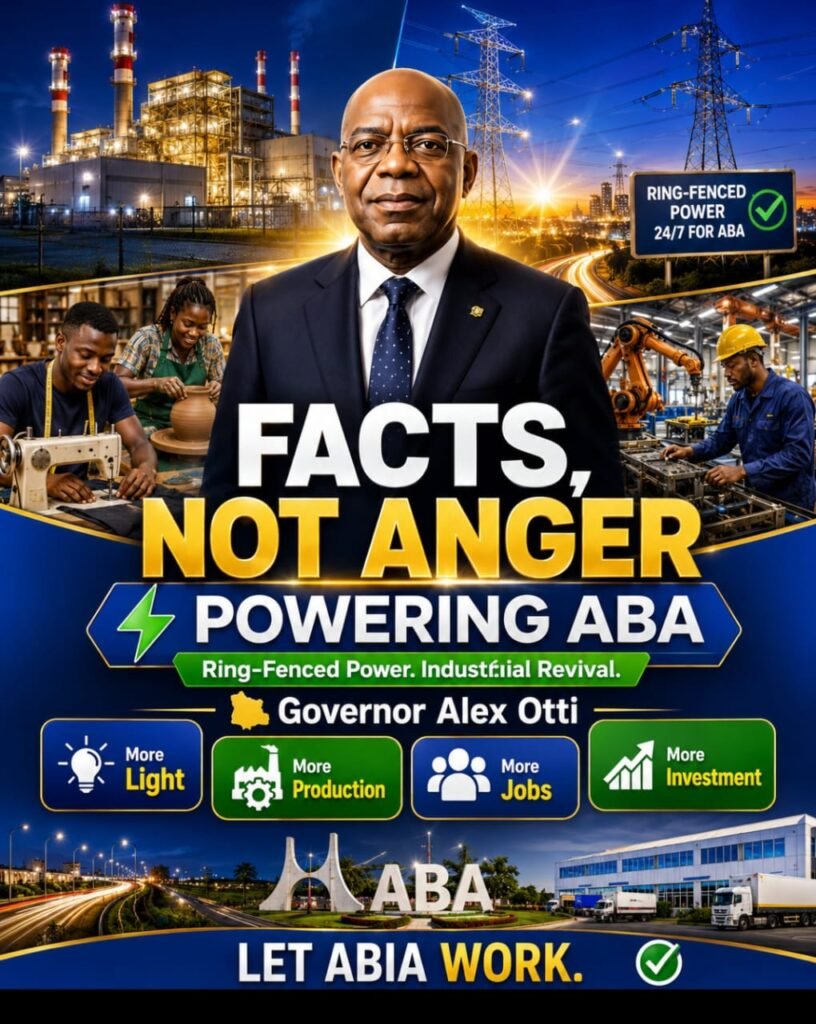
First, the claim that Governor Alex Otti “lied” about Aba power is based on a shallow misunderstanding of what a ring-fenced electricity system means. A ring-fenced power model does not mean that every bulb in every room in every street will be permanently immune from faults, feeder interruptions, transformer failures, billing disputes, technical maintenance or distribution glitches. That is not how power systems work anywhere in the world.
The correct question is not, “Did one house or one office experience outage?”
The correct question is, “Has Aba’s power architecture changed from total dependence on the unstable national grid to a dedicated generation-and-distribution framework serving an identified industrial zone?”
The answer is yes.
That is the difference between gossip and analysis.
Geometric Power’s Aba Integrated Power Project is a documented 141MW gas-fired power project with a ring-fenced distribution network. Afreximbank also confirmed that the project was designed to generate and distribute power across nine local government areas within the Aba ring-fenced zone. So anybody who reduces this structural energy reform to “my house had no light” is committing what scholars call the anecdotal fallacy.
One personal experience cannot cancel a system-level intervention.
It can only point to a service-delivery complaint.
Second, the attack on Otti’s Lagos presentation is another example of political reasoning without economic literacy. An investment summit is not a village meeting. A governor does not go there merely to praise himself or recite emotional poetry about Aba. He goes there to tell investors where the gaps are, where the opportunities are, and why capital should move.
Investors are not children.
They do not invest because a governor shouts “Made-in-Aba” ten times.
They invest when they see power, infrastructure, land, policy direction, industrial clusters, health opportunities, market access and credible governance signals.
That is exactly why Otti’s message about power, Medical City, industrial development and investment entry points was strategically valid.
Third, the claim that Otti “diminished” Made-in-Aba producers is intellectually dishonest. The old “Aba-made” stereotype was never a gift to Aba manufacturers. It was a stigma built by years of poor power, weak standards support, inadequate infrastructure, limited branding, market informality and government failure. To confront that history is not to insult Aba. It is to diagnose the disease so that the cure can be applied.
A doctor who identifies malaria is not insulting the patient.
He is preparing treatment.
Otti’s point is simple: Aba must move from survival production to quality-certified industrial production. That requires power, standards, finance, branding, logistics and market access. Sentimental praise alone cannot achieve that.
Fourth, the opposition is also guilty of what economists call the fallacy of inherited credit. Yes, government is a continuum. Yes, earlier administrations may have played roles in several projects. But continuity does not mean permanent ownership. The question in governance is not who first announced a dream. The question is who converted it into operational value for citizens.
Nigeria is full of foundation stones.
Nigeria is full of abandoned signboards.
Nigeria is full of projects that were “flagged off” and never delivered.
So when an administration takes a long-delayed structure and begins to integrate it into a wider electricity, investment and industrial policy framework, serious minds do not scream theft. They examine execution.
Fifth, the repeated claim of “almost ₦2 trillion” is thrown around like a magic stick, but without a disciplined fiscal breakdown. Serious public finance analysis does not stop at gross inflows. It asks: What was recurrent expenditure? What were statutory obligations? What debts were inherited? What salaries, pensions, gratuities, contractors’ liabilities, counterpart funding, health, education, security and infrastructure costs were covered? What portion was capital spending? What is the debt profile? What is the project pipeline?
Anyone who mentions a large revenue figure without expenditure structure is not doing analysis.
He is doing propaganda arithmetic.
Sixth, the argument about electric buses is weak. If the Federal Government released palliative support to states, that does not prevent a state from designing its own transport rollout according to procurement, route planning, charging infrastructure, maintenance capacity and operational sustainability. Public transport is not judged by counting buses alone. It is judged by whether the system is planned, maintainable, affordable and scalable.
A hundred badly managed buses can become a junkyard.
Twenty properly integrated buses can become a pilot model.
Seventh, the criticism of the Abia Medical City exposes another contradiction. The same writer complains that Otti is not attracting investment, yet also complains that Otti used a major investment platform to seek investors for a Medical City. Which one exactly is the offence? That he is seeking investors, or that he is not seeking investors?
In development economics, foundation stone is not financing closure. Land preparation is not full project funding. Announcement is not execution. A serious governor can acquire land, prepare access, secure preliminary partnerships, and still use an investment summit to widen funding, deepen partnerships and attract technical operators.
That is not confusion.
That is project development.
Eighth, the Abia Industrial and Innovation Park should not be dismissed by people who previously celebrated foundation stones as achievements. If a foundation stone was enough yesterday, why has it suddenly become useless today? The intellectually honest position is simple: ask for project milestones, site progress, financing structure, timelines, anchor investors and implementation updates. That is valid accountability.
But to mock industrial planning while also demanding industrialization is self-contradiction.
Ninth, the road argument is another case of semantic evasion. Whether one calls it construction, reconstruction, rehabilitation, rigid pavement, drainage-backed rebuilding or full corridor upgrade, the real question is whether movement, access, flood control, business activity and connectivity have improved. Roads are economic instruments. They are not built to satisfy dictionary debates.
If a road was impassable and becomes motorable, businesses gain.
If a market road opens, traders gain.
If drainage reduces flooding, residents gain.
If industrial access improves, investors gain.
That is the development question.
Tenth, the comparison that “Onitsha to Lagos is 500 kilometres” is rhetorically dramatic but analytically empty. Road length in governance is not measured only as one straight highway. It includes multiple road segments, urban streets, rural access roads, internal roads, drainage corridors, reconstructed sections and local government connectivity. Anybody who teaches infrastructure measurement with motor-park distance is not doing science.
He is doing roadside mathematics.
Eleventh, the attack on health facilities also ignores a basic fact of public-sector reform: renovating, staffing, equipping, financing and operationalizing existing facilities can be more important than building empty monuments. A repainting-only health policy would be weak. But upgrading primary health centres, improving access, supporting health financing and strengthening service delivery are legitimate development actions, especially where the inherited system was weak.
The analytical question is not, “Was the building already there?”
The question is, “Is service delivery improving?”
Twelfth, Ariaria Market should not be dragged into partisan amnesia. Markets do not become modern because one administration signs a PPP or erects a gate. Markets improve when power, sanitation, drainage, access roads, security, financing, logistics and digital payment systems begin to work together. That is why Aba’s power story matters directly to Ariaria. A market without reliable energy remains underproductive, no matter who remodelled one section.
Now let us theorize the issue properly.
Abia’s development challenge is not a personality contest. It is a structural transition problem. The state must move from consumption politics to production economics. Consumption politics shares money, praises noise, builds patronage and celebrates announcements. Production economics builds power, roads, markets, industrial parks, health systems, schools, investment credibility and enterprise capacity.
That is the real difference.
Otti’s model, whether one likes him or not, is moving toward production economics.
Power is the foundation.
Roads are the arteries.
Markets are the exchange platforms.
Health investment is human capital protection.
Industrial parks are spatial production clusters.
Investor summits are capital mobilization platforms.
That is the development chain.
A serious opposition should interrogate this chain with data. It should ask about tariffs, power reliability, project timelines, procurement transparency, road cost per kilometre, healthcare outcomes, investment conversion rates, job numbers and budget performance.
That would be intelligent opposition.
But this one is not that.
This one is political lamentation dressed as analysis.
It starts with a conclusion, then searches for anger to support it.
It calls Otti unprepared, yet attacks him for presenting investment opportunities.
It claims Aba producers need promotion, yet downplays the power infrastructure that can make them produce better.
It says government is a continuum, yet becomes angry when Otti continues abandoned or delayed projects.
It demands industrialization, yet mocks industrial parks.
It demands healthcare transformation, yet mocks investment in Medical City.
It demands evidence, yet offers mostly assertion.
That is not accountability.
That is contradiction.
Let it be said clearly: no government should be worshipped. Otti should be questioned. His claims should be audited. His projects should be verified. His costs should be examined. His delivery should be measured. Citizens have every right to demand outcomes, not slogans.
But criticism must be intellectually honest.
You cannot fight exaggeration with falsehood.
You cannot accuse another man of lying while building your own argument on selective memory.
You cannot defend Aba manufacturers by ignoring the electricity crisis that punished them for decades.
You cannot reduce an industrial power reform to one personal outage.
You cannot discuss investment like a beer-parlour quarrel and call it analysis.
The truth is simple.
Aba does not need emotional defenders.
Aba needs power.
Aba needs roads.
Aba needs quality certification.
Aba needs finance.
Aba needs branding.
Aba needs export support.
Aba needs industrial clusters.
Aba needs a governor who can speak to investors in the language of infrastructure and opportunity.
That is what Otti attempted to do in Lagos.
Those who are angry should bring superior facts, not louder insults.
Because in the end, development is not measured by who shouted “fake” or “lie” the loudest.
Development is measured by systems built, markets strengthened, investors attracted, jobs created, services improved and productivity expanded.
Aba has been waiting for that conversation for years.
And if ring-fenced power becomes stable, if industrial planning is sustained, if the Medical City moves from pitch to financing, if roads continue to open access, and if local manufacturers are integrated into the investment agenda, then Abia will not merely be defended on social media.
Abia will be defended by evidence.
That is the scientific test.
Not Oracle’s anger.
Not political nostalgia.
Not inherited propaganda.
Evidence.
And on the evidence available today, Otti did not waste the Lagos stage.
He used it to tell investors that Abia is no longer begging for pity.
Abia is preparing for production.
REFERENCES / LINKS
Geometric Power — Aba Integrated Power Project: https://geometricpower.com/projects/aba-phase-i/�
Afreximbank — Commissioning of the 141MW Aba Integrated Power Project: https://www.afreximbank.com/geometric-power-commissions-the-afreximbank-backed-141mw-aba-integrated-power-project-%EF%BF%BC/�
The Cable — Otti signs Abia Electricity Bill, ring-fenced power system: https://www.thecable.ng/otti-signs-abia-electricity-bill-into-law-says-itll-attract-investors/�
BusinessDay — Abia Electricity Bill and state power regulation: https://businessday.ng/news/article/otti-signs-abia-electricity-bill-into-law/�
The Nation — Otti woos investors to Abia Medical City, Industrial Park and others: https://thenationonlineng.net/otti-woos-investors-to-abia-medical-city-industrial-park-others/�
Premium Times — Otti says Abia completed 414 road projects covering 864.12km: https://www.premiumtimesng.com/news/top-news/882052-weve-completed-414-road-projects-in-three-years-otti.html�
Punch — Otti flags off Ariaria and Ubakala water schemes: https://punchng.com/otti-unveils-n1-3bn-water-projects-in-abia/�
Federal Ministry of Information — Abia Medical City project: https://fmino.gov.ng/abia-state-government-sets-to-flag-off-its-signature-project-the-medical-city/�
State House — Invest Lagos 3.0 and enterprise-driven economic growth: https://statehouse.gov.ng/investments-enterprise-will-drive-nigerias-1trn-economy-vp-shettima/� :::
Key factual anchors used above include the documented Aba IPP/ring-fenced distribution model, Afreximbank’s confirmation of the 141MW project serving nine LGAs, Otti’s signing of the Abia Electricity Bill, his Invest Lagos pitch on Medical City/industrial opportunities, and his publicly reported 414-road claim. �
geometricpower.com +4