

THE HYPOCRISY OF MOCKING ABIA’S PORT VISION
Theme: Facts, History, Geography, Strategy and Aba’s Manufacturing Future
THE HYPOCRISY OF MOCKING ABIA’S PORT VISION
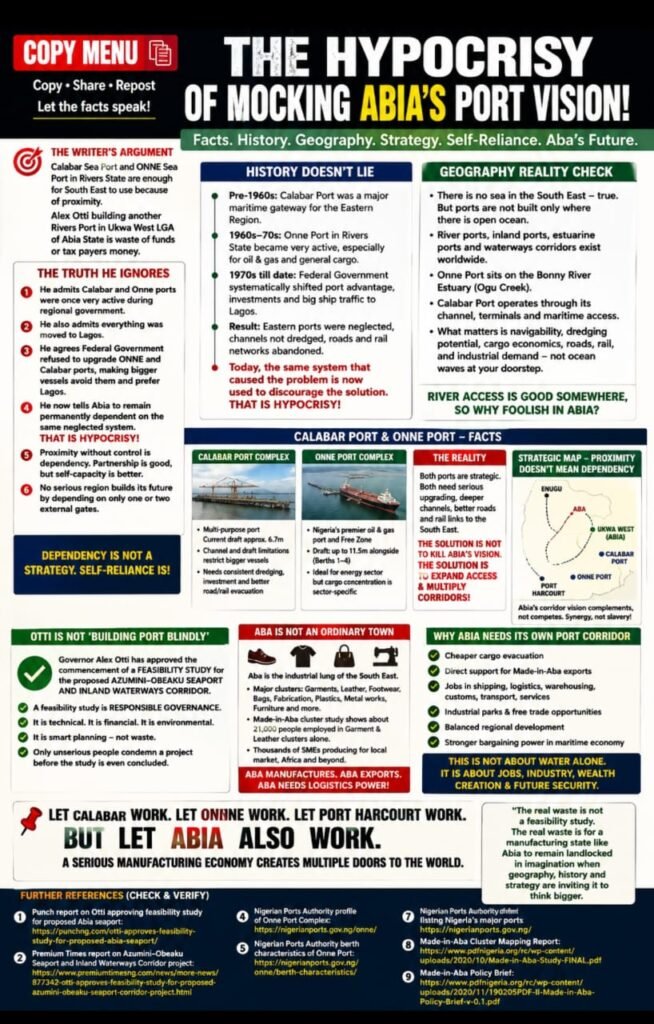
The argument credited to Mr Jerry Ademola is not just weak; it is hypocritical, historically shallow and strategically empty.
He admits that Calabar Port and Onne Port were once active, but that the Federal Government neglected the eastern maritime corridor and moved serious port advantage to Lagos. Then, in the same breath, he turns around to advise Abia to remain dependent on the same neglected system.
That is not analysis. That is surrender decorated as advice.
If the problem is that Lagos has swallowed Nigeria’s maritime economy, then the solution cannot be for Abia, Aba manufacturers and the South East to continue waiting forever for Lagos, Abuja or another state to remember them. The solution is to expand access, multiply corridors, open new trade arteries and create competitive alternatives.
Let us be clear: Governor Alex Otti is not “building another Rivers Port.” Reports show that he approved the commencement of a feasibility study for the proposed Azumini–Obeaku Seaport and Inland Waterways Corridor project. A feasibility study is not waste. It is responsible governance. Only unserious critics condemn a project before the technical, commercial and environmental studies are even concluded.
The writer says “there is no sea in the South East.” That statement sounds clever only to those who do not understand geography. Ports are not built only where there is open ocean. River ports, inland ports, estuarine ports and waterways corridors exist across the world. What matters is navigability, dredging possibility, cargo economics, hinterland connection, road access, rail possibility, industrial demand and long-term commercial viability.
Onne Port itself is situated on the Bonny River Estuary along Ogu Creek, according to the Nigerian Ports Authority. Calabar Port is also not Lagos Atlantic magic; it is a port complex that depends on its channel, terminals, jetties and maritime access. So why is river access good when it is in Rivers or Cross River, but suddenly foolish when Abia explores its own corridor?
That is the hypocrisy.
The same people who say “use Onne and Calabar because they are close” forget that proximity without control is dependency. Abia cannot build its industrial future on borrowed access alone. Partnership is good, but self-capacity is better. Synergy with Rivers and Cross River is important, but synergy does not mean strategic blindness. A wise state cooperates with neighbours and still develops its own competitive advantage.
Aba is not an ordinary town. Aba is the industrial lung of the South East. Aba manufactures shoes, garments, bags, leather products, fabricated items and countless light industrial goods. Studies on Made-in-Aba garment and leather clusters have shown the employment strength and productive depth of the Aba manufacturing ecosystem. Aba does not need pity. Aba needs power, roads, export channels, logistics parks, industrial policy and direct access to markets.
If Aba must grow from local production to continental export, then the question is not whether Abia needs a logistics corridor. The question is why it took this long for any serious government to think in that direction.
This is why Otti’s strategy makes sense.
You cannot preach Made-in-Aba and oppose export infrastructure.
You cannot praise Aba manufacturers and deny them cheaper cargo movement.
You cannot complain that Lagos dominates trade and then attack a governor trying to reduce that dependence.
You cannot admit that Calabar and Onne were neglected and then tell Abia to remain permanently tied to ports it does not control.
That is not patriotism. That is mental colonialism within Nigeria’s federal structure.
The future of Abia is not in begging for access. The future of Abia is in building access.
The future of Aba manufacturing is not in carrying every container through avoidable delays, bad corridors and external bottlenecks. The future is in an integrated economy where Aba, Ukwa, Azumini, Obeaku, industrial parks, inland waterways, roads, rail possibilities and export processing are planned together.
Governor Otti is thinking like a development strategist, not like a roadside critic.
A port corridor is not merely about water. It is about jobs, factories, exports, warehousing, shipping, customs services, transport, industrial parks, value chains and regional bargaining power. It is about giving the South East another economic lung.
Those who mocked airports in the past now use airports. Those who mocked bridges now drive on bridges. Those who mocked industrial parks now ask where the jobs are. Today, they are mocking a port corridor because they cannot see beyond yesterday.
Abia must not think small because some people are comfortable with smallness.
Let Calabar work. Let Onne work. Let Port Harcourt work. But let Abia also work.
No serious region builds its future by depending on only one or two external gates. A serious manufacturing economy creates multiple doors to the world.
Otti is not wasting money.
Otti is studying possibility.
Otti is planning beyond election noise.
Otti is positioning Aba and Abia for the next economy.
The real waste is not a feasibility study.
The real waste is for a manufacturing state like Abia to remain landlocked in imagination when geography, history and strategy are inviting it to think bigger.
FURTHER REFERENCES / LINKS
- Punch report on Otti approving feasibility study for proposed Abia seaport:
https://punchng.com/otti-approves-feasibility-study-for-proposed-abia-seaport/ - Premium Times report on Azumini–Obeaku Seaport and Inland Waterways Corridor project:
https://www.premiumtimesng.com/news/more-news/877342-otti-approves-feasibility-study-for-proposed-azumini-obeaku-seaport-corridor-project.html - BusinessDay report on Otti approving feasibility study to revive Abia seaport project:
https://businessday.ng/maritime/article/otti-approves-feasibility-study-to-revive-abias-seaport-project/ - Nigerian Ports Authority profile of Onne Port Complex:
https://nigerianports.gov.ng/onne/ - Nigerian Ports Authority berth characteristics of Onne Port:
https://nigerianports.gov.ng/onne/berth-characteristics/ - Nigerian Ports Authority profile of Calabar Port Complex:
https://nigerianports.gov.ng/calabar/ - Nigerian Ports Authority official website listing Nigeria’s major ports:
https://nigerianports.gov.ng/ - Made-in-Aba Cluster Mapping Report:
https://www.pdfnigeria.org/rc/wp-content/uploads/2020/10/Made-in-Aba-Study-FINAL.pdf - Made-in-Aba Policy Brief:
https://www.pdfnigeria.org/rc/wp-content/uploads/2020/11/190205PDF-II-Made-in-Aba-Policy-Brief-v-0.1.pdf