
WHEN QUESTIONS BECOME FALSE CONCLUSIONS: THE TRUTH ABOUT OTTI’S PROJECTS, JOBS AND ABIA’S DEVELOPMENT JOURNEY
By Pastor AProf. Chukwuemeka Ifegwu Eke
Criticism is an essential part of democracy. Every government must be questioned, scrutinised and held accountable.
However, accountability must be founded on facts—not on the deliberate presentation of ongoing projects as abandoned projects, feasibility studies as failed projects, and decades-old moribund industries as promises that Governor Alex Otti should have completed overnight.
The question, “When will these projects be completed?” is legitimate.
The conclusion that nothing is happening is not.
Governor Alex Otti assumed office on May 29, 2023. Large airports, seaports, industrial parks, medical cities, hotels and power systems are not roadside kiosks that can be announced today and completed tomorrow. They require land acquisition, compensation, environmental studies, engineering designs, regulatory approvals, financing, procurement and construction.
The proper question is therefore not whether every project has been completed simultaneously.
The proper questions are:
Has work started?
Is there physical evidence?
Have credible partners been engaged?
Are the projects moving from announcements to implementation?
On several of the projects listed, the answer is clearly yes.
NO YOUTH EMPOWERMENT?
The claim that there has been “no youth empowerment” under Governor Otti is false.
The Abia TechRise programme provides selected young Abians with intensive digital training, accommodation, feeding, internet access and laptops. The third cohort alone selected 850 participants drawn from the 17 local government areas of Abia State.
The government has also partnered with the United Nations Development Programme on youth development and employment initiatives.
These programmes may not yet reach every unemployed young person in Abia, but it is dishonest to claim that no youth-empowerment programme exists.
Proof:
“THERE ARE NO JOBS FOR THE YOUTHS”
Youth unemployment remains a serious Nigerian problem, and no responsible government should pretend otherwise.
However, saying that “there are no jobs” ignores direct employment, public-sector recruitment, construction jobs, private investments and emerging industrial opportunities created by the new economic environment.
Ultimum Beverages has established an operational manufacturing facility in Osisioma, Aba. The Otti administration is also attracting proposed pharmaceutical and solar-equipment manufacturing investments.
Road construction, school reconstruction, healthcare expansion, waste management, public transportation and industrial recovery are equally generating direct and indirect economic activities.
Governor Otti has also maintained a policy of offering automatic employment to outstanding National Youth Service Corps members who distinguish themselves while serving in Abia.
The honest argument should be that more jobs are still required—not that no employment effort exists.
Proof:
“ABIA CAME LAST IN VAT”
This claim is inaccurate.
Published figures for the first quarter of 2025 placed Abia’s VAT contribution at approximately ₦2.92 billion. It was among the lower contributors, but it was not last.
More importantly, VAT figures should not be casually presented as a comprehensive measurement of a state government’s performance.
Nigeria’s VAT collection system has historically suffered from the “headquarters effect.” Taxes generated from commercial activities occurring in different states may be recorded where a company’s head office or tax-accounting structure is located.
Therefore, a state’s VAT figure is not automatically the same thing as its total economic output, number of businesses or development performance.
Abia must certainly expand its formal economy and tax base, but propaganda should not replace economic analysis.
Proof:
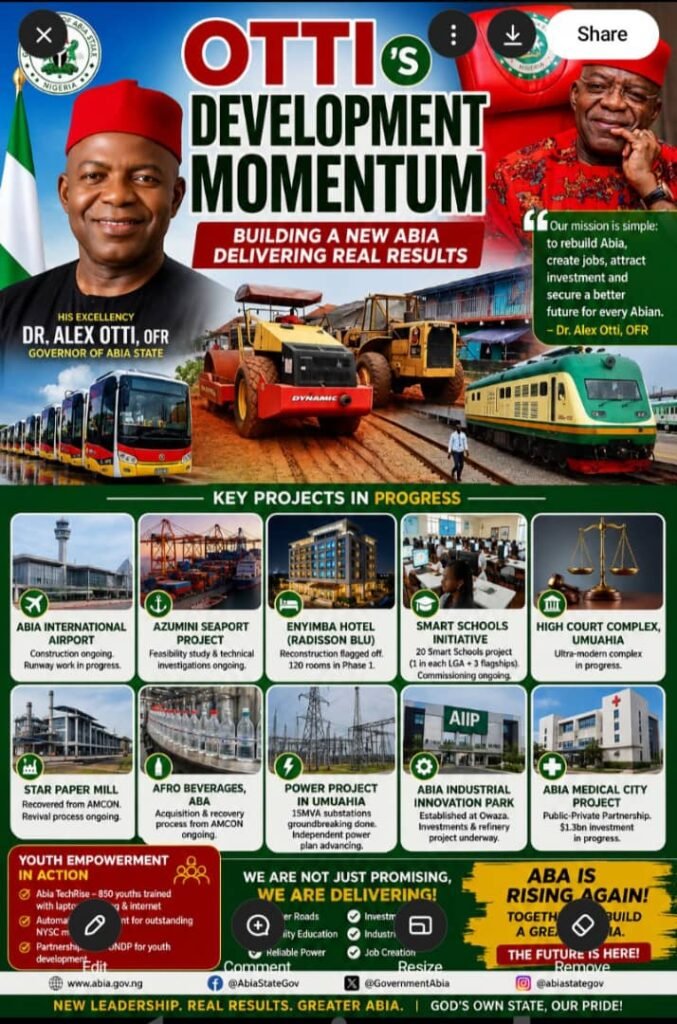
ABIA INTERNATIONAL AIRPORT
The Abia Airport is not an abandoned project.
The airport project was formally launched in December 2024 as a partnership involving the Federal Government and the Abia State Government.
Construction activities have continued at the project site, particularly on the runway and supporting infrastructure.
In March 2026, Governor Otti approved an additional 100 hectares within the airport project area for a Nigerian Air Force training base.
The Federal Government has also indicated support for the airport terminal component.
A project receiving an Air Force base allocation, federal participation and continuing runway work cannot honestly be described as a forgotten social-media promise.
An international airport is a major engineering project. It must be evaluated according to construction milestones and agreed timelines—not partisan impatience.
Proof:
AZUMINI–OBEAKU SEAPORT
The proposed Azumini–Obeaku Seaport and Inland Waterways Corridor has not reached the construction stage.
Governor Otti approved an immediate feasibility study in May 2026, while China Harbour Engineering Company commenced technical and hydrographic investigations.
A feasibility study determines water depth, navigability, engineering requirements, environmental implications, commercial viability and probable cost.
It would therefore be misleading to ask when construction will be completed as though the government announced that physical construction had already begun.
The correct position is that this project remains at the feasibility and regulatory stage. Its viability must be professionally established before major public or private funds are committed.
That is financial prudence—not failure.
Proof:
RAILWAY NETWORK AND PROPOSED STATION
Railways are constitutionally and operationally tied heavily to the Federal Government and the Nigerian Railway Corporation.
A state government cannot independently reconstruct the national railway corridor, operate interstate railway services and commission a national rail station without federal approvals and collaboration.
The proper demand is for the Abia State Government to continue engaging the Federal Government and private investors—not to pretend that Governor Otti possesses unilateral control over the national railway system.
RADISSON BLU ENYIMBA HOTEL
The claim that the Five-Star Enyimba Hotel is merely a promise ignores visible progress.
The Abia State Government signed an agreement with Radisson Blu for the reconstruction and management of the long-abandoned Enyimba Hotel.
Governor Otti formally flagged off its reconstruction in February 2026.
The first phase is designed as a 120-room five-star hotel with an international conference facility, with a planned expansion to approximately 250 rooms.
A project formally handed over, partnered with an international hospitality brand and under reconstruction cannot reasonably be classified as abandoned.
Proof:
SMART SCHOOLS
The reference to “51 Smart Schools” appears to confuse different components of the administration’s wider school-reconstruction programme.
The currently documented smart-school rollout involves 20 digital schools: three flagship smart schools across the senatorial districts and one additional smart school in each of the 17 local government areas.
The Ogbo Central Smart School at Ubakala was commissioned in July 2026 by the Minister of Education.
Another smart school at Umuomayiukwu in Isiala Ngwa North was subsequently inaugurated.
Therefore, the smart-school programme is not merely an announcement. Commissioning has commenced, while other locations remain at different stages of development.
Proof:
ULTRA-MODERN HIGH COURT COMPLEX
A modern court complex must pass through design, budgeting, procurement and construction stages.
The fact that such a capital project has not been commissioned does not automatically establish abandonment.
The government should continue to publish project milestones, expenditure and expected completion dates. That is the legitimate accountability demand.
But absence of immediate completion is not evidence that no work exists.
STAR PAPER MILL
Star Paper Mill was not established or destroyed by Governor Otti.
It is one of Abia’s formerly productive industries that became moribund long before he assumed office.
The Otti administration has recovered Star Paper Mill’s assets in Aba and Owerrinta from the Asset Management Corporation of Nigeria.
Recovering a distressed industrial asset from AMCON is a necessary legal and financial step before rehabilitation, restructuring or engagement with private investors can begin.
The recovery itself is therefore progress, although the public is entitled to demand a clear revival model and implementation timeline.
Proof:
AFRO BEVERAGES, ABA
Afro Beverages is another distressed industrial asset inherited by the Otti administration.
The government has been pursuing its acquisition and recovery from AMCON as part of a broader plan to revive dormant Abia industries.
The process of acquiring a distressed company involves debt resolution, valuation, title transfer, restructuring and the identification of credible operating partners.
The correct demand is that the administration should publish the post-acquisition business plan.
It is incorrect to portray the company as a new factory that Otti promised to build from scratch and then abandoned.
Proof:
INDEPENDENT ELECTRICITY FOR UMUAHIA
The electricity plan for Umuahia is progressing through infrastructure, regulatory and commercial stages.
In December 2025, Governor Otti performed the groundbreaking for combined 15MVA injection substations intended to improve electricity supply in Umuahia and surrounding areas.
The government is also pursuing a broader electricity strategy involving state regulation, additional generating capacity and the proposed integration of more parts of Abia into a reliable independent electricity structure.
Electricity reform involves generation, transmission, distribution, metering, regulation and the acquisition or restructuring of existing distribution territories.
It cannot be completed by proclamation.
Proof:
ABA TEXTILE MILL, INTERNATIONAL GLASS INDUSTRY AND OGWE GOLDEN CHICKEN
These are not newly built factories waiting to be commissioned.
They are among Abia’s old and moribund industrial assets.
The Otti administration announced an industrial-revival policy covering Star Paper Mill, Afro Beverages, Aba Textile Mills, International Equitable Associates and Ogwe Golden Chicken.
Reviving such companies requires resolving ownership disputes, liabilities, obsolete machinery, accumulated debts, workers’ claims and market viability.
Government should provide timelines and transparent investment structures, but nobody should pretend that decades of industrial decay can be reversed in a few months.
Proof:
ABIA INDUSTRIAL INNOVATION PARK
The Abia Industrial Innovation Park at Owaza was formally inaugurated through a groundbreaking ceremony in September 2023.
It is conceived as a large industrial ecosystem rather than a single building.
The Federal Government subsequently approved the establishment of a modular refinery within the park, while private-sector energy and industrial investments have been pursued.
Questions about the pace of development are legitimate. However, the park has moved beyond the level of an ordinary campaign statement.
Proof:
ABIA MEDICAL CITY
The proposed Abia Medical City is an ambitious public-private development designed to provide advanced healthcare and reduce medical tourism.
The projected cost has been placed at approximately $1.3 billion, with private development partners expected to provide investment while the state supports the project through land, security and institutional facilitation.
A project of this size cannot be financed like an ordinary state clinic.
It requires credible investors, detailed designs, environmental approvals, land resolution, financial closure and phased development.
The fair position is that the Medical City remains a developing investment project whose progress must be continuously disclosed to the public.
Proof:
ABIA RICE MILL, AGRICULTURAL ESTATES, FILM VILLAGE, RECREATIONAL FACILITY AND ICT CENTRE
Some of these projects remain proposals, policy initiatives or developments at preliminary stages.
The government must provide clear locations, financing structures, contractors, completion milestones and measurable outcomes.
Supporters of the government should not manufacture completion where none exists.
Nevertheless, a project that remains under planning or development is not automatically a failed project.
Failure can reasonably be declared when promised milestones have passed without explanation, when budgeted money cannot be accounted for, when contractors abandon sites, or when the government refuses to provide evidence of progress.
That standard should be applied fairly to every project.
UNDERSTANDING OTTI’S DEVELOPMENT MODEL
Governor Otti’s strategy is based on four connected pillars:
First, rebuild foundational infrastructure such as roads, drainage, schools, hospitals, electricity and security.
Second, recover strategic state assets that were abandoned, concessioned badly or trapped in debt.
Third, attract private capital and internationally recognised operators instead of forcing the state government to manage every hotel, factory and industrial facility.
Fourth, use large projects such as the airport, industrial park, medical city and seaport corridor to reposition Abia as a production, logistics and investment centre.
This model takes time because its objective is not merely to commission painted buildings.
Its objective is to create institutions and investments that can operate sustainably after political ceremonies have ended.
THE GOVERNMENT MUST STILL ANSWER QUESTIONS
Supporting Governor Otti does not mean suppressing legitimate questions.
Abians deserve periodic project reports stating:
The percentage of work completed;
The amount budgeted and released;
The identity of contractors and investors;
The agreed completion dates;
The reasons for delays; and
The expected employment and economic benefits.
That is constructive accountability.
But circulating a long list containing projects at completely different stages and then declaring all of them failures is not accountability.
It is political manipulation.
THE VERDICT
The Abia Airport is under development.
The seaport is at the feasibility-study stage.
The Radisson Blu Enyimba Hotel has been formally flagged off for reconstruction.
Smart schools have begun to be commissioned.
Star Paper Mill has been recovered from AMCON.
Afro Beverages and other moribund industries are undergoing acquisition or revival processes.
The Umuahia electricity initiative has entered an infrastructure-development stage.
The Industrial Innovation Park has been established, with refinery and other investments being pursued.
The Medical City remains a major developing public-private investment.
Not every project has been completed.
Not every timeline has been adequately communicated.
Not every Abia youth has felt the impact of the government’s programmes.
Those are valid concerns.
But it is demonstrably false to say that nothing is happening or that every project listed is another “promise and fail.”
Governor Alex Otti inherited decades of infrastructural decay, abandoned industries, distressed public assets and deep institutional dysfunction.
He should be judged firmly, but fairly.
The rebuilding of Abia is not social-media noise.
The roads are visible.
The schools are visible.
The recovered assets are documented.
The construction sites can be inspected.
The investors can be identified.
The partnerships can be verified.
Let critics ask hard questions.
But let the questions be based on facts.
Abia is not yet where it should be.
But under Governor Alex Otti, it is no longer where it used to be.