

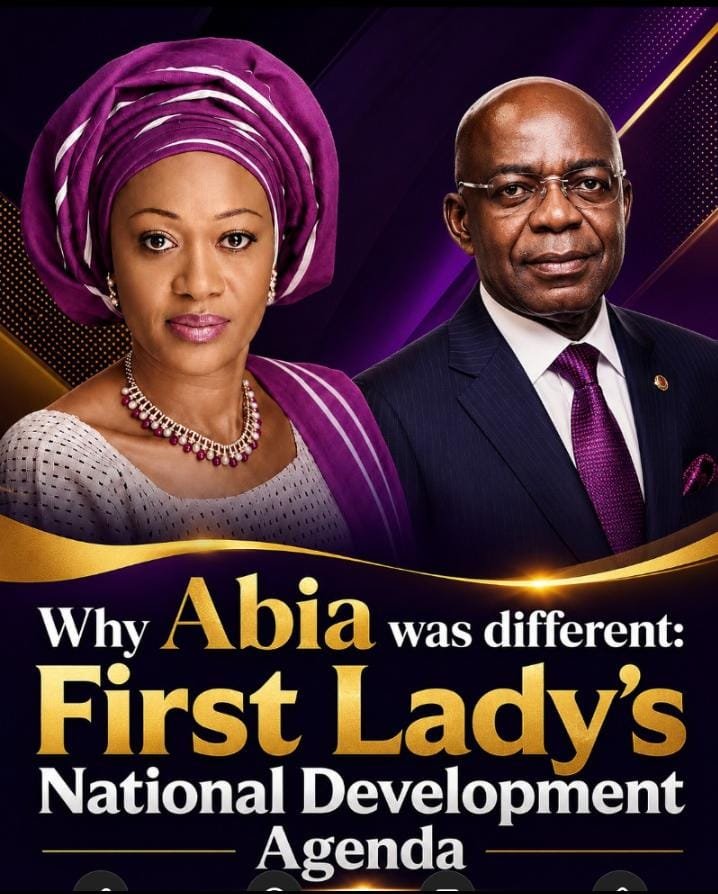
WHY ABIA WAS DIFFERENT: MRS TINUBU’S VISITS AND THE NATIONAL DEVELOPMENT AGENDA
By Pastor Prof. Chukwuemeka Ifegwu Eke
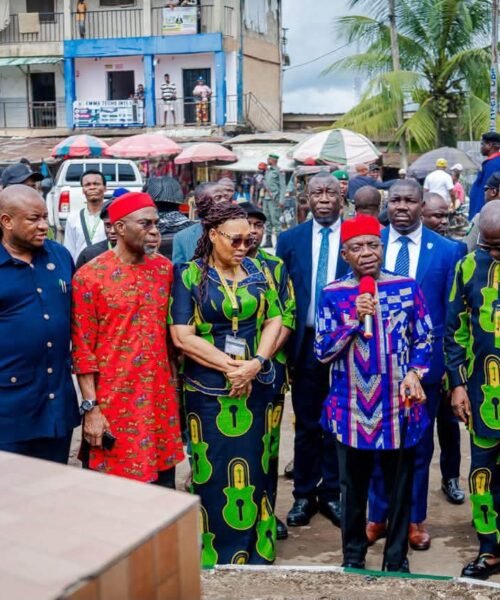
There are official visits that disappear almost immediately after the convoy leaves. Speeches are delivered, photographs are taken, ribbons are cut and the occasion is quietly added to the government record. But there are also visits that reveal the economic soul of a place and open a new national conversation about its future. The visit of Nigeria’s First Lady, Senator Oluremi Tinubu, to Abia State belonged unmistakably to the second category.
Across Nigeria, Mrs Tinubu’s visits have reflected different dimensions of the national development agenda. In Kogi State, the emphasis was on food security, social welfare and institutional development. In Benue State, attention was directed towards roads, digital inclusion, community infrastructure and support for women traders. In Ekiti State, the focus was on technology, education, youth development and the broader interventions of the Renewed Hope Initiative.
Each visit was important because it responded to the peculiar needs and opportunities of the host state. Abia, however, presented something profoundly different.
The centrepiece of the Abia visit was not merely a completed road, an administrative building or the distribution of temporary relief. The visit drew national attention to Akwete weaving, one of Nigeria’s most remarkable indigenous industries and a powerful symbol of women-led production, cultural intelligence and generational enterprise.
That was what made Abia different.
Akwete cloth is far more than a colourful fabric worn during ceremonies. It represents knowledge accumulated over generations, intricate artistic skill, community identity and an indigenous production system sustained largely by women. Every piece of Akwete fabric carries within it the labour of designing, selecting yarn, weaving, finishing, tailoring, marketing and distribution.
Properly developed, Akwete is not merely a cultural treasure. It is a complete economic value chain with the capacity to create employment, empower women, stimulate tourism, expand local production and earn foreign exchange.
Mrs Tinubu’s reported ₦2 billion intervention for the development of Akwete weaving therefore gave the visit a significance beyond ceremony. It demonstrated that the national development agenda can recognise what communities already possess and help transform it into a modern, productive and globally competitive industry.
Rather than introducing an entirely foreign development model into Abia, the visit placed a national spotlight on an economic resource that had survived for generations in the hands of local women.
In Kogi, the First Lady’s intervention spoke to hunger, food security and social protection. In Benue, it spoke to roads, digital access and women’s enterprise. In Ekiti, it spoke to education, technology and opportunities for young people.
In Abia, it spoke to the transformation of heritage into industry.
It represented a movement from culture to commerce, from tradition to innovation and from local craftsmanship to the possibility of global production.
This distinction is important because sustainable development cannot rest solely on government spending and temporary empowerment programmes. Lasting development must build productive capacity. It must help citizens create goods, develop markets, acquire technology, expand businesses and earn sustainable incomes.
The Akwete initiative offers exactly that possibility. It can transform women who have long been regarded merely as custodians of tradition into recognised entrepreneurs, employers, exporters and cultural ambassadors.
The visit also fitted naturally into the development direction of Governor Alex Otti’s administration. Abia’s renewal has been built around the rehabilitation of roads, improvement of healthcare, restoration of educational institutions, strengthening of public administration and rebuilding of investor confidence.
However, infrastructure becomes most valuable when it supports production. A rehabilitated road becomes economically meaningful when it connects Akwete weavers to markets. Reliable electricity becomes transformative when it powers looms, workshops and small businesses. Digital connectivity becomes useful when local producers can advertise and sell their fabrics to customers around the world.
This is why the Akwete intervention must be viewed as part of a larger industrial ecosystem. The weavers require modern but culturally sensitive equipment, reliable electricity, affordable finance, quality control, professional branding, intellectual-property protection and access to national and international markets.
They also require partnerships with universities, textile institutes, fashion schools, researchers, designers and private investors. Akwete should not be preserved merely as an artefact from the past. It should be developed as a living industry for the future.
The visit carried an equally important political message. Abia is governed by an opposition party, yet the First Lady visited the state, engaged warmly with its leadership and supported an indigenous economic initiative capable of transforming the lives of women.
That is how a federation should function.
Development must be bigger than party differences. Hunger has no political affiliation. Unemployment carries no party card. Bad roads do not discriminate among voters. Poverty does not recognise whether a citizen belongs to the government or the opposition.
When the Federal Government acknowledges progress in an opposition-controlled state, democracy becomes stronger. When a state government receives a national leader with dignity and maturity, the federation becomes healthier. When national intervention supports a local industry, cooperative federalism becomes visible.
That was another reason Abia was different.
The visit became a bridge between Abuja and Umuahia. It became a bridge between national policy and local enterprise. It became a bridge between political diversity and shared developmental purpose. It also became a bridge between an ancient craft and a modern economy.
The visit was therefore not only about what Mrs Tinubu saw in Abia. It was also about what Nigeria could see through Abia.
Nigeria could see that indigenous knowledge has economic value. Nigeria could see that women working in rural communities are not economically insignificant. Nigeria could see that culture can create employment, heritage can attract investment and local production can become a foundation for global visibility.
The real task, however, begins after the ceremonies.
The ₦2 billion intervention must not disappear into administrative language, endless committees, political speeches or ceremonial documentation. It must produce visible and measurable outcomes.
There should be a properly equipped Akwete weaving, research and production centre. There should be improved production facilities without destroying the authenticity of traditional designs. There should be structured training for younger women and men so that the skill does not disappear with an ageing generation.
There should also be an “Authentic Akwete” certification system to protect the fabric from imitation and preserve its identity. Akwete designs should be showcased at national and international exhibitions, fashion weeks, trade fairs and diplomatic events.
Digital platforms should enable the weavers to reach customers directly, while partnerships with designers should introduce Akwete fabric into contemporary clothing, accessories, interior decoration and luxury fashion.
Most importantly, the original Akwete weavers must remain at the centre of the programme. They must not become spectators while contractors, consultants and political intermediaries take control of an industry preserved by their mothers and grandmothers.
Development must not dispossess the custodians of the heritage it claims to promote.
The success of the intervention will not ultimately be measured by the convoy, the reception, the speeches or the amount announced. It will be measured by whether an Akwete woman can increase her production, improve her income, train apprentices, employ additional workers and sell her fabric beyond the borders of Abia and Nigeria.
That is the difference between a ceremonial announcement and genuine economic transformation.
Mrs Tinubu’s visits across the country have revealed different faces of the national development agenda. Kogi reflected food security and social protection. Benue reflected infrastructure, technology and women’s empowerment. Ekiti reflected education, innovation and youth development.
Abia reflected the enormous possibility of converting indigenous heritage into a modern productive industry.
That is why Abia was different.
The First Lady did not merely arrive to commission what had already been built. She encountered what had been preserved. She discovered a living industry carried by women, sustained by history and waiting for the capital, technology and national attention required to achieve its full potential.
The enduring image of the visit should therefore not simply be the convoy, the speeches or the official photographs. It should be the loom.
The loom represents patience, creativity, discipline and production. Separate threads are carefully brought together until they form something stronger, richer and more valuable than their individual parts.
Nigeria itself needs that kind of weaving. The Federal Government, state governments, communities, investors, researchers and producers must be woven into a common national purpose.
In Abia, Mrs Tinubu found an appropriate symbol for that agenda.
Akwete is heritage.
Akwete is enterprise.
Akwete is women’s economic power.
Akwete is Nigeria’s creative industry waiting to be fully unleashed.
That is why the visit mattered.
That is why its promises must be fulfilled.
And that is why Abia was different.