
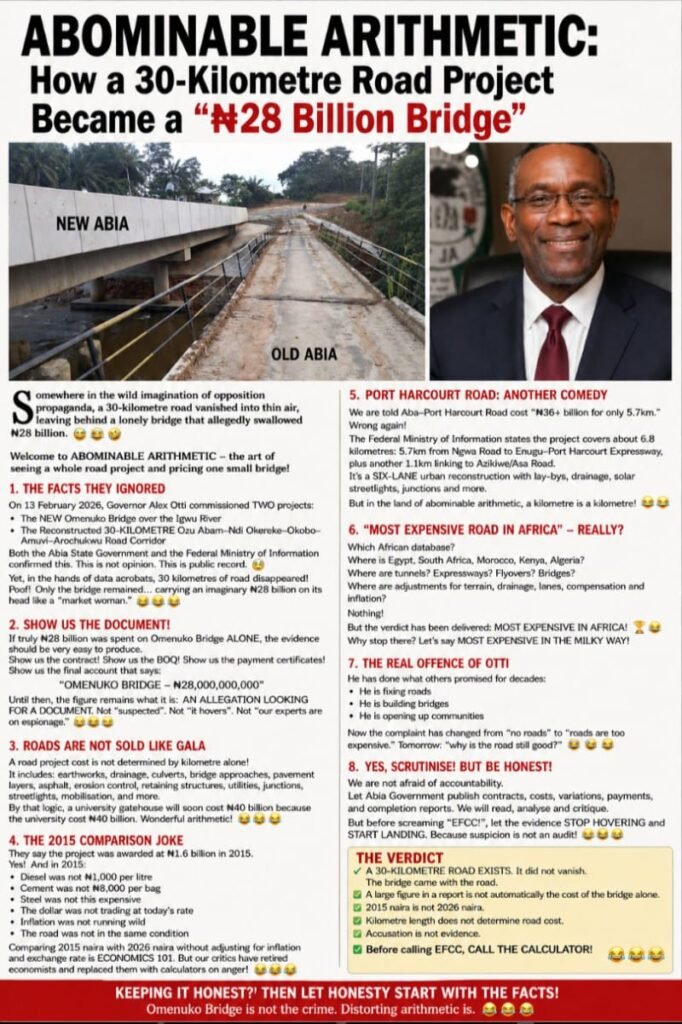
ABOMINABLE ARITHMETIC: How a 30-Kilometre Road Project Became a “₦28 Billion Bridge”
There is a new school of accounting in Abia politics, and I must confess that it deserves its own department in one of our universities. 😂😂😂
Its methodology is very simple. First, find a bridge. Second, find a large figure somewhere inside a budget or expenditure report. Third, ignore the road attached to the bridge. Fourth, ignore the communities connected by the road. Fifth, ignore drainage, earthworks, culverts, approaches and associated engineering works. Finally, carry the entire figure, dump it on top of the bridge and shout: “₦28 BILLION! EFCC, OYA COME!”
My people, this is not forensic accounting. This is abominable arithmetic. 😂
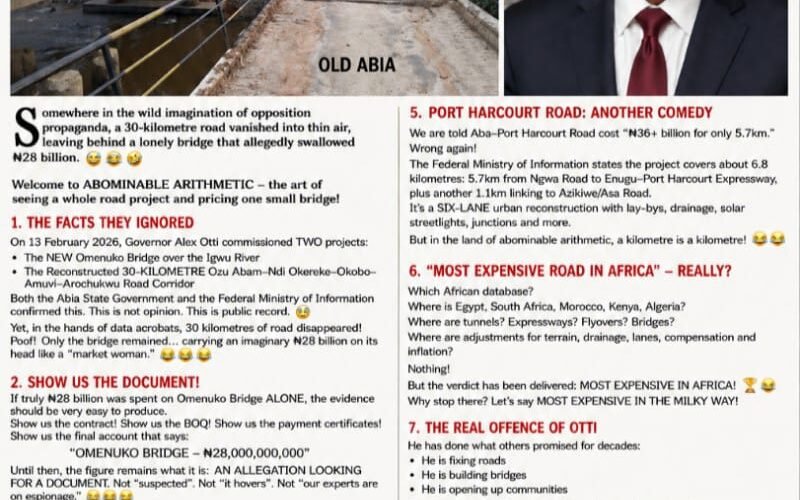
The first fact that ruins the drama is embarrassingly straightforward. On 13 February 2026, Governor Alex Otti did not commission a solitary 45-metre bridge standing majestically in the bush after allegedly swallowing ₦28 billion. What was commissioned was the reconstructed 30-kilometre Ozu Abam–Ndi Okereke–Okobo–Amuvi–Arochukwu Road, alongside the newly constructed Omenuko Bridge over the Igwu River. Both the Abia State Government and the Federal Ministry of Information publicly described the projects in those terms.
Thirty kilometres.
Let us write it again for the calculators that may have developed political fever:
30 KILOMETRES.
Yet somewhere between Ozu Abam and the keyboard of our newly recruited quantity surveyors, thirty kilometres disappeared. 😂😂😂
The road vanished. The connecting communities vanished. The reconstruction vanished. The earthworks vanished. The bridge approaches vanished. Only one small bridge remained, carrying an alleged ₦28 billion on its head like a woman returning from the village market.
Wonderful!
If this method is accepted, tomorrow somebody can take the entire cost of constructing a teaching hospital, point at the gatehouse and announce: “Otti spent ₦40 billion building one security post!” 😂
That is precisely why project scope matters.
The Federal Ministry of Information describes the Omenuko Bridge as part of a critical corridor on the long-abandoned Bende federal road, while the accompanying 30-kilometre road traverses several communities in Abam and Arochukwu. The old bridge itself had become notoriously narrow and dangerous after decades of neglect, and the Federal Ministry had earlier confirmed that the reconstruction being undertaken by the Otti administration was actually on a federal road.
So before anybody invites EFCC, ICPC, Interpol, Scotland Yard and perhaps the International Criminal Court, can we first see one very simple document?
Show us the official contract document that says:
“Omenuko Bridge alone — ₦28,000,000,000.”
That is all.
Not “it appears.”
Not “it hovers around.”
Not “our experts are digging.”
Not “records suggest.”
Not “we are on espionage.”
😂😂😂
Please land the figure first. It has been hovering for too long.
Show the contract title. Show the contractor. Show the Bill of Quantities. Show the approved variation. Show the interim payment certificates. Show the final payment certificate. Show the exact budget line proving that ₦28 billion was paid for the bridge alone.
Until that evidence appears, the ₦28 billion bridge story remains what it presently is: an allegation searching desperately for its own documents.
And this is where the mockery becomes unavoidable.
The same writer proudly tells us that “our team of financial experts are on espionage.”
Espionage? 😂😂😂😂
To read a publicly available government budget report?
James Bond has finally arrived in Abia.
I can already see the film:
007: Licence to Calculate.
Scene One: Oracle opens Excel.
Scene Two: He discovers Omenuko Bridge.
Scene Three: Thirty kilometres mysteriously disappear.
Scene Four: He screams, “EFCC!”
End credits. 😂
There is also this obsession with simply dividing contract figures by kilometres, as though road construction were a commodity sold like Gala sausage.
A road project is not priced merely by length. Engineering costs depend on pavement design, soil conditions, earthworks, drainage, culverts, bridges, retaining walls, erosion protection, utilities, number of lanes, bridge approaches, traffic management, mobilisation and many other variables.
If cost-per-kilometre arithmetic were all that civil engineering required, we could close every engineering faculty in Nigeria tomorrow and appoint Microsoft Calculator as Vice-Chancellor. 😂
The old-contract comparison is equally amusing.
We are told the project was previously awarded at approximately ₦1.6 billion in 2015 and supposedly reviewed upward later.
Fine.
Now let us ask the questions an economist would ask before fainting.
What was the exchange rate in 2015?
What was the price of diesel?
What was the price of cement?
What did steel cost?
What was the cost of bitumen?
What was the inflation rate?
What was the state of the road then compared with a decade later?
Was the engineering scope identical?
Was the earlier contract completed?
What variations became necessary?
What additional deterioration occurred?
Apparently, none of these matters.
A naira from 2015 has been declared equal to a naira in 2025 or 2026.
😂😂😂
Somewhere, Economics 101 is requesting early retirement.
Between 2015 and 2026, Nigeria experienced enormous inflation and severe currency depreciation. Construction materials, diesel, equipment, imported inputs and labour costs changed dramatically. Comparing nominal contract values separated by roughly a decade without adjusting for these realities is not financial analysis.
It is nostalgia carrying a calculator.
Then we are informed that celebrating Omenuko Bridge is somehow “abominable.”
This may be the finest joke of all.
For decades, the old Omenuko Bridge represented neglect. The Federal Ministry of Information itself described it as long abandoned and dangerous when Otti flagged off reconstruction in February 2025.
One year later, on 13 February 2026, the reconstructed 30-kilometre corridor and the new bridge were commissioned.
Yesterday, the complaint was:
“Nobody has fixed Omenuko.”
Today, the complaint is:
“Why are people celebrating Omenuko?”
😂😂😂
At this rate, tomorrow we may hear:
“Why is the bridge still standing?”
Progress is gradually making some old opposition talking points unemployed.
And there is another important issue. The bridge sits on a federal road. The Otti administration openly acknowledged this at the flag-off, while explaining that the state chose to intervene because Abians were suffering regardless of whether the asset was labelled federal or state.
That is actually a governance point worth discussing. Should a governor leave citizens suffering because Abuja owns the road? Or should he intervene, obtain the necessary approval and later pursue reimbursement where applicable?
Otti chose intervention.
Apparently that too is now suspicious. 😂
Then comes the claim that the bridge design was somehow downgraded to a single-lane structure.
Fine.
Produce the original engineering drawings.
Produce the revised drawings.
Produce the approved design variation.
Produce the bridge-width specification.
Produce the original BOQ.
Produce the as-built specification.
That is how engineering claims are established.
A photograph accompanied by exclamation marks is not an engineering drawing.
There is also the familiar attempt to drag Port Harcourt Road, Aba, into every argument about contract cost. Once again, kilometre length alone proves very little. Urban reconstruction involving widened carriageways, major drainage, storm-water infrastructure, utility relocation and difficult built-up environments cannot reasonably be compared with a simpler rural road simply because both are measured in kilometres.
Engineering is inconvenient like that.
It refuses to obey political arithmetic.
And then there is the famous claim that one Abia road or another has become “the most expensive road in Africa.”
Africa?
All fifty-four countries?
😂😂😂
Who produced this continental road-cost league table?
Where are the comparable projects in Egypt, South Africa, Morocco, Algeria, Kenya, Ethiopia, Angola and Senegal?
Where are the adjustments for terrain, number of lanes, bridges, drainage, compensation, urban density and inflation?
Nothing.
But the trophy has already been awarded:
MOST EXPENSIVE ROAD IN AFRICA!
Why stop there?
Why not “most expensive road since the Roman Empire”?
Or “most expensive road in the Milky Way”?
Once evidence becomes optional, imagination should not be restrained. 😂
Let us nevertheless make one thing clear: demanding transparency is legitimate.
Government should disclose contract sums, project scope, contractors, variations, payment certificates and completion records as fully as the law permits.
That is healthy democratic scrutiny.
But the critic also has an obligation to be accurate.
If you claim that ₦28 billion was spent on a bridge, you must demonstrate that the ₦28 billion relates to that bridge alone.
If the expenditure relates to a wider 30-kilometre road corridor and associated structures, say so.
If it is a budgetary provision rather than actual expenditure, say so.
If several line items have been combined, identify them.
If payments span multiple fiscal years, explain that.
Capital letters do not turn estimates into audited facts.
And suspicion does not become evidence merely because somebody writes EFCC underneath it.
😂😂😂
The Abia Government’s own 2026 budget makes clear just how extensive road spending is across multiple projects: the road sector carries very substantial allocations covering construction, reconstruction, rehabilitation and maintenance throughout the state. That is precisely why individual project codes and expenditure lines must be read carefully before attaching a large aggregate number to one visible bridge.
Otherwise, we arrive at the wonderful methodology:
Government spends money on a road corridor.
A commentator sees the bridge.
The road disappears.
The bridge inherits the entire expenditure.
EFCC is summoned.
😂😂😂
That is not “keeping it honest.”
That is keeping it hilarious.
By all means, invite the Federal Ministry of Works.
Invite EFCC.
Invite ICPC.
Invite quantity surveyors.
Invite engineers.
Invite accountants.
Invite auditors.
Invite Oracle’s “team of financial experts.”
Invite James Bond if he is still available.
But when everybody arrives, please place one document on the table:
The evidence that ₦28 billion was spent on Omenuko Bridge alone.
Because if the investigators eventually ask:
“Where did you get ₦28 billion for this bridge?”
it would be terribly unfortunate to answer:
“Well… the figure was hovering.”
😂😂😂😂😂
The Omenuko Bridge did not arrive alone.
The 30 kilometres did not disappear.
A road corridor is not priced like roasted corn.
2015 naira is not 2026 naira.
An allegation is not an audit.
A budget line is not automatically a final contract payment.
And shouting EFCC does not cure defective arithmetic.
So yes, scrutinise Otti.
Ask questions.
Demand documents.
Demand value for money.
That is citizenship.
But before declaring the celebration of Omenuko “abominable,” perhaps we should identify the genuinely abominable thing here.
It may not be the bridge.
It may not even be the road.
It may simply be the arithmetic.
😂😂😂
ABOMINABLE ARITHMETIC indeed.