
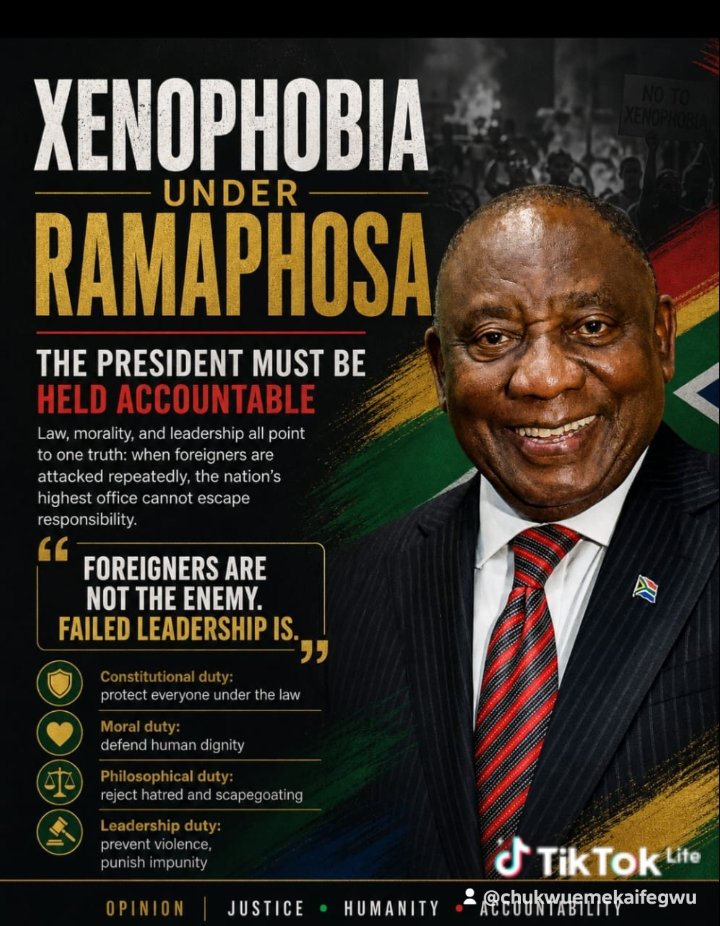
The President Who Inherited Apartheid’s Wound but Failed to Heal Xenophobia
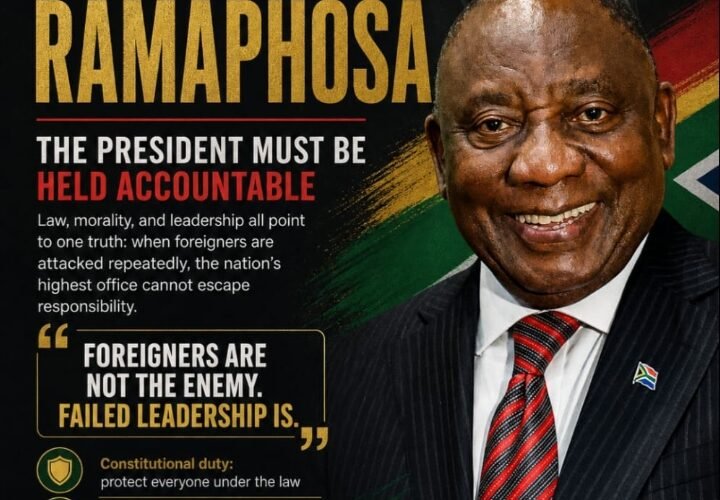
The renewed xenophobic violence against foreigners and African migrants in South Africa must be placed where constitutional responsibility ultimately rests: at the foot of President Cyril Ramaphosa, the current President of the Republic of South Africa. This is not because he personally threw stones, looted shops, chased migrants, or shouted hate slogans. It is because a president is not merely a ceremonial occupant of office; he is the constitutional custodian of national morality, public order, human dignity, and the rule of law.
South Africa’s Constitution is not silent. It declares the country to be founded on human dignity, equality, non-racialism, human rights, constitutional supremacy and the rule of law. Its Bill of Rights says “everyone” is equal before the law, not only citizens, not only voters, not only those with South African identity documents. � When foreigners are hunted, humiliated, displaced, assaulted, or forced into fear, the South African state has failed the very text that gave post-apartheid South Africa its global moral authority.
Justice +1
Legally, therefore, xenophobia is not just street violence. It is a constitutional crisis. It mocks Section 9 equality. It mocks human dignity. It mocks the rule of law. It tells migrants that their humanity is conditional, that their safety depends on mob permission, and that the police may arrive only after their shops are burnt, their bodies broken, or their lives destroyed. South Africa already adopted a National Action Plan to Combat Racism, Racial Discrimination, Xenophobia and Related Intolerance, with mechanisms for monitoring incidents and rapid response. � If xenophobic violence continues under that framework, then the problem is not the absence of documents; it is the absence of decisive presidential will.
Justice +1
Philosophically, the crisis is even deeper. A nation that defeated apartheid through African and global solidarity cannot now turn around and treat other Africans as disposable strangers. The moral foundation of the anti-apartheid struggle was that no human being should be reduced to race, origin, tribe, passport, or labour value. Xenophobia therefore makes South Africa argue against its own liberation history. It is a tragic contradiction: a country once rescued by solidarity now humiliating those who seek survival within its borders.
The president must carry the blame because leadership shapes public permission. When citizens repeatedly hear that foreigners are the cause of unemployment, crime, housing pressure, hospital congestion, and poverty, and the state fails to aggressively correct that poison, mobs begin to feel licensed. Economic frustration may explain anger, but it can never justify barbarism. Unemployment is not a licence to burn a migrant’s shop. Poverty is not a permit to assault a Nigerian, Zimbabwean, Malawian, Mozambican, Ghanaian, Congolese, or Somali trader. Failed governance should not be transferred onto the body of the foreigner.
Recent reports show renewed anti-immigration protests in Johannesburg and Pretoria, with shops shutting over fears of looting and at least 130 Nigerians seeking voluntary repatriation amid rising fear and diplomatic concern. � That is not ordinary politics. That is a warning that foreigners no longer feel protected by the South African state. When residents of another African country would rather flee than trust the host state’s protection, presidential speeches are no longer enough.
AP News +2
Morally, Ramaphosa’s failure is the failure to convert condemnation into consequence. It is easy to warn citizens not to attack foreigners. It is harder to arrest instigators, prosecute hate merchants, discipline negligent police officers, compensate victims, protect migrant businesses, and confront political actors who use foreigners as campaign material. A president who only condemns xenophobia after blood has touched the ground is not leading history; he is chasing it.
The catchy truth is this: xenophobia is apartheid’s orphan, and Ramaphosa’s government has allowed it to grow teeth.
South Africa cannot claim Mandela’s moral inheritance while tolerating the persecution of African migrants. It cannot preach Pan-Africanism at summits and permit anti-African hatred in townships. It cannot celebrate Freedom Day while foreigners are afraid to open their shops. It cannot condemn racism abroad while normalising xenophobia at home.
President Ramaphosa must be blamed not as the only guilty man, but as the first accountable officer of the Republic. Under his watch, the constitutional promise of “everyone” is being narrowed by mobs into “South Africans only.” That is not law. That is not philosophy. That is not morality. That is betrayal.