
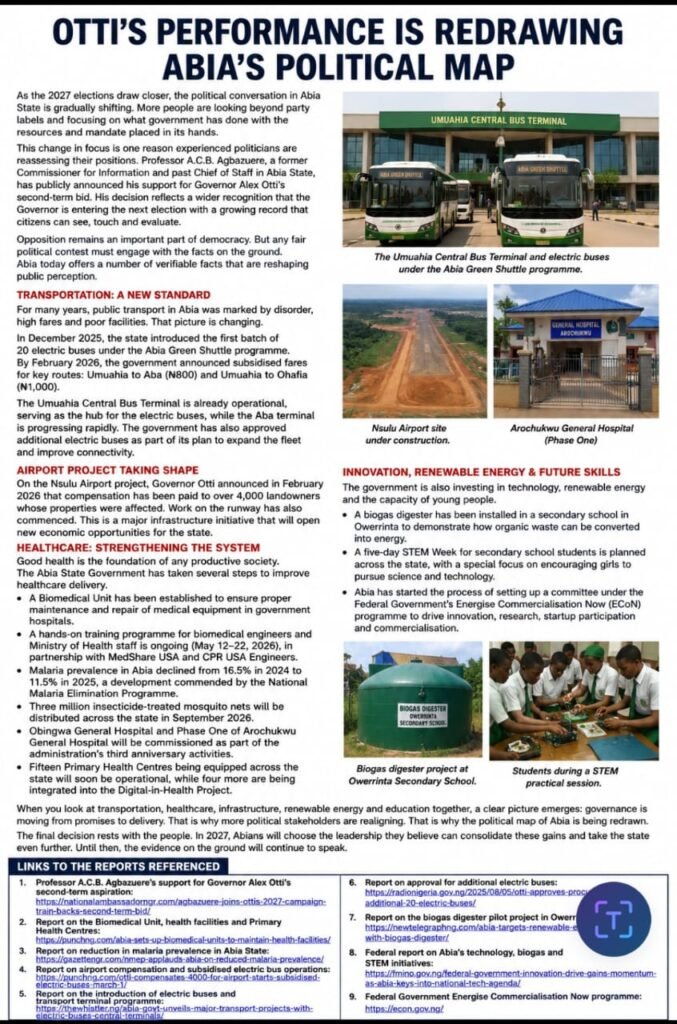
OTTI’S PERFORMANCE IS REDRAWING ABIA’S POLITICAL MAP
An election season does not begin only when campaign posters appear. It begins when citizens start connecting their everyday experiences with the question of leadership; when public works become subjects of community discussion; when familiar political relationships begin to shift; and when politicians recognise that the mood of the people may no longer be where it used to be.
That process appears to be taking shape in Abia State.
As the 2027 political season gradually approaches, the discussion is becoming less dependent on party names, old loyalties and inherited camps. More people are beginning to ask a direct question: what has the present administration done that citizens can physically identify, experience and assess?
For Governor Alex Otti, this question may become his greatest advantage. In a society where election promises are often abandoned shortly after victory, every usable facility, every completed intervention and every policy that reduces hardship strengthens the public case of the administration responsible for it.
It is within this atmosphere that the recent decision of Professor A.C.B. Agbazuere to identify with Governor Otti’s second-term aspiration deserves attention. His decision has naturally attracted discussion because of his previous place within another political establishment in the state. However, beyond the emotion surrounding political movement, there is a straightforward explanation: politicians study where public confidence is heading, evaluate the realities before them and choose the direction in which they believe relevance and influence can be sustained.
Professor Agbazuere’s position is therefore important beyond his personal choice. It may be evidence of a wider appreciation among politically experienced individuals that Governor Otti now enters the next election cycle with an expanding record that can be defended before the electorate. It also suggests that the coming contest may not be determined simply by party machinery, but by what residents feel government has delivered in their communities.
This does not mean Abia should become a state without opposition. No democracy grows well without scrutiny, criticism and alternative proposals. Public officials must be questioned. Contracts must be monitored. Expenditure must be examined. Promises must be measured against results. But serious opposition cannot be sustained by acting as though citizens are incapable of seeing what is before them. Where projects exist, they must be confronted with stronger alternatives, not denied out of political discomfort.
Transportation is one area in which the current government has created an entirely new public conversation. For a long time, many commuters in Abia had little expectation of a structured, government-supported transport system anchored on modern terminals, cleaner vehicles and reduced travel costs. That assumption is changing.
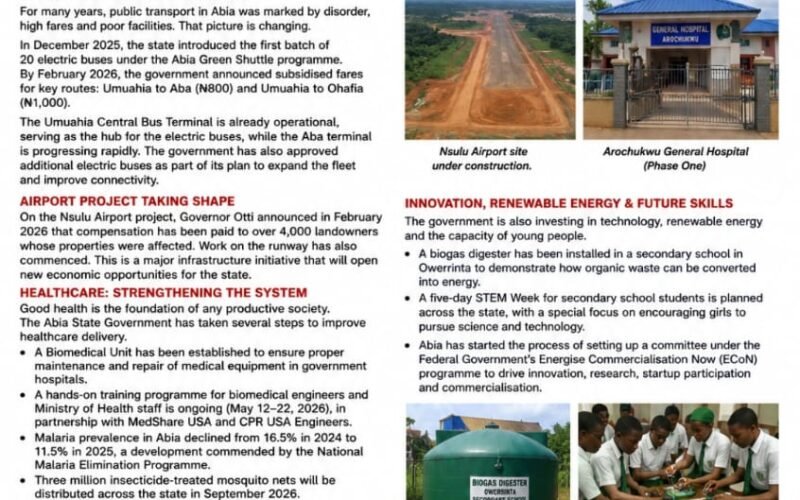
In December 2025, the state unveiled the first phase of the Abia Green Shuttle programme with 20 electric buses for public transportation. By February 2026, the administration announced subsidised fares for passengers on key routes, including Umuahia to Aba and Umuahia to Ohafia. This matters because it introduces a different understanding of what a state government can do in the area of mobility: not only regulate transport operators, but provide accessible alternatives capable of easing the pressure on residents.
The value of this programme cannot be measured by the buses alone. Its wider importance lies in the connection between vehicles, terminals, charging infrastructure and organised routes. The Umuahia Central Bus Terminal has been positioned as an operational centre for the electric buses, while the Aba terminal is part of the broader transport arrangement being developed by the administration. There have also been reports of additional electric buses approved as the state works towards enlarging the fleet.
For ordinary people, this is not an academic argument. A trader travelling with goods, a civil servant going to work, a student returning home or a family managing monthly expenses is interested in whether transportation becomes more affordable, more orderly and more dependable. A policy that touches such daily concerns naturally becomes politically significant.
The airport project at Nsulu provides another indication of the administration’s infrastructure direction. In February 2026, Governor Otti disclosed that compensation had been paid to more than 4,000 persons whose lands were affected by the proposed runway corridor. An airport cannot be judged only by a ceremonial announcement. It must pass through compensation, site preparation, construction and eventual usability. The relevant point today is that steps connected with the project have entered a stage that members of the public can follow and evaluate.
Healthcare provides an equally important basis for evaluating the administration. Recently, the state announced the establishment of a Biomedical Unit charged with the servicing and repair of medical equipment in government hospitals. This may not be the sort of policy that produces instant applause in political rallies, but it addresses a longstanding weakness in public healthcare: medical machines purchased at considerable cost becoming unusable because there is no reliable maintenance system.
The practical relevance is considerable. Hospitals are not improved merely by new buildings or installed machines. They are strengthened when essential equipment remains functional and available to patients. A maintenance structure therefore protects public investment and supports better service delivery.
In addition, biomedical engineers and Ministry of Health personnel began a technical training programme in May 2026, supported by MedShare USA and CPR USA Engineers. The purpose is to build local competence for managing and repairing modern hospital equipment. This is the kind of institutional investment that can continue to produce benefits beyond a commissioning ceremony, because the skills acquired remain within the state health system.
Another significant report concerns malaria control. The National Malaria Elimination Programme commended Abia State after malaria prevalence was reported to have declined from 16.5 per cent in 2024 to 11.5 per cent in 2025. The state also announced plans for the distribution of three million insecticide-treated mosquito nets in September 2026.
These figures are not merely useful for government publicity. Malaria affects school attendance, household income, workplace productivity and the wellbeing of families. A reduction in its prevalence represents a public health gain that residents can understand. Preventive measures such as mosquito net distribution, when effectively implemented, can further reduce the burden of illness across communities.
The administration has also announced additional health facility interventions. Phase One of the Obingwa General Hospital and the Arochukwu General Hospital are expected to be commissioned as part of activities marking the administration’s third year in office. Fifteen primary health centres being equipped across the state are also expected to become operational and commissioned, while four additional centres are being included in the Digital Health Project.
This aspect of development is particularly important for people living outside the major commercial centres. To such families, a well-equipped primary health centre is not a distant government achievement. It is where a child may receive urgent treatment, where expectant mothers seek professional attention and where early intervention can prevent avoidable loss of life. Any government that improves access at that level is dealing with development at its most human point.
The present administration is also making moves in areas associated with technology, renewable energy and future skills. At a secondary school in Owerrinta, a pilot biogas digester has been introduced to examine how organic waste can be converted into a useful source of energy. The project remains at an early stage, but its importance lies in its potential. If successful, it could provide an adaptable example for schools and other public institutions seeking alternative energy solutions.
There is also a planned five-day STEM Week for secondary school students across the state. The programme is expected to expose young people to science, digital tools and technology-related activities, with a deliberate focus on increasing the participation of girls. That decision is important because the economic future of any society depends on the knowledge, confidence and opportunities available to its younger population.
In the same direction, the state has commenced steps connected with the Federal Government’s Energise Commercialisation Now programme. The initiative is intended to support the movement of research and innovative ideas into commercial products, enterprises, jobs and useful solutions. A government that pursues this kind of connection between education, enterprise and production is not merely addressing today’s needs; it is attempting to create tomorrow’s opportunities.
When these developments are considered together, the political effect becomes understandable. Public transportation affects movement and household expenses. Airport development speaks to economic connection and investment possibilities. Healthcare touches life, survival and family welfare. Renewable energy and STEM programmes concern the capacity of future generations. These may be separate government activities, but their combined influence can reshape how voters judge leadership.
That is the background against which more political figures may decide to associate with Governor Otti in the months ahead. Such movements will continue to generate arguments, as they should. But it would be unrealistic to expect people with political experience to ignore an administration whose activities are becoming increasingly visible across different sectors.
The final judgment will, of course, belong to the voters of Abia State. Before the 2027 election, they will assess more than campaign speeches. They will consider whether travelling has improved, whether public facilities are more functional, whether hospitals are receiving meaningful attention, whether infrastructure is reaching their areas and whether the administration has demonstrated enough seriousness to earn another mandate.
Governor Otti still carries the responsibility of completing ongoing projects and ensuring that announced programmes translate into lasting results. Every administration must remain accountable, and citizens are entitled to insist that promises be fully delivered.
Nevertheless, it is becoming increasingly difficult to deny that the Governor has already changed the terms of the political conversation in Abia. His opponents may disagree with him. They may campaign against him. They may put forward different candidates and different plans. But they will now have to contend with an expanding public record that citizens can examine for themselves.
Professor A.C.B. Agbazuere has chosen his direction early. Others may follow as the election period draws nearer. The reason is not hidden: in today’s Abia, what government has done is becoming a major force in determining where political support will gather.
The alignment is changing.
The public record is expanding.
The voters will eventually decide.
LINKS TO THE REPORTS REFERENCED
Professor A.C.B. Agbazuere’s support for Governor Alex Otti’s second-term aspiration:
https://nationalambassadorngr.com/agbazuere-joins-ottis-2027-campaign-train-backs-second-term-bid/
Report on the Biomedical Unit, health facilities and Primary Health Centres:
https://punchng.com/abia-sets-up-biomedical-units-to-maintain-health-facilities/
Report on reduction in malaria prevalence in Abia State:
https://gazettengr.com/nmep-applauds-abia-on-reduced-malaria-prevalence/
Report on airport compensation and subsidised electric bus operations:
https://punchng.com/otti-compensates-4000-for-airport-starts-subsidised-electric-buses-march-1/
Report on the introduction of electric buses and transport terminal programme:
https://thewhistler.ng/abia-govt-unveils-major-transport-projects-with-electric-buses-central-terminals/
Report on approval for additional electric buses:
https://radionigeria.gov.ng/2025/08/05/otti-approves-procurement-of-additional-20-electric-buses/
Report on the biogas digester pilot project in Owerrinta:
https://newtelegraphng.com/abia-targets-renewable-energy-in-schools-with-biogas-digester/
Federal report on Abia’s technology, biogas and STEM initiatives:
https://fmino.gov.ng/federal-government-innovation-drive-gains-momentum-as-abia-keys-into-national-tech-agenda/
Federal Government Energise Commercialisation Now programme:
https://econ.gov.ng/