
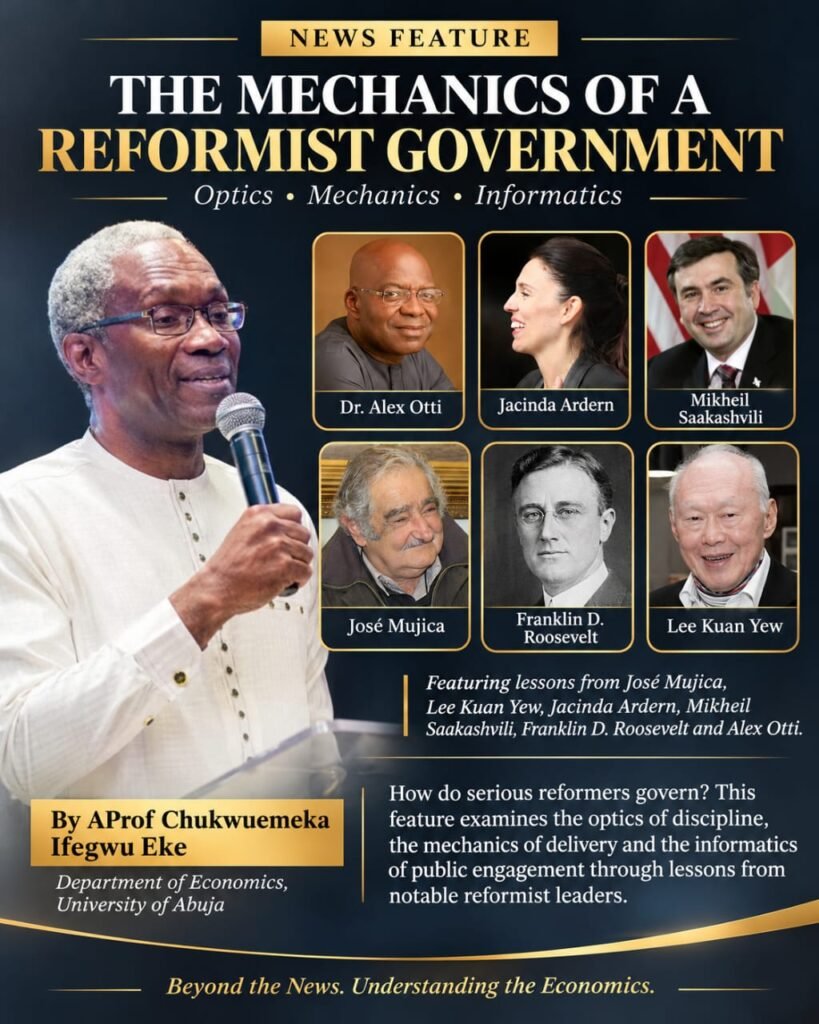
THE MECHANICS OF A REFORMIST GOVERNMENT
Optics • Mechanics • Informatics
By AProf Chukwuemeka Ifegwu Eke
Department of Economics, University of Abuja
Chief Editor, Abia Then, Abia Now
There is something profoundly fascinating about reformist governments. They do not merely occupy political offices; they attempt to change the very character of governance.
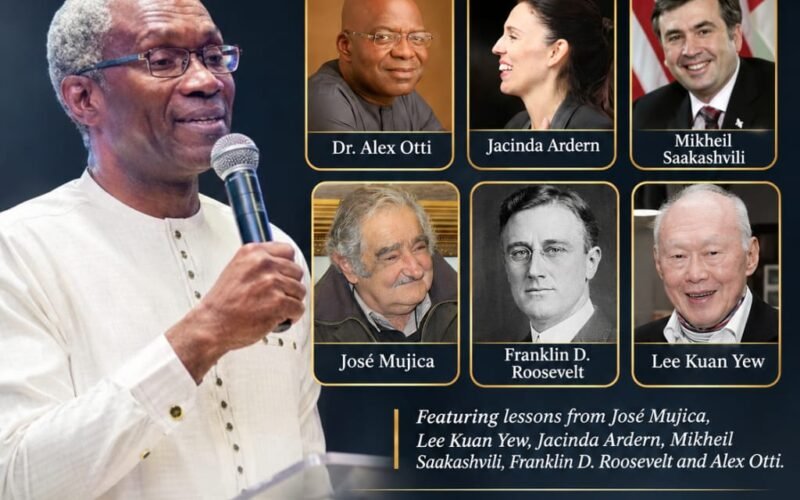
I have taken considerable interest in studying the behaviour, administrative culture and development philosophy of reformist leaders across the world. From Singapore to Uruguay, Georgia to New Zealand, the United States to contemporary Abia, I have observed three recurring dimensions of reformist leadership.
I describe them as the Optics of Governance, the Mechanics of Governance and the Informatics of Governance.
These three dimensions help explain how reformist governments establish credibility, deliver development and cultivate public confidence.
- THE OPTICS OF GOVERNANCE: THE POWER OF PERSONAL EXAMPLE
When José Mujica became President of Uruguay in 2010, the world encountered an unusual political leader.
He retained his modest farmhouse, drove an old Volkswagen Beetle and donated much of his presidential salary to charitable causes.
Mujica understood something that many political leaders overlook: the personal conduct of a leader communicates the philosophical direction of his government.
Leadership has a signalling effect.
In economics, signals influence expectations, expectations influence behaviour, and behaviour influences outcomes.
When a government demands discipline from its citizens, the credibility of that demand increases when discipline is visible at the highest level of government.
I see an interesting parallel in the administrative disposition of Governor Alex Otti, particularly his emphasis on financial discipline, expenditure priorities and the restoration of public institutions.
The optics of reformist governance must communicate seriousness, responsibility and a departure from business as usual.
However, optics alone cannot develop an economy.
A modest governor without an effective government is merely a modest individual occupying an important office.
This brings me to the second dimension.
- THE MECHANICS OF GOVERNANCE: BUILDING THE ENGINE OF DEVELOPMENT
Lee Kuan Yew became Prime Minister of Singapore in 1959.
Singapore subsequently emerged as an independent country in 1965, confronting enormous economic vulnerabilities, limited natural resources and substantial development challenges.
Lee understood that development was not an accident. It required deliberate institutional engineering.
Housing, education, industrialisation, infrastructure, administrative competence and international competitiveness became interconnected components of Singapore’s transformation.
He was not simply constructing roads and buildings. He was constructing an economic system.
This distinction is extremely important.
A road is not merely a road.
A road is a reduction in transaction costs, an expansion of market accessibility, an appreciation of productive assets and an opportunity for increased economic interaction.
A functional hospital is not merely a building. It is an investment in human capital.
A functional school is not merely a collection of classrooms. It is an instrument for intergenerational economic transformation.
This is the analytical framework through which I examine the infrastructural interventions of Governor Alex Otti.
When I look at Aba, Umuahia and the emerging infrastructure corridors across Abia State, I am interested in the economic relationships being created by these investments.
I am interested in what happens to businesses, transportation costs, property values, employment opportunities, investment decisions and household productivity.
This is precisely the intellectual foundation of my work, Abia Then, Abia Now.
I am not merely interested in counting projects. I am interested in understanding the development architecture that connects them.
- MIKHEIL SAAKASHVILI AND THE ECONOMICS OF INSTITUTIONAL RECONSTRUCTION
Following Georgia’s Rose Revolution of 2003, Mikheil Saakashvili embarked on an ambitious programme of institutional reforms.
Georgia confronted corruption, inefficient public institutions, administrative bottlenecks and a difficult investment environment.
Its government undertook extensive reforms in public administration, policing, taxation and public service delivery.
The World Bank subsequently documented significant improvements in several areas of public service delivery.
The Georgian experience demonstrates that economic transformation requires more than the allocation of money.
It requires the reconstruction of the institutions through which money is converted into public value.
A government may possess enormous financial resources and still deliver very little if its institutional machinery is inefficient.
Conversely, improvements in administrative efficiency can increase the developmental impact of available resources.
This is why I pay considerable attention to the institutional dimensions of the Otti administration.
Payroll management, revenue administration, procurement systems, expenditure discipline and public service efficiency constitute important components of economic reform.
Infrastructure represents the visible hardware of development.
Institutional reform represents its operating system.
Both must function together.
- FRANKLIN D. ROOSEVELT AND THE ECONOMICS OF PUBLIC CONFIDENCE
When Franklin D. Roosevelt assumed the presidency of the United States in 1933, America was confronted by the Great Depression.
Banks had failed, unemployment was widespread, businesses were struggling and public confidence had deteriorated.
Roosevelt recognised that economic reconstruction required not only government intervention but also the restoration of confidence.
Through his famous fireside chats, he communicated directly with American citizens, explaining government policies and addressing public anxieties.
He understood the economics of expectations.
Investors make decisions based on expectations.
Consumers make decisions based on expectations.
Entrepreneurs undertake risks based on expectations.
Confidence is therefore not merely a psychological phenomenon. It is an economic variable.
I consider the restoration of confidence an important dimension of Abia’s contemporary development conversation.
When entrepreneurs begin to anticipate improved infrastructure, more predictable public administration and a better business environment, their investment calculations can change.
Development begins not only when capital is deployed but also when confidence returns.
- JACINDA ARDERN AND THE INFORMATICS OF GOVERNANCE
Jacinda Ardern, who served as Prime Minister of New Zealand between 2017 and 2023, demonstrated the importance of communication, empathy and public engagement in modern governance.
Her leadership style illustrated how public communication could become an integral component of government administration.
This brings me to what I describe as the Informatics of Governance.
By informatics, I mean the systematic collection, interpretation, organisation and dissemination of information concerning government policies, decisions, activities and outcomes.
A reformist government must not only perform.
It must explain what it is doing, why it is doing it, how it intends to achieve its objectives and what those objectives mean for ordinary citizens.
Communication is not necessarily propaganda.
Properly conceived, it is an instrument of democratic accountability, public education and citizen participation.
A government that constructs a road should also explain the economic significance of that road.
A government that reforms its revenue system should explain the relationship between revenue mobilisation and public service delivery.
A government that invests in education should communicate the long-term human capital implications of that investment.
Citizens deserve to understand the economics behind government decisions.
- ALEX OTTI AND THE THREE DIMENSIONS OF REFORMIST GOVERNANCE
In studying the administration of Governor Alex Otti, I find these three dimensions useful in explaining the direction of contemporary governance in Abia State.
The optics concern the administrative culture and public conduct of leadership.
The mechanics concern infrastructure, institutional restructuring, economic policies and the machinery of public service delivery.
The informatics concern the communication, interpretation and documentation of the development process.
My interest as an economist is in the convergence of these three dimensions.
The administration has reported substantial road infrastructure interventions, while its 2026 budget prioritises infrastructure and broader economic development.
In October 2026, the government flagged off the reconstruction of the approximately four-kilometre Old Express Road and the three-kilometre Uratta Road in Aba under an integrated infrastructure development programme.
The significance of these investments extends beyond their physical dimensions.
Aba is a commercial and manufacturing ecosystem. Improving connectivity within that ecosystem has implications for production, distribution, logistics and competitiveness.
That is the economics behind the infrastructure.
I do not suggest that Abia is Singapore, Georgia, Uruguay, New Zealand or the United States. Each operates within a different historical, political and institutional environment.
What I suggest is that the experiences of reformist governments offer important comparative lessons for understanding Abia’s development journey.
- WHY I CONSIDER ABIA THEN, ABIA NOW IMPORTANT
My motivation for undertaking the Abia Then, Abia Now project extends beyond the documentation of government activities.
I want to create an intellectual record of a development process.
I want future researchers to understand the historical conditions, institutional decisions, policy interventions and economic considerations that shaped this period in Abia’s history.
Development must be documented.
Development must be interpreted.
Development must be interrogated through evidence.
Development must be understood beyond political slogans.
A photograph of a newly constructed road captures an event.
An economic interpretation of that road captures a development process.
There is a significant difference between the two.
- BEYOND GOVERNMENT BY ANNOUNCEMENT
One of the greatest challenges of governance in developing economies is the tendency to confuse announcements with achievements, expenditure with productivity, and political visibility with economic transformation.
A reformist government must ultimately be assessed by the quality, sustainability and measurable consequences of its interventions.
The number of projects matters.
The quality of the projects matters.
Their economic consequences matter even more.
The ultimate objective of reform is not the accumulation of political accolades. It is the improvement of the productive capacity, welfare and opportunities of society.
This is why I advocate an economic interpretation of governance rather than a purely political interpretation.
MY CONCLUSION
José Mujica reminds me of the power of personal example.
Lee Kuan Yew reminds me of the importance of institutional architecture and long-term development planning.
Mikheil Saakashvili reminds me that dysfunctional institutions can be reconstructed.
Franklin D. Roosevelt reminds me that public confidence is an economic asset.
Jacinda Ardern reminds me that communication is an essential instrument of governance.
And the administration of Governor Alex Otti provides a contemporary Nigerian case through which I can examine the convergence of these principles.
The optics establish credibility.
The mechanics deliver development.
The informatics deepen understanding.
When these three dimensions reinforce one another, governance acquires the potential to become a sustained instrument of socioeconomic transformation.
This is the economics of reformist governance.
This is the intellectual conversation I seek to advance through Abia Then, Abia Now.
AProf Chukwuemeka Ifegwu Eke
Department of Economics
University of Abuja
Chief Editor, Abia Then, Abia Now
26 November 2026
Beyond the News. Understanding the Economics.