
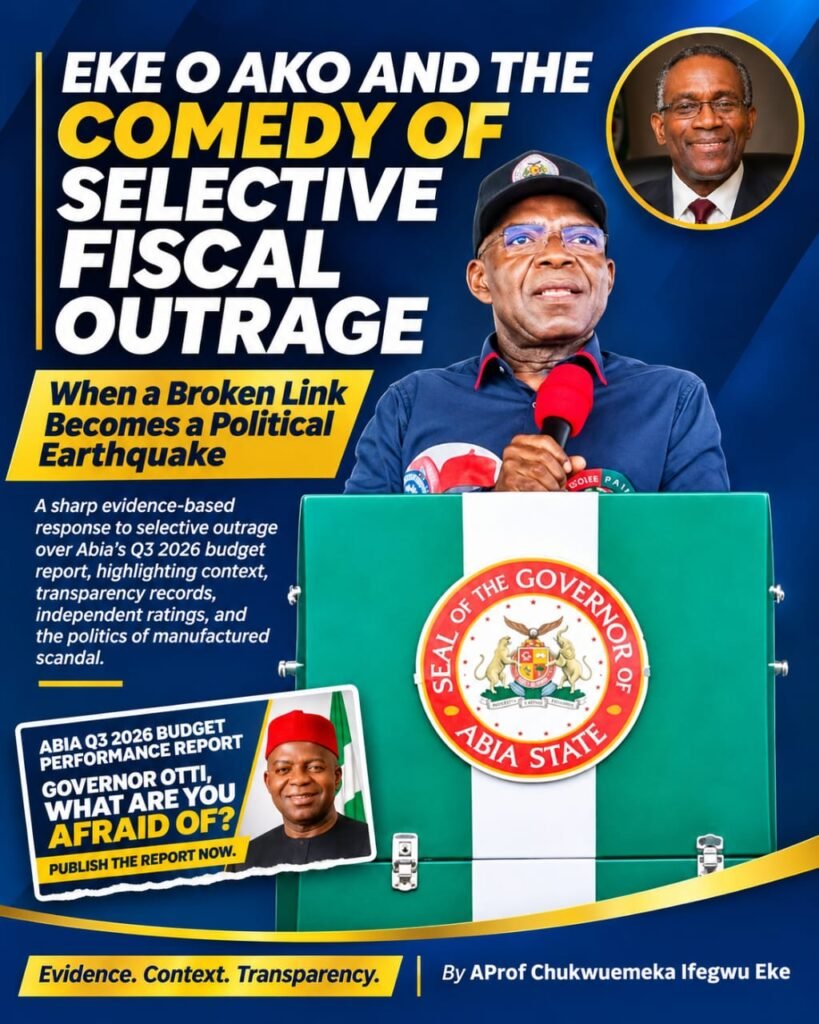
EKE O AKO AND THE COMEDY OF SELECTIVE FISCAL OUTRAGE: WHEN A BROKEN LINK BECOMES A POLITICAL EARTHQUAKE!
By AProf Chukwuemeka Ifegwu Eke
Hahahahahaha! 😂😂😂
Is it you people again? These staged theatrics, manufactured emergencies and rehearsed performances of political indignation!
Hahahahaha!
Eke O Ako, my brother, congratulations! You have apparently discovered a revolutionary theory of public finance: whenever a government document is temporarily inaccessible, billions of naira must have disappeared!
What an extraordinary contribution to economic scholarship!
John Maynard Keynes gave us the theory of effective demand. Milton Friedman advanced monetary analysis. Robert Solow explained the sources of economic growth. And now, from Freedom House, Scotland, comes the remarkable Theory of the Missing PDF!
Hahahahaha!
But beneath the comedy lies a serious issue of intellectual honesty.
Let me address your claims with evidence, history, elementary public finance and the institutional assessments you conveniently omitted.
- YOUR FIRST ERROR: CONFUSING A PUBLICATION PROBLEM WITH PROOF OF CORRUPTION
You allege that the Abia State Government’s Q3 2026 Budget Performance Report was listed on its official portal without an accessible document.
That is a legitimate issue to raise.
Indeed, the Foundation for Investigative Journalism reported on November 2, 2026, that Abia was among the states whose reports could not be publicly accessed.
However, what you have not established is that the document’s inaccessibility proves concealment of expenditure, the existence of ghost projects or the diversion of public funds.
A document-access problem and financial misconduct are different propositions requiring different standards of evidence.
As an economist, I distinguish between an observation, a hypothesis and a verified conclusion.
Your observation concerns a report that could not be accessed. Your hypothesis suggests deliberate concealment. Your conclusion insinuates corruption.
Where, precisely, is the evidence connecting these three propositions?
You cannot simply replace an evidentiary bridge with capital letters and exclamation marks!
- THE HISTORY YOU CONVENIENTLY OMITTED
Let us examine the same November 2, 2026, FIJ investigation you cited.
The report identified nine states whose Q3 budget implementation reports were not publicly accessible:
Lagos, Abia, Kebbi, Bayelsa, Cross River, Gombe, Osun, Oyo and Rivers.
Consequently, the problem was neither peculiar to Abia nor sufficient, by itself, to establish deliberate financial concealment.
Earlier, on October 15, FIJ reported that 35 of Nigeria’s 36 states had yet to make their Q3 reports available, although the publication deadline had not then expired.
Only Delta had published at that point.
These historical examples do not excuse Abia’s reported delay. They establish the wider administrative context that any serious comparative analysis must acknowledge.
My question to you is simple: why did your account of a nationwide reporting problem read like evidence of an exclusively Abia conspiracy?
Source: FIJ, November 2, 2026.
- WHAT DID INDEPENDENT FISCAL ASSESSMENTS SAY ABOUT OTTI’S ADMINISTRATION?
Now, let us leave political theatre and examine institutional evidence.
In May 2026, during a visit to Governor Alex Otti, BudgIT representatives publicly acknowledged improvements in Abia’s fiscal performance.
The organisation’s Country Director, Vahyala Kwaga, noted that Abia had moved from 17th position to fourth in BudgIT’s 2025 State of States fiscal performance assessment.
That ranking measured fiscal performance, including revenue strength, expenditure priorities and debt sustainability. It should not be confused with a separate fiscal transparency ranking.
Furthermore, BudgIT’s Q2 2026 States Fiscal Transparency League awarded Abia an overall score of 85%, placing it 18th nationally.
Significantly, Abia received the full available 16 points for the quarterly budget implementation report indicator in that assessment.
The state also received full points for the availability of fiscal data on its website.
Does this prove that every subsequent report was published promptly? Certainly not.
Does it contradict the sweeping suggestion that the administration has made no meaningful effort toward fiscal disclosure? Absolutely.
These are independently reported indicators, not statistics manufactured by my imagination.
Sources:
BudgIT States Fiscal Transparency League:
https://www.fiscalleague.budgit.org/latest-ranking
Abia Government’s account of BudgIT’s May 2026 visit:
https://abiastate.gov.ng/gov-otti-reaffirms-commitment-to-fiscal-transparency-as-abia-moves-from-17th-to-4th-in-budgit-states-performance-report-in-two-years/
- LET ME EDUCATE YOU ON THE ECONOMICS OF PUBLIC FINANCIAL REPORTING
Public financial reporting involves several distinct administrative processes.
Revenue records must be reconciled, expenditure classifications checked, payment information consolidated, budget releases distinguished from actual expenditure, and implementation figures reviewed before publication.
There is also a difference between an appropriation, a cash release, a contractual commitment and an actual payment.
These distinctions matter enormously.
A government may appropriate money for a project without releasing the entire sum. It may release money without the contractor having completed the work. It may also make expenditure commitments that are not yet reflected as cash payments.
This is precisely why budget performance reports are important.
Now, none of these procedures automatically justifies missing a statutory deadline. A functioning public financial management system should perform them efficiently and publish its reports on time.
Nevertheless, responsible criticism must distinguish administrative delay from demonstrated dishonesty.
The efficiency question is whether reporting systems are producing complete, accurate and timely information. The integrity question is whether there is evidence of deliberate misrepresentation.
You cannot answer the second question merely by shouting about the first.
- YOUR INTERPRETATION OF THE FISCAL RESPONSIBILITY ACT NEEDS GREATER PRECISION
You cited Sections 30 and 50 of the Fiscal Responsibility Act 2007.
Very good!
But read the legislation carefully.
Section 30 establishes federal quarterly budget monitoring and publication obligations, including the requirement that the relevant report be published within 30 days of the quarter’s end.
Section 31 separately provides that states and local governments may adopt the provisions of that part with appropriate modifications.
Therefore, determining the precise statutory obligation applicable to Abia requires consideration of the relevant state legislation and reporting framework, rather than assuming that every federal provision applies identically to every state.
I am not suggesting that Abia should be exempt from public accountability.
I am saying that when you accuse a government of violating a particular statute, intellectual discipline requires identifying the applicable provision correctly.
Legal analysis is not political karaoke: one cannot simply repeat the loudest line and assume the law has been established.
Source: Fiscal Responsibility Act 2007.
https://nipc.gov.ng/wp-content/uploads/2020/07/Fiscal-Responsibility-Act-2007-1.pdf
- YOUR CLAIM ABOUT GHOST PROJECTS IS AN ACCUSATION IN SEARCH OF EVIDENCE
You asked whether billions were being concealed through ghost projects during the rainy season.
That is a serious insinuation.
Where are the project names?
Where are the contract references?
Where are the payment vouchers?
Where are the procurement records?
Where are the site inspection findings?
Where is the evidence demonstrating that payments were made for projects that did not exist?
A credible allegation of financial impropriety should identify a transaction and establish why that transaction is questionable.
Otherwise, what you are offering is suspicion dressed in the vocabulary of investigation.
I have no objection to rigorous scrutiny of public expenditure. Indeed, transparency is most useful when citizens examine actual budget lines, implementation percentages and procurement outcomes.
But I refuse to confuse theatrical suspicion with forensic financial analysis.
- A WORD ABOUT YOUR HISTORY OF PUBLIC COMMENTARY
Eke O Ako, there is another dimension to this matter.
I have followed the argumentative pattern reflected in your latest intervention, and what stands out is the preference for ridicule, dramatic allegations and sweeping conclusions over the presentation of constructive policy alternatives.
Your latest letter contains repeated rhetorical questions.
But where is your proposal for improving quarterly reporting?
Where is your recommendation for an automated publication system?
Where is your framework for reconciling project expenditure with independently verifiable implementation records?
Where is your proposal for improving local government financial disclosure?
Where is your comparative assessment of publication timelines across successive administrations?
These are the questions that should distinguish a serious policy commentator from someone whose principal contribution is the production of caricatures of government documents.
If you have produced substantive proposals elsewhere, I am prepared to examine them.
But this particular letter offers remarkably little by way of practical institutional reform.
And that, unfortunately, is where the intellectual poverty of the intervention becomes evident.
- GOVERNANCE REQUIRES MORE THAN THE ABILITY TO DOWNLOAD A DOCUMENT
Let me introduce another important distinction.
Fiscal transparency, fiscal efficiency and developmental effectiveness are related, but they are not identical.
Transparency concerns access to information.
Efficiency concerns the relationship between resources employed and outputs achieved.
Developmental effectiveness concerns whether public expenditure produces meaningful improvements in infrastructure, education, healthcare, productivity and living standards.
A serious evaluation of Governor Otti’s administration must examine these dimensions together.
It should also distinguish planned expenditure from actual expenditure and completed projects from projects still under implementation.
BudgIT’s 2025 fiscal performance assessment placed Abia fourth nationally, an outcome that deserves recognition alongside legitimate scrutiny of reporting delays.
That achievement should neither be exaggerated into a claim of administrative perfection nor discarded whenever a new criticism emerges.
An intellectually consistent critic examines the entire record.
- MY POSITION ON THE Q3 REPORT
I support the publication of the Q3 2026 Budget Performance Report in a complete, downloadable and publicly accessible format.
If an official document link is defective, it should be repaired.
If a report has not been uploaded, the appropriate authorities should make it available and explain the delay.
Such action would strengthen the administration’s established commitment to openness.
But I reject the suggestion that an inaccessible report, without additional evidence, proves that Governor Otti is concealing billions of naira.
That inference is not established by the evidence you have presented.
And no amount of capitalisation will transform speculation into proof.
- EKE O AKO, WHAT EXACTLY IS YOUR CONTRIBUTION?
I will conclude with a question that goes beyond this particular controversy.
What concrete institutional innovation are you proposing for Abia State?
What economically coherent development strategy have you placed before the public?
What measurable improvement in fiscal administration would result from your latest intervention?
Criticism is indispensable in a democracy, but criticism becomes more valuable when it is accurate, consistent, proportionate and supported by workable alternatives.
I will continue to defend Governor Alex Otti’s administration where the evidence supports its achievements.
I will also continue to distinguish documented institutional progress from exaggerated political narratives.
Abia deserves fiscal accountability.
Abia deserves efficient government.
Abia deserves constructive public debate.
And Abia certainly deserves better than the assumption that every inaccessible PDF is the discovery of a financial scandal.
Eke O Ako, the next time you discover a broken document link, please check the facts before declaring the discovery of another Watergate!
Hahahahahaha!
A broken link is a technical or administrative problem. Evidence of corruption is an entirely different matter.
The difference is elementary.
And that is precisely why serious public finance analysis must never be replaced by political melodrama.
AProf Chukwuemeka Ifegwu Eke
Department of Economics
University of Abuja