
THE QUIET CENTURY
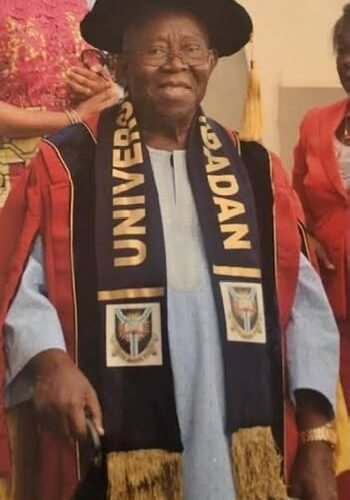
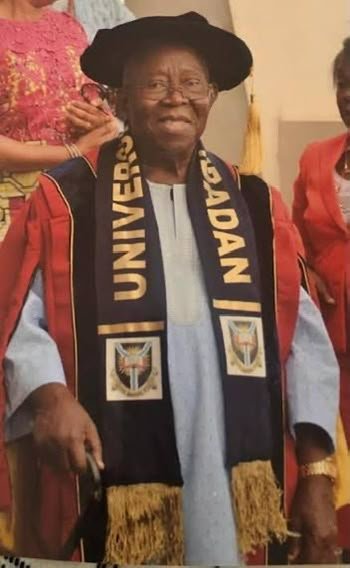
Professor Joseph Okwuabudike Ojukwu at 100
Agbeze Ireke Kalu Onuma, AI-KO
Life is short, the art long, opportunity fleeting, experience treacherous, judgment difficult.
— Hippocrates, Aphorisms
Waste no more time arguing about what a good man should be. Be one.
— Marcus Aurelius, Meditations, Book 10
Egbe bere, ugo bere; nke si ibe ya ebela, nku kwaa ya. (Let the kite perch and let the eagle perch; whichever says the other shall not, may its wing break.)
— Igbo proverb
How many of you reading this have ever heard of Professor Joseph Okwuabudike Ojukwu? How many have encountered the name, or know anything at all about the man? How many of us can even name the siblings of our famous leader, not to talk of an elder brother who is still alive and kicking, and who has only just turned one hundred?
How did the scion of a famous father, and the elder brother of a still more famous younger brother, manage to live quietly and richly under the radar for a full century? In a country that shouts its heroes into existence, how does a man of such lineage, learning and honour pass through nearly a hundred years of Nigerian history, through colonial Lagos, Cambridge, independence, a civil war and successive governments, without becoming a household name? Was it accident, temperament or choice?
These are not idle questions, and this essay is my attempt to answer them. I will not pretend to certainty. Where the record is silent I will offer a clue or a guess and say plainly that it is a guess. But I think that if we walk slowly through this one long life, the answers begin to show themselves. Let us begin with a story from far away.
In the spring of 1913, Albert Schweitzer, already famous across Europe as a theologian, a philosopher and a master of the organ, left Alsace with his wife, Helene, a trained nurse, and sailed for French Equatorial Africa. He was thirty-eight. He had spent years qualifying as a physician for the sole purpose of making this journey. At Lambaréné, on the banks of the Ogooué River, he first received patients in a converted chicken house, and from that humble beginning grew a hospital that he would serve, with interruptions, for the rest of his life.
The world eventually gave him a Nobel Peace Prize, awarded for 1952, and turned him into a legend. But the legend was the least of it. What the people along the Ogooué knew was simpler: a doctor had come, and he had stayed. He died at Lambaréné in September 1965, at the age of ninety, in the place he had chosen.
History remembers the physicians who become legends. It rarely notices the ones who become fixtures: the surgeons who keep turning up at the ward, year after year, until whole generations of patients and students can say, without embellishment, that he was there. Schweitzer was noticed because he was a famous man who did an unusual thing. Our subject is the opposite case, a man from a famous family who did an ordinary thing extraordinarily well, and whom hardly anyone noticed at all. Why the difference? Hold that question, because the whole essay is an attempt to answer it.
Start with the plain facts, because even the plain facts are surprising. Joseph Okwuabudike Ojukwu was born on 26 September 1926 at Akamili, Umudim, in Nnewi, in what is today Anambra State. He was the first child and eldest son of Sir Louis Philip Odumegwu Ojukwu, the transport and trading giant whom popular memory would later call Nigeria’s first billionaire, and of Ogbenyeanu Janet Malize of Ukpor. So he did not come from nowhere. He came from a house whose name was already painted on lorries and hung over shops. Here is the first clue to our puzzle. Some people go unnoticed because nobody is looking at them. He went unnoticed while standing in a very bright light.
Follow him to Lagos. He did his early schooling on Lagos Island and then entered King’s College, Lagos, one of the country’s foremost secondary schools. He rose to Class Six and became Head Boy.
Now notice the timing. In the very year he held that office, his younger brother Chukwuemeka and their cousin Emmanuel walked into Class One, in the same intake as Alex Ekwueme, who would one day be Vice-President of Nigeria. Think about that scene for a moment. At the top of the school stands a senior boy, seven years older than his little brother. At the bottom, coming in through the gates, are a future Biafran leader and a future Vice-President. History has kept the names of the arrivals and lost the name of the boy who stood at the top of the steps. That is the pattern of his whole life. He is there. He is always there. And he is always at the edge of the picture.
After King’s College came Britain. He studied at Cambridge, where published accounts date his qualification to 1952, and completed his clinical training at Guy’s Hospital in London. He went on to become a Fellow of the Royal College of Surgeons of England and to take a Master of Surgery degree. Pause here, because a second clue is hiding in this stretch of his life. Surgery is a strange trade. When a surgeon does the job perfectly, nothing happens. The patient wakes up, goes home and forgets the surgeon’s face. A bad surgeon makes the news; a good one makes nothing at all. A man who spends decades perfecting a craft whose highest success is an uneventful Tuesday has, almost by training, learnt how to be unseen. Either the profession shaped the temperament or the temperament chose the profession, and we cannot say which came first. But the fit was perfect.
He came home and worked at University College Hospital, Ibadan, and then as a Consultant Surgeon at the General Hospital in Lagos. In December 1957 he married Maria Ukamaka Aghaji at St Michael’s Church in Umudim, Nnewi. These were the years when Nigeria was arguing its way towards independence, and the people we remember from those years are the ones who did the arguing: the politicians, the editors, the men with microphones. Behind them, in the hospitals, other people were doing the quieter national work of keeping the population alive. Both kinds of work were building the country. Only one kind was written down.
Then the country broke. Sir Louis died in 1966, the year before Biafra was declared, and as the disturbances of those years swept across Nigeria the Ojukwu family moved east. Here the story becomes almost too strange to believe. His younger brother, Chukwuemeka Odumegwu-Ojukwu, born in 1933, had gone from King’s College and Epsom College to Oxford, then the army, and now to the leadership of Biafra. He became one of the most talked-about Africans of his generation. And the elder brother? The elder brother served at the Specialist Hospital in Enugu, at Queen Elizabeth Hospital, Umuahia, and at Emekuku Catholic Hospital.
One brother stood at the microphone; the other stood at the operating table. The published record names the hospitals but not the nights, and those belong to the patients and to him. What we can say is this. A wound does not ask whose side you are on, and a surgeon who answers a wound has stepped, for those hours at least, outside the argument.
Here is a third clue, and it is a hard one. After 1967 the name Ojukwu was no longer just a family name. It had become a cause, a flag and, to many people, a warning. Whatever anyone thinks of Biafra, and honest people still disagree, nobody can deny that the name carried a heavy load. A man who bore that name and wished to serve all comers in a country with mixed feelings about it might reasonably decide that his work should speak and his mouth should rest. I cannot claim that this is what he decided. He may never have decided anything; some people are simply quiet. But it is a fair guess that the wards were safer ground than the podium, and that a healer had good reason not to be the loud face of anything.
After the guns fell silent he returned to Enugu, where the Specialist Hospital had become the University of Nigeria Teaching Hospital. He became a Clinical Professor of Surgery, which means his job was no longer only to cure patients but to make more people who could cure patients.
One published account places the professorship after his retirement and the rest place it before; the record cannot settle the point, and the lesson does not depend on it. He retired from active service in 1987. Four years earlier, in 1983, the government of President Shehu Shagari had conferred on him the national honour of Member of the Order of the Federal Republic. So the nation did notice him once, in a formal way. But an honour is not the same as being known. Honours are handed out in one room and forgotten in another. The country said thank you, and then went back to talking about other people.
Look at what else the record says. It says he is a devoted Catholic, a husband, a father, a grandfather and a businessman. It says that about two decades ago his people in Nnewi gave him the title Chimelumdibia. It says that in hospital corridors and family compounds alike he became known simply as Pa Ojukwu. Notice that small word, Pa. Nobody gives that name to a man because he is famous. People give it to a man who has been useful to them for so long that he has become something like a father. That is a different kind of fame, and it is measured differently: not by how many strangers know your name, but by how many people would trust you with their trouble.
There is another layer, and it has to do with what it means to be an eldest son. In an Igbo family the first son is expected to carry the house. Published tributes call him the custodian of a significant family legacy, and speak warmly of a younger half-brother, Hyacinth, as a loyal and devoted brother. Put those pieces together and a guess suggests itself. A family with a great fortune on one side and a great fame on the other needs someone in the middle who holds it together, someone who does not compete for the spotlight because somebody has to keep the lights on in the compound. The elders say, egbe bere, ugo bere: let the kite perch and let the eagle perch. There was room on the branch for an eagle who flew over the battlefield and for a kite who stayed near the home. It may be that the elder brother understood something the rest of us are slow to learn, that a family, like a nation, needs its banner-carrier and its wound-tender, and that the second is no smaller than the first. He has now outlived his famous brother, who died on 26 November 2011, by nearly fifteen years. The one who made less noise has lasted longer.
So how did he live quietly and richly under the radar for a century? Let us gather the clues and be honest that they are guesses. Perhaps it was his craft, which rewards silence. Perhaps it was his faith, for the tributes call him a devoted Catholic and speak again and again of humility, and a faith that teaches you to do good without announcing it has little use for a publicity department. Perhaps it was his place in the family, the steady elder who leaves the stage to the younger.
Perhaps it was prudence, born of a name that after 1967 was heavier than one man should have to carry. Perhaps it was simply a settled temperament, the kind that never felt it had anything to prove. And perhaps, and this is the guess that should trouble us most, it was us.
We are a people who honour the loud. We know the names of the men who shouted from platforms, and we have forgotten the names of those who stitched us back together. We build monuments to speeches and none to sutures. Ask any Nigerian to name ten politicians and he will oblige; ask him to name three surgeons who served through the war and he will fall silent. We confuse being famous with being important, and we confuse being quiet with being absent. The invisibility was not only his doing. It was also our failure to look. So when I ask how many of you have heard of him, I am not scolding you. I am asking all of us, myself included, why we were so slow to ask.
And what of that word, richly? It matters. There is a way of living unseen that is poor: the forgotten man, the neglected one, the one whom nobody thanks. But there is another way, and the record suggests it was his. He had a profession he mastered, a marriage that began in 1957, children and grandchildren, a faith, a national honour, a title from his hometown, and the respect of the people who worked beside him. He was known to everyone who needed to know him and unknown to everyone who only wanted a story. That is not obscurity. That is a well-kept life. It is worth asking which of us, chasing a bigger audience, would swap places with a man who had the love and was spared the noise.
Put the pieces side by side and the strange truth appears. He was at King’s College when the future stood in Class One.
He was in the hospitals of Ibadan and Lagos while the nation was being born. He was in the East when it nearly died. He was in Enugu when it began to mend, in the wards and lecture rooms where a new generation of doctors was made. There is hardly a chapter of modern Nigerian history in which he was not present, and hardly a page on which his name appears.
He was everywhere, and yet invisibly unseen. Marcus Aurelius told himself to waste no more time arguing about what a good man should be, and to be one. Our subject seems to have done exactly that, without arguing, without advertising and, as it turns out, without ever being asked to explain himself.
What, then, are the lessons buried in this life? The first is for the young, and it is the simplest. Fame and usefulness are two different things, and only one of them survives a bad year. The test is easy to state and hard to pass: would you still do the work if nobody clapped? Here is a man whose work went on, decade after decade, in rooms where nobody clapped.
The second is for every profession. Competence is a moral act. A nation does not run on speeches; it runs on people who stay at their posts, who know their craft and keep their hands clean. Institutions are only the shadows that such people cast. When we complain about our hospitals, our schools and our roads, we are really complaining that there are too few Pa Ojukwus in too few places for too few years.
The third is for anyone who teaches or leads. A Clinical Professor is measured by what the juniors can do without him. The mark of a senior person is not how much he knows but how many others he has made able.
The fourth is for families. Brothers do not have to want the same thing. One may go out into history and the other may hold the house, and neither is a failure. If one of them is the eagle and the other the kite, the tragedy is not in the difference but in a family or a people that can only bear to look at the eagle.
The fifth is for a whole country, and it is the hardest. We must learn to look in the right places. Heroes are not only found in barracks, on platforms and in the pages of newspapers. They are found in corridors, in classrooms, in the homes of the faithful, and in the hands that do the same good thing for forty years.
The last lesson is about time. A century is not made of great days. It is made of ordinary days done well, one after another, until the sum looks like a miracle. Nobody plans a hundred years. You simply turn up, and turn up, and turn up.
And it is about us, the living, who have a bad habit of saving our best words for funerals. A century of Nigerian medicine, of King’s College in the 1940s, of the Lagos and Enugu wards, of the years the country broke and mended, is held in one man’s memory, and archives do not build themselves. He turned one hundred on 26 September 2026. The right response is not applause alone but attention: to go and sit with him, to ask, to listen and to write it down while he can still tell it.
So we come back to where we began. How many of us have heard of him? Not enough. How many can name our famous leader’s brothers and sisters? Fewer still. How did a man so placed live so quietly for so long? Because of who he was, and because of who we were. A doctor came, and he stayed. In Schweitzer’s case the world made a legend of it. In this case the world looked the other way. It is not too late to look.
Tuesday, 29 September 2026
aiko.writes2424@gmail.com