
BEYOND THE “BEST-GOVERNED” HEADLINE: MEASURING THE ABIA GOVERNANCE EXPERIMENT
From fiscal transparency and an unusually capital-heavy budget to roads, healthcare reform and an investment push, Abia has attracted a succession of favourable headlines. But the more consequential question is not whether the state deserves a superlative. It is whether the changes being reported can be measured, institutionalised and sustained.
By AProf Chukwuemeka Ifegwu Eke
On the morning of Wednesday, September 16, 2026, The Punch published a striking headline:
“RMAFC chief hails Otti, declares Abia best-governed state.”
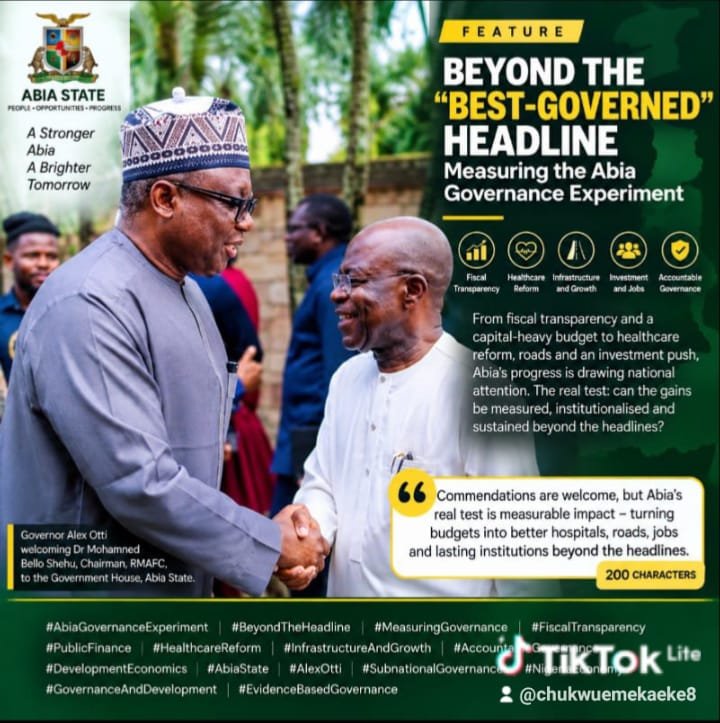
The report, published at 9:13 a.m. by Sunday Nwakanma, followed a courtesy visit by the Chairman of the Revenue Mobilisation Allocation and Fiscal Commission, Dr Mohammed Bello Shehu, and other officials of the commission to Governor Alex Otti at his office in Nvosi, Isiala Ngwa South Local Government Area.
The phrase that naturally caught public attention was Shehu’s description of Abia as, in his assessment, among the best-governed states in Nigeria.
He linked his commendation to road infrastructure, education, primary healthcare, fiscal transparency, security and what he described as prudent resource management.
He also referred to an improvement in the state’s fiscal-transparency position and a reduction in its debt profile.
Such a declaration is politically powerful.
But it is also where serious analysis should begin rather than end.
The relevant question is not simply:
Is Abia Nigeria’s best-governed state?
That proposition would require a common national definition of “best governed”, comparable indicators across all 36 states and evidence covering everything from fiscal management to education outcomes, health, security, jobs, poverty, infrastructure, public-service quality and institutional accountability.
A more productive question is:
What measurable changes have occurred in Abia, and do they amount to a governance model capable of surviving beyond personalities, publicity and the electoral cycle?
That is the real Abia governance experiment.
A REMARKABLE CONCENTRATION OF HEADLINES
The RMAFC story did not appear in isolation.
Indeed, September 16, 2026 produced an unusual cluster of Abia-related reports.
At 3:11 a.m. that same Wednesday, The Punch published:
“Group expresses satisfaction with Abia eye centres.”
The newspaper reported that the Registrar and Chief Executive Officer of the Optometrists and Dispensing Opticians Registration Board of Nigeria, Dr Obinna Awiaka, had inspected eye-care facilities at:
- Arochukwu General Hospital;
- Abia State Specialist and Diagnostic Centre, Umuahia; and
- Aba General Hospital.
He described the facilities as meeting high standards and said they could potentially attract patients from elsewhere in the South-East and South-South.
The Administrator of the Abia State Eye Health Management Bureau, Dr Betty Emeka-Obasi, said the eye programme had recorded approximately 35,000 to 37,000 patient visits over two years, in addition to outreaches, screenings, medical interventions and surgeries.
Those figures are claims from the state health authority, but they provide precisely the kind of measurable service-delivery indicator against which reform should be tested.
Just ten minutes after the eye-centre report, at 3:21 a.m., The Punch published another report:
“Otti calls for collaboration to strengthen healthcare system.”
The story concerned the 115th quarterly meeting of the Committee of Chief Medical Directors and Medical Directors of Federal Tertiary Hospitals in Nigeria and the state’s proposal for an Abia Medical City.
Represented by Deputy Governor Ikechukwu Emetu, Otti’s administration argued for stronger collaboration with federal tertiary hospitals and other medical institutions.
According to that report, Abia allocated 15 per cent of its 2026 budget to healthcare, while the government said it had recruited hundreds of health professionals and was rehabilitating primary healthcare centres.
The significance is not that several positive stories appeared on the same day.
Governments are naturally skilled at announcing projects.
The harder test is whether different policy interventions begin to connect:
Budgets to hospitals.
Hospitals to patients.
Roads to commerce.
Fiscal disclosure to accountability.
Investment promotion to actual businesses and employment.
That is where governance becomes more than publicity.
FOLLOW THE MONEY
Any serious assessment of government begins with the budget.
Abia’s 2026 budget is approximately ₦1.016 trillion.
The administration allocated about ₦811.8 billion, or 80 per cent, to capital expenditure, leaving roughly 20 per cent for recurrent expenditure.
Education received about 20 per cent, while healthcare received approximately ₦149.7 billion, equivalent to 15 per cent.
An 80:20 capital-to-recurrent ratio is noteworthy in Nigerian subnational budgeting.
It signals an explicit preference for infrastructure and investment over the routine cost of government.
But budget composition is an input, not an outcome.
Appropriating ₦100 for a road is not the same as constructing ₦100 worth of road.
Allocating money to hospitals is not equivalent to better maternal survival, shorter waiting times, increased doctor availability or improved access to medicines.
Consequently, the next stage of evaluating the Abia experiment should shift increasingly from budget allocation ratios to budget execution rates.
For every major sector, citizens should be able to ask:
- How much was budgeted?
- How much was released?
- How much was actually spent?
- What was delivered?
- At what unit cost?
- Who was the contractor?
- Was the project completed on time?
- What measurable benefit followed?
That is the difference between fiscal ambition and fiscal performance.
FISCAL TRANSPARENCY: THE NUMBERS NEED CONTEXT
There is an instructive point here.
The September 16 Punch report stated that the RMAFC chairman cited Abia’s movement from 17th to fourth position in fiscal transparency.
Otti himself had made a similar reference days earlier during the Nigerian-British Chamber of Commerce’s Meet the Governor Series, with several newspapers reporting his statement that Abia ranked fourth in BudgIT’s States Fiscal Transparency League for the fourth quarter of 2025.
BudgIT’s States Fiscal Transparency League examines such matters as:
- availability and timeliness of budget-implementation reports;
- citizens’ budgets;
- procurement information; and
- state fiscal-data repositories.
However, transparency rankings are snapshots.
They are not permanent titles.
BudgIT’s later quarterly rankings also demonstrate that state positions can change over time.
That does not erase earlier progress.
Instead, it demonstrates why governance should be treated as a moving set of indicators rather than as an award permanently won.
For Abia, therefore, the important achievement would not be reaching fourth position at one moment.
It would be building fiscal institutions capable of keeping budget documents, implementation reports, audit information, procurement records and project data consistently accessible irrespective of who occupies Government House.
Transparency has to become routine before it can become institutional.
HEALTHCARE AS A TEST OF THE SOCIAL CONTRACT
Healthcare may ultimately provide a stronger test of the Abia experiment than roads because the consequences are intensely human.
The state’s 2026 budget provides approximately ₦149.7 billion for health.
The government’s budget presentation specified plans for equipment at the Abia State University Teaching Hospital and other public facilities, as well as reconstruction or renovation of general hospitals.
The administration has also reported extensive work on primary healthcare centres.
Its third-anniversary account in May 2026 stated that nearly 1,000 healthcare professionals had been recruited and more than 277 primary healthcare centres had been retrofitted and functionalised through state and partner initiatives.
Those figures originate from the government and therefore merit continuing independent verification.
But they provide clear benchmarks against which future progress can be judged.
Now add the developments reported on September 16:
- upgraded eye centres;
- tens of thousands of reported patient visits;
- regulatory inspection; and
- the proposed Abia Medical City.
Something potentially significant begins to emerge.
Healthcare expenditure can operate simultaneously as social expenditure and economic infrastructure.
A functioning specialist-health ecosystem creates jobs for:
- doctors;
- nurses;
- optometrists;
- pharmacists;
- laboratory scientists;
- technicians;
- administrators; and
- suppliers.
If sufficiently advanced, it can reduce outbound medical expenditure and potentially attract patients from neighbouring states.
That is why the proposed Abia Medical City deserves close scrutiny.
The appropriate questions are practical:
- Where will it be located?
- What is its projected cost?
- Who will finance it?
- Which institutions will participate?
- What specialist services will distinguish it from existing tertiary hospitals?
- What is the completion timeline?
- Will it operate as a public facility, a public-private partnership or some hybrid structure?
A Medical City should ultimately be measured not by the ceremony at which it was announced, but by whether patients eventually enter its doors.
ROADS AND THE ECONOMICS OF MOVEMENT
Physical infrastructure remains central to the administration’s economic narrative.
At the Nigerian-British Chamber of Commerce event in Lagos in September, Otti said 414 roads had been completed and another 82 were under construction.
The same figures appeared in several national reports.
These are government-reported figures and should be independently audited according to road length, classification, construction standard and completion status.
Yet road construction in Abia has an unusually important economic dimension because of Aba.
Aba’s productive economy depends heavily on movement:
- movement of leather;
- movement of textiles;
- movement of intermediate inputs;
- movement of traders;
- movement between factories, workshops and markets; and
- movement of finished products to domestic and regional markets.
A bad road therefore represents more than inconvenience.
It becomes an implicit tax on enterprise.
Vehicle maintenance rises.
Travel times increase.
Inventory moves more slowly.
Transporters charge more.
Supply chains become unpredictable.
Conversely, improved transportation can increase productivity even without handing a business owner a government grant.
The strongest evaluation of Abia’s road programme will therefore come not merely from counting kilometres of asphalt, but from measuring:
- travel times;
- transport costs;
- commercial traffic;
- property development; and
- business activity along rehabilitated corridors.
CAN “OPEN FOR BUSINESS” BECOME MEASURABLE?
Between September 12 and September 15, 2026, The Sun, Punch, Premium Times, The Guardian, THISDAY and the News Agency of Nigeria carried reports arising from Otti’s presentation to the Nigerian-British Chamber of Commerce in Lagos.
The administration identified seven investment priorities:
- Agribusiness and agro-processing;
- Trade and markets;
- Creative and digital economy;
- Manufacturing and industrialisation;
- SME development and the informal sector;
- Inclusive finance; and
- Diaspora investment and innovation.
The Sun reported on September 15, 2026 that the administration had taken an investment drive to Lagos built around those sectors.
But investment promotion is perhaps the easiest area in which rhetoric can outrun results.
The true indicators will be different:
- How many firms register?
- How many actually commence operations?
- What volume of private capital is committed?
- How many jobs are created?
- How much manufacturing output is added?
- What happens to the state’s internally generated revenue?
The state has projected ₦223.4 billion in internally generated revenue, which Otti said should cover recurrent obligations.
That is itself an important hypothesis to test.
If recurrent government can increasingly be financed from sustainable internally generated revenue while borrowing and federal transfers are directed towards economically productive assets, that would represent a significant subnational fiscal model.
If the revenue projection fails substantially, however, the financing assumptions underpinning the model will require reconsideration.
THE UNCOMFORTABLE QUESTIONS MATTER TOO
A credible governance assessment cannot count only favourable headlines.
On September 13 and 14, 2026, The Sun reported a dispute over allegations that Abia residents and small businesses were being overtaxed.
The government rejected the allegations and challenged critics to produce documentary evidence.
On September 16, The Sun also carried commentary on the controversy surrounding a claim involving a supposed ₦50,000 levy on an akara seller, while noting the government’s denial that such a tax had been imposed.
The point is not to determine the dispute by assertion.
It is to recognise that a government seeking higher internally generated revenue must continually balance revenue mobilisation with the survival of micro and small enterprises.
In a heavily informal economy, poorly designed levies can damage precisely the productive base government hopes to expand.
Equally, misinformation about taxation can undermine confidence even where the policy itself is different from what is alleged.
The antidote in both cases is transparency:
- published schedules;
- digital payments;
- official receipts;
- complaint mechanisms; and
- clear information about what citizens and businesses are legally required to pay.
FROM PROJECTS TO INSTITUTIONS
This brings us to the most consequential measurement of all.
Governors can build roads.
Governors can renovate hospitals.
Governors can purchase equipment.
Governors can increase budget allocations.
But genuine governance transformation occurs when systems are constructed alongside physical assets.
Who maintains the new hospitals?
Who services expensive diagnostic equipment five years from now?
Who determines road-maintenance priorities after the current administration?
Can citizens track procurement electronically?
Are budgets and implementation reports automatically published without requiring political instruction?
Can a contractor win a project based on transparent rules rather than political proximity?
Does the civil service possess the institutional capacity to continue reforms irrespective of the governor in office?
These questions determine whether Abia is experiencing a successful administration or the beginning of institutional change.
The distinction matters enormously.
BEYOND THE SUPERLATIVE
Perhaps, then, the most useful consequence of Dr Mohammed Bello Shehu’s September 15 visit is not the phrase:
“Best-governed state.”
The phrase produced a headline.
Inevitably, supporters will celebrate it and opponents will interrogate it.
But governance is too important to be settled by applause or counter-applause.
Abia can instead be subjected to a more demanding examination.
Track the ₦1.016 trillion budget.
Track the 80 per cent capital allocation.
Track the 15 per cent health allocation.
Track actual releases and expenditure.
Track the hospitals.
Track the 35,000-plus reported eye-care visits.
Track the primary healthcare centres.
Track the roads.
Track travel times and logistics costs.
Track the ₦223.4 billion IGR projection.
Track procurement disclosure.
Track private investment.
Track employment.
Track the Medical City from proposal to construction to first patient.
Track fiscal-transparency rankings quarter after quarter rather than selecting a favourable quarter.
And, above all, track whether today’s reforms survive tomorrow’s politics.
Because that is how the Abia governance experiment should ultimately be measured.
Not by how frequently a government is praised.
Not by how loudly its opponents disagree.
And certainly not by one superlative headline.
The enduring measure of governance is whether public resources are converted, transparently and sustainably, into improvements that citizens can see, use and verify — and whether the institutions responsible remain functional long after the headlines have changed.
That is the test before Abia.
And it is a far more consequential test than the title of “best governed.”
SOURCE LINKS
- Punch – RMAFC chief hails Otti, declares Abia best-governed state
https://punchng.com/rmafc-chief-hails-otti-declares-abia-best-governed-state/ - Punch – Group expresses satisfaction with Abia eye centres
https://punchng.com/group-expresses-satisfaction-with-abia-eye-centres/ - Punch – Otti calls for collaboration to strengthen healthcare system
https://punchng.com/otti-calls-for-collaboration-to-strengthen-healthcare-system/ - Premium Times – Otti presents ₦1.016 trillion 2026 Appropriation Bill
https://www.premiumtimesng.com/news/top-news/838477-gov-otti-presents-n1-016trillion-2026-appropriation-bill-to-assembly.html - BudgIT – States Fiscal Transparency League
https://fiscalleague.budgit.org/latest-ranking - BudgIT – Q4 2025 Fiscal Transparency League
https://budgit.org/post_publications/states-fiscal-transparency-league-q4-2025/ - Abia State Government – 2026 Budget / Acceleration and New Possibilities
https://abiastate.gov.ng/acceleration-and-new-possibilities/ - Abia State Government – Third Anniversary Report
https://environment.abiastate.gov.ng/gov-otti-holds-third-anniversary-parade-reaffirms-commitment-to-dignity-development-of-abia/ - News Agency of Nigeria – Otti highlights seven investment priority sectors in Abia
https://nannews.ng/otti-highlights-7-investment-priority-sectors-in-abia/ - Punch – Abia targets seven sectors to boost industrialisation
https://punchng.com/abia-targets-seven-sectors-to-boost-industrialisation/ - The Sun – Otti woos investors to Abia, unveils investment plan
https://thesun.ng/otti-woos-investors-to-abia-unveils-n1trn-investment-plan/ - Premium Times – Otti highlights seven investment priority sectors in Abia
https://www.premiumtimesng.com/business/business-news/908934-otti-highlights-seven-investment-priority-sectors-in-abia.html - The Sun – Abia government denies overtaxing residents
https://thesun.ng/abia-govt-denies-overtaxing-residents/ - The Sun – Commentary on Otti, akara seller and ₦50,000 taxation controversy
https://thesun.ng/still-on-abia-gov-otti-akara-seller-and-n50000-taxation/