
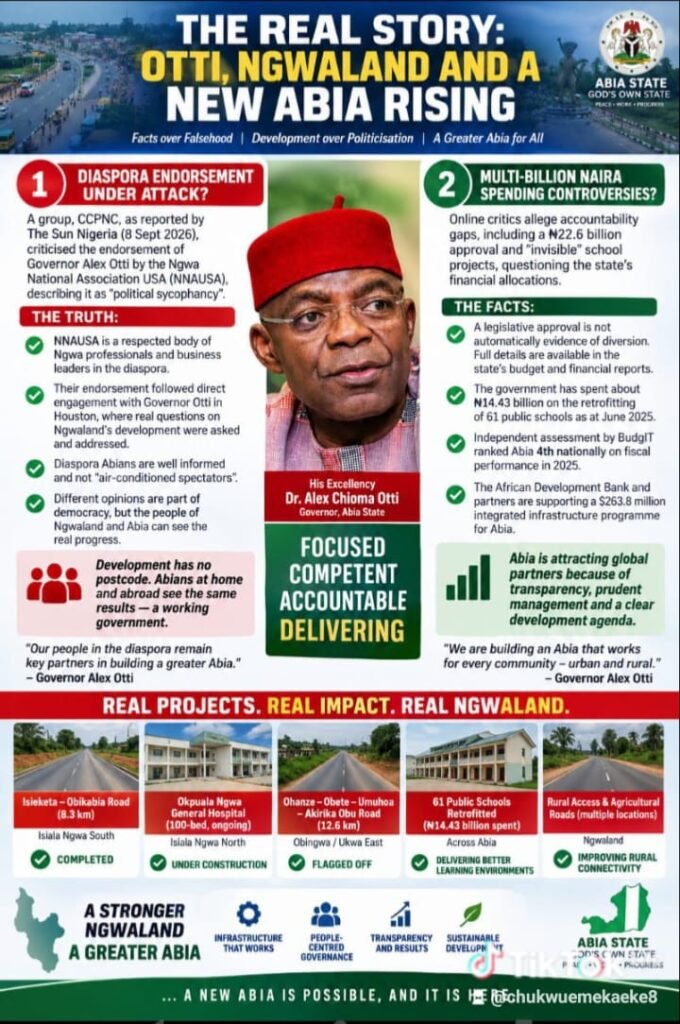
OTTI, NGWALAND AND THE POLITICS OF SELECTIVE AMNESIA: FACTS ARE MORE STUBBORN THAN PRESS STATEMENTS
The latest attack on Governor Alex Otti following the endorsement of his second-term bid by the Ngwa National Association USA (NNAUSA) deserves a response — not because criticism of government is illegitimate, but because criticism becomes intellectually weak when it conveniently walks around verifiable facts.
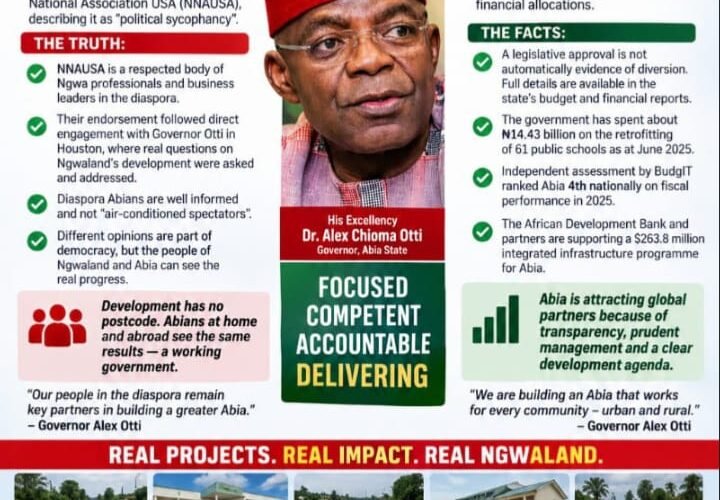
The Coalition of Concerned and Patriotic Ngwa Citizens (CCPNC), as reported by The Sun on 8 September 2026, described the NNAUSA endorsement as “political sycophancy” and challenged anyone to identify meaningful development in Ngwaland.
That is an extraordinary challenge because it can be answered with names, kilometres, locations and completed or ongoing projects.
The question, therefore, is no longer whether anyone has a right to criticise Alex Otti. Of course they do.
The real question is whether a political argument survives contact with the evidence.
THE NNAUSA ENDORSEMENT DID NOT OCCUR IN AN INFORMATION VACUUM
There is something particularly curious about dismissing Nigerians in the diaspora as people sitting in “air-conditioned homes” and supposedly consuming propaganda.
These are adults capable of asking questions, interrogating evidence and forming their own political judgments.
Indeed, reports from the Houston engagement indicate that participants questioned Governor Otti directly about specific projects and communities. One participant reportedly raised the Mgboko Road leading towards Obingwa, while the Governor discussed ongoing and proposed road interventions.
The Houston engagement and discussions involving NNAUSA were documented by Premium Times.
So disagreement with NNAUSA is perfectly legitimate. Insulting its members’ capacity to assess their own homeland is not an argument.
And if a group of Ngwa people abroad endorses Otti while another group at home opposes him, neither side automatically becomes the “authentic voice” of millions of people.
The ultimate authentic voice will be the electorate.
NOW, LET US TEST THE CLAIM OF “NEGLECT” AGAINST ACTUAL PROJECTS
The most damaging weakness in the CCPNC statement is its sweeping challenge concerning development in Ngwaland.
Take Isiala Ngwa South.
The Otti administration commissioned the 8.3-kilometre Isieketa–Obikabia Road and the retrofitted Primary Healthcare Centre at Owerinta.
The administration has also documented the Umuikama–Okpuala Nvosi Road, Umunkpeyi–Okpokiri–Umuehim Road and other projects around the Isiala Ngwa axis.
These are identifiable places.
These are identifiable projects.
They cannot reasonably be dismissed as photographs manufactured in an air-conditioned media office.
Then take Isiala Ngwa North.
The administration commenced reconstruction of the historic 100-bed Okpuala Ngwa General Hospital, a major health facility serving the area and beyond.
Then Obingwa.
Governor Otti flagged off reconstruction of the 12.6-kilometre Ohanze–Ntighauzu–Obete–Umuoha–Oberete–Abiaka–Akirika Obu road corridor connecting communities in Obingwa and Ukwa East.
That is precisely the kind of community and economically strategic road that the statement suggests does not exist.
And this is where the argument becomes even more difficult to sustain.
Under the Rural Access and Agricultural Marketing Project programme reported by the Abia State Government, rural feeder-road packages included interventions in Isiala Ngwa South, Isiala Ngwa North, Obingwa and Ugwunagbo/Ukwa East.
The details can be examined in the Abia State Government Monthly Update containing the rural-road programme.
In other words, the very geographical areas invoked as evidence of abandonment appear in documented rural-road interventions.
Osisioma cannot simply be erased either.
Official government reporting documented work on the Osisioma–Ekeakpara Road and other road interventions.
Further government reporting also recorded repairs and rehabilitation around the Osisioma interchange and other locations.
One may legitimately argue that MORE roads remain to be done.
Of course they do.
One may argue that implementation should move faster.
Fair enough.
One may identify a particular village road that remains terrible and demand that government fix it.
That is constructive opposition.
But “nothing has been done” and “not enough has been done” are two completely different propositions.
The evidence may support debate over the second.
It does not comfortably support the first.
THE BIGGER ROAD RECORD IS EVEN HARDER TO DISMISS
By May 2026, Governor Otti reported that his administration had completed 414 road projects covering 864.12 kilometres in three years.
Nobody is required to accept a governor’s statistics unquestioningly.
Journalists, opposition parties and civil-society organisations should interrogate them.
But serious interrogation means identifying the roads claimed, checking them and demonstrating discrepancies.
It does not mean pretending that hundreds of kilometres of road claims do not exist.
And consider Aba itself.
Port Harcourt Road — for years practically a monument to governmental failure — has been reconstructed. Ohanku Road has been delivered. Other roads have followed, while additional corridors remain under construction or planned.
The government’s own archive of completed projects across Abia State is publicly accessible.
This is especially relevant because Aba is overwhelmingly central to the social and economic life of Ngwaland.
You cannot simultaneously demand development for Ngwa people and then declare infrastructure transforming Aba irrelevant because it does not fit a preferred political narrative.
THE “INVISIBLE SCHOOLS” ARGUMENT ALSO REQUIRES NUMBERS, NOT INNUENDO
Another allegation circulating online concerns supposedly “invisible” expenditure on schools.
This deserves scrutiny.
Every naira of public money deserves scrutiny.
But scrutiny must distinguish between BUDGET ALLOCATION and ACTUAL EXPENDITURE.
That distinction is fundamental.
A budget is authority to spend.
It is not automatically evidence that the entire authorised amount has been spent.
The appropriate method is to identify the schools, inspect the projects, establish what was appropriated, determine what was released, determine what was actually spent and compare the expenditure against physical work delivered.
That would be accountability.
Taking a large appropriation figure, presenting it as though the entire amount had already been withdrawn and disappeared, and then demanding to see physical projects equivalent to the entire budget envelope is not sound public-finance analysis.
The wider fiscal framework can be examined from the Abia State Government’s presentation of the 2025 budget and its capital-development programme.
ABIA’S FISCAL RECORD ALSO DESERVES TO BE PUT ON THE TABLE
The debate becomes even more interesting when independent fiscal assessment is considered.
BudgIT’s 2025 State of States assessment ranked Abia fourth nationally on fiscal performance, according to the state government’s report on the ranking.
The details are available in the Abia State Government report on the 2025 BudgIT fiscal-performance ranking.
Again, critics are free to interrogate those numbers.
But they cannot reasonably construct an argument about Abia’s finances as though no independent fiscal assessment exists.
There is another important signal.
The African Development Bank announced, with development partners and Nigerian authorities, a major integrated infrastructure programme for Abia State.
International development institutions do not replace domestic accountability, and their participation does not prove that every state expenditure is perfect.
But such partnerships do matter when evaluating the proposition that Abia is simply staging an infrastructure “illusion.”
THE ₦22.6 BILLION CLAIM MUST ALSO PASS A BASIC ACCOUNTING TEST
If anyone alleges an “undocumented diversion” of ₦22.6 billion, the burden should be straightforward:
What appropriation line?
What supplementary appropriation?
What date?
What House resolution?
What amount was actually released?
To which MDA?
For what purpose?
What does the budget-performance report show?
What does the Accountant-General’s record show?
Was the money merely APPROVED, or was it RELEASED and SPENT?
These distinctions are not technical tricks.
They are the elementary architecture of public-sector accounting.
An approval by a legislature is not, by itself, proof of diversion.
If evidence exists showing unlawful diversion, publish it.
Government should answer it.
But an allegation does not become an established fact merely because it is written in bold letters on Facebook.
ABIA IS NOT FINISHED — AND OTTI SHOULD NEVER CLAIM THAT IT IS
There are still bad roads in Abia.
There are communities waiting for infrastructure.
There are schools requiring intervention.
There are hospitals that must be upgraded.
There are rural farmers who need better access roads.
There are projects that should move faster.
And Governor Otti must continue to be held accountable for every appropriation, contract, variation and expenditure.
Supporting a government should never mean suspending scrutiny.
But neither should opposition mean suspending reality.
No administration could possibly repair in three years every road, school, hospital, drainage system and public institution accumulated through decades of underinvestment.
The fair question is therefore not:
“Has Alex Otti completed Abia?”
Obviously not.
The fair questions are:
Is Abia moving?
Are abandoned projects being revived?
Are new roads appearing?
Are health facilities being rehabilitated?
Are schools being rebuilt?
Is capital expenditure translating increasingly into physical assets?
Is Aba changing?
Are rural interventions occurring?
And, importantly, is there independently verifiable evidence beyond government publicity?
On those questions, the evidence makes the “carefully crafted illusion” thesis increasingly difficult to sustain.
POLITICS WILL COME AND GO. THE ROADS WILL REMAIN.
There is an irony in all this.
The CCPNC statement was apparently intended to puncture NNAUSA’s endorsement of Governor Otti.
Instead, it has created an opportunity to put the development record under a microscope.
That is healthy.
Let everybody bring evidence.
Let government publish project locations, contract sums, completion percentages and photographs.
Let journalists visit them.
Let opposition politicians visit them.
Let NNAUSA members visit them when they return home.
Let communities speak.
And where government has failed, say so loudly.
But where roads, schools, hospitals and other infrastructure physically exist, let nobody ask Abians to deny their own eyes merely because 2027 is approaching.
NNAUSA has exercised its democratic right to endorse Alex Otti.
CCPNC has exercised its democratic right to reject that endorsement.
Neither organisation owns Ngwaland.
The people do.
And ultimately, Governor Alex Otti will not be judged by press statements from supporters or opponents.
He will be judged by the condition of Abia he inherited, the resources available to his administration, the integrity with which those resources were managed, the infrastructure standing on the ground — and the Abia he presents to the electorate in 2027.
For now, one proposition deserves emphasis:
Criticise Otti where criticism is warranted.
Demand receipts.
Demand value for money.
Demand faster rural development.
Demand more.
But do not call visible roads invisible.
Do not call identifiable projects imaginary.
And do not convert political disagreement into an alternative set of facts.
Abia has travelled too far from where it was for that argument to survive serious scrutiny.
The rebuilding is not complete.
But the rebuilding is real.
And Abians can see it.