

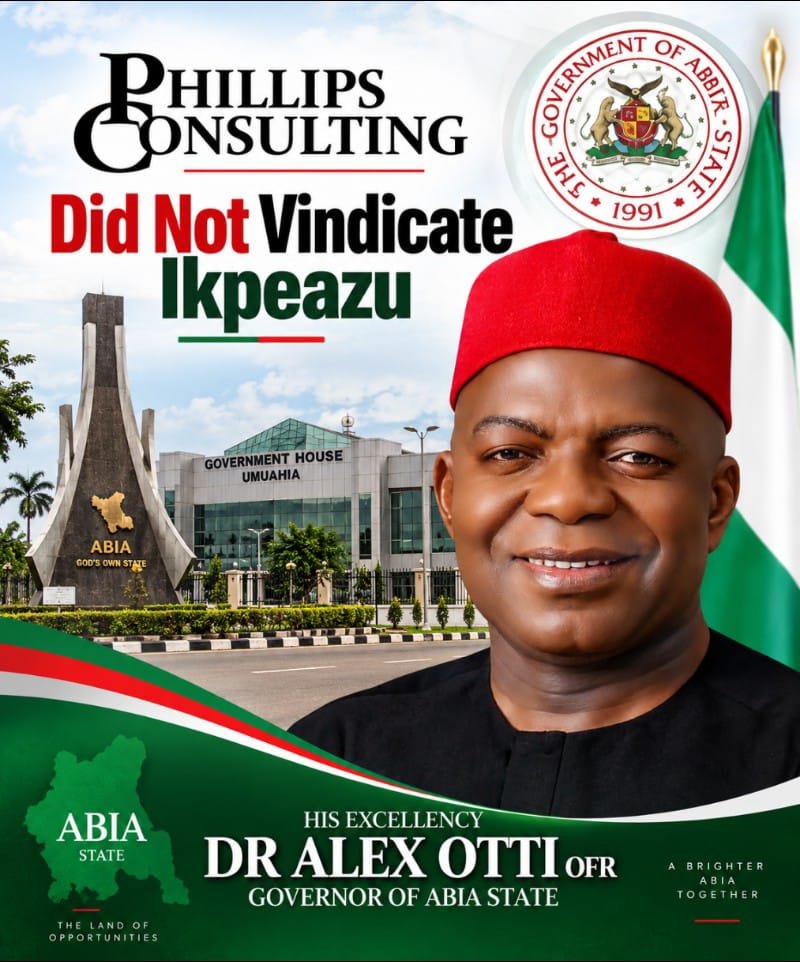
PHILLIPS CONSULTING DID NOT VINDICATE IKPEAZU: THE STATISTICAL ERROR BEHIND A CONVENIENT POLITICAL NARRATIVE
There is nothing wrong with defending the record of a former governor. There is, however, something fundamentally wrong with bending an independent performance index until it says what it never said.
The article titled “Phillips Consulting Report Exposes Otti’s Propaganda, Vindicates Ikpeazu” attempts to convert the 2026 Phillips Consulting State Performance Index into a nine-year report card jointly assessing the Okezie Ikpeazu and Alex Otti administrations.
That interpretation is attractive politically.
It is also statistically wrong.
The argument rests almost entirely on one sentence reported by PUNCH following a briefing by the Abia State Commissioner for Information, Prince Okey Kanu:
“The Abia State Government recorded significant fiscal and infrastructural progress between 2017 and 2026…”
From that sentence, the writer jumps to the conclusion that because Ikpeazu governed for six of those years, the Phillips Consulting findings must necessarily constitute independent validation of the Ikpeazu administration.
But that is not what PUNCH reported.
Read the report carefully.
PUNCH says the Commissioner cited the 2026 Budget Report AND the Phillips Consulting State Performance Index in discussing Abia’s fiscal performance.
Two sources.
Not one Phillips Consulting study covering 2017–2026.
That distinction demolishes the central premise of the argument.
www.punchng.com/abia-ranks-among-top-states-in-revenue-capital-growth-report/
Even more decisively, Phillips Consulting itself explains what its 2026 Momentum Index measures.
It measures the progress states have made since the 2025 report.
Not since 2017.
Not since the beginning of the Ikpeazu administration.
Not six years of Ikpeazu plus three years of Otti.
Phillips Consulting states that the 2026 edition adopted a “momentum approach”, assessing the progress made by states since the 2025 edition rather than simply where they rank today.
That is the methodological fact around which every serious discussion of this report must revolve.
So where exactly is the statistical basis for declaring that the 2026 Momentum Index “vindicates Ikpeazu”?
There isn’t one.
The attempt to stretch a year-on-year momentum assessment backwards to 2017 is not interpretation. It is a category error.
And the evidence becomes even more inconvenient for this revisionist argument when we go back one edition.
In the 2024 Phillips Consulting State Performance Index, Abia reportedly occupied 36th position.
By the 2025 assessment, Abia had climbed to 10th position.
That was a staggering 26-place movement — the single biggest improvement recorded by any state in the federation.
TheCable reported it clearly:
www.thecable.ng/2025-state-performance-index-abia-jumps-26-places-to-10th-as-lagos-retains-top-spot/
Pause there.
If Phillips Consulting were somehow “vindicating Ikpeazu”, as is now being claimed, what exactly are we to make of an Abia State sitting at 36th position in the preceding index before surging 26 places to 10th?
Was 36th the vindication?
Or was the extraordinary movement away from 36th the important story?
One cannot celebrate the improvement while pretending that the baseline from which that improvement occurred does not matter.
Then came the 2026 assessment.
Phillips Consulting introduced its Momentum Index and Abia emerged as the third-fastest-improving state in Nigeria, with a positive momentum score of +0.67, behind only Enugu and Jigawa.
PUNCH reported it on July 23, 2026:
www.punchng.com/abia-ranks-third-fastest-improving-state-report/
Phillips Consulting further explains that the 2026 pSPI is built around 37 performance indicators across seven dimensions: security, education, health, basic infrastructure, governance, economic development and fiscal performance.
Its methodology combines 70 per cent objective secondary data with 30 per cent citizen-perception data.
This is therefore not an exercise in counting who first imagined a road.
It evaluates outcomes.
It measures performance.
It examines where states stand and, critically in the 2026 edition, how rapidly they are moving.
That distinction matters.
CONCEIVING A PROJECT IS NOT THE SAME THING AS DELIVERING AN OUTCOME
The defence of the previous administration devotes considerable space to listing projects allegedly conceived, commenced or contemplated under Governor Ikpeazu.
That is a legitimate historical discussion.
But it does not answer the Phillips Consulting question.
An abandoned road can have a conception date.
An uncompleted hospital can have an award date.
A project may have drawings, approvals, contractors and budgetary allocations.
None of those things automatically constitutes a development outcome.
Public administration ultimately asks a harder question:
What did citizens actually receive?
A road motorists can drive on is an outcome.
A hospital actually providing healthcare is an outcome.
A school in which children are learning is an outcome.
Regular salaries received by workers are outcomes.
Pensions actually paid to retirees are outcomes.
Streetlights providing illumination are outcomes.
A functioning transport system moving passengers is an outcome.
Higher internally generated revenue backed by measurable economic activity is an outcome.
Phillips Consulting’s framework is fundamentally concerned with these kinds of measurable performance outcomes — not political ownership certificates for ideas.
PORT HARCOURT ROAD IS ACTUALLY A GOOD EXAMPLE OF THE DIFFERENCE
The argument concerning Port Harcourt Road illustrates the problem perfectly.
Yes, governments are continuous.
If an earlier administration conceived or commenced any part of a project, that historical fact should not be erased.
But neither should “we started it” become a substitute for completion.
The people of Aba do not drive on conception.
They do not trade on engineering drawings.
They do not move goods through intentions.
Development acquires economic value when infrastructure becomes usable.
Consequently, acknowledging that an earlier administration touched a project does not deprive the administration that mobilised resources, redesigned where necessary, executed and delivered it of the measurable governance outcome.
Both propositions can be true simultaneously.
That is what an intellectually serious account of continuity looks like.
THE CLAIM THAT THE REPORT “EXPOSES OTTI’S PROPAGANDA” ACTUALLY COLLAPSES UNDER THE REPORT ITSELF
There is another remarkable contradiction.
The same Phillips Consulting series being presented as evidence against the current government records Abia’s extraordinary recent upward movement.
From 36th in 2024 to 10th in 2025.
Then, under the 2026 Momentum Index, third-fastest improving state in Nigeria.
That sequence does not read like an independent institution exposing a government.
It reads like an independent institution documenting unusually rapid improvement.
And Phillips Consulting is explicit about why it created the Momentum Index: to capture the trajectory of progress within each state, rather than merely producing another static league table.
Its own officials describe the index as a way of identifying where reforms are yielding results and where additional intervention remains necessary.
That is very different from the retrospective political certificate being manufactured from it.
THE PUNCH STORY ITSELF DOES NOT MAKE THE CLAIM BEING ATTRIBUTED TO IT
This is perhaps the most important point.
PUNCH did not report:
“Phillips Consulting says Ikpeazu laid the foundation for Otti.”
PUNCH did not report:
“Phillips Consulting attributes Abia’s current ranking to achievements recorded between 2017 and 2023.”
PUNCH did not report:
“Phillips Consulting vindicates the PDP administration.”
Those are political extrapolations subsequently imposed upon the story.
What PUNCH actually reported was that the Abia Government, citing its 2026 Budget Report and the Phillips Consulting index, said Abia ranked:
2nd nationally in aggregate revenue growth;
3rd nationally in IGR growth;
1st nationally in total expenditure growth;
1st nationally in capital expenditure growth;
1st nationally in personnel expenditure growth;
while keeping overhead expenditure comparatively low.
Those are the numbers that require explanation.
And there is another number the revisionist argument does not comfortably confront:
36th to 10th.
Twenty-six positions.
The largest movement recorded among the states in the 2025 index.
A serious critic can debate individual projects, question expenditure, interrogate procurement and challenge government policy. That is democracy.
But one cannot take an index documenting rapid recent improvement and logically transform it into proof that the administration presiding over that improvement inherited substantially the same performance.
The mathematics will simply not cooperate.
IKPEAZU DOES NOT HAVE TO BE ERASED FOR OTTI’S PERFORMANCE TO BE RECOGNISED
There is also no need for historical absolutism.
Okezie Ikpeazu governed Abia for eight years. There were projects executed during those years. There were roads constructed, initiatives undertaken and institutions established.
Those facts can be documented and assessed on their individual merits.
But acknowledging them is entirely different from using the 2026 Phillips Consulting report as their certificate of validation.
It is not.
Likewise, saying that Abia has experienced a dramatic change in performance indicators since 2023 does not require pretending that no physical structure existed before May 29, 2023.
“New Abia” is fundamentally a political description of a changed governance direction. Its validity should therefore be tested against outcomes.
And that is precisely where independent measurements become useful.
Does revenue improve?
Does capital expenditure expand?
Does citizen perception improve?
Does the state’s comparative national position change?
Are infrastructure and service-delivery outcomes visible?
Does the trajectory accelerate?
Phillips Consulting’s recent answers are substantially favourable.
AND THE METHODOLOGY MAKES THE ARGUMENT EVEN HARDER TO DISMISS
The 2026 pSPI is not merely an Abia Government publication.
Phillips Consulting says the report draws on extensive objective data, citizen perceptions and expert analysis. The 2026 exercise reportedly incorporated insights from more than 30,000 citizen responses nationwide.
The assessment allocates 70 per cent weight to objective secondary data and 30 per cent to citizen perception.
It assesses states across security, education, health, basic infrastructure, governance, economic development and fiscal performance.
Therefore, reducing Abia’s movement to public-relations messaging requires one to explain away not merely the Abia Government, but an independently structured methodology measuring numerous indicators and citizen experiences.
That is a much more difficult proposition.
THE REAL QUESTION
So the question arising from the Phillips Consulting evidence is not:
“Did anything happen in Abia before Alex Otti?”
Of course things happened.
The serious question is:
Why did Abia move from the bottom of a Phillips Consulting ranking to become one of Nigeria’s fastest-improving states?
That is the question the available evidence raises.
And it cannot be answered by reciting a catalogue of projects conceived many years earlier.
The trajectory matters.
The baseline matters.
The timing matters.
The methodology matters.
And outcomes matter most.
NUMBERS DO NOT BECOME IKPEAZU’S NUMBERS SIMPLY BECAUSE SOMEONE STARTS COUNTING FROM 2017
This is ultimately where the attempted “vindication” fails.
A sentence containing the years “2017–2026” does not magically turn the Phillips Consulting 2026 Momentum Index into a nine-year longitudinal evaluation of two governors.
Phillips Consulting itself tells us what the 2026 momentum assessment does:
It measures progress since the preceding edition.
That should settle the methodological argument.
The 2025 report showed Abia making the largest upward movement in Nigeria — 26 places, from 36th to 10th.
The 2026 Momentum Index then placed Abia third among the country’s fastest-improving states.
The latest fiscal figures cited by the government place the state among national leaders in revenue growth, IGR growth and capital expenditure growth.
Those are legitimate facts to interrogate.
But they cannot reasonably be repackaged as evidence that nothing fundamentally changed after May 2023.
If anything, the direction of movement documented by the Phillips Consulting series makes the opposite question unavoidable:
What changed in Abia for a state at the bottom of the table to begin climbing so rapidly?
Political rhetoric may offer competing answers.
The numbers, however, establish that the movement occurred.
And that is precisely why the attempt to recruit Phillips Consulting as a witness for the proposition that the old order has now been “vindicated” does not survive a careful reading of the evidence.
The report did not say it.
PUNCH did not say it.
The methodology does not support it.
And the trajectory contradicts it.
There is enough room in Abia’s history to acknowledge whatever any previous administration genuinely achieved.
But there is no need to rewrite an independent performance index to manufacture that recognition.
Governance may be a continuum. Performance is still measurable.
And on the evidence currently available, Abia’s most dramatic measurable movement is not buried somewhere between 2017 and 2023.
It is happening now.
SOURCES
PUNCH — Abia ranks among top states in revenue, capital growth – Report
www.punchng.com/abia-ranks-among-top-states-in-revenue-capital-growth-report/
PUNCH — Abia ranks third fastest-improving state — Report
www.punchng.com/abia-ranks-third-fastest-improving-state-report/
TheCable — 2025 State Performance Index: Abia jumps 26 places to 10th as Lagos retains top spot
www.thecable.ng/2025-state-performance-index-abia-jumps-26-places-to-10th-as-lagos-retains-top-spot/
Phillips Consulting — State Performance Index
www.phillipsconsulting.net/reports_post/my-state-the-pcl-state-performance-index-pspi-report/
2026 pSPI
www.pspi.com.ng