
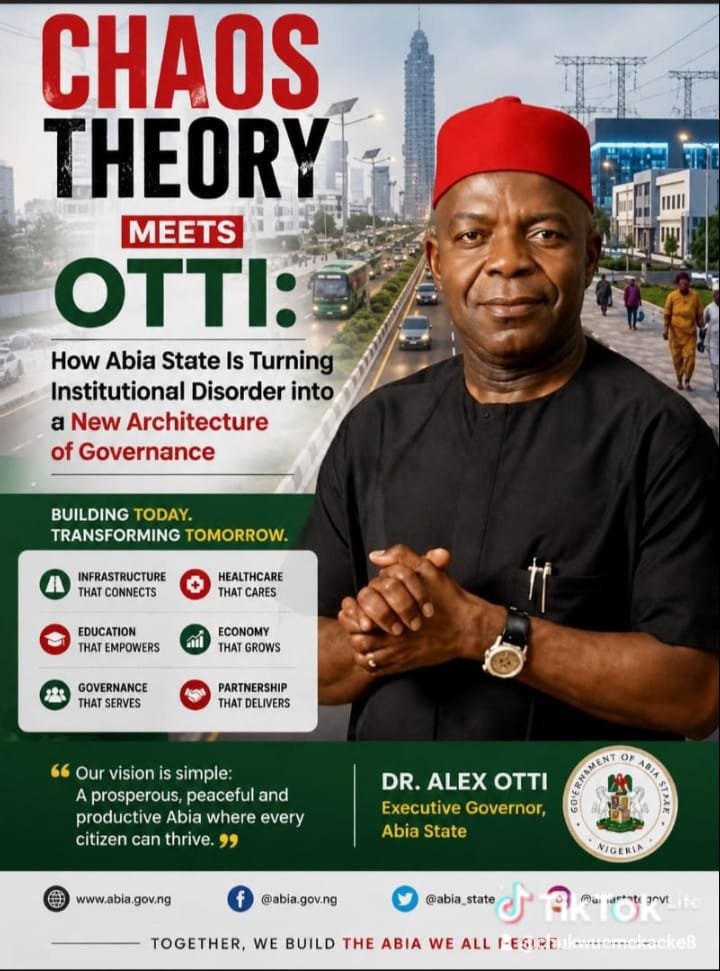
CHAOS THEORY MEETS OTTI: How Abia State Is Turning Institutional Disorder into a New Architecture of Governance
Chaos theory began in mathematics and the physical sciences, but its deepest intuition travels remarkably well into politics and economics. A complex system may appear stable until tiny disturbances produce consequences far larger than anyone anticipated. Equally, a system trapped in disorder may begin to reorganise when critical variables are changed at the right points. Roads alter commerce. Schools alter human capital. Hospitals alter survival and productivity. Public accounts alter trust. Institutions alter incentives. And incentives, repeated long enough, alter societies.
This is where the Abia story becomes intellectually interesting.
The argument about Abia under Governor Alex Otti should not be reduced to whether one likes Otti, belongs to his political camp or supports his opponents. Neither should the evaluation of a government be reduced to photographs of freshly paved roads and commissioned buildings. The more consequential question is whether Abia is witnessing something deeper: a transition from an institutional equilibrium built around dysfunction to one increasingly organised around functionality, predictability and public value.
That distinction matters.
Governments build roads everywhere. Governments renovate schools. Politicians commission hospitals. What separates routine public expenditure from genuine state reconstruction is whether these interventions begin to reinforce one another until they change the operating logic of the society itself.
That is the sense in which chaos theory meets Otti.
The Abia That Government Had to Confront
Every administration inherits assets, liabilities and institutions. Some inherit functioning bureaucracies and simply manage them. Others arrive where the problem is more fundamental: the machinery itself has deteriorated.
For years, the narrative surrounding Abia, particularly Aba, was painfully paradoxical. Here was one of Nigeria’s most naturally entrepreneurial societies: traders, shoemakers, garment producers, fabricators, transporters, industrial clusters and an extraordinarily energetic informal economy. Yet the physical environment in which much of that enterprise operated often failed to reflect the productive energy of the people.
That contradiction is economically expensive.
When roads collapse, transport costs rise. When drainage fails, businesses lose inventories and productive hours. When power is unreliable, firms purchase generators and diesel instead of machinery. When public health deteriorates, workers lose productive days. When schools decline, the future labour force becomes less competitive. When government transactions are opaque, investors price uncertainty into every decision.
Institutional disorder therefore behaves much like a tax.
It does not arrive as a single tax notice. It appears in hundreds of small additional costs borne by households and businesses: an extra hour in traffic, a damaged vehicle suspension, a flooded shop, an avoidable hospital journey, an unreliable public service, a young person inadequately prepared for employment.
Individually, these may appear trivial. Collectively, they constitute an enormous drag on productivity.
The true challenge confronting any reform administration in such an environment is consequently not simply to build things. It is to begin dismantling the economics of dysfunction.
The Butterfly Effect of a Functional Road
Chaos theory is famous for the butterfly effect: the proposition that a small alteration in initial conditions can produce disproportionately large consequences elsewhere in a complex system.
A road offers a useful development-economics equivalent.
Consider what happens when a commercially important road becomes reliably passable.
Travel time falls. Vehicle maintenance costs decline. Traders move goods faster. Property values can rise. Customers return. Delivery businesses expand. Commercial vehicles make more trips per day. Construction occurs along previously unattractive corridors. Government revenue may improve as businesses become more visible and formalised. Employment follows some of those investments.
A road, therefore, is not merely asphalt.
It is an economic network.
This helps explain why the reconstruction of roads in Aba and across Abia has attracted so much attention. The administration’s infrastructure programme has encompassed major corridors as well as internal urban roads. Independent reporting has documented projects involving the Aba-Port Harcourt Road corridor, Umuahia-Uzuakoli Road and numerous roads within Aba and elsewhere in the state.
By 2026, Otti was publicly claiming that his administration had completed 414 roads over three years. Such a figure should properly remain subject to independent project-by-project verification rather than being accepted merely because government announced it. Nevertheless, the scale of road activity itself is difficult to dismiss as inconsequential.
The important question is what happens next.
If new roads merely become ribbons for political commissioning, little has changed. If, however, they lower logistics costs, reconnect production clusters, stimulate private investment and remain maintained after commissioning, then the road programme becomes part of a larger institutional transformation.
That distinction—between infrastructure as spectacle and infrastructure as productive capital—should form the basis of serious evaluation of the Otti years.
Aba Is Not Merely a City; It Is an Economic Idea
Aba deserves particular attention because its significance exceeds its geography.
Aba represents perhaps one of Nigeria’s clearest demonstrations of indigenous capitalism: production without permission, innovation without perfect infrastructure and entrepreneurship frequently occurring despite the state rather than because of it.
The deeper tragedy of Aba’s historical infrastructural difficulties was therefore not cosmetic. Nigeria had allowed one of its great concentrations of small-scale productive intelligence to operate under conditions that continuously raised the cost of doing business.
Rebuilding Aba consequently has national economic implications.
If a shoemaker can obtain inputs more quickly, if a garment producer can distribute products more reliably, if a transporter spends fewer hours negotiating failed roads, if markets become easier to access, and if private investors begin believing that today’s infrastructure will still function tomorrow, the economic consequences compound.
And compounding is precisely where the chaos metaphor becomes useful.
The turnaround of a complex economy rarely comes from one spectacular project. It comes from mutually reinforcing improvements.
Roads support markets.
Markets support employment.
Employment supports household income.
Household income supports consumption.
Consumption supports firms.
Growing firms enlarge the tax base.
A larger tax base provides government with greater capacity to fund roads, schools and hospitals.
Development becomes a feedback loop.
So does decay.
The entire problem of governance is determining which feedback loop dominates.
From Concrete to Institutions
There is, however, a danger in discussing government exclusively through infrastructure.
A state can build extensively and remain institutionally weak.
The harder test of Otti’s government will therefore not ultimately be the number of kilometres of roads constructed. It will be whether the administration changes how Abia government itself functions.
That means procurement.
Accounting.
Budget execution.
Civil-service competence.
Revenue administration.
Maintenance culture.
Planning.
Measurement.
Continuity.
The World Bank’s work on Nigerian state-level fiscal reform makes precisely this larger point. Sustainable subnational reform depends on fiscal transparency, domestic revenue mobilisation, expenditure efficiency, debt management and stronger institutional capacity—not merely on expenditure itself.
This is why Abia’s emerging longer-term planning architecture may ultimately prove more important than any single commissioned project. In late 2025, the state announced a 25-year development plan structured around areas including people and resources, growth and stability, sustainable economy, social infrastructure and inclusion, governance reform and cross-sector linkages.
A development plan, of course, proves nothing merely by existing.
Nigeria is littered with impressive plans that died in filing cabinets.
Its value will depend on whether annual budgets, procurement decisions, capital projects and measurable performance indicators actually flow from it. If they do, Abia would be attempting something much more significant than road rehabilitation: the gradual replacement of personality-driven government with rules-driven development.
That is the architecture of governance.
The Budget as a Statement of Philosophy
Budgets reveal what speeches conceal.
An administration may call everything a priority, but the budget eventually exposes the hierarchy.
Abia’s recent budgets have placed unusually large emphasis on capital spending. The proposed 2026 budget, for example, allocated approximately 80 per cent of the planned expenditure to capital projects, while health was allocated about 15 per cent.
The preceding 2025 proposal had similarly placed substantial resources into capital expenditure and allocated significant proportions to health and education.
These numbers should not be romanticised. An appropriation is an intention, not an outcome. A government deserves credit for what is actually executed, properly procured, completed, maintained and translated into improved welfare—not merely what appears in an appropriation law.
But budget structure nevertheless tells us something about governing philosophy.
The Otti model appears to be betting that a government can accelerate development by concentrating resources on productive and social infrastructure rather than allowing recurrent expenditure to consume nearly everything.
If that approach survives implementation, fiscal discipline and political pressure, it could become one of the most important dimensions of the Abia experiment.
Human Capital Is Infrastructure Too
No serious theory of development can stop at concrete.
A perfectly reconstructed road leading to a dysfunctional school is incomplete development.
A glittering city occupied by poorly educated young people is not transformation.
A new marketplace populated by unhealthy citizens cannot achieve its productive potential.
This is why the education and healthcare components of the Abia experiment matter.
In February 2025, the administration launched the Abia FIRST education transformation programme, focusing on areas including school infrastructure, teacher development and curriculum improvement. By 2026, the governor reported that 5,394 teachers had been recruited and that additional recruitment was planned. Again, government figures require continuing independent verification, but they indicate the scale of the administration’s stated ambition.
Healthcare provides another example.
The government launched a programme to rehabilitate and retrofit 200 primary healthcare centres, while subsequent reporting described broader attempts to recruit health professionals, strengthen remuneration and upgrade secondary healthcare facilities.
These interventions matter because the economics of healthcare is inseparable from the economics of growth.
A healthier child learns better.
A healthier worker produces more.
A functioning primary healthcare system prevents families from converting manageable illnesses into catastrophic medical expenditure.
The great economic insight is that social spending and productive spending are not always opposites. Properly designed healthcare and education are investments in productive capacity.
Human capital is infrastructure made flesh.
The Otti Experiment and the Restoration of Expectations
Perhaps the least measurable but most powerful component of governance is expectation.
People behave partly according to what they believe tomorrow will look like.
If contractors assume they must participate in patronage networks, they price that expectation into contracts.
If workers believe salaries may not come, behaviour adjusts.
If investors expect public infrastructure to deteriorate, they shorten investment horizons.
If citizens expect government never to respond, civic indifference becomes rational.
Bad governance therefore produces not only bad outcomes. It produces bad expectations, and bad expectations reproduce bad outcomes.
This may be where institutional reconstruction becomes psychologically transformative.
When residents begin to expect roads to be repaired rather than abandoned, hospitals to function rather than decay, public workers to be paid, projects to be completed and government officials to explain themselves, a new political benchmark gradually forms.
That new benchmark can outlive the politician who created it.
And that is ultimately how institutions are born.
Not when citizens believe one governor is exceptional, but when they begin regarding yesterday’s exception as tomorrow’s minimum standard.
But Celebration Must Not Replace Measurement
There is another side to this argument, and anyone interested in the success of Abia should insist on discussing it.
Every reform government needs sceptics.
Not cynics—sceptics.
The distinction is important.
A cynic has already decided that nothing good is possible. A sceptic asks for evidence.
Abia needs evidence.
How many announced roads are fully completed?
What was their procurement cost per kilometre compared with comparable projects?
What percentage of capital budgets is actually executed?
How have school enrolment, attendance and learning outcomes changed?
What has happened to maternal mortality, infant mortality and primary healthcare utilisation?
How many doctors and nurses remain in public employment after recruitment?
How much private investment has been attracted?
How many new formal businesses have emerged?
How has internally generated revenue changed after adjusting for inflation?
What is happening to the state’s debt and contingent liabilities?
How satisfied are citizens with public services?
Those are the questions that will separate transformation from publicity.
The World Bank itself warns that broad governance indicators are often too coarse to judge specific reforms and recommends detailed diagnostic measures appropriate to particular contexts.
The same discipline should apply to Abia.
Supporters of the administration should welcome measurement rather than fear it. If the transformation is genuine, rigorous data will strengthen the case.
Opponents should equally resist the temptation to dismiss every achievement merely because acknowledging it may appear politically inconvenient.
Development is too important to be oppositionised.
A functioning hospital does not ask for the voter’s party card before treating a patient.
A reconstructed road is not politically selective when reducing travel time.
A properly taught child belongs ultimately to society.
Public policy must therefore be judged first by public value.
The Greatest Risk Is the Man Himself
There is an irony embedded in successful reform.
The more closely transformation becomes associated with an individual leader, the more vulnerable that transformation becomes when the individual leaves.
This is the real test confronting Otti.
Can the reform process survive Alex Otti?
If procurement systems function only because the governor supervises them personally, they are not yet institutions.
If contractors perform only because they fear one administration, institutionalisation has not occurred.
If fiscal discipline disappears once political leadership changes, what existed was managerial competence, not state capacity.
The highest achievement available to Otti is therefore not to become indispensable.
It is to make himself institutionally unnecessary.
That requires systems strong enough to constrain successors, bureaucracies competent enough to continue policy, transparent enough public finances that citizens can detect reversal, and a sufficiently transformed electorate that any future administration attempting to restore old dysfunction pays an immediate political price.
Then the state would have truly changed.
From the Politics of Who to the Politics of How
Nigeria’s political conversation is frequently obsessed with personalities.
Who is governor?
Who is senator?
Who belongs to which party?
Who defeated whom?
But developed societies eventually move from the politics of who to the politics of how.
How is revenue collected?
How are contracts awarded?
How are teachers recruited?
How are hospitals financed?
How are roads selected?
How are outcomes measured?
How does government explain failure?
How does the citizen obtain redress?
That transition is the beginning of institutional civilisation.
Abia’s present moment should therefore be understood beyond one administration.
Otti’s most meaningful contribution would not be proving that Alex Otti can govern Abia.
It would be proving that Abia can be made governable through institutions.
Order Emerging from Chaos
Chaos theory does not teach that disorder inevitably produces order. It teaches something more sobering: complex systems are extraordinarily sensitive to their underlying conditions.
Change those conditions and trajectories can change.
Abia’s future will consequently not be determined by slogans about a “New Abia,” nor by the denunciations of opponents, nor by the applause of supporters.
It will be determined by whether today’s interventions alter tomorrow’s institutions.
If roads lower the cost of commerce;
if Aba’s productive clusters become more competitive;
if schools produce better human capital;
if primary healthcare becomes dependable;
if budgets become instruments of development rather than documents of ceremony;
if public revenue is transparently converted into public goods;
if long-term planning survives election cycles;
if citizens learn to demand performance as a right rather than celebrate it as a favour;
then something genuinely consequential will have happened.
The chaos will not merely have been covered with asphalt.
The system itself will have begun to change.
And perhaps that is the most important way to understand the Alex Otti phenomenon.
Not as the story of one governor constructing roads.
Not as another chapter in Nigeria’s endless partisan contest.
But as a live experiment in a much larger proposition:
Can purposeful governance reverse institutional decay?
Can a state long associated with unrealised potential alter its developmental trajectory by changing the incentives, infrastructure, expectations and institutions around which economic life is organised?
Can one generation of reform create standards that the next generation of politicians can no longer afford to reverse?
That is the real Abia question.
And if the answer eventually becomes yes, historians may conclude that what occurred in Abia was more profound than an infrastructure boom.
It was the moment when a political economy accustomed to managing disorder began constructing an architecture of order.
That is where chaos theory truly meets Otti.