
ABIA THROUGH INDEPENDENT LENSES: WHAT THE DATA, RANKINGS AND RECOGNISED INSTITUTIONS ACTUALLY SAY
The strongest way to assess the direction of Abia State is not through political slogans, government self-praise or opposition commentary.
It is through independent measurement.
When Abia is examined through the lenses of BudgIT, the Presidential Enabling Business Environment Council, the United Nations Development Programme, the World Bank and Nigeria’s Debt Management Office, a clearer picture begins to emerge.
It is not a picture of perfection.
But it is increasingly a picture of measurable fiscal improvement, stronger transparency, increased capital investment and an improving business-reform environment.
BUDGIT: FROM 17TH TO 4TH NATIONALLY
One of the strongest external assessments comes from BudgIT’s State of States report.
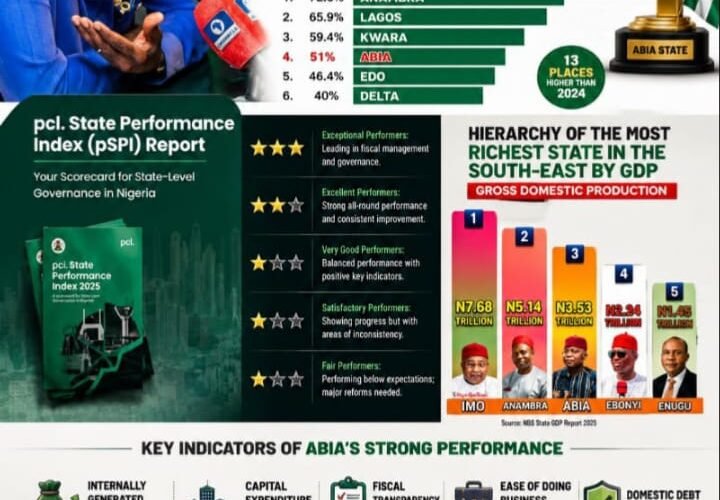
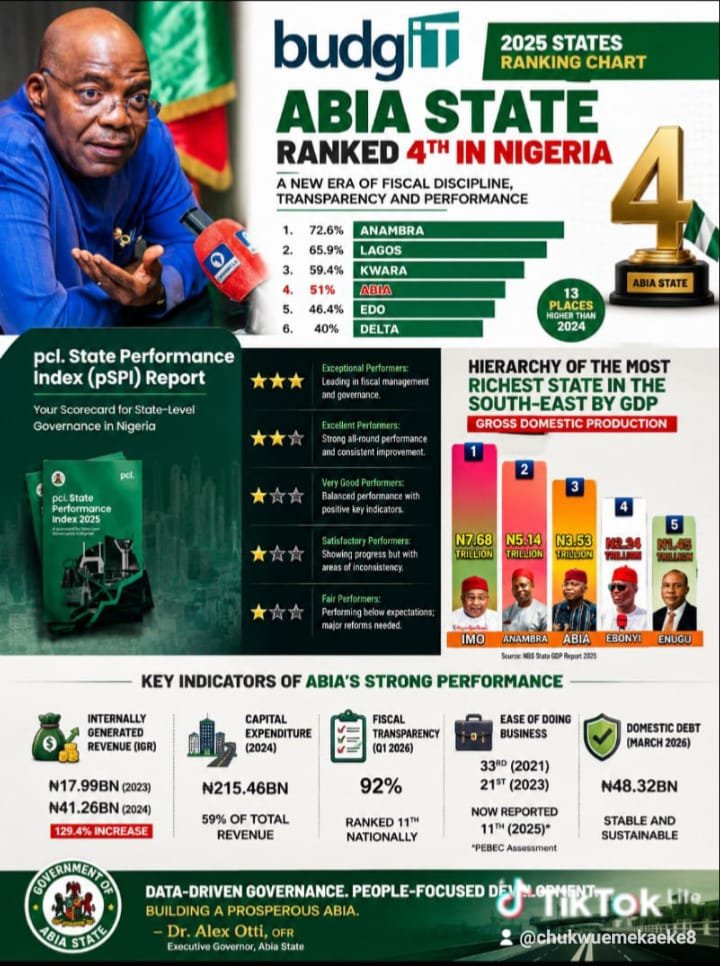
In the 2024 assessment, Abia was ranked 17th nationally in overall fiscal performance.
In the 2025 edition, Abia rose to 4th position.
That is a movement of 13 places in one assessment cycle.
This is significant because BudgIT does not rank states on political popularity, media visibility or the number of commissioning ceremonies conducted by a governor.
Its methodology examines fiscal sustainability, internally generated revenue, operating obligations, debt sustainability, expenditure structure and the capacity of states to finance development.
So this is not a popularity contest.
It is a fiscal-performance assessment.
BudgIT State of States:
BudgIT 2024 Report:
https://budgit.org/wp-content/uploads/2024/10/State-of-States-2024-.pdf
ABIA’S IGR MORE THAN DOUBLED
The internally generated revenue figures are equally striking.
BudgIT data indicate that Abia’s IGR increased from approximately ₦17.99 billion in 2023 to about ₦41.26 billion in 2024.
That represents an increase of approximately 129.4 percent in one year.
Put differently, Abia more than doubled its internally generated revenue within the period under review.
That matters because IGR provides an indication of a state’s capacity to generate resources internally rather than depend entirely on allocations from Abuja.
However, the data must be interpreted honestly.
Abia still receives substantially more from FAAC than it generates internally.
Therefore, the correct conclusion is not that Abia has become financially independent.
The correct conclusion is that its internal revenue capacity has improved dramatically, while the challenge of reducing dependence on federal allocations remains.
Source:
https://budgit.org/wp-content/uploads/2025/10/StateofStates2025SEIIWEB.pdf
CAPITAL EXPENDITURE: THE NUMBERS BEHIND THE INFRASTRUCTURE
The capital-expenditure figures help to explain why infrastructure has become so visible across the state.
BudgIT recorded actual capital expenditure of approximately ₦215.46 billion for Abia in 2024.
Total revenue, including grants, was approximately ₦362.83 billion.
Operating expenses were around ₦64.18 billion.
This means capital expenditure accounted for roughly 59 percent of total revenue including grants.
Even more revealing, actual capital expenditure was more than three times operating expenditure.
That is an important structural signal.
It suggests that a substantial proportion of the state’s resources was being directed towards capital projects rather than being consumed predominantly by recurrent expenditure.
The same broad figure is reflected in a World Bank-hosted Abia capital-expenditure dashboard, which records approximately ₦215 billion in actual capital expenditure.
A substantial component was directed towards roads and infrastructure.
World Bank-hosted Abia CAPEX Dashboard:
FISCAL TRANSPARENCY: 92 PERCENT
BudgIT’s Fiscal Transparency League provides another important independent measure.
In the Q1 2026 assessment, Abia scored 92 percent.
The state placed 11th nationally on the published table.
The index evaluates the availability and accessibility of important fiscal documents, including proposed budgets, approved budgets, budget implementation reports and other public-finance information.
Abia performed strongly in several components.
It did not, however, achieve the maximum available score in e-procurement.
That is exactly why independent assessments are valuable.
They do not simply praise.
They also expose areas requiring improvement.
The 92 percent score therefore represents strong progress in fiscal disclosure while simultaneously showing that e-procurement can still be strengthened.
BudgIT Fiscal Transparency League:
THE BUSINESS ENVIRONMENT
The business environment tells another important story.
UNDP reported that Abia moved from 33rd position, with a score of 4.48 in 2021, to 21st position with a score of 5.59 in the 2023 PEBEC Subnational Ease of Doing Business assessment.
That represents an improvement of 12 positions.
The score itself increased by approximately 25 percent.
UNDP also reported interventions relating to investment promotion, tax administration and revenue mobilisation.
There is, however, an important scientific qualification.
Governor Alex Otti assumed office in May 2023.
It would therefore be statistically incorrect to attribute the entire improvement between 2021 and 2023 exclusively to his administration.
The 2023 result is better treated as a transition benchmark against which subsequent performance can be measured.
UNDP Report:
FROM 32ND TO 11TH: THE MORE RECENT BUSINESS-REFORM CLAIM
A Federal Ministry of Information report published in 2026 cited Abia officials as stating that the state had moved from 32nd to 11th position nationally in Ease of Doing Business.
That would represent a considerable improvement.
However, intellectual honesty requires that the evidentiary status of this figure be made clear.
The figure was reported as a statement from Abia officials.
It should therefore not automatically be treated with exactly the same evidentiary weight as an independently published BudgIT ranking until the corresponding PEBEC table is directly matched to it.
Federal Ministry of Information Report:
PEBEC Reports Portal:
WORLD BANK SABER: REFORMS THAT MUST MEET BENCHMARKS
The World Bank’s State Action on Business Enabling Reforms programme, known as SABER, is another useful reference point.
SABER is performance-based.
States are expected to meet specified eligibility conditions and Disbursement Linked Indicators in areas such as land administration, taxation, investment regulation, public-private partnerships and business-enabling reforms.
This distinction is important.
Participation is not simply a certificate handed to a governor.
Specific benchmarks have to be met.
Abia has been reported as qualifying under relevant performance conditions.
That should not be presented as a World Bank “rating of Governor Otti.”
But it does represent evidence that the state is participating in an internationally supported reform framework built around measurable outcomes.
World Bank SABER:
PEBEC SABER:
WHAT DOES THE DEBT DATA SAY?
Debt sustainability is particularly important.
A government can create an impressive appearance of development by borrowing excessively.
That is why the Debt Management Office figures deserve attention.
Abia’s domestic debt stood at approximately ₦48.32 billion as of March 2026.
It had been approximately ₦48.58 billion in June 2025 and approximately ₦48.50 billion in September 2025.
The domestic debt stock therefore remained broadly stable and declined slightly over the period.
That does not mean Abia has no debt.
It does.
There are also external obligations.
But the available DMO data do not show an explosive increase in domestic borrowing occurring alongside the increase in capital expenditure.
That is an important distinction.
DMO March 2026 Domestic Debt Data:
DMO Subnational Debt Database:
THE MOST IMPORTANT FINDING IS CONVERGENCE
Taken individually, every one of these indicators can be debated.
Taken together, however, they become considerably more powerful.
BudgIT places Abia 4th nationally in fiscal performance.
BudgIT’s Fiscal Transparency League gives Abia 92 percent.
Internally generated revenue increased from approximately ₦17.99 billion to ₦41.26 billion.
Capital expenditure exceeded ₦215 billion.
UNDP records improvement in the business environment.
PEBEC-linked reforms point towards continuing institutional changes.
World Bank-supported reform programmes provide measurable benchmarks.
DMO figures show domestic debt remaining broadly stable.
These organisations are not measuring exactly the same thing.
They use different methodologies.
They examine different aspects of governance.
And that is precisely why their convergence matters.
THIS IS WHAT STATISTICAL EVIDENCE LOOKS LIKE
In empirical analysis, confidence in a proposition becomes stronger when different indicators generated independently begin pointing broadly in the same direction.
No single ranking can prove that every Abia government contract is properly priced.
No fiscal index can prove that every road is perfectly constructed.
No business ranking can establish that every investor is satisfied.
And no debt figure can prove that every expenditure decision is optimal.
But neither can one disputed contract, one accounting entry or one failed project logically invalidate every independently measured improvement across an entire state.
That would be statistically indefensible.
THE PROPER CONCLUSION
The evidence does not establish that Abia is perfect.
It establishes something more useful.
It suggests that measurable improvements are occurring across several important fiscal and institutional indicators.
There are still weaknesses.
E-procurement can improve.
IGR must continue growing.
Dependence on FAAC remains significant.
Public expenditure must continue to face scrutiny.
Individual contracts must remain open to interrogation.
And government should explain genuine accounting anomalies whenever they arise.
But these weaknesses do not erase the broader data.
NUMBERS, NOT NOISE
That is why the debate over Abia should increasingly be driven by evidence.
If critics question a particular expenditure, let the procurement records answer them.
If government claims increased revenue, let audited accounts verify it.
If government says debt is under control, let DMO figures establish it.
If government claims improved fiscal performance, let independent organisations such as BudgIT measure it.
That is how mature public debate should work.
The most compelling part of the emerging Abia story is therefore not that the government says it is improving.
Governments normally say that.
The important development is that several external institutions are beginning to record measurable improvements as well.
That changes the quality of the argument.
Because once performance can be independently measured, governance moves beyond propaganda and counter-propaganda.
It becomes testable.
It becomes comparable.
It becomes empirical.
And ultimately, it becomes a question of evidence.
Not propaganda.
Not applause.
DATA.