
ABIA CAPITAL EXPENDITURE: PUTTING ₦707 BILLION IN CONTEXT
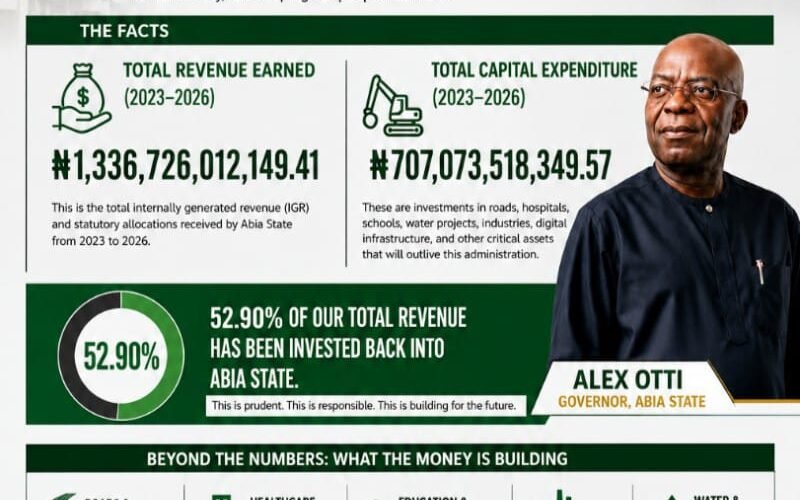
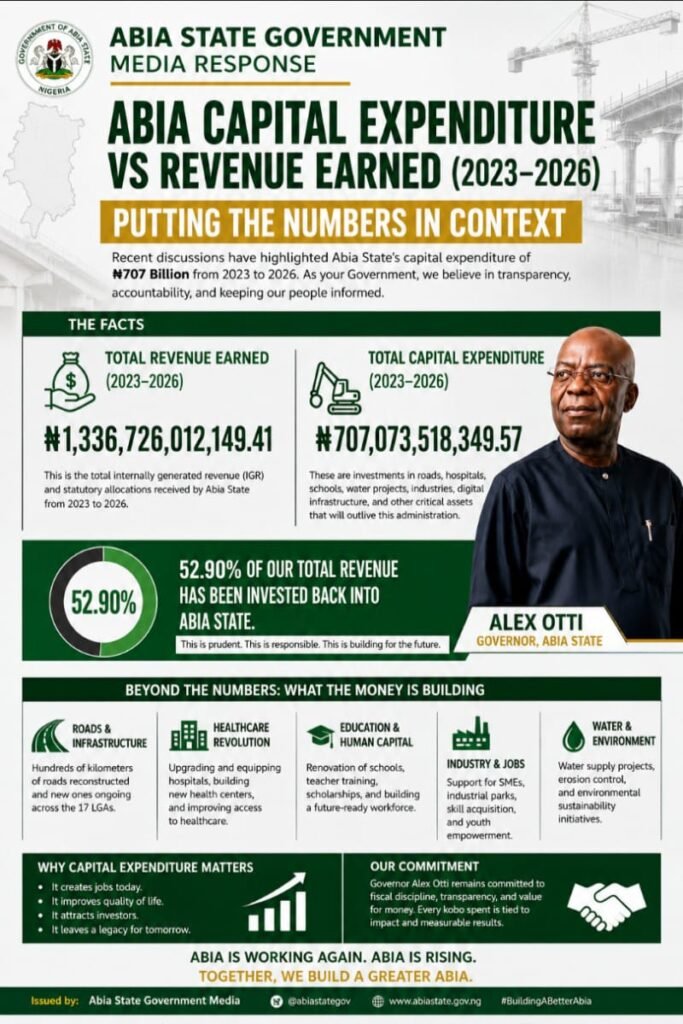
Recent public commentary has focused on the claim that Abia State recorded approximately ₦707.07 billion in capital expenditure between 2023 and 2026 out of total reported revenue of about ₦1.337 trillion. The figures deserve scrutiny, but they also deserve context. Public finance should not be reduced to a dramatic headline without asking the most important question: what was the money used to build?
Capital expenditure is fundamentally different from recurrent expenditure. It is money committed to assets and infrastructure whose benefits are expected to extend beyond the year in which the expenditure is made. Roads, bridges, schools, hospitals, water schemes, public buildings, equipment, urban renewal projects and other productive infrastructure ordinarily fall within this category.
If approximately 52.9 per cent of total revenue was committed to capital expenditure, the relevant public policy question is not simply whether the figure is large. The proper questions are whether the projects exist, whether they were properly procured, whether they represent value for money, whether they are geographically spread, and whether citizens are deriving measurable benefits from them.
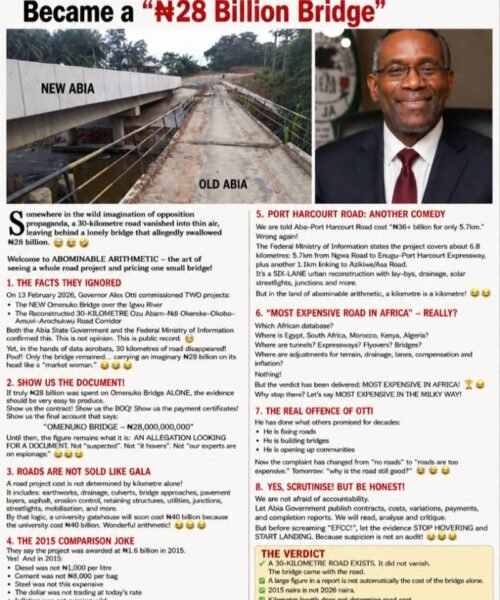
Abia State today presents numerous visible areas in which public expenditure can be interrogated. Roads are being reconstructed and rehabilitated across several parts of the state. Health facilities are being upgraded and equipped. Schools and other educational infrastructure are receiving attention. Urban renewal, water, drainage, erosion-control and public infrastructure projects also constitute legitimate areas of capital investment.
An opposition that wishes to perform its democratic role professionally should therefore move beyond throwing up a single aggregate figure. It should establish a project-monitoring mechanism, obtain budget and implementation documents, identify individual projects, visit project locations, compare contract sums with work done, assess quality and publish evidence-based findings. That is how serious opposition strengthens democracy.
There is nothing inherently scandalous about a government spending heavily on capital projects. Indeed, in a state that inherited substantial infrastructural deficits, a high capital-to-total-expenditure ratio may be desirable if the spending is efficiently executed and transparently accounted for.
The Abia State Government welcomes scrutiny. Accountability is strengthened when citizens ask questions. But scrutiny must be factual, balanced and connected to observable outcomes. A capital expenditure figure is not, by itself, evidence of waste, fraud or mismanagement.
The challenge before every stakeholder is therefore straightforward: follow the money to the projects, examine the projects and judge the government by measurable results.
Abia State Government remains committed to prudent public finance, transparency, infrastructure renewal and responsible investment in the future of the state.
Facts matter. Projects matter. Value for money matters.
Abia is working again. Abia is rising.