
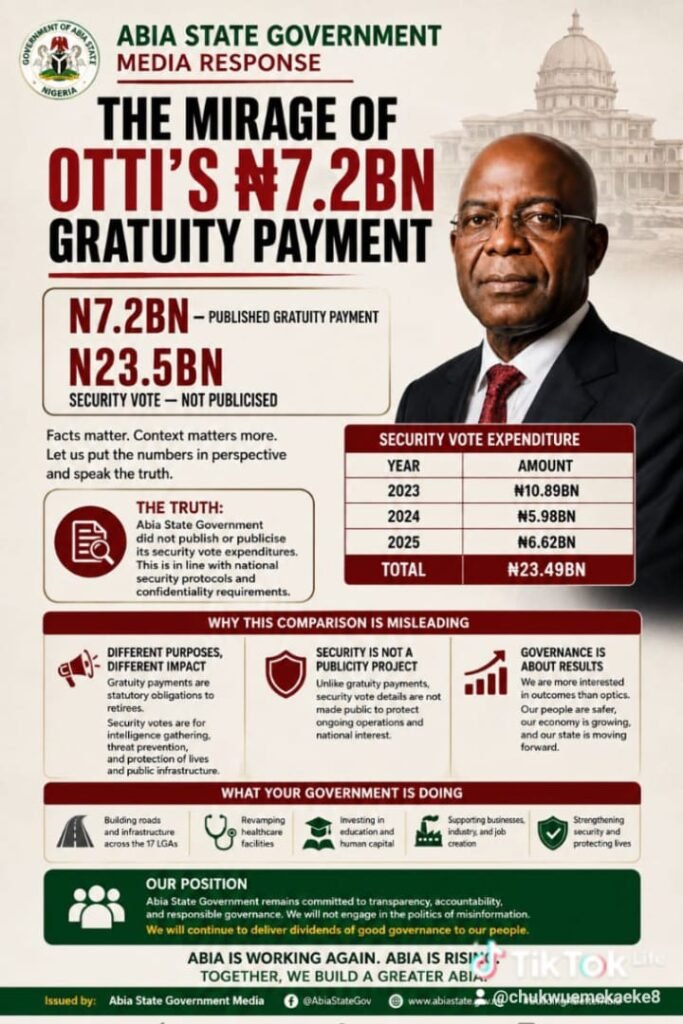
₦7.2 BILLION GRATUITY PAYMENT AND THE SECURITY-VOTE DEBATE: LET US COMPARE LIKE WITH LIKE
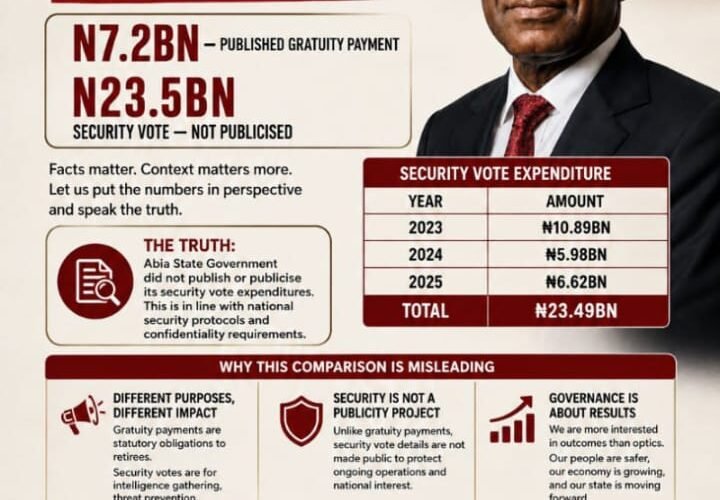
A recent graphic seeks to create controversy by placing the reported ₦7.2 billion gratuity payment beside alleged security-related expenditure of about ₦23.49 billion between 2023 and 2025. The comparison may make an attractive political poster, but it does not by itself amount to serious public-finance analysis.
Gratuity and security expenditure are fundamentally different obligations.
Gratuity is a statutory retirement benefit owed to qualifying former public servants. Its payment is rightly of immense public interest because pensioners deserve dignity after years of service. The Abia State Government acknowledges the burden inherited from years of accumulated pension and gratuity arrears and remains committed to progressively addressing those obligations within available resources.
Security expenditure, on the other hand, serves an entirely different purpose. It relates to the protection of lives and property, intelligence support, emergency response, logistics, security coordination and other interventions required to maintain public safety. Such expenditure cannot reasonably be analysed as though every naira allocated to security could simply have been transferred to gratuity payments without consequences.
The meaningful question is therefore not: Why spend on security when gratuity is outstanding? A responsible government must do both. It must protect the living, honour obligations to retirees, maintain hospitals and schools, build roads, pay salaries, support economic activity and keep government functioning.
Nor should the phrase “security vote” automatically be treated as synonymous with waste. Any allegation of impropriety should be supported with verifiable evidence. Public debate is strengthened when critics identify specific transactions, demonstrate breaches of appropriation or procurement rules, and present facts that can be independently examined.
At the same time, the government understands why citizens demand transparency around public expenditure. That demand is legitimate. The administration therefore welcomes informed scrutiny of budget documents, audited accounts and other legally disclosable financial records.
On gratuity, the important issue is continuity and sustainability. The accumulated liability was not created in one day and cannot responsibly be eliminated through publicity alone. What matters is the establishment of a credible payment framework, regular releases, accurate verification of beneficiaries and continued reduction of the inherited backlog while preventing new arrears from becoming another burden on future governments.
Those who genuinely care about pensioners should insist on measurable progress, not merely convert the suffering of elderly citizens into partisan ammunition.
Abia State Government will continue to balance competing obligations with fiscal responsibility. Security must be funded. Retirees must be paid. Infrastructure must be rebuilt. Workers must receive their salaries. Health and education must function. Development requires responsible choices across all these areas.
The administration remains open to criticism, but it also insists that public discourse should compare like with like and distinguish legitimate questions from misleading arithmetic.
Accountability is welcome. Misinformation is not.
Abia is working again. Abia is rising.