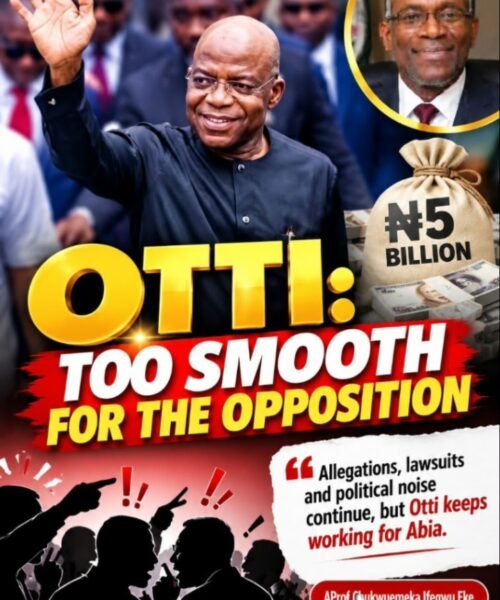



VANGUARD NEWSPAPERS AND THE ABSU CONTROVERSY: WHEN OWEI LAKEMFA’S POWERFUL HEADLINE OUTRAN THE FACTS, HISTORY AND ECONOMICS
At first, the title “ABSU: Running a University as a Local Village Contraption”, published by Vanguard Newspapers and written by Owei Lakemfa, seemed to promise a serious interrogation of university governance, funding, labour relations and institutional autonomy. It sounded like the beginning of a rigorous public-interest intervention. Unfortunately, as one travelled deeper into the piece, the thunder of the headline increasingly became louder than the economics, history and institutional context required to sustain it.
Mr Lakemfa is entitled to criticise Governor Alex Otti. The striking lecturers of Abia State University are equally entitled to demand every legitimate entitlement owed them. Professor Nnamdi Nwaeze is entitled to make arguments about the economic condition of university academics. Indeed, where salaries, promotion arrears, cooperative deductions or earned allowances are legitimately outstanding, those matters deserve resolution rather than propaganda.
But public commentary becomes defective when inheritance, current liability, university responsibility and state-government responsibility are poured into one political bucket and labelled “Otti.”
That is precisely where the Vanguard Newspapers column requires some elementary economic housekeeping.
Let us begin with history.
Governor Alex Otti did not create the financial crisis in Abia State University in May 2023. The Otti administration inherited a state system carrying enormous accumulated liabilities. The Abia Government has publicly acknowledged inherited salary arrears across state-owned tertiary institutions and has pursued a phased approach to dealing with legacy obligations.
That distinction is fundamental.
If an academic employee is owed, for example, 40 months of accumulated entitlements and the current administration has governed for only part of that period, an intellectually responsible analysis must decompose the 40 months. How many months arose under the previous administration? How many arose under the present government? Which components are salary arrears? Which are promotion differentials? Which are deductions? Which are allowances? Which obligations legally belong to the university? Which require direct intervention by the Visitor or state government?
That is basic attribution.
Economists call this avoiding a stock-flow confusion. Political writers may call everything “what government owes.” But serious analysis must distinguish the inherited stock of liabilities from the flow of obligations generated under the incumbent administration.
Ironically, this distinction ought to be particularly obvious in an article built substantially around economic comparisons.
Professor Nwaeze’s comparison between the income of a lecturer and that of a commercial tricycle operator is emotionally powerful, but it is not a complete labour-market analysis. The Vanguard Newspapers article reports the claim that a tricycle operator earning ₦15,000 daily makes more than some lecturers receiving ₦400,000 monthly. But revenue is not necessarily income. A proper comparison would deduct fuel, maintenance, union levies, depreciation of the vehicle, financing costs, repairs and days not worked. Likewise, comparing the salary of a university lecturer to the remuneration of an elected legislator does not establish the appropriate wage of either occupation. Different labour markets, tenure structures, allowances and institutional frameworks are involved.
This does not mean lecturers are adequately paid. Nigerian academics have a compelling case for substantially improved remuneration. It means only that rhetorical arithmetic should not masquerade as economic proof.
And if we are going to invoke economics, perhaps we should also remember the economist presently occupying Government House, Umuahia.
Alex Otti is not an accidental visitor to intellectual discourse. He graduated from the University of Port Harcourt with a First Class Honours degree in Economics. He subsequently pursued postgraduate and executive education and built a distinguished banking career, rising to become Group Managing Director and Chief Executive Officer of Diamond Bank.
Why does that antecedent matter?
Not because possessing a First Class degree makes a governor infallible. It certainly does not. It matters because Lakemfa’s portrait almost invites the reader to imagine an administration intellectually hostile to education and incapable of appreciating academic value. The historical record makes that caricature difficult to sustain.
Here is a man whose own social mobility was substantially built on education, economics, professional training and institutional excellence. The relevant question, therefore, should not be whether Alex Otti understands the value of education. There is overwhelming biographical evidence that he does. The more serious question is whether the fiscal and institutional mechanisms being deployed to rescue ABSU are adequate, sufficiently fast and fairly communicated.
That would have been the intellectually interesting article.
The evidence of policy priority also deserves examination. The Otti administration has consistently placed education among the largest components of Abia State’s annual budgets and has publicly committed about one-fifth of the state’s budgetary framework to education. The administration has also pursued teacher recruitment, school rehabilitation and wider reforms across the education sector.
One may criticise execution. One may argue that ABSU deserves more. One may question the speed of implementation. But it becomes analytically reckless to move from “ABSU has unresolved labour obligations” to an insinuation that the Otti administration places little value on education.
The data require a more nuanced conclusion.
There is another logical problem in the Vanguard Newspapers article.
Lakemfa reports that the ABSU Vice-Chancellor stated during the university’s combined convocation that Governor Otti had cleared backlogs left by previous administrations, and then argues that lecturers should have contradicted that statement earlier. Fair enough. But once there are competing claims regarding what has been cleared and what remains outstanding, the journalist’s next duty is reconciliation of the accounts.
What precisely was paid?
What remains unpaid?
What period does each outstanding liability cover?
What was inherited?
What accumulated after May 29, 2023?
What amount has the state released to ABSU?
What amount has ABSU received as internally generated revenue?
What is the university’s monthly wage bill?
What is the monthly state subvention?
How much of the claimed cooperative deductions accumulated under which administration?
Those are the numbers that would transform an angry column into an investigation.
Instead, conclusions arrived before reconciliation.
Even the article itself acknowledges an important fact that complicates its narrative: some of the demands predate the Otti government. The union may legitimately argue that government is continuous and that an incumbent administration must ultimately address inherited obligations.
That is correct.
But “government is continuous” does not mean history is irrelevant.
A successor government may inherit a debt, but an analyst cannot honestly describe the inherited debt as though the successor originally created it. If a new bank management inherits a non-performing loan portfolio, the bank remains liable for resolving the problem, but any competent financial analyst still separates legacy exposures from loans originated by the new management.
That distinction is not propaganda.
It is accounting.
The reported April 2026 approval of some demands by Governor Otti also deserves serious attention. If government approved particular obligations and implementation has been delayed, workers are entitled to demand a timetable and explanation.
But responsible analysis must still determine what “approval” meant administratively. Was it immediate cash payment? Phased implementation? Verification before payment? Budgetary incorporation? A directive to university management? These distinctions are central to public finance.
Then there is the issue of Professor Nwaeze’s suspension.
I would not defend the suppression of legitimate academic criticism. Universities must remain environments in which evidence can confront authority. If Professor Nwaeze was suspended solely because he respectfully criticised government policy, then ABSU authorities owe the academic community a convincing explanation consistent with due process, university law and academic freedom.
But it is equally improper for a columnist to jump from disputing an administrative decision to describing an entire university leadership as an “Okeudo gang”, a “village contraption” and people in “academic gowns” as “clowns.”
Those are colourful expressions.
Colour is not evidence.
You cannot preach institutional civility while dispensing personalised contempt.
You cannot demand procedural justice while conducting a newspaper trial in which motive, guilt and institutional incompetence have already been decided.
And you certainly cannot complain about allegedly “uncomplimentary” language from one side while normalising even more demeaning language from the other.
Universities deserve better than that.
The Otti administration should settle every verified obligation legitimately due to ABSU workers. It should explain disputed figures transparently. It should ensure that agreements reached with organised labour are implemented within clearly communicated timelines. ABSU management should equally observe due process, protect academic freedom and avoid actions capable of converting an industrial dispute into a free-speech confrontation.
But fairness imposes obligations on commentators too.
Mr Lakemfa should return to the evidence.
He should disaggregate the arrears.
He should distinguish Otti-era liabilities from liabilities inherited from previous administrations.
He should examine the financial structure of ABSU.
He should interrogate its internally generated revenue.
He should establish how much the present administration has actually released.
He should compare budgeted expenditure with actual expenditure.
He should reconcile the claims of ASUU, ABSU management and the Abia State Government.
Then he can reach a conclusion.
That is how economics works.
That is how investigative journalism works.
That is how history works.
And that, with respect, is how Vanguard Newspapers should interrogate an administration led by a man whose intellectual and professional antecedents deserve to be assessed with facts rather than caricature.
Alex Otti’s First Class degree does not place him beyond criticism. His banking record does not absolve his government of present responsibilities. His substantial education allocations do not automatically resolve ABSU’s problems.
But those facts do destroy the lazy theory that Abia is being governed by people who neither understand nor value education.
The more defensible conclusion is far less sensational: ABSU is carrying deep structural and inherited problems; the Otti administration has undertaken substantial education-sector commitments while still facing unresolved university labour liabilities; the lecturers have genuine grievances deserving urgent attention; and university management must exercise greater wisdom in handling dissent.
That story is complicated.
But truth is often complicated.
A headline describing a university as a “local village contraption” may generate applause.
It does not relieve the writer of the obligation to do the accounting.
And when the accounting is eventually done, history may prove considerably less hostile to Alex Otti than Owei Lakemfa’s Vanguard Newspapers column would have its readers believe.