
ADELEKE’S OSUN, OTTI’S CONGRATULATORY MESSAGE AND THE 2027 ABIA QUESTION: WHEN DEVELOPMENT, WELFARE AND ELECTORAL LEGITIMACY MEET
Osun as a Contemporary Governance Laboratory
The re-election of Governor Ademola Adeleke in Osun State on 16 August 2026 offers more than a conventional electoral story. It provides a useful case study of how welfare intervention, infrastructure delivery, fiscal management and political communication can combine to shape voter judgment. Adeleke, contesting on the platform of the Accord Party, was declared winner by INEC after securing 19 of Osun’s 30 local government areas. His victory gave him a second term after a campaign conducted against the background of intense scrutiny of his first four years in office.
The significance of that result lies partly in the fact that Adeleke entered office in 2022 burdened by a state with accumulated salary and pension liabilities, infrastructural deficits, public-sector morale problems and a relatively weak fiscal base. His administration chose to make worker welfare and the settlement of inherited liabilities central elements of its political economy. That approach became one of the clearest defining features of his tenure.
The Osun experience should therefore not be reduced to dancing, political theatre or personality. Beneath the public image was a deliberate attempt to build a constituency around the proposition that government must be seen to repair immediate household welfare while simultaneously investing in visible development.
That combination appears to have mattered electorally.
The Welfare Question: Adeleke and the Politics of Restoring Household Income
Perhaps Adeleke’s most politically consequential intervention was his approach to workers and pensioners.
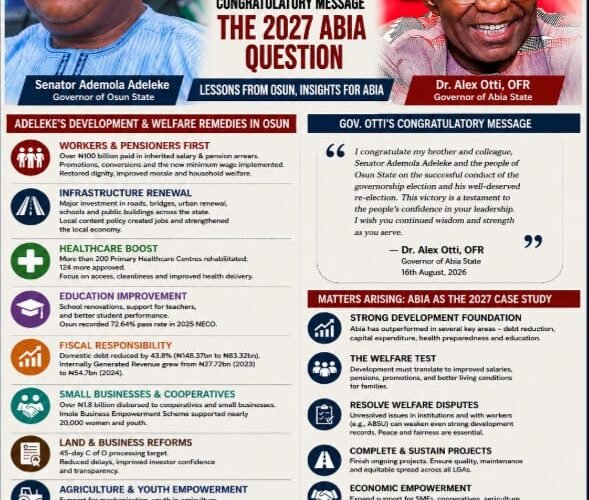
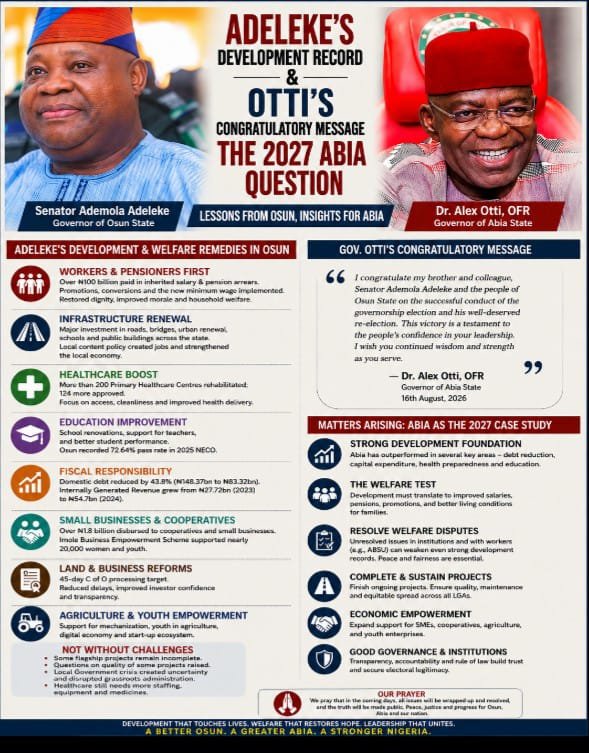
When he took office, Osun had accumulated substantial unpaid salary and pension obligations. Adeleke subsequently made the repayment of inherited salary arrears, pension liabilities and promotion-related obligations a major policy objective. By November 2025, his administration publicly claimed that almost ₦100 billion had been committed to inherited pension and salary arrears. It also said that promotions previously granted without financial backing were being cash-backed and that delayed conversions and career progressions were being addressed.
This was not merely a government talking point. At the 2025 Workers’ Day celebration, the Osun State chairman of the Nigeria Labour Congress publicly commended the administration for salary and promotion arrears payments and for implementing the new minimum wage.
The political significance is easy to underestimate.
When a government pays an inherited road contractor, the benefit may eventually reach the public. When it pays salary arrears, however, the effect enters thousands of households immediately. School fees are paid. Debts are reduced. Food consumption improves. Small businesses receive patronage. Pensioners recover purchasing power. The policy therefore produces both a welfare effect and a local multiplier effect.
This is one reason Adeleke’s welfare strategy deserves serious study.
It converted what might ordinarily have been dismissed as inherited liabilities into a contemporary political asset.
Instead of repeatedly saying, “I did not create this debt,” the administration substantially accepted that continuity of government meant that old liabilities had become present responsibilities.
That distinction may have contributed to Adeleke’s political resilience.
Minimum Wage, Promotions and the Psychology of the Public Service
The administration’s welfare programme extended beyond historical salary arrears.
Promotion exercises were conducted and financial backing attached to career advancement. The administration also implemented the new minimum wage. By 2026, further promotion examinations and recruitment exercises had been approved, including efforts to strengthen staffing in public schools.
This matters because public-sector reform is not only about the nominal wage.
Workers evaluate government through a broader set of expectations: whether salaries arrive regularly, whether promotion translates into higher pay, whether pension deductions are remitted, whether retirees are treated with dignity and whether the civil service feels secure enough to plan household expenditure.
A government that repairs those institutional expectations creates a powerful political constituency even before the first bridge is commissioned.
That appears to have been one of Adeleke’s strongest achievements.
Infrastructure as a Second Pillar
Adeleke did not rely exclusively on welfare.
His administration launched major infrastructure programmes covering roads, bridges, schools, health facilities and urban renewal. An independent pre-election assessment by PREMIUM TIMES concluded that infrastructure was one of the stronger areas of the administration, while also noting that several flagship projects remained incomplete and that questions had arisen about the quality of some projects, including controversy surrounding the LAMECO flyover.
The government’s own development philosophy placed considerable emphasis on local content. Adeleke argued that local contractors, engineers, artisans and locally sourced construction materials should benefit from public works. The administration described this as an “Osun first” approach designed to ensure that infrastructure expenditure circulated within the local economy.
The economic logic is important.
A road project can be approached merely as physical construction.
Or it can be treated simultaneously as employment policy, SME support, local procurement strategy and infrastructure investment.
The Adeleke model attempted the second approach.
That does not mean every contract was efficient or every project flawless. PREMIUM TIMES documented criticisms concerning project quality and incomplete flagship schemes.
But the wider strategy connected visible development with local economic participation.
That is politically powerful because citizens do not experience infrastructure only when they drive on the completed road. They also experience it when their businesses supply materials, when their relatives find work on construction sites and when neighbourhood economic activity increases around the project.
Healthcare and the Primary-Care Strategy
Healthcare was another major component of Adeleke’s developmental programme.
The administration pursued rehabilitation of primary healthcare centres across Osun. According to the state government, more than 200 PHCs had been rehabilitated by late 2025, including structural improvements, water supply, sanitation, fencing, roofing and furnishing. A subsequent phase included a further allocation for the renovation of 124 primary healthcare facilities.
The strategy was rational from a development perspective.
Primary healthcare centres are the closest formal health institutions to many rural and low-income households. Strengthening them can reduce pressure on tertiary hospitals and improve maternal care, immunisation, malaria treatment and preventive health access.
Again, however, independent evaluation reveals the limits of infrastructure-centred measurement. Renovated buildings do not automatically solve shortages of doctors, nurses, medicines, diagnostic equipment or health insurance coverage. PREMIUM TIMES specifically identified those continuing weaknesses.
The deeper lesson is therefore not that Adeleke solved healthcare.
It is that his administration established a broad physical platform while the second-generation challenge remains staffing, equipment, financing and service quality.
Education: Improvement Without Perfection
Education presents a similarly mixed but important record.
Adeleke’s administration undertook school rehabilitation and education-sector investments. Osun recorded a 72.64 per cent pass rate in the 2025 NECO Senior Secondary School Certificate Examination, while the state also received recognition for education and human-capital competitiveness in January 2026.
Yet independent analysis found that Osun’s 2026 education allocation represented approximately 12 per cent of the state budget, below the 26 per cent benchmark often referenced in Nigerian education policy discussions. The state also spent 73.2 per cent of its 2025 education allocation.
This again demonstrates why governance analysis should avoid propaganda.
A government can record genuine improvement while still having substantial unfinished work.
Adeleke’s education story was therefore one of measurable progress, particularly in school interventions and examination outcomes, without evidence that the entire sector had been transformed.
That nuance matters when Osun is compared with Abia.
Small Business, Cooperatives and Grassroots Credit
One of the less glamorous but potentially more consequential elements of the Adeleke administration was its cooperative and small-business intervention.
The government reported that 401 ward-based cooperative societies received interest-free financing, with almost ₦800 million disbursed and more than 30,000 beneficiaries recorded. It also reported almost ₦1 billion in financing to more than 250 conventional cooperative unions and societies.
The administration further introduced the Imole Business Empowerment Scheme for women and young people across the local government areas. Government figures indicated that almost 20,000 beneficiaries received support through the initiative.
The political significance of such interventions is different from that of a flyover.
A flyover may dominate television footage.
A small-business loan enters the daily survival economy.
A cooperative loan can affect traders, farmers, artisans, transport operators and microenterprises.
Where such schemes are properly administered, they distribute the visibility of government much more widely than concentrated mega-projects.
That is an important lesson for any governor approaching re-election.
Fiscal Management: Adeleke Was Not Simply Spending
The Osun record also contains notable fiscal reforms.
Government data cited by independent reporting showed that Osun’s domestic debt fell from approximately ₦148.37 billion in December 2022 to ₦83.32 billion by March 2025, a reduction of roughly 43.8 per cent. External debt also declined over the same period.
Internally generated revenue increased sharply, from approximately ₦27.72 billion in 2023 to about ₦54.7 billion in 2024. That represented almost a doubling of internally generated revenue within one year.
The administration attributed that improvement to tax harmonisation, digitisation of revenue collection, stronger compliance and reforms designed to reduce leakages.
This is perhaps the most important corrective to the simplistic portrayal of Adeleke as merely a populist governor.
His administration combined welfare payments with debt reduction and revenue expansion.
That combination is considerably more sophisticated than indiscriminate spending.
Land Reform and the Business Environment
Adeleke also attempted to reform land administration.
The government introduced a target of processing Certificates of Occupancy within 45 days and argued that the reform reduced delays, duplicate allocations and forgery. The policy was linked to a wider digital-governance agenda and an effort to improve the environment for private investment and public-private partnerships.
Whether that reform ultimately generates sustained investment will require longer-term evidence.
But institutional reforms of this kind are important because they move development policy beyond roads and salaries into the less visible architecture that determines how easily businesses can acquire property rights and invest.
Agriculture, Technology and the Limits of the Record
Adeleke’s administration also promoted agricultural mechanisation, youth agriculture programmes, cooperative financing, ICT policy development, digital-economy reforms and the domestication of the Nigerian Startup Act.
However, agriculture is one area where independent assessment has been more cautious. PREMIUM TIMES concluded that government messaging appeared stronger than available evidence of economy-wide agricultural transformation.
This is useful because the Osun lesson should not become another form of political mythology.
Adeleke’s first term produced clear accomplishments, particularly in workers’ welfare, arrears reduction, infrastructure, revenue growth and debt management.
It also contained unresolved weaknesses.
The Local Government Crisis: Adeleke’s Most Serious Institutional Blemish
The administration’s record cannot be responsibly analysed without mentioning the prolonged local government crisis.
The political and legal confrontation over control of Osun’s 30 local councils contributed to violence, administrative uncertainty and disruption of local government financing. The dispute became entangled with the withholding of council allocations by the Federal Government. The Supreme Court subsequently struck out a suit filed by the state Attorney-General for lack of standing, while also criticising aspects of the withholding of allocations.
This was a major governance weakness.
It demonstrated that a government may perform strongly in welfare and infrastructure while simultaneously becoming embroiled in an institutional dispute capable of damaging grassroots administration.
That is one of the areas where Adeleke’s experience should be studied as a warning rather than imitated.
Why Adeleke Won Again
Adeleke’s victory cannot be scientifically attributed to one policy without detailed electoral modelling.
But there is a reasonable inference from the evidence.
Workers had experienced salary and promotion arrears payments.
Pensioners had seen substantial historical liabilities addressed.
Residents could identify road and infrastructure interventions.
Healthcare facilities had received rehabilitation.
Cooperatives and small businesses had received direct interventions.
Government revenue had risen considerably.
Debt had fallen.
Those developments existed alongside real controversies and incomplete projects, but they created a tangible record with which the incumbent could approach voters.
The result was an electoral victory in 19 of 30 local government areas and 511,067 votes according to the declared result.
The political lesson is not that voters reward every incumbent who builds roads.
It is that a combination of visible infrastructure and felt household welfare can become electorally formidable.
Otti’s Congratulatory Message: More Than Courtesy
Governor Alex Otti of Abia State promptly congratulated Adeleke following the Osun result.
In the message circulated on 16 August 2026, Otti congratulated Adeleke and the people of Osun on the peaceful electoral outcome and recognised the significance of the victory.
On the surface, this was normal gubernatorial courtesy.
At a deeper level, however, the congratulation carries an interesting political symbolism.
Here are two governors frequently mentioned in contemporary discussions of state-level governance. Both inherited difficult fiscal and institutional environments. Both have emphasised infrastructure. Both have undertaken debt reduction. Both have tried to strengthen internally generated revenue. Both have attempted to construct an image of governance based less on old party machines and more on performance.
Yet their approaches have not been identical.
And that brings us directly to Abia.
Abia as the 2027 Case Study
The Osun election raises a critical question for Abia ahead of 2027:
What exactly will voters use to judge Alex Otti?
The answer cannot simply be social-media popularity.
It cannot simply be the number of roads reconstructed.
It cannot simply be the weakness of the opposition.
Osun suggests that an incumbent seeking a renewed mandate benefits most when the electorate can connect macro-development statistics to their own household experience.
This is where Abia’s situation becomes particularly interesting.
Otti already enters the pre-2027 period with a substantial infrastructure narrative. His administration has invested heavily in road reconstruction, urban renewal, education, healthcare, power-sector development and fiscal restructuring. He has also repeatedly insisted that electoral politics will not distract his administration from continuing its governance programme.
Independent comparative analysis published in April 2026 actually found that Abia performed strongly against Osun in several measurable areas. According to the analysis, Abia recorded a larger percentage reduction in domestic debt, ranked higher in fiscal performance, committed a higher share of its budget to capital expenditure, ranked better in the referenced health preparedness index and maintained stronger educational performance indicators.
That means Abia does not enter 2027 from a position of developmental weakness.
The more interesting question is whether the achievements have been converted sufficiently into felt welfare.
The Infrastructure–Welfare Balance
This may be the single most important lesson Osun offers Abia.
Roads matter.
Hospitals matter.
Schools matter.
Electricity matters.
Urban renewal matters.
But elections are also fought inside kitchens.
They are fought through salary alerts.
They are fought through pension payments.
They are fought through promotion arrears.
They are fought through school fees.
They are fought through the cost of transportation.
They are fought through the ease with which traders obtain affordable credit.
They are fought through whether a lecturer, teacher, nurse, civil servant or retiree believes government has improved his or her material condition.
Adeleke combined infrastructure with aggressive settlement of worker and pension liabilities.
That gave his administration an important welfare narrative.
For Abia, therefore, the challenge before 2027 is not simply to commission more projects.
It is to ensure that the developmental transformation becomes visible in household welfare.
ABSU and the Wider Welfare Question
This is where the current ABSU dispute becomes politically relevant beyond the university gates.
Whether or not Governor Otti personally bears responsibility for specific university-management decisions, an unresolved dispute with academic staff can create a narrative fundamentally different from the broader developmental record.
Political opponents do not require the entirety of government performance to be poor.
They require one emotionally resonant contradiction.
A government may construct roads while being portrayed as insensitive to lecturers.
It may rehabilitate hospitals while pension grievances circulate.
It may improve fiscal performance while public servants complain about allowances or promotions.
Whether those narratives are accurate is another matter.
Politically, however, unresolved welfare disputes create ammunition.
Osun demonstrates that removing such ammunition through negotiated welfare settlements can generate powerful political returns.
Inherited Liabilities and the Politics of Ownership
There is another important comparison.
Both Adeleke and Otti inherited liabilities.
Adeleke aggressively converted payment of inherited liabilities into a political achievement.
He did not merely emphasise who created them.
He emphasised who was clearing them.
That is a sophisticated political-economy strategy.
For Abia, inherited obligations in institutions, pensions and public-sector remuneration can similarly be framed in two ways.
The first is defensive:
“We did not create these liabilities.”
The second is transformative:
“We inherited them, verified them, paid them and closed the chapter.”
The second narrative is much stronger electorally.
Voters usually care less about the accounting origin of a debt than about the government that eventually puts the money into their account.
Adeleke’s Re-election Also Shows That Party Labels Can Become Secondary
Adeleke won his first term as a PDP candidate.
He contested the 2026 election on the Accord Party platform and still won.
That is politically significant.
It suggests that under certain conditions, an incumbent’s personal political brand and performance coalition can become stronger than the political party label under which the administration originally emerged.
That has obvious implications for Abia.
The 2027 Abia election may ultimately involve complex party alignments, defections and national political calculations.
But Osun demonstrates that an incumbent who has built a sufficiently resilient personal performance constituency may survive major shifts in partisan architecture.
That is not a prediction about Abia.
It is a lesson from Osun.
The Opposition’s Real Challenge in Abia
For opposition parties in Abia, the Osun experience also provides a warning.
Simply repeating that an incumbent has failed is unlikely to be enough where citizens can physically identify projects and institutional changes.
A credible opposition must interrogate outcomes rather than merely deny visible development.
It would have to ask whether road spending delivers value for money, whether rural areas receive equitable attention, whether healthcare staffing matches infrastructure, whether education expenditure translates into learning outcomes, whether public-sector welfare has improved and whether state finances remain sustainable.
In other words, 2027 is likely to reward evidence more than slogans.
That standard should apply both to the government and its critics.
The Central Matter Arising for Otti
Otti’s greatest opportunity going into 2027 may also be his greatest vulnerability.
His administration possesses a strong infrastructure and reform story.
The challenge is completing the social contract.
If visible development is accompanied by rapid resolution of workers’ grievances, pension obligations, university disputes, promotion entitlements, rural infrastructure deficits and small-business financing needs, Abia could approach 2027 with a development-plus-welfare narrative comparable to the coalition Adeleke constructed in Osun.
If those welfare questions remain unresolved, opponents may try to frame the administration as a government of impressive concrete structures but insufficient attention to household pressures.
Whether that characterisation would be fair is less important politically than whether enough citizens believe it.
The Osun Lesson for Abia
The deepest lesson from Adeleke’s victory is therefore not simply that good governance wins elections.
Politics is rarely that mechanical.
The deeper lesson is that development becomes electorally powerful when citizens can see it, feel it and trace it to their own lives.
A bridge can be seen.
A salary arrear can be felt.
A hospital can be seen.
A pension payment can be felt.
A school rehabilitation can be seen.
A promotion adjustment can be felt.
A new road can be seen.
A cooperative loan can be felt.
The politically formidable administration is the one that produces both experiences simultaneously.
The Final 2027 Question
Governor Otti’s congratulatory message to Adeleke was therefore fitting.
Adeleke has just secured another mandate after presenting Osun voters with a record built substantially around infrastructure, welfare intervention and fiscal reforms. Otti himself heads an administration that independent comparisons have rated strongly in areas including domestic debt reduction, capital investment, health preparedness and education.
The emerging question for Abia is not whether Otti can point to development.
He can.
The question is whether, between now and 2027, development will become sufficiently integrated with welfare that the ordinary Abian experiences government not only through reconstructed roads, hospitals, schools and public infrastructure but also through improved personal economic security.
Osun has just demonstrated the political potency of that combination.
And therein lies the real matter arising for Abia.
Infrastructure creates evidence of government. Welfare creates emotional ownership of government.
When both are delivered together, re-election politics becomes much more difficult for an opposition to reduce to propaganda.
The road to 2027 in Abia may therefore be decided less by the volume of political noise than by a simpler question:
By the time Abians return to the ballot box, how many can point to something government built—and how many can say, with equal conviction, that government materially improved their own lives?