
ABSU, ASUU-ABSU AND THE OTTI QUESTION: WHO REALLY CREATED THE CRISIS AT UTURU?
An investigative examination of salary arrears, union claims, inherited liabilities, university finances and the suspension controversy now being placed at Governor Alex Otti’s doorstep
There is a seductive simplicity to the story presently being told about Abia State University, Uturu. Lecturers are unhappy. ASUU-ABSU has declared an indefinite strike. A professor has been suspended after criticising the remuneration and welfare of academics. Alex Otti is Governor and Visitor to the university. Therefore, the argument goes, Alex Otti must be responsible for everything that is wrong at ABSU.
It is a politically convenient narrative.
It is also historically incomplete.
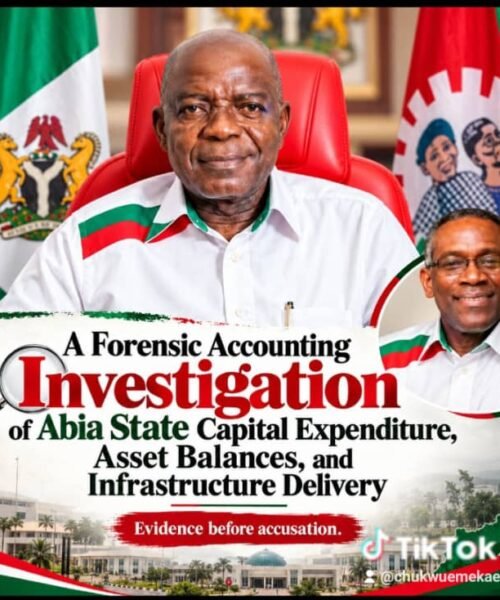
A deeper investigation into the financial history of Abia State University, the previous statements of its own Academic Staff Union of Universities branch, the university’s salary arrears, the institutional allocation of responsibility and what the Otti administration actually inherited tells a considerably more complicated story. It reveals an institution whose financial crisis did not begin with Alex Otti, salary debts that were already several years old when he took office, welfare obligations accumulated under previous administrations, deductions and promotion issues that involve university management structures, and a state government that subsequently committed billions of naira to liabilities it did not create.
That does not mean every present complaint by ABSU lecturers is false. Far from it. Some are serious and deserve urgent resolution. But an investigation must distinguish the existence of a grievance from responsibility for creating it. That distinction is being lost in the political noise surrounding ABSU.
And that is where the evidence becomes uncomfortable.
THE FIRST PIECE OF EVIDENCE: ASUU-ABSU SPOKE BEFORE OTTI BECAME GOVERNOR
To understand today’s crisis, one must return to July 2022.
Alex Otti was not Governor.
Okezie Ikpeazu was Governor.
And ABSU lecturers were already crying publicly about unpaid salaries and deteriorating welfare.
In a remarkable statement reported by Vanguard in July 2022, ASUU-ABSU complained that lecturers were owed salaries, that Earned Academic Allowances had remained unpaid since 2009, that there were issues involving cooperative and loan deductions, that pension arrangements were problematic and that the financial condition of lecturers had become desperate.
Read those dates again.
2009.
2021.
2022.
Otti assumed office only on 29 May 2023.
That chronology alone demolishes any attempt to portray the ABSU welfare crisis as something manufactured by the Otti administration.
Even more revealing is what ASUU-ABSU itself said at the time.
The union acknowledged in 2022 that the Abia State Government did not directly pay the salaries of ABSU workers. Its complaint was that government should release adequate and regular subvention to the university. The university, meanwhile, argued that it depended substantially on internally generated revenue, particularly student fees, to supplement government subvention and meet its obligations.
That historical statement matters enormously today.
It means that whenever somebody casually says, “Otti refuses to pay ABSU lecturers,” an investigator is entitled to ask: When did the institutional financing arrangement change? Who is technically the employer? Who processes the payroll? Who receives university revenue? Which obligations are those of the university management, which are those of its Governing Council and which require direct state-government intervention?
Those are not semantic questions.
They go to the heart of accountability.
THE SALARY CRISIS DID NOT BEGIN IN 2023
ABSU’s salary troubles run much deeper than the present political argument.
As far back as 2014, lecturers at the university were reported to have embarked on a warning strike over unpaid salaries.
By December 2020, when Professor Onyemachi Ogbulu assumed office as Vice-Chancellor, the university management itself said it inherited approximately nine months of salary arrears. Management later said it had attempted to reduce the backlog through accelerated salary payments.
By 2022, the disagreement between management and ASUU was no longer about whether arrears existed but about how many months were actually owed. ASUU said ten months. Management said five, insisting that it had inherited a far worse situation and had been trying to reduce it.
Whichever side was correct about the exact figure, one fact is beyond reasonable dispute:
ABSU was already financially distressed before Alex Otti entered Government House.
The institution did not suddenly discover unpaid salaries, promotion problems, Earned Academic Allowances, pension difficulties and staff deductions on 29 May 2023.
They were waiting for him.
WHAT OTTI ACTUALLY INHERITED
By June and July 2024, the Otti administration publicly quantified the inherited salary liabilities across several state institutions.
The figures were extraordinary.
According to Abia’s Commissioner for Finance, the government initially calculated inherited salary arrears at about ₦16.5 billion. Following verification, the figure was subsequently put at approximately ₦17.63 billion across affected institutions and agencies.
ABSU alone was reported as carrying approximately 11 months of inherited salary arrears amounting to about ₦3.1 billion. ABSUTH had approximately 21 months; Abia State Polytechnic had 33 months; ASCETA had 22 months, while other education and health institutions also carried substantial backlogs.
This is one of the most important facts missing from much of the current debate.
Otti did not walk into an institution with a clean balance sheet and subsequently stop paying lecturers.
He walked into a state educational system containing billions of naira in accumulated salary liabilities.
In September 2024, the government announced a programme to liquidate approximately ₦17.63 billion in inherited arrears, committing roughly ₦1.5 billion monthly over twelve months toward the exercise. Punch reported the commencement of the programme and the government’s description of the liabilities as debts inherited from the preceding administration.
One may legitimately interrogate the implementation. One may demand documentary schedules of every tranche. One may ask who received what and when.
But it is intellectually impossible to transform an inherited ₦3.1 billion ABSU salary liability into evidence that Otti created that liability.
AND THEN SOMETHING IMPORTANT HAPPENED
By September 2025, ABSU’s Pro-Chancellor and Chairman of Governing Council, Rt. Hon. Agwu U. Agwu, publicly stated that the government had cleared the university’s inherited 11-month salary backlog. The Guardian reported the council chairman as saying that there were no longer arrears of workers’ salaries arising from that backlog.
That statement is significant for another reason.
There had been controversy in 2024 over whether the arrears had actually been cleared. ASUU-ABSU had publicly challenged earlier claims concerning the salary situation.
A responsible investigation therefore should not simply reproduce the government’s account and stop. It should ask ABSU management, ASUU-ABSU, the Accountant-General and relevant banks to reconcile month-by-month payment schedules.
But whatever the remaining accounting questions, the public record establishes that the Otti administration accepted liability for inherited debts, created a payment mechanism and committed billions of naira toward clearing them.
That is the opposite of creating the crisis.
THE 2026 STRIKE: WHAT EXACTLY DOES ASUU WANT?
This brings us to the current confrontation.
ASUU-ABSU’s demands reported in August 2026 include omitted salaries affecting some members; correct salary placement following promotions; financial benefits associated with promotions; eleven months of outstanding check-off dues; implementation of the 2025 salary arrangement; Earned Academic Allowances; Professorial Allowance; and the remittance of approximately ₦165 million reportedly deducted from salaries for the ASUU Cooperative Society.
Those are not trivial matters.
A lecturer who has earned promotion to professor should not indefinitely receive the remuneration of a lower rank. Money deducted for a cooperative should reach the cooperative. Earned allowances should be reconciled. Salary structures should be clear. Omitted staff should be treated promptly.
The lecturers deserve answers.
But here comes the investigative question that political commentary usually avoids:
Who is responsible for each item?
Promotion and staff placement ordinarily involve university administrative processes and governing structures.
Payroll omissions require payroll reconciliation.
Cooperative deductions raise questions about where the deducted funds were held, which institution deducted them, whose accounts received them and who was responsible for remitting them.
Earned Academic Allowances stretch back years nationally and locally.
Salary-structure implementation involves the wider relationship between state governments, governing councils and agreements negotiated within the Nigerian university system.
To dump every one of those separate liabilities into a political sack marked “Alex Otti” may be useful propaganda.
It is not forensic accounting.
THE ASUU-ABSU ADMISSION THAT CHANGES THE STORY
Perhaps the most damaging fact against the simplistic anti-Otti narrative came from ASUU-ABSU itself.
In reporting the August 2026 industrial action, The Guardian stated that ASUU-ABSU Chairperson Dr Chidi S. Mba acknowledged that some of the union’s outstanding demands existed before the Otti administration assumed office. His argument was that government is a continuum and that the present administration inherits both assets and liabilities.
That is a defensible constitutional and governance argument.
But notice what it concedes.
It concedes precisely what partisan narratives sometimes attempt to obscure:
Otti inherited significant portions of the problem.
The argument has therefore shifted from:
“Otti created this problem”
to:
“Otti inherited this problem and must finish resolving it.”
Those are two completely different accusations.
The second may be debated on its merits.
The first is contradicted by the historical record.
THE 2009 SALARY STRUCTURE QUESTION IS EVEN MORE REVEALING
ASUU-ABSU has complained that lecturers remained on an old salary framework while modern deductions and economic realities had overtaken their earnings. Reports surrounding the August strike say the branch complained about ABSU academics still being remunerated on an older structure.
That is a powerful welfare argument.
But the date again matters.
If a salary framework dating from 2009 persisted through successive governments, university councils and managements, it cannot reasonably be portrayed as a policy invented by a governor elected in 2023.
Otti may now have the responsibility to help correct it.
That does not make him its author.
There is a profound difference between inheritance and causation.
THE NATIONAL CONTEXT THE POLITICAL STORY OFTEN HIDES
ABSU is also not operating in isolation.
In August 2026 lecturers embarked on or threatened industrial action in universities in several states, including institutions in Imo, Ondo and Nasarawa, over implementation of salary agreements and various local welfare disputes.
ASUU’s National Executive Council also reportedly reviewed unresolved issues across numerous institutions.
Earlier in 2026, ASUU was simultaneously confronting the Federal Government over salary implementation, salary arrears, promotion arrears, Earned Academic Allowances, deductions and related matters in Nigerian universities generally.
This does not excuse any genuine failure at ABSU.
It does, however, demolish the suggestion that the present welfare agitation at Uturu proves some unique Otti hostility toward academics.
There is a national university remuneration crisis sitting behind the local controversy.
NOW TO PROFESSOR NNAMDI NWAEZE
Then came the combustible issue.
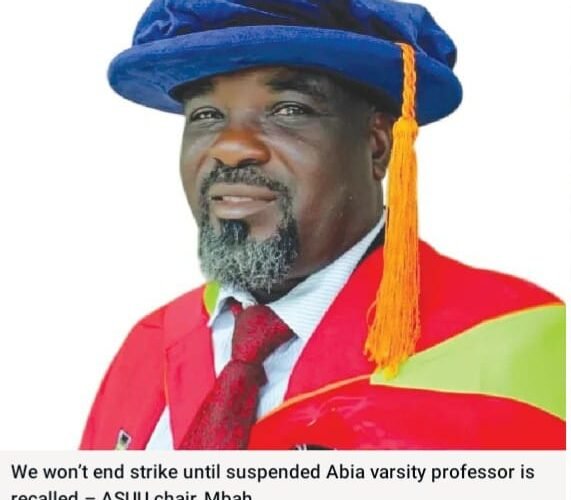
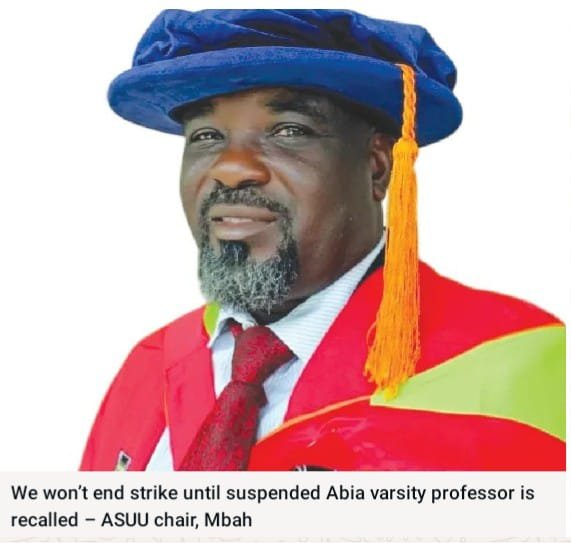
On 13 August 2026, reports emerged that ABSU had suspended Professor Nnamdi Nwaeze of the Department of Economics following social-media commentary in which he reportedly criticised remuneration and staff welfare and suggested that some tricycle operators earned more than professors at the university.
The university’s own statement reportedly said the posts were considered inimical to the interests of the university and “uncomplimentary” to its Visitor, and that an investigative panel had been constituted.
Here an investigative newspaper must resist propaganda from both sides.
The wording reportedly used by the university deserves scrutiny.
A professor should not ordinarily face professional sanction merely because his opinion is “uncomplimentary” to a political officeholder. Universities exist precisely because ideas—including uncomfortable ideas—must be capable of contestation.
If Professor Nwaeze made factual allegations that management believes are false, the appropriate answer should include the salary scale, documentary facts and a fair disciplinary process consistent with the university’s governing law and conditions of service.
But there is another crucial fact.
No credible evidence currently in the public record reviewed for this feature establishes that Governor Alex Otti personally ordered Professor Nwaeze’s suspension.
The announcement was made by Abia State University management and said that the university had constituted an investigative panel.
Being Visitor does not automatically mean every administrative decision emanates personally from the Governor.
Until somebody produces a directive, minute, letter, telephone record, instruction or other credible evidence linking Otti directly to the suspension decision, presenting the suspension as “Otti suspended a professor for criticising him” goes beyond the evidence currently available.
That distinction is elementary journalism.
ABSU HAD A SUSPENSION PROBLEM BEFORE OTTI
And there is another extraordinary historical fact.
In May 2022, more than a year before Otti became Governor, the National Industrial Court delivered judgment in a case involving a former ABSU lecturer, Onwuka Okereke, whose suspension and subsequent termination had been challenged.
The court criticised the manner in which the university’s disciplinary authority had been exercised, declared the suspension unlawful in the circumstances before it and ordered salary remedies. The judgment specifically warned against arbitrary exercise of disciplinary powers.
This does not determine Professor Nwaeze’s present case. The facts and procedures must be considered independently.
But historically it is devastating to the narrative that disciplinary controversy at ABSU somehow began with Alex Otti.
ABSU had already been judicially rebuked over a lecturer’s suspension before Otti entered office.
That is institutional history.
It should not be erased because an election is approaching.
THE REAL “DIRT” MAY BE THE SYSTEM ITSELF
The deepest dirt uncovered in this investigation is therefore less sensational than partisan social media might prefer.
It is structural.
For years ABSU appears to have operated a financially fragile model in which student-generated revenue was central to meeting recurrent obligations. In 2022, management openly described the university as substantially dependent on internally generated revenue to complement government subvention.
That arrangement creates an obvious vulnerability.
When enrolment suffers, fees are delayed or the university shuts during a nationwide strike, income falls while salaries continue accruing.
The result is predictable: arrears.
The same university then accumulates obligations for promotions, deductions, allowances and pension-related liabilities.
Eventually a new government arrives and inherits not simply a university but a warehouse of deferred financial obligations.
That appears substantially closer to the ABSU story than the convenient theory that one governor suddenly decided to impoverish professors.
WHAT ABOUT OTTI’S DIRECT INTERVENTIONS?
The record also contains developments that sit awkwardly beside claims that the present government is deliberately destroying ABSU.
The university’s medical training ecosystem had suffered serious accreditation difficulties before the Otti administration. ABSUTH and the medical programme subsequently regained crucial accreditation after interventions and upgrading under the new administration in late 2023.
ABSU itself reported a March 2025 visit by Otti during which further university infrastructure, including hostel development and rehabilitation, was discussed.
The Governing Council later publicly referred to the clearance of the inherited eleven-month salary backlog and outlined further recruitment and infrastructure ambitions for the institution.
None of those facts proves perfection.
They prove intervention.
SO, IS OTTI EXONERATED?
From creating the historic ABSU salary crisis, the evidence overwhelmingly points away from Otti.
The arrears existed before him.
ASUU complained about them before him.
Earned allowances were reportedly outstanding from as far back as 2009.
Salary disputes existed under previous governments.
ABSU management itself acknowledged inherited salary backlogs years before Otti’s inauguration.
The Otti administration then quantified inherited liabilities running into billions and established a programme to liquidate them.
From the claim that Otti personally suspended Professor Nwaeze, the evidence presently available also fails to establish that accusation. The publicly reported action is an ABSU management decision pending investigation.
But from responsibility for helping resolve today’s remaining ABSU problems, no Governor who serves as Visitor can simply walk away.
That would be equally dishonest.
Government is indeed continuous, as ASUU correctly argues. Otti inherited liabilities he did not create, but once inherited, they became governance problems requiring resolution.
The distinction therefore should be brutally clear:
Otti can be held responsible for how quickly and effectively he resolves inherited ABSU problems. He cannot honestly be held responsible for originating problems that documentary history shows existed years before he became Governor.
SEVEN QUESTIONS ASUU-ABSU AND ABSU MANAGEMENT SHOULD NOW ANSWER
An authentic investigation should go one stage further.
ASUU-ABSU should publish a reconciled schedule showing every amount currently claimed, the period in which each liability arose, the administration under which it arose, the responsible paying authority and all payments received against it.
ABSU management should publish the corresponding payroll and deduction reconciliation.
For the approximately ₦165 million cooperative deduction alleged by ASUU, the public deserves to know when each deduction was made, who deducted it, into which account it entered and why it was allegedly not remitted.
For promotion arrears, the dates of promotion, approval and financial implementation should be disclosed.
For omitted salaries, the affected staff and months should be reconciled subject to reasonable privacy safeguards.
For the old salary structure, management and government should state precisely what has been approved, what remains unimplemented and its annual financial implications.
And regarding Professor Nwaeze, ABSU should state precisely which rule he is alleged to have breached, guarantee him fair hearing and explain why the reported wording “uncomplimentary to the Visitor” should constitute a disciplinary concern in a university environment.
That is what transparency looks like.
THE POLITICAL TRAP
There is a temptation, especially as 2027 approaches, to turn every industrial disagreement in Abia into a referendum on Alex Otti.
That would be intellectually lazy.
A university crisis spanning more than a decade cannot be compressed into a three-year political slogan.
If ASUU-ABSU wants the public completely on its side, it should resist the temptation to allow inherited liabilities, current entitlements, university-management failures and state-government obligations to be presented as one undifferentiated grievance.
If ABSU management wants credibility, it must become equally transparent and extraordinarily careful about academic freedom.
And if the Otti administration wants this controversy ended, it should put the numbers on the table.
Publish the money inherited.
Publish the money paid.
Publish what remains.
Publish the salary framework.
Reconcile every deduction.
Then let arithmetic replace propaganda.
THE VERDICT FROM THE DOCUMENTS
The documentary trail does not support the simplistic claim that Alex Otti came into office and created the misery of ABSU lecturers.
The opposite chronology is much stronger.
ABSU was sick before Otti.
Salary arrears preceded Otti.
Earned allowance disputes preceded Otti.
Problems with deductions preceded Otti.
Funding difficulties preceded Otti.
Industrial disputes preceded Otti.
Even a judicial controversy over the university’s handling of the suspension of an academic preceded Otti.
What Otti inherited was not a pristine university.
He inherited a financial and institutional rehabilitation project.
The evidence also indicates that his administration has spent substantial public resources confronting some of those inherited liabilities, including the multimillion- and multibillion-naira salary backlogs.
That does not place the Governor beyond criticism.
It places criticism within chronology.
ASUU has every right to fight for its members.
Professor Nwaeze has a right to fair process and a university environment in which critical thought is not casually equated with disloyalty.
ABSU management has a legitimate responsibility to maintain institutional standards.
The Abia Government has a responsibility to provide adequate support and help settle legitimate obligations.
But nobody has the right to rewrite history.
And history, inconveniently, has receipts.
The most serious charge that can presently be sustained against Otti is not that he created the ABSU crisis. The evidence shows he inherited much of it. The legitimate question is whether, having already cleared or attacked substantial inherited liabilities, his administration can now complete the repair fast enough to restore lasting industrial peace.
That is the investigation the public deserves.
Not propaganda.
Not conveniently truncated timelines.
Not political attribution by association.
Follow the dates. Follow the deductions. Follow the arrears. Follow the institutional responsibilities. And above all, follow the money.