
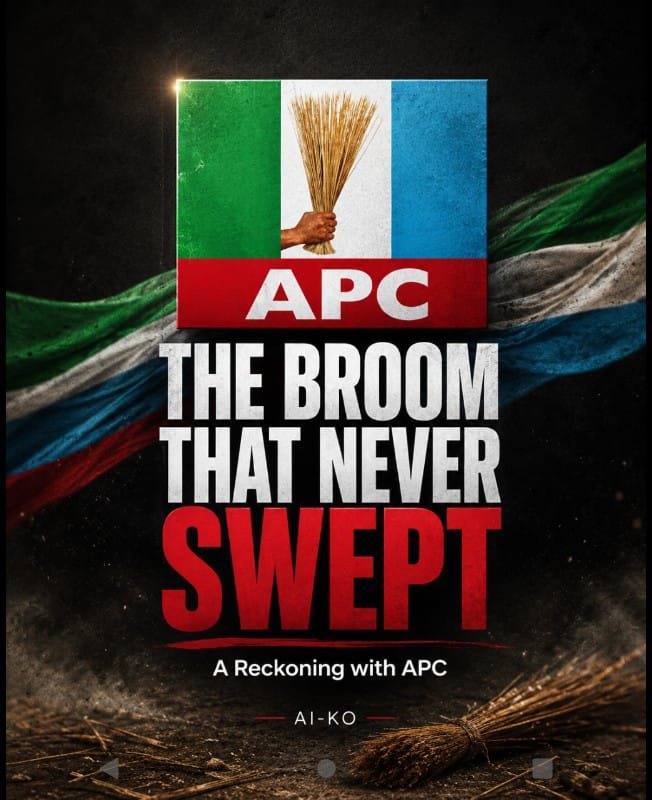
ACADEMIC REVIEW OF THE BROOM THAT NEVER SWEPT: A RECKONING WITH THE APC AND THE BIGGEST POLITICAL CON IN NIGERIA’S HISTORY
Author: Agbeze Ireke Kalu Onuma (AI-KO)
Reviewed by: AProf Chukwuemeka Ifegwu Eke
Introduction
Agbeze Ireke Kalu Onuma’s The Broom That Never Swept: A Reckoning with the APC and the Biggest Political Con in Nigeria’s History is a provocative work of political commentary, historical interpretation and governance criticism that interrogates the trajectory of Nigeria’s All Progressives Congress (APC) from its formation through its years in national power. Writing under the pen name AI-KO, Onuma presents himself as a Nigerian writer, analyst and public intellectual whose interests traverse political history, governance, security, theology and narrative nonfiction.
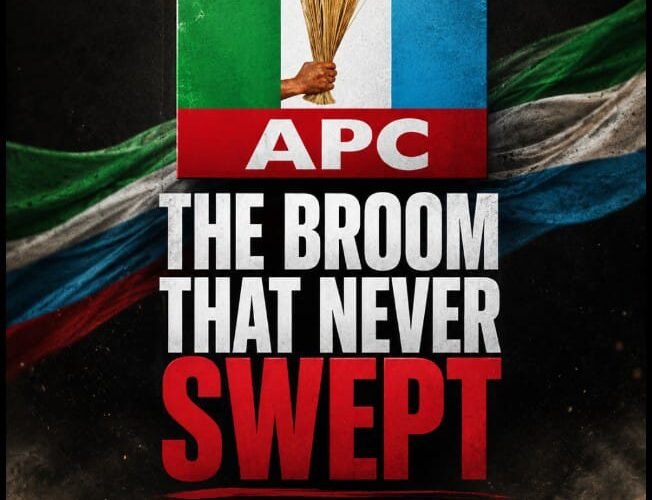
The title immediately discloses the argumentative character of the work. Onuma does not approach the APC as a neutral chronicler. Rather, he advances a clearly stated thesis: that the broom—the party’s defining political symbol—represented a promise of national cleansing that, in his assessment, remained substantially unfulfilled. The subtitle, which traces the movement “from the promise of Change to the arithmetic of ruin,” similarly establishes the author’s interpretative position from the outset.
From an academic standpoint, the significance of the work lies not simply in whether one accepts or rejects Onuma’s verdict on the APC. Its greater value lies in the questions it raises concerning political symbolism, electoral promises, governmental accountability, economic outcomes, democratic expectations and the widening distance that can emerge between campaign rhetoric and the lived experiences of citizens.
Conceptual Strength and the Metaphor of the Broom
The most compelling intellectual device in the essay is its sustained deployment of the broom as political metaphor. Onuma begins not in Abuja, at a party convention or at an election rally, but with the familiar domestic broom and its cultural meanings of cleanliness, purification, order and renewal. He subsequently connects these meanings to the political deployment of the broom during the mobilisation that preceded the 2015 general election.
This is an effective narrative strategy. The broom becomes simultaneously an object, a campaign symbol, a political promise and an analytical framework. The author’s central question—whether the broom “ever actually” swept—allows the essay to examine governance as a test of correspondence between symbolism and substantive outcomes.
Particularly noteworthy is Onuma’s distinction between a political symbol designed to win power and one whose meaning is validated through the use of power. His contention is that the APC successfully transformed the broom into an instrument of electoral mobilisation but failed, in his assessment, to make an equivalent transition from electoral machinery to transformative governance. This is arguably one of the strongest conceptual insights in the work because it reaches beyond the APC. It raises the universal democratic question of whether political organisations should ultimately be evaluated according to the sophistication of their campaigns or according to measurable improvements achieved after assuming office.
Historical and Political Analysis
The work adopts an essentially chronological architecture. It traces the emergence of the APC from the 2013 merger involving the Action Congress of Nigeria, Congress for Progressive Change, All Nigeria Peoples Party and a faction of the All Progressives Grand Alliance. From this foundation, the author moves through the Buhari administration, the 2019 “Next Level” campaign, the 2023 transition to President Bola Ahmed Tinubu, subsidy removal and the contemporary economic environment.
This chronological structure gives the argument coherence. Instead of examining isolated policies, Onuma attempts to present the APC period as a political continuum. His treatment of the slogans “Change,” “Next Level” and “Renewed Hope” is particularly interesting because he reads them not merely as campaign slogans but as successive constructions of political expectation. In his interpretation, each slogan constitutes a renewed claim upon the confidence of the electorate despite what he considers unresolved deficiencies associated with the preceding political promise.
This aspect of the essay could be developed into a serious academic study of political communication in Nigeria. Political slogans are condensed statements of ideology, aspiration and electoral marketing. Onuma demonstrates, even if principally through narrative analysis, how slogans can become useful benchmarks against which citizens retrospectively evaluate governments.
Governance, Economy and Accountability
Another strength of the essay is the author’s attempt to move beyond rhetoric into measurable dimensions of governance. He examines insecurity, corruption, unemployment, exchange-rate depreciation, inflation, poverty, fuel prices and electoral participation. For instance, his review of the Buhari years explicitly organises the APC’s 2015 mandate around the broad promises of tackling insecurity, confronting corruption and improving the economy.
Importantly, the author does occasionally acknowledge developments that complicate his overall thesis. His discussion of insecurity, for example, concedes that the territorial Boko Haram caliphate in the Northeast was significantly degraded, before arguing that other forms of insecurity subsequently expanded geographically. Such acknowledgements strengthen the analysis because effective criticism becomes more persuasive when contrary evidence is recognised rather than suppressed.
The treatment of the Tinubu administration centres significantly on the removal of the petrol subsidy and its consequences. The author regards the statement “Subsidy is gone” as a decisive moment because of its implications for transportation costs, food supply, inflation and household welfare. This provides the essay with an economic-policy dimension that is especially relevant to scholars of public finance and political economy.
For an economist, however, this section also presents one of the clearest opportunities for strengthening the manuscript. Establishing that economic indicators deteriorated after a particular policy intervention is not, by itself, sufficient to establish that the policy was solely or principally responsible for every observed deterioration. Exchange-rate reform, accumulated monetary imbalances, fiscal deficits, debt servicing, international commodity conditions, insecurity, structural dependence on imports and inherited macroeconomic distortions may operate simultaneously.
Consequently, a stronger academic version of the argument would distinguish correlation, temporal association and causation more carefully. It would also separate inherited economic conditions from new policy-induced outcomes. Doing so would not necessarily weaken Onuma’s criticism; indeed, it could make it considerably more difficult to challenge.
The Question of Evidence
Onuma deserves credit for attempting to ground his argument in identifiable sources rather than treating political opinion as self-validating. The reference section includes organisations and publications such as Britannica, Premium Times, Channels Television, Al Jazeera, Afrobarometer, Human Rights Watch and ACLED, alongside Nigerian newspapers and other commentary sources. Further sources include Human Rights Watch, Punch, ACLED and other publications relating to subsidy removal, hardship and security.
Nevertheless, this is also where the distinction between an excellent political essay and a fully developed academic article becomes particularly important. Several quantitative claims are presented very forcefully. Among them are figures relating to exchange rates, inflation, poverty, food inflation, conflict deaths and subsidy savings. In an academic publication, each major statistic should ideally carry an immediate citation indicating the originating dataset, date, measurement method and, where appropriate, relevant caveats.
A general bibliography at the end of the essay is insufficient for some of the more consequential empirical claims. A reader ought to be able to move directly from a figure in the text to the precise report, statistical release, dataset or publication from which it was obtained. This becomes even more important where concepts such as “poverty rate,” “inflation,” “political violence,” “subsidy savings” and exchange rates can depend upon different definitions and measurement periods.
I would therefore recommend that the author convert the present source list into a recognised academic citation system—APA, Chicago, Harvard or another appropriate style—and provide full publication details, dates, URLs/DOIs where applicable, and in-text citations.
Objectivity and Counterfactual Analysis
The manuscript is unapologetically critical, and there is nothing inherently academically illegitimate about taking a strong position. Scholarship does not require an author to have no argument; it requires that the argument survive rigorous confrontation with evidence.
The work would nevertheless become considerably stronger if it devoted greater analytical attention to plausible competing explanations and counterarguments. For example, an evaluation of the Buhari administration could distinguish between policy failures attributable directly to government choices and adverse outcomes associated partly with the 2014–2016 oil-price shock, the COVID-19 pandemic and structural weaknesses inherited from earlier administrations. Similarly, analysis of the Tinubu reforms would benefit from engagement with the government’s own economic rationale for subsidy removal and exchange-rate reforms before evaluating whether their implementation, sequencing and social protection mechanisms were adequate.
The strongest criticism is one that first reconstructs the opposing argument in its most persuasive form and then demonstrates where that argument fails empirically or conceptually.
There is, however, evidence that Onuma understands this requirement. He explicitly states that his argument is not that the PDP was necessarily equivalent to the APC or that Goodluck Jonathan would certainly have performed better. Rather, he narrows his proposition to the APC’s measurable promises and whether they were substantially fulfilled. That qualification is important and represents one of the work’s more methodologically disciplined passages.
Political Parties, Ideology and Elite Circulation
One of the manuscript’s most intellectually fertile arguments concerns the character of political party formation in Nigeria. Onuma interprets the APC merger largely as a coalition structured around the acquisition of political power rather than a deeply ideological convergence. He draws attention to movement between the PDP and APC and argues that elite circulation complicates claims of fundamental difference between the parties.
This argument deserves much deeper scholarly development. It connects the essay to established debates on elite theory, party institutionalisation, ideological differentiation, party switching and the character of opposition politics in emerging democracies. A future academic version of the work could engage theories of elite circulation associated with Pareto and Mosca, Sartori’s work on party systems, and contemporary African political-party scholarship.
Such theoretical engagement would elevate the manuscript from powerful political commentary into a more conventionally scholarly contribution to Nigerian political economy.
Democratic Disillusionment and Voter Participation
Another particularly important dimension of the work is the relationship it draws between governmental performance, popular disappointment and declining electoral participation. The author contrasts the civic optimism associated with the peaceful change of government in 2015 with the substantially lower turnout recorded in 2023, which he interprets partly as evidence of political exhaustion and disillusionment.
This is an important hypothesis, but it requires further empirical interrogation. Low voter turnout may arise from several factors, including insecurity, voter registration problems, electoral administration, logistical difficulties, distrust, political alienation and the competitiveness of individual elections. The author’s interpretation is persuasive as a political narrative, but an academic paper would need to test the causal proposition that disappointment with APC governance substantially produced the decline.
Still, Onuma’s broader concern is significant: democratic systems cannot remain healthy indefinitely when citizens lose faith that electoral changes produce meaningful differences in governance.
Language, Style and Narrative Technique
Stylistically, The Broom That Never Swept is powerful. Onuma writes with rhythm, repetition, imagery and controlled indignation. The recurring broom metaphor holds together what might otherwise become a collection of unrelated complaints about security, corruption, party organisation, economic hardship and political leadership.
One of the manuscript’s strongest passages returns to the image of the grandmother sweeping the compound every morning. Governance is consequently reconceptualised not as a single dramatic act but as continuous institutional discipline—just as a compound must be swept repeatedly because new dust accumulates every day. The author extends the analogy to corruption control, economic management and security.
This is excellent narrative nonfiction. It communicates a relatively sophisticated conception of governance through an immediately recognisable domestic image.
At the same time, the density of metaphor occasionally produces rhetorical excess. Repetition of the proposition that the broom “swept nothing” is effective initially but becomes predictable after repeated deployment. Greater economy would improve the later sections. An academic version should retain the metaphor as the organising concept while reducing repetitions that do not introduce new evidence.
Normative Contribution
Perhaps the work’s most defensible democratic proposition appears toward its conclusion, where Onuma argues that political parties seeking renewed mandates should be required to account concretely for their preceding mandates. His questions are fundamentally empirical: what happened to public resources, what happened to inflation and poverty, what happened to insecurity, and what precisely differentiates future promises from previous ones?
This represents the most important contribution of the work. Beyond its criticism of one political party, The Broom That Never Swept is essentially an argument for performance-based democratic accountability.
Nigeria’s democratic culture would benefit if electoral evaluation increasingly moved from personalities, ethnic calculations, slogans and symbolic politics toward measurable questions concerning employment, purchasing power, infrastructure, education, healthcare, security, institutional quality, corruption and poverty reduction.
In that respect, Onuma’s broom metaphor transcends the APC. Every governing party carries, figuratively speaking, a broom. The relevant democratic question is not the attractiveness of the symbol but whether governance leaves the national house demonstrably cleaner than it found it.
Areas Requiring Improvement
For publication as a conventional scholarly article, I would encourage the author to strengthen the manuscript in five interconnected respects. First, its major empirical claims should be referenced directly and consistently within the text. Second, economic comparisons should distinguish nominal from real variables and clearly state the dates and exchange-rate windows used. Third, causal claims should be treated more cautiously, with explicit consideration of competing explanations. Fourth, the manuscript should engage more substantially with evidence and arguments favourable to the administrations being criticised. Fifth, the essay’s powerful narrative insights should be connected to established literature on political symbolism, party institutionalisation, democratic accountability, political economy and voter behaviour.
These amendments would not require the author to abandon his argument. They would instead transform a forceful polemical thesis into a more resilient scholarly one.
Overall Assessment
The Broom That Never Swept is an intellectually engaging, rhetorically accomplished and politically provocative contribution to contemporary Nigerian governance discourse. Agbeze Ireke Kalu Onuma (AI-KO) succeeds particularly in transforming the APC’s broom from an ordinary party emblem into an analytical metaphor for the relationship between electoral promise and governmental performance.
The manuscript’s greatest strengths are its narrative coherence, memorable central metaphor, chronological organisation, willingness to interrogate measurable outcomes and insistence upon democratic accountability. Its principal limitations arise from the same intensity that gives it literary force: conclusions occasionally run ahead of the empirical method required to prove them conclusively, while the argumentative posture sometimes leaves insufficient space for alternative interpretations.
These weaknesses are remediable.
Indeed, with stronger source documentation, systematic comparison of relevant economic and governance indicators, engagement with counterarguments and a more explicit conceptual framework, Onuma’s essay could evolve from an impressive long-form political intervention into a substantial scholarly contribution to the literature on Nigeria’s Fourth Republic.
The final message of the work is therefore larger than the APC itself. Political symbolism may mobilise citizens and win elections, but symbols cannot substitute indefinitely for measurable outcomes. Governments must eventually be judged not by the attractiveness of their slogans, but by the condition of the society after those slogans have been translated—or have failed to be translated—into policy.
Onuma closes with the striking proposition that Nigeria does not simply require another broom but a reckoning with what happened to the previous one, and with citizens sufficiently mature to demand an account rather than another symbol. Whether one agrees entirely with his political conclusion or not, the democratic principle underlying that demand deserves serious consideration.
Recommendation
I consider The Broom That Never Swept a strong and thought-provoking work of political narrative and governance criticism worthy of serious public and scholarly engagement. In its present form, it is best classified as an extended analytical essay or political commentary rather than a conventional peer-reviewed academic paper. Subject to the strengthening of its citation architecture, empirical methodology, theoretical grounding and treatment of competing explanations, it possesses the conceptual foundation to be developed into a publishable scholarly contribution on political symbolism, party governance and democratic accountability in contemporary Nigeria.
Reviewed by:
AProf Chukwuemeka Ifegwu Eke
Economist and Academic