
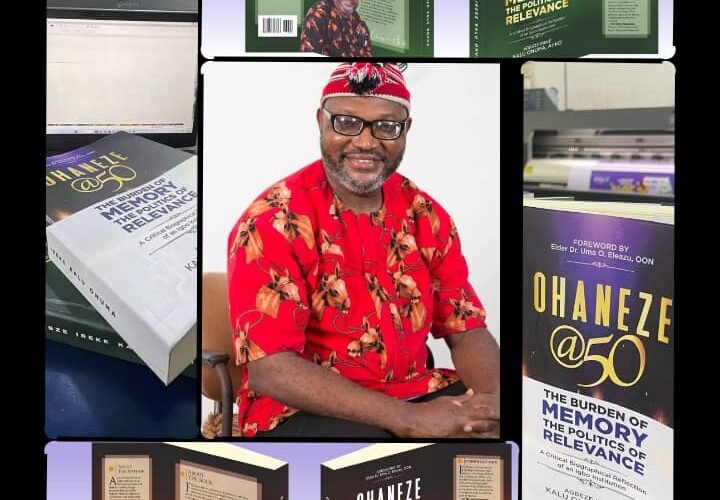
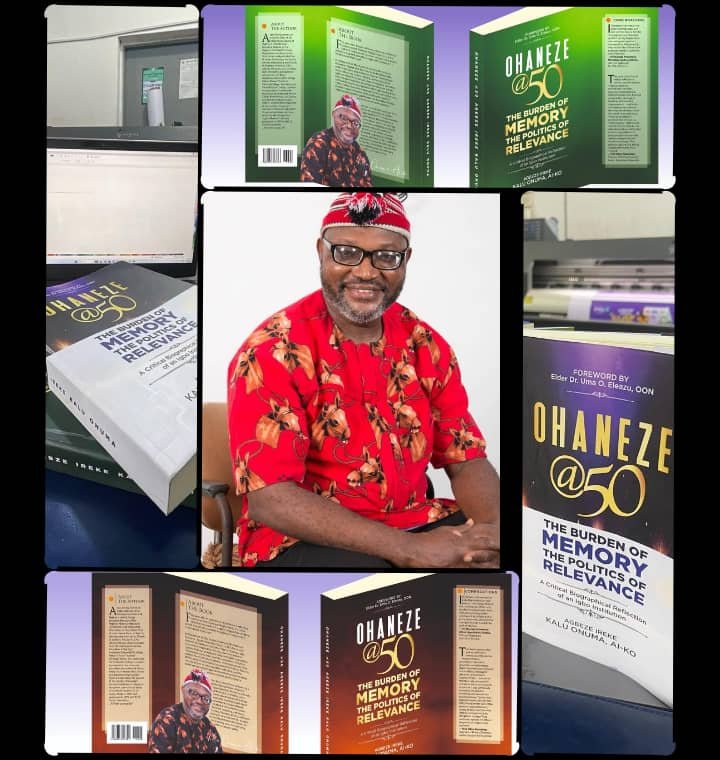
RECKONING FIFTY YEARS IN THE MAKING On the arrival of Ohanaeze @ 50: The Burden of Memory, The Politics of Relevance — and why it matters to every Igbo person alive today. By Okeke Nwankwo | Public Affairs AnalystFor Advance Circulation — September 2026
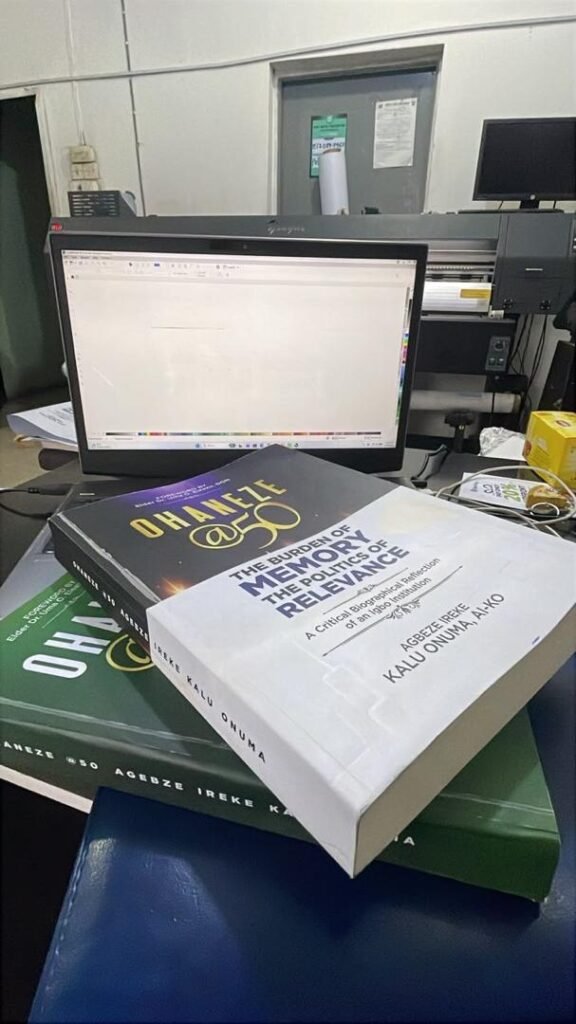
There are books that arrive at their moment. And there are books that arrive after their moment — faithful records of a past already settled, useful for the archive but not for the present. And then, rarely, there is a book that arrives before its moment has fully passed. A book that catches a story still in motion and holds it up to the light while there is still time to act on what the light reveals.Ohanaeze @ 50: The Burden of Memory, The Politics of Relevance, by Agbeze Ireke Kalu Onuma, is that third kind of book.It is arriving now. In September 2026. Fifty years after Ohanaeze Ndigbo was born from the urgency of a post-war Igbo people trying to answer a single existential question: who speaks for us?
Fifty years of institutions built and broken, of elections contested and outcomes disputed, of leadership that rose to the occasion and leadership that shrank from it, of a civilisation trying to organise itself in the aftermath of a catastrophe and finding the task harder than anyone had predicted.This book is the account of those fifty years. But it is far more than a history. It is an argument. And the argument it makes is one that every Igbo man and woman in Nigeria — and in the diaspora — needs to hear before the next chapter of this story is written.“The Igbo do not lack intelligence, do not lack ambition, do not lack industry. What we have sometimes lacked is the willingness to hold our own institutions accountable in the way we hold everything else.
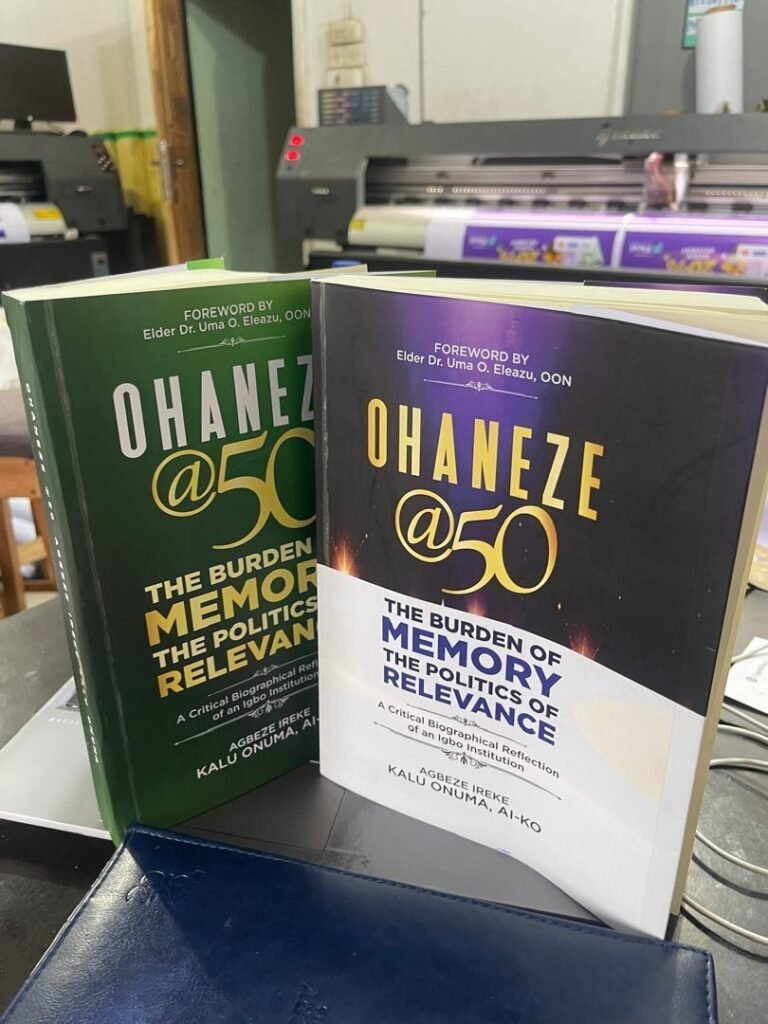
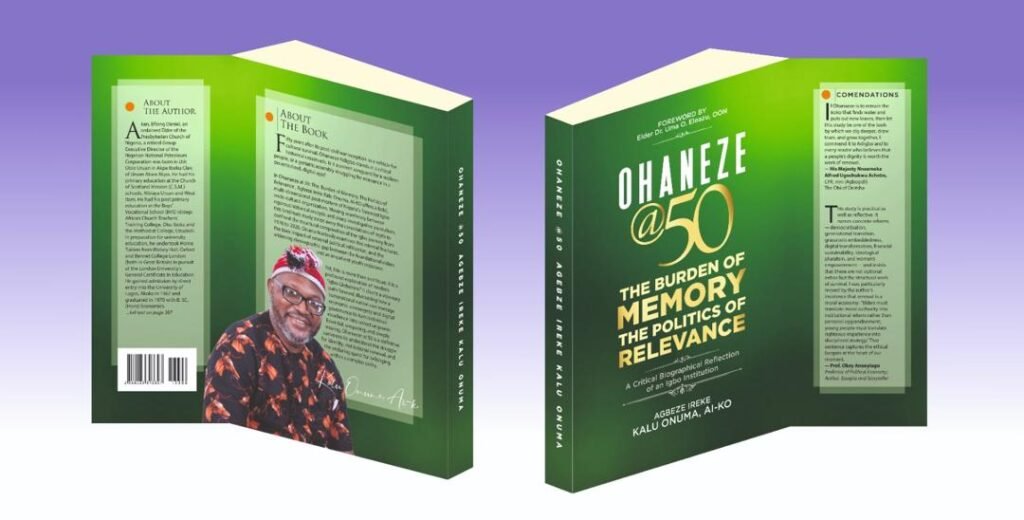
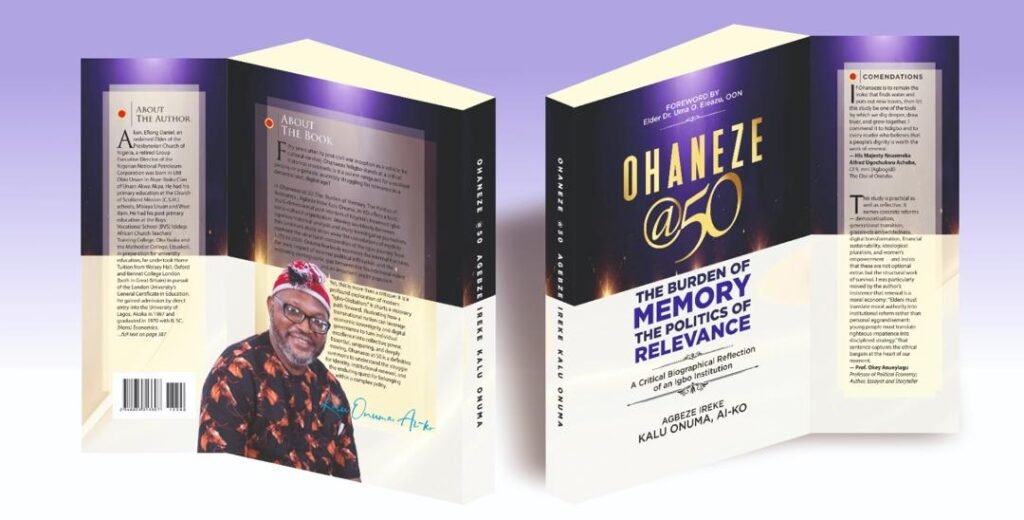
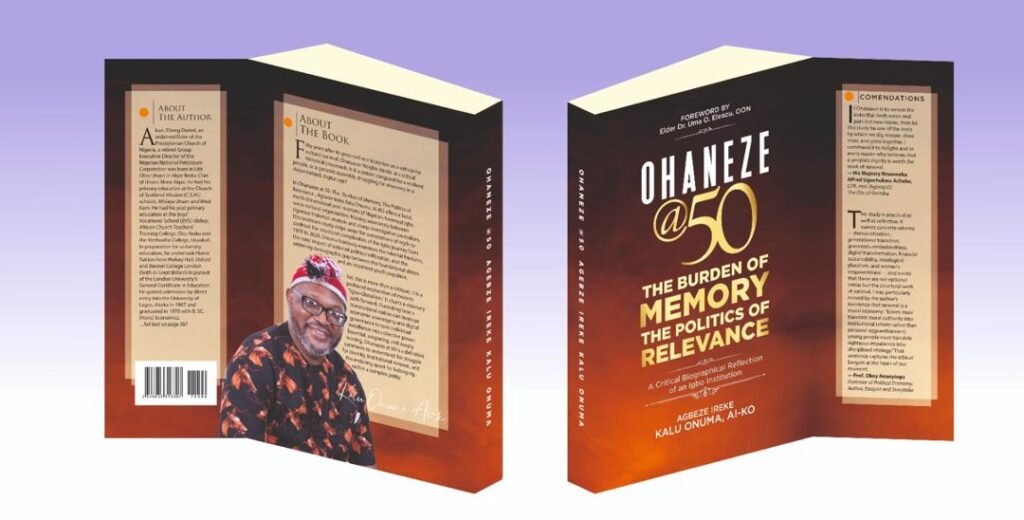
”WHAT THIS BOOK IS Let us begin with what this book is, because it has been described in advance in ways that do not do it full justice.It is not a celebration. Ohanaeze @ 50 does not arrive with bunting and congratulations. It arrives with a lantern and a mirror. The lantern illuminates what happened over the past five decades — accurately, specifically, and with the kind of detail that comes only from someone who has spent years not merely reading about Ohanaeze but thinking seriously about what it means. The mirror holds that record up to the faces of those who led the institution and those who watched it lead — and asks: is this what we intended? Is this what the Igbo people deserved?It is a critical biographical reflection — the author’s own phrase, and a precise one. Biographical because it follows the institution through its seasons: its founding idealism, its early achievements, its long slide into institutional incoherence, and the glimmers of renewal that have appeared in recent years. Reflective because it does not merely report; it thinks. It analyses. It asks why — and it answers, with the care of someone who has earned the right to answer by doing the necessary reading and the necessary conversations.
Those conversations include an extensive interview with one of the most consequential figures in Igbo cultural and public life: His Majesty the Obi of Onitsha, Nnaemeka Alfred Ugochukwu Achebe, CFR, mni (Agbogidi), whose reflections on Ohanaeze, Igbo unity, and the condition of the Igbo in Nigeria form one of the most candid and illuminating documents in the appendix of this book. Reading it, one understands that this is not a polite book. It is an honest one.It is also, crucially, a work of literature in the best sense of that term. Agbeze Ireke Kalu Onuma writes with the discipline of a scholar and the instincts of someone who understands that argument without art is merely noise. The prose is controlled but alive. The analysis is rigorous but never cold. The book can be read by a professor of political science and by a young Igbo woman trying to understand why the institution that carries her people’s name so often seems to be working against their interests. That breadth of address is rare, and it is intentional.“Ohanaeze was born to be the conscience of the Igbo nation. That is what makes its failure to consistently be that conscience not merely an institutional disappointment — but a civilisational one.
”WHAT THIS BOOK IS NOT It is not a party document. The author has no candidate to promote and no faction to protect. He is as willing to credit an administration that served Ohanaeze well as he is to name the failures of those who did not. This evenhandedness is not diplomatic cowardice — it is the only framework from which honest assessment is possible.It is not a eulogy. If you are looking for a book that will confirm your existing respect for Ohanaeze by telling only the uplifting stories, this is not that book. The author has no interest in the comfort of his reader at the expense of the accuracy of his record.It is not a hatchet job. Those who have worried that this book will be used to settle old scores, to embarrass particular leaders, or to advance a political agenda will find those fears unfounded. The author is hard on the institution, not on the individuals within it — and where he is hard on individuals, it is because their choices shaped the institution in ways that cannot be understood without accountability.And it is not a pessimistic book. This is perhaps its most important quality. A book that spent five hundred pages telling the Igbo that their flagship organisation had failed and left it there would be an act of cruelty dressed as criticism. This book does no such thing. It ends where all honest assessments of an institution in trouble must end: with a prescription. With a vision of what the next fifty years could look like if the lessons of the first fifty are finally taken seriously.“The question the Igbo must now answer is not whether Ohanaeze has mattered. It is whether it will matter in twenty years — and whether the generation that inherits it will have the courage to make it mean something real.
”THE AUTHOR – Agbeze Ireke Kalu Onuma writes under the moniker AI-KO — a pen name that has become synonymous with a particular kind of Igbo public intellectual engagement: grounded in scholarship, unapologetic in its assessments, and committed to the idea that the Igbo deserve to be taken seriously by the world, but that this begins with taking themselves seriously.He has spent years in the proximity of Igbo institutional life — not as a politician, not as an office-holder, but as someone who watched, read, listened, and eventually wrote. The result is a book that carries within it the weight of long observation and the restlessness of someone who believes that the Igbo story is not finished, and that its next chapter can be better than its last.
The Foreword has been written by Elder Dr. Uma O. Eleazu, OON — a man whose own biography is inseparable from the history of post-war Igbo intellectual and institutional life. When a man of Elder Eleazu’s standing chooses to place his name at the front of a book, he is saying something about its character that no review can replicate.His Majesty the Obi of Onitsha has written a commendation. So has Professor Okey Anueyiagu, one of the sharpest analytical minds in contemporary Igbo public discourse. These are not courtesy endorsements. These are men who read the manuscript and said: this is worth reading. That, in itself, is a recommendation.
THE PUBLIC PRESENTATIONOhanaeze @ 50 will be formally presented to the public on Tuesday, 22nd September 2026, at 10:00 AM, at the Main Events Hall of Dover Hotel, Ikeja, Lagos.The occasion has drawn together a gathering of Igbo leaders and national figures that is, by any measure, remarkable. His Majesty the Obi of Onitsha, Agbogidi — Nnaemeka Alfred Ugochukwu Achebe, CFR, mni — will serve as Royal Father of the Day. His Excellency Dr. Alex Otti, OFR, Executive Governor of Abia State, will be Chief Host. His Excellency Mr. Peter Obi, CON, will attend as Special Guest of Honour.Elder U.K. Eke, MFR, will serve as Chairman of the Occasion — not as a ceremonial figurehead but as the presiding authority who will open the proceedings, control the day, and give it its formal valediction. Elder Dr. Uma O. Eleazu, OON, whose Foreword opens the book, will be Grand Patriarch of the Day.Among the Elder Statesmen expected are Ochiagha Ebitu Ukiwe, General Ike Nwachukwu (Rtd), and Admiral Allison Madueke (Rtd) — a generation of Igbo public servants whose service to Nigeria spans the military, the diplomatic service, and the highest offices of state. Chief John Nnia Nwodo, former President-General of Ohanaeze, will deliver the Distinguished Address. Professor Okey Anueyiagu will present the Official Book Review. Senator John Azuta-Mbata, the serving President-General of Ohanaeze Ndigbo Worldwide, will be present to lend the institution’s weight to an occasion that concerns it directly.
Chief George Agu, GMD/CEO of ActivEdge Technologies, is Principal Patron and Anchor of the event. It is a gathering, in short, of the Igbo and their friends at close to their highest concentration of intellectual and institutional authority.The formal unveiling of the book — the moment when Ohanaeze @ 50 is placed formally into the world — will be the climax of the proceedings, following the distinguished addresses. It is a deliberate choice. In this ceremony, the book arrives last because it is the point of everything else.“Read this book. Not as a fan. Not as a critic. Read it as an Igbo person who still believes that the story is not over, and that the next chapter is ours to write.”A FINAL WORDThere will be those who read this advance notice and ask whether Ohanaeze @ 50 is friendly to their side of one internal argument or another. They will search the author’s affiliations for clues about which faction he serves. They will find nothing useful, because the author serves none of them. He serves the Igbo people. And the Igbo people, whatever else may divide them, share a common interest in the truth about the institutions that carry their name.That is what this book offers. Not comfort. Not flattery. Not the institutional cheerleading that has done more harm than good to Ohanaeze’s public credibility over five decades. It offers the truth — as best as one serious, disciplined, independent writer can arrive at it after years of research, reflection, and conversation with the people who were there.The Igbo deserve that truth. They have waited long enough for it.Ohanaeze @ 50: The Burden of Memory, The Politics of Relevance will be available at the venue of the public presentation on 22nd September 2026 and through major booksellers thereafter. For advance copies and media enquiries, contact aiko.writes2424@gmail.com or 09092159088.