
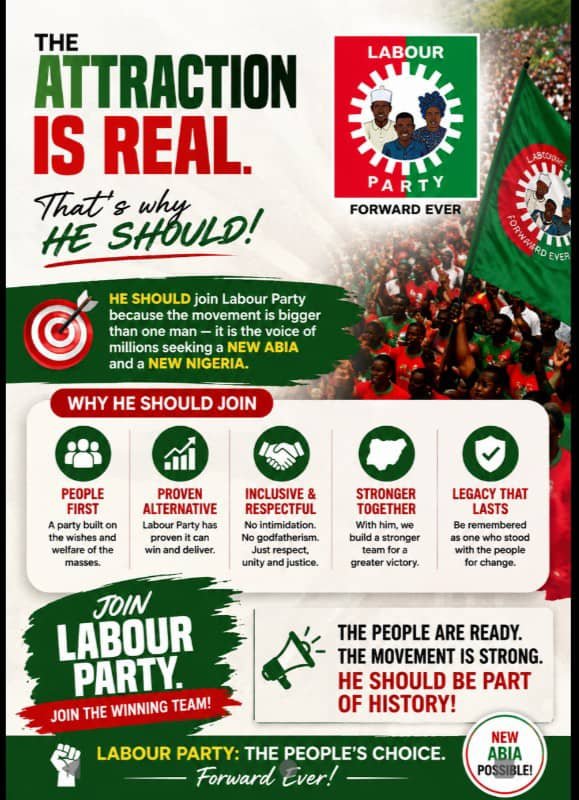
ABIA APC AND THE POLITICS OF SELF-DESTRUCTION: HISTORY IS WARNING THEM AGAIN
The latest communiqué from the Abia State Working Committee of the APC is far more revealing than its authors may have intended. A party preparing to capture Government House in 2027 is publicly threatening two of its most recognisable political figures because they expressed confidence in the incumbent governor. Senator Orji Uzor Kalu and Hon. Chris Nkwonta are being accused of anti-party conduct, ordered to apologise and threatened with disciplinary proceedings. The communiqué itself confirms the depth of the disagreement within the party. 0
The irony is difficult to miss. A party that has not yet persuaded Abians that it can govern the state is already fighting over who is insufficiently enthusiastic about a governorship candidate that has not even emerged. Instead of presenting a compelling alternative programme, its internal conversation has become loyalty tests, threats and disciplinary committees. History suggests that political organisations entering major elections in this condition usually make an already difficult contest even harder.
FIRST REPUBLIC: WHEN INTERNAL WAR BECAME POLITICAL COLLAPSE
Nigeria has seen this movie before. During the First Republic, the Action Group was one of the country’s strongest political organisations. Yet the bitter struggle between Obafemi Awolowo and Samuel Ladoke Akintola fractured the party and destabilised the Western Region. The division eventually produced competing factions, federal intervention and a political crisis that contributed to the wider instability preceding the collapse of the First Republic. 1
The lesson was simple: a political party does not need an external enemy when its principal leaders are busy destroying one another.
That lesson appears remarkably relevant to Abia APC today.
SECOND REPUBLIC: DIVIDED OPPOSITION, ADVANTAGE INCUMBENT
The Second Republic provided another lesson. Opposition parties repeatedly struggled with fragmentation, rival ambitions and unstable alliances while the NPN consolidated power. By the disputed 1983 elections, the opposition attempted to organise a Progressive Parties Alliance, but divisions among political formations remained significant. The political temperature ultimately became part of the crisis surrounding the collapse of that republic. 2
History therefore teaches something elementary: when opposition leaders spend their energy fighting themselves, incumbents rarely need to manufacture additional assistance.
THE THIRD REPUBLIC: A WARNING ABOUT BUILDING STRUCTURES WITHOUT COHESION
The so-called Third Republic never matured into a fully inaugurated civilian republic at the federal level. The political transition produced elected governors and legislatures, but the 1993 presidential election was annulled and the transition collapsed. Its history remains a reminder that political structures alone do not guarantee political stability.
Parties may have offices, chairmen, executives, committees and impressive communiqués. What matters during an election is whether the political coalition underneath those structures actually holds together.
That is precisely the question confronting APC in Abia.
1999–2007: PERSONALITY, STRUCTURE AND COALITION MATTERED
Abia’s Fourth Republic history reinforces the point. In 1999, Orji Uzor Kalu won the governorship on the PDP platform and was re-elected in 2003. 3 Whatever one’s assessment of that era, the elections demonstrated that successful gubernatorial politics in Abia requires a broad political organisation capable of holding influential personalities, local structures and electoral interests together.
Now consider the spectacle in 2026: one of the very politicians who once built a winning statewide political machine is being threatened by his current party because he publicly assessed another candidate as likely to win.
You may disagree with Kalu.
But disciplining the messenger does not automatically change the electoral mathematics.
2015: APC WAS NOT EVEN THE PRINCIPAL CHALLENGER
The 2015 Abia election provides an uncomfortable historical fact for anyone claiming APC has naturally become the state’s alternative government. The governorship contest was essentially between PDP’s Okezie Ikpeazu and APGA’s Alex Otti. Ikpeazu was declared winner with 264,713 votes against Otti’s 180,882. 4
APC was not the major challenger.
So the party entered the modern Abia governorship battlefield already needing to build credibility, organisation and a distinctive electoral coalition.
2019: APC GOT ITS CHANCE — AND FINISHED FAR BEHIND
By 2019, APC fielded Uche Ogah. The result should be compulsory reading at every Abia APC strategy meeting.
Okezie Ikpeazu of PDP received 261,127 votes.
Uche Ogah of APC received 99,574 votes.
APC therefore had a significant electoral gap to close even before today’s internal quarrels. 5
That history makes the present spectacle even more puzzling. A party that requires expansion is threatening prominent members. A party that needs coalition-building is broadcasting division. A party that needs new voters is discussing punishment.
You do not close a 160,000-vote historical deficit with disciplinary notices.
2023 CHANGED THE POLITICAL EQUATION
Then came 2023.
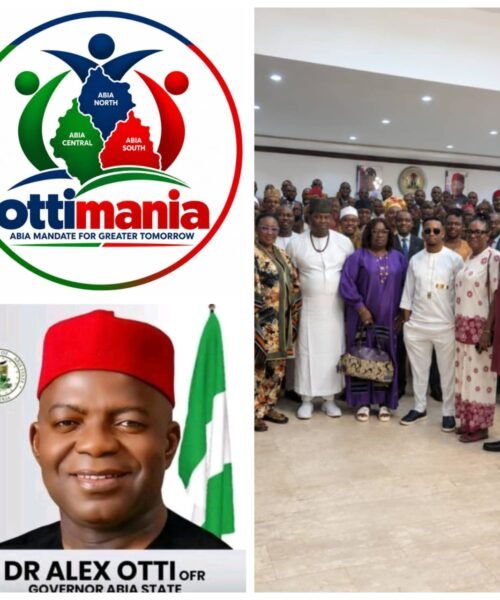
Alex Otti, now running on the Labour Party platform, won the Abia governorship with 175,467 votes, defeating PDP’s Okey Ahiwe, who received 88,529 votes. 6
That election demonstrated something important about Abia politics: voters were capable of abandoning the party that had controlled the state since 1999 and rallying behind an alternative candidate.
But here is APC’s problem.
The beneficiary of that political realignment was not APC.
It was Alex Otti.
Therefore, for APC to win in 2027, it would have to do more than criticise Otti. It would need to persuade a substantial portion of the coalition that elected him to abandon him while simultaneously keeping its own leaders, structures and supporters together.
And what is happening instead?
Its own leading figures are publicly expressing confidence in Otti.
Then the party leadership responds by threatening them.
You almost have to admire the political efficiency.
The opponent is campaigning outside; APC appears to be campaigning against itself inside.
THE COMMUNIQUÉ IS THE REAL CAMPAIGN POSTER
Read the communiqué carefully.
It complains about internal sabotage.
It complains about disloyalty.
It complains about prominent leaders undermining morale.
It threatens disciplinary proceedings.
It threatens withdrawal of political privileges.
That document therefore unintentionally tells Abians something more damaging than any opposition advertisement could invent:
the Abia APC leadership itself believes that important people within APC are not convinced about APC’s governorship prospects.
That is politically devastating.
If some of your prominent leaders are publicly predicting victory for your opponent, the strategic question should perhaps be:
“Why don’t they believe we can win?”
Instead, the response appears to be:
“Apologise for saying it.”
That treats the symptom while leaving the disease untouched.
YOU CANNOT DISCIPLINE YOUR WAY INTO GOVERNMENT HOUSE
Governorship elections are not won through communiqués.
They are won through coalitions.
They require candidates with statewide acceptance, ward structures, financing, grassroots mobilisation, elite consensus, persuasive policy alternatives and voters who believe that changing government will improve their lives.
A disciplinary committee cannot manufacture those things.
Suspending dissenters cannot create them.
Threatening party leaders cannot create them.
And declaring that the party is united certainly does not make it united when the communiqué itself exists because major figures are publicly disagreeing with the party’s electoral expectations.
It is almost political comedy:
“We are completely united — and anybody who disagrees will face disciplinary action.”
THE HISTORICAL VERDICT
From the factional battles of the First Republic, through the fragmentation of the Second Republic, the aborted transition of the Third Republic and the intensely competitive politics since 1999, Nigerian political history repeatedly demonstrates that divided political organisations enter elections at a severe disadvantage.
Abia’s own electoral record makes the challenge clearer. APC has never won the Abia governorship. In 2015 it was not the principal challenger. In 2019 its candidate finished far behind the winner. In 2023, the great political realignment that finally displaced PDP delivered Government House to Labour Party — not APC. 7
Therefore, the evidence does not permit anyone to scientifically declare that APC can “never” win Abia; elections are inherently uncertain and political coalitions can change rapidly.
But it supports a much more devastating conclusion:
an Abia APC that enters 2027 divided between its state leadership and some of its most prominent political figures will make an already difficult governorship contest extraordinarily difficult to win.
THE FINAL IRONY
The greatest threat to Abia APC may therefore not be Alex Otti.
It may be Abia APC.
While Otti’s opponents should ordinarily be developing an alternative manifesto, alternative economic numbers, alternative infrastructure programme and alternative vision for Abia, the party is explaining who must apologise to whom within fourteen days.
And perhaps that is the real story of the communiqué.
A party hoping to take Government House is already holding disciplinary hearings in the waiting room.
History has seen that strategy before.
It rarely ends with the keys to Government House.