
A REBUTTAL TO THE FALSE “SPONTANEOUS CONFESSION” NARRATIVE
The attempt to interpret Governor Alex Otti’s declaration of integrity as a “confession of guilt” is not serious political analysis. It is psychological speculation dressed in Latin expressions.
- Declaring innocence is not confessing guilt
Governor Otti has been repeatedly accused of corruption by opposition figures. Responding publicly that he is not a thief is therefore neither unsolicited nor suspicious. A person does not become guilty simply because he rejects an allegation.
The proper question is not: Why did he defend himself?
The proper question is: Where is the evidence that he stole public funds?
- Allegations are not judicial findings
The claims concerning ₦72 billion for schools and ₦36 billion for a road are presented as established fraud without any court judgment, audit determination or investigative finding proving that Governor Otti diverted the money.
There have been legitimate questions about how some education expenditures were classified in Abia’s budget-performance documents. The government’s publicly stated position was that approximately ₦14.43 billion had been spent on retrofitting 61 schools as of June 2025—not ₦72 billion on “phantom schools.”
Any discrepancy in budget reporting should be reconciled transparently. But disagreement over accounting classifications cannot honestly be converted into proof of personal theft.
- Port Harcourt Road is not a phantom project
The road exists and was reconstructed by Julius Berger. The contract was not merely for laying asphalt over six kilometres. It involved dual carriageways, major drainage and flood-control works, earthworks, rehabilitation of a severely degraded industrial corridor and associated infrastructure.
The fair demand is for publication and examination of the bill of quantities—not the simplistic division of the contract sum by road length while ignoring engineering scope.
Abia has also reported hundreds of completed and ongoing road projects across the state. These claims remain open to public verification and scrutiny.
- An investigation is not a conviction
Where any public institution is examining a contract, the investigation should be allowed to proceed. An investigation proves that questions are being considered; it does not establish guilt.
Those who already pronounce a verdict before producing an official report are practising propaganda, not accountability.
- The Medical City did not “disappear”
The assertion that the Abia Medical City vanished from government plans is factually weak. The project was publicly announced as a proposed $1.3 billion healthcare development intended to reduce medical tourism, and its planned commencement was reported by several news organisations.
Citizens are entitled to demand updates on financing, partnerships, timelines and implementation. But asking for progress is different from falsely declaring that the project has become another “phantom.”
- Seeking private support for security is not evidence of fraud
Security trust funds are commonly designed to complement government resources through voluntary contributions from businesses and other stakeholders. The existence of such a fund does not prove that statutory security allocations have disappeared.
The relevant questions should concern its legal framework, trustees, audit process, expenditure controls and public reporting.
- Latin terminology cannot replace evidence
Expressions such as confessio spontanea, absolutio and peccatum contra prudentiam may decorate an article, but they do not prove embezzlement.
Fraud is established through documents, payment records, procurement violations, beneficial ownership evidence, audit findings and lawful investigation—not through interpretations of a politician’s tone, facial expression or choice of words.
Governor Otti must remain accountable, publish clear financial records and answer legitimate questions. However, accountability must also bind his accusers.
Let anyone alleging theft provide:
- the exact contract and payment documents;
- evidence of work not executed;
- the recipient accounts;
- proof linking the funds personally to the Governor; and
- a competent investigative or judicial finding.
Until then, calling a denial a “confession” remains a clever headline built upon an elementary logical fallacy.
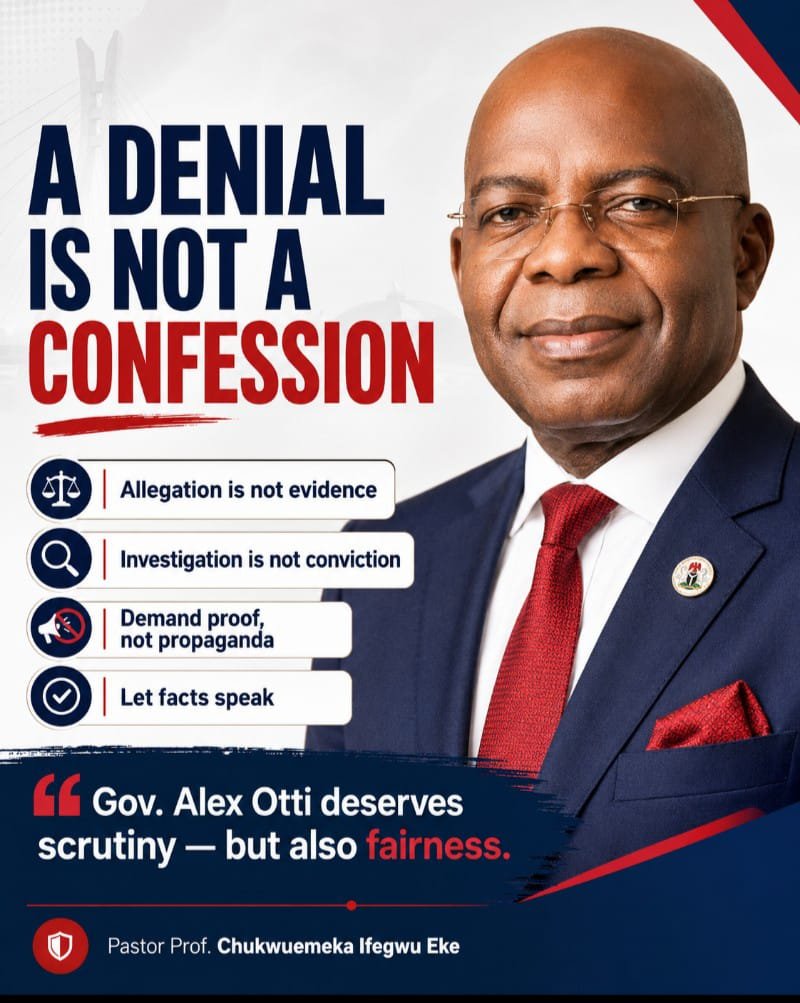
A denial is not a confession.
An allegation is not evidence.
An investigation is not a conviction.
And political Latin is not a substitute for proof.
Pastor Prof. Chukwuemeka Ifegwu Eke