
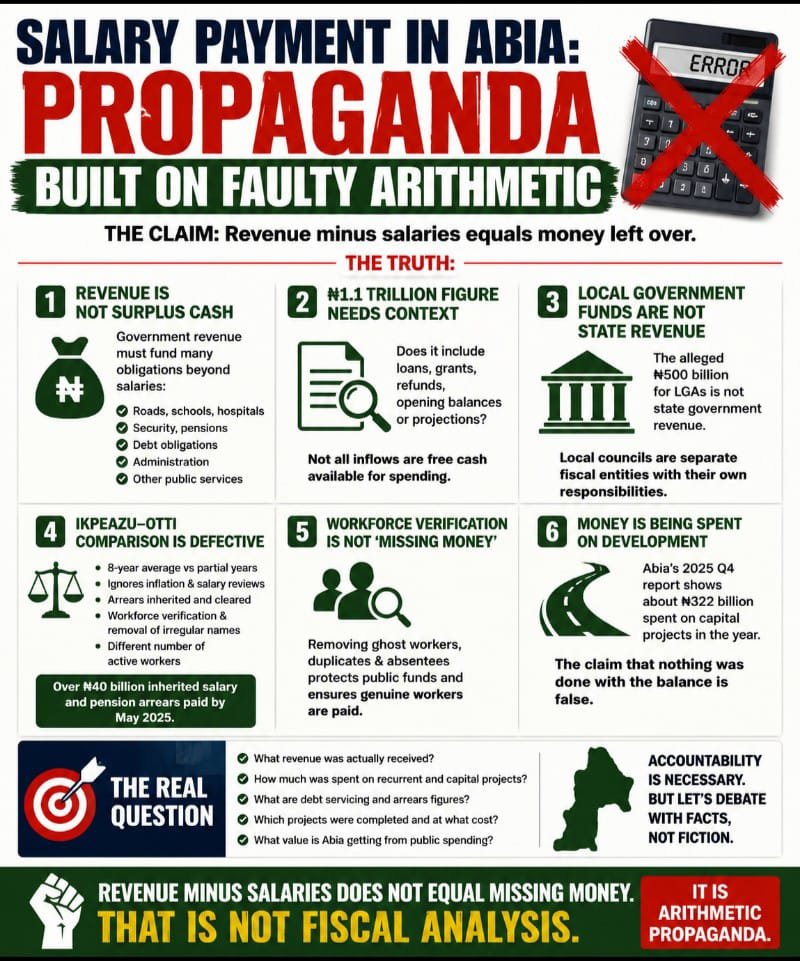
SALARY PAYMENT IN ABIA: PROPAGANDA BUILT ON FAULTY ARITHMETIC
The attempt to reduce Abia’s public finances to “total revenue minus salaries equals money left over” is economically misleading.
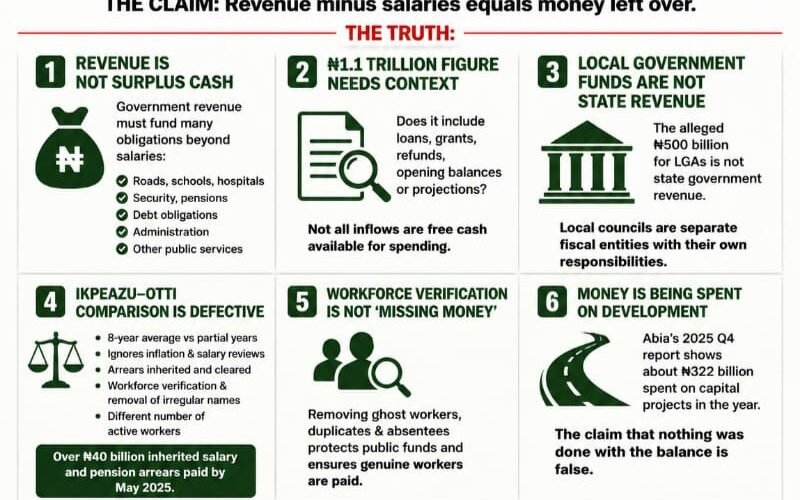
- Revenue is not the same as surplus cash
Government revenue must fund roads, schools, hospitals, security, waste management, pensions, debt obligations, administration, counterpart funding and other public services. Subtracting only salaries from revenue and declaring the remainder “available” is not credible public-sector accounting.
- The ₦1.1 trillion figure requires proper disclosure
Does it represent actual recurrent revenue, capital receipts, grants, opening balances, refunds or financing inflows? Budget projections and borrowed funds cannot simply be presented as free cash available for spending.
- Local government funds are not state-government revenue
The alleged ₦500 billion received by the 17 local governments cannot be casually added to the Abia State Government’s revenue. Local councils are separate fiscal entities with their own salaries, pensions, infrastructure and statutory responsibilities.
- The Ikpeazu–Otti comparison is fundamentally defective
Comparing an eight-year nominal average with selected figures for 2023 and 2024 ignores:
- inflation and salary adjustments;
- the fact that Otti governed for only seven months of 2023;
- pension and salary arrears inherited from previous administrations;
- workforce verification and removal of irregular names;
- differences in the number of active workers and payment compliance.
The Otti administration says it committed over ₦40 billion to inherited salary and pension arrears by May 2025. That is not captured by simply comparing annual personnel-cost averages.
- Workforce verification is not proof of missing salary money
If fraudulent, duplicate, absentee or improperly recruited names were removed, the legitimate question is whether genuine workers continued to receive their entitlements—not whether the government preserved an inflated payroll.
- The claim that nothing was done with the balance is contradicted by expenditure records
Abia’s 2025 fourth-quarter report recorded approximately ₦322 billion in capital expenditure during the year. Therefore, the suggestion that the entire amount remaining after salaries simply disappeared is demonstrably false.
THE REAL QUESTION
The proper debate should examine:
- actual revenue received;
- recurrent and capital expenditure;
- debt servicing and arrears;
- projects completed and their verified costs;
- value obtained from public spending.
Accountability is necessary. But accountability cannot be achieved by subtracting salaries from gross inflows, mixing state and local-government finances, ignoring every other expenditure and labelling the imaginary remainder “missing.”
That is not fiscal analysis.
It is arithmetic propaganda.