
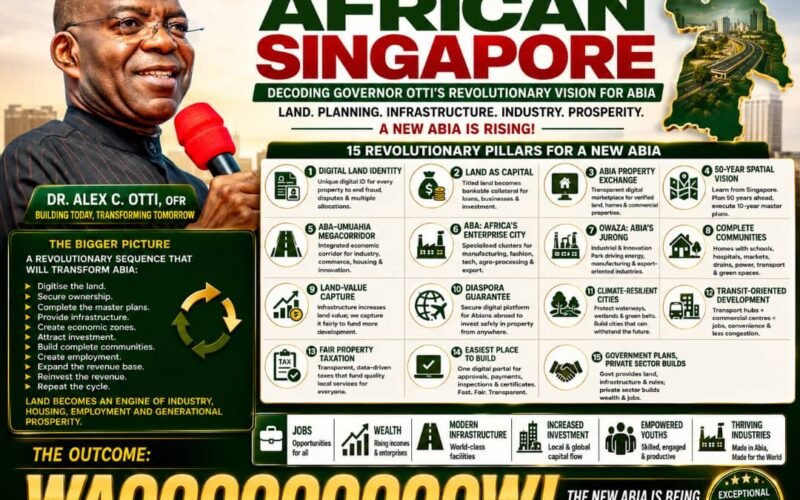
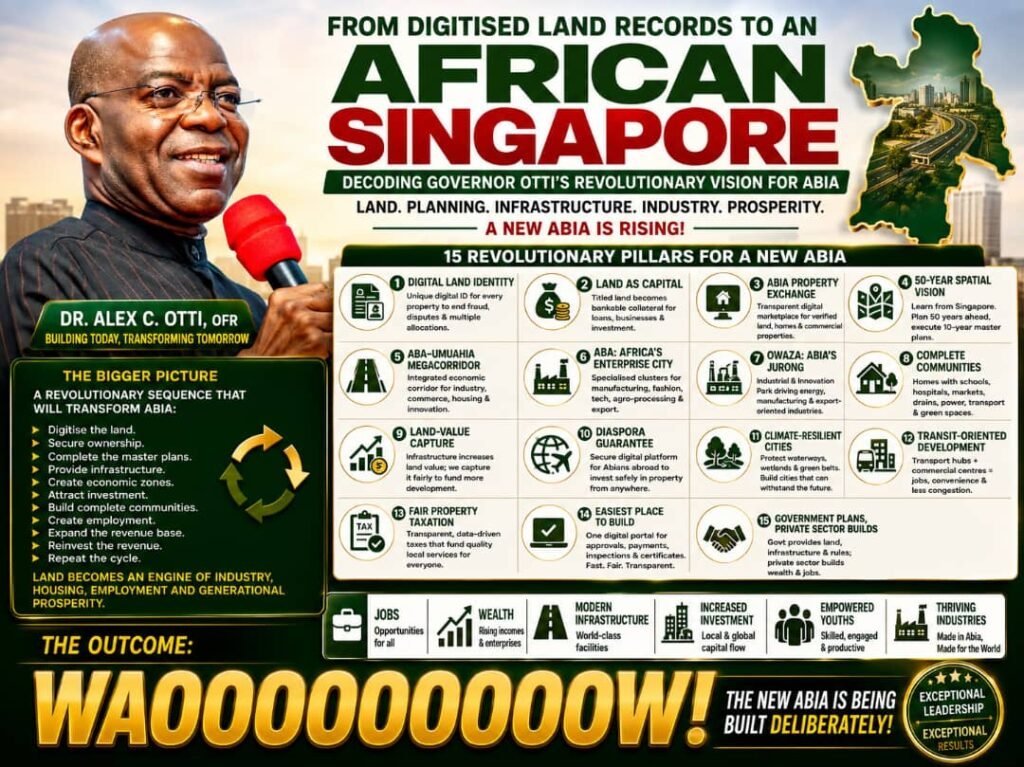
FROM DIGITISED LAND RECORDS TO AN AFRICAN SINGAPORE: DECODING GOVERNOR OTTI’S REVOLUTIONARY VISION FOR ABIA
This is a visionary projection built logically from Governor Alex C. Otti’s reforms and achievements so far—not a disclosure of any unpublished government policy.
Governor Alex C. Otti, OFR, may not simply be digitising millions of land documents. He may be laying the foundation for an entirely new Abia economy—where land becomes secure, measurable, bankable and productive.
When land digitisation, Certificates of Occupancy, urban master plans, industrial parks, smart cities, road infrastructure and the Abia 25-year development plan are connected, a much bigger picture emerges.
THE POSSIBLE OTTI REVOLUTIONARY FRAMEWORK
1. ONE DIGITAL IDENTITY FOR EVERY PROPERTY
Every parcel of land could eventually receive a unique digital identification number connected to:
- Ownership history
- Survey details
- Geographic coordinates
- Approved land use
- Building approvals
- Property valuation
- Taxes and financial transactions
This could drastically reduce forged documents, multiple allocations, boundary disputes and fraudulent land sales.
A person living anywhere in the world could verify an Abia property before making payment.
2. TURNING LAND INTO BANKABLE CAPITAL
Many Abians possess land but cannot use it as collateral because their ownership records are informal, disputed or difficult to verify.
Through digital titles and faster Certificates of Occupancy, Governor Otti could transform such properties into recognised financial assets.
A trader could use a properly titled shop to obtain business credit. A farmer could leverage certified agricultural land to finance production. A developer could obtain institutional funding because ownership risks had been reduced.
The principle is simple: Land should not merely be inherited—it should create wealth.
3. AN ABIA DIGITAL PROPERTY EXCHANGE
Abia could eventually establish a regulated digital marketplace where verified land, houses, factories, warehouses and commercial properties are listed.
Every listed property could display:
- Verified ownership
- Approved use
- Location and infrastructure status
- Professional valuation
- Transaction history
- Applicable government charges
This could make Abia one of Nigeria’s safest and most transparent real-estate markets.
4. LEARNING FROM SINGAPORE
Singapore was not transformed through scattered projects. Its development was driven by long-term planning, disciplined land administration, industrial zones, organised housing and strong public institutions.
Governor Otti’s 25-year development plan and emerging urban master plans may represent an Abia adaptation of this principle:
Think beyond one administration. Plan beyond one election.
Land could be deliberately reserved for housing, industry, transportation, education, healthcare, agriculture, recreation and environmental protection.
5. THE ABA–UMUAHIA ECONOMIC MEGACORRIDOR
A revolutionary possibility is the gradual integration of Aba, Osisioma, Isiala Ngwa and Umuahia into one coordinated economic corridor.
The corridor could accommodate:
- Manufacturing clusters
- Modern residential districts
- Logistics and distribution centres
- Technology campuses
- Healthcare cities
- Education and research districts
- Entertainment and hospitality zones
Every district would have a defined economic function supported by roads, drainage, power, broadband and public transportation.
6. ABA AS AFRICA’S ENTERPRISE CITY
Aba could be transformed from a naturally successful commercial centre into a deliberately planned global production city.
Specialised districts could be established for:
- Leather and footwear
- Fashion and garments
- Machinery and fabrication
- Electronics assembly
- Food processing
- Creative industries
- Digital commerce
- Export packaging and certification
These clusters could share reliable power, laboratories, warehouses, training facilities, financial services and logistics infrastructure.
The objective would move beyond celebrating Made in Aba to making Aba products globally certified, digitally traceable and internationally competitive.
7. OWAZA AS ABIA’S JURONG
Singapore deliberately developed Jurong as a major industrial zone.
In the same way, the Abia Industrial and Innovation Park at Owaza could become the state’s industrial powerhouse.
It could accommodate:
- Gas-powered industries
- Petrochemical production
- Fertiliser manufacturing
- Construction materials
- Renewable-energy equipment
- Industrial research centres
- Export-oriented factories
- Technical training institutions
Owaza could become the industrial engine supporting Abia’s long-term prosperity.
8. COMPLETE COMMUNITIES—NOT ISOLATED ESTATES
Singapore treated housing as economic and social infrastructure.
An Abia housing model could create planned communities containing:
- Affordable homes
- Schools
- Healthcare centres
- Markets
- Transport connections
- Drainage systems
- Recreational spaces
- Reliable electricity
- Digital connectivity
Civil servants, teachers, artisans, health workers, young professionals and low-income families could access homes through mortgages, cooperatives and rent-to-own programmes.
Do not build houses first and search for infrastructure later. Build complete communities.
9. INFRASTRUCTURE THAT FINANCES MORE INFRASTRUCTURE
Whenever government builds roads, drainage, transport terminals or industrial parks, surrounding land becomes more valuable.
Abia could capture part of this increased value through transparent development charges, land leases and planned property auctions.
The revenue could finance additional roads, schools, drainage, housing and public transportation.
Infrastructure would therefore help finance further infrastructure.
10. ABIA DIASPORA PROPERTY GUARANTEE
Many Abians abroad fear fraudulent land and building transactions.
A government-supported digital platform could allow diaspora investors to:
- Verify land remotely
- Track property approvals
- Pay official charges electronically
- Monitor construction stages
- Engage certified professionals
- Receive authenticated documents
This could make Abia one of Nigeria’s most attractive destinations for diaspora property investment.
11. CLIMATE-RESILIENT CITIES
The future Abia must not become a concrete jungle.
Urban planning could protect:
- Natural waterways
- Floodplains
- Wetlands
- Agricultural belts
- Urban forests
- Storm-water channels
New developments could be required to provide drainage, green areas, permeable surfaces, water-retention systems and environmental assessments.
This would prevent today’s construction boom from becoming tomorrow’s flooding crisis.
12. MODERN TRANSPORT-ORIENTED DEVELOPMENT
Major transport terminals and road corridors could become organised commercial centres rather than chaotic loading points.
Around transport hubs, government could designate areas for:
- Shops and offices
- Hotels
- Residential apartments
- Parking facilities
- Logistics services
- Public amenities
This would reduce congestion while increasing the economic value of transport investments.
13. FAIR PROPERTY TAXATION
Digitised land records could make property taxation transparent and fair.
Charges could be based on verified location, size, value and property use—not arbitrary assessments.
Low-income owner-occupied homes could receive protection, while luxury properties, commercial buildings and vacant speculative land contribute appropriately.
The revenue should be visibly connected to neighbourhood roads, drainage, waste management and street lighting.
14. ABIA AS NIGERIA’S EASIEST PLACE TO BUILD
A single digital development portal could process:
- Title searches
- Survey verification
- Building plans
- Environmental approvals
- Development permits
- Official payments
- Inspections
- Occupancy certificates
Applicants could track each stage, see official fees and identify where delays occur.
This would reduce corruption, uncertainty and investment costs.
15. GOVERNMENT PLANS—THE PRIVATE SECTOR BUILDS
The emerging Otti model may not require government to own every market, factory or housing estate.
Government would:
- Secure and designate land
- Provide major infrastructure
- Establish transparent regulations
- Protect investors and communities
- Enforce development standards
- Attract credible private capital
The private sector would finance, construct, operate and expand projects under clear rules.
THE BIGGER PICTURE
The roads, land digitisation, Certificates of Occupancy, industrial parks, smart-city projects and 25-year development plan may appear separate.
But connected logically, they reveal a revolutionary sequence:
Digitise the land.
Secure ownership.
Complete the master plans.
Provide infrastructure.
Create specialised economic zones.
Attract investment.
Build complete communities.
Create employment.
Expand the revenue base.
Reinvest the revenue.
Repeat the cycle.
This is how land moves from being a source of conflict and speculation to becoming an engine of industry, housing, employment and generational prosperity.
Governor Alex C. Otti, OFR, may therefore be pursuing something much greater than land reform.
He may be constructing the institutional foundations of an organised, investment-ready and globally competitive Abia—an Abia that learns from Singapore but builds its own distinctive development model.
The revolution is not merely in the buildings that will rise.
It is in the planning, digital records, institutions and economic architecture that will make sustainable prosperity possible.
WAOOOOOOOOOW! THE NEW ABIA IS BEING BUILT DELIBERATELY.