
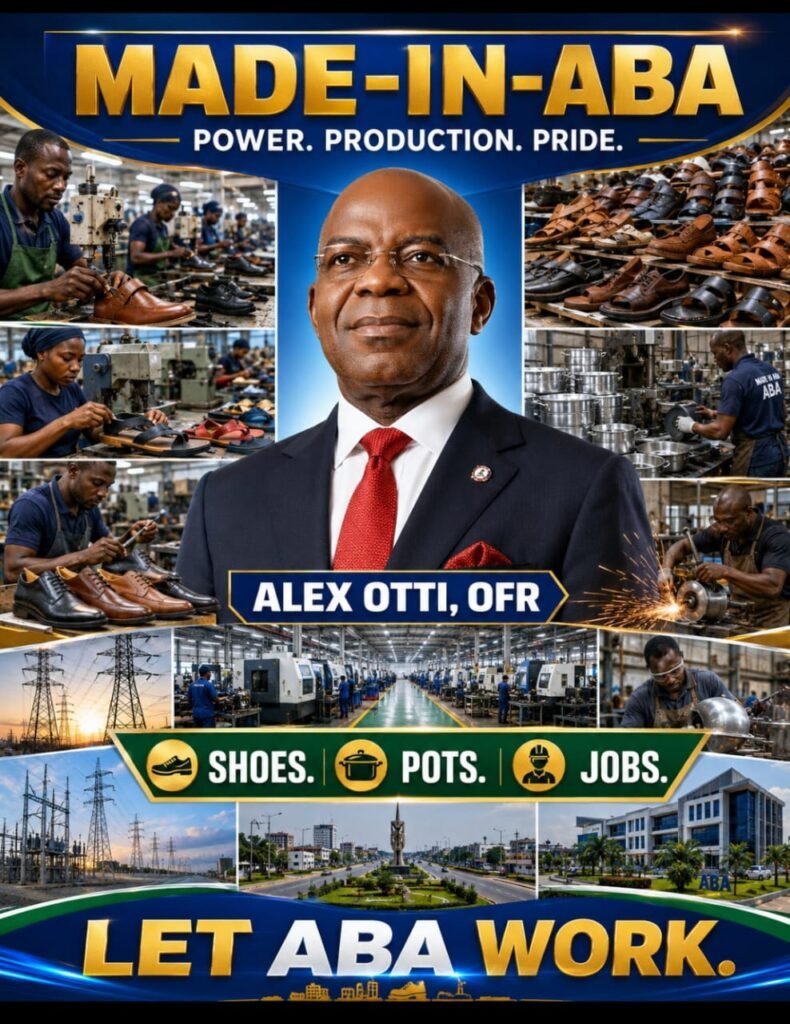
MADE-IN-ABA DOES NOT NEED EMPTY ROMANCE. IT NEEDS POWER, STANDARDS, CAPITAL, MARKETS AND GLOBAL ACCESS.
Let us lecture this argument properly.
Nobody who understands Aba will ever talk down on Made-in-Aba manufacturers.
Aba is not ordinary.
Aba is genius.
Aba is enterprise.
Aba is survival converted into production.
Aba is the city where a young man can start with a bench, a needle, a cutting table, a hammer, a machine, a customer, and a dream — and still build a business.
So let us be clear from the beginning: Made-in-Aba deserves global promotion.
But promotion without industrial support is noise.
Promotion without power is hypocrisy.
Promotion without standards is sentiment.
Promotion without financing is drama.
Promotion without production hubs is empty praise.
Promotion without logistics, certification, branding, export access and quality control is political comedy.
That is where Governor Alex Otti, OFR, is thinking beyond the shallow emotional argument.
The old politics praised Aba with mouth.
The new economics must strengthen Aba with systems.
You do not promote manufacturers by merely wearing their sandals for camera.
You promote them by reducing the cost of production.
You promote them by improving power supply.
You promote them by fixing access roads.
You promote them by supporting production hubs.
You promote them by connecting them to investors.
You promote them by improving the business environment.
You promote them by helping them move from informal craftsmanship to scalable industrial output.
That is the real issue.
Aba manufacturers do not need pity.
They need structure.
They do not need sentimental defence.
They need competitive advantage.
They do not need praise singers.
They need policy support.
They do not need people shouting “Made-in-Aba” while the same producers are spending profit on diesel.
This is why Otti’s power strategy matters.
When Aba is ring-fenced for improved electricity through the Geometric Power framework, the implication is not only that homes may enjoy better light. The bigger implication is industrial. Machines can run longer. Workshops can plan better. Tailors can meet deadlines. Shoemakers can produce in volume. Welders can reduce generator dependence. Small factories can become more predictable. Investors can take Aba more seriously.
That is how you promote Made-in-Aba.
Not by shouting.
By powering production.
The critic says Otti should promote Made-in-Aba.
Good.
But what exactly is power for?
What exactly are roads for?
What exactly is industrial planning for?
What exactly are investment summits for?
What exactly are production hubs for?
What exactly is the Made-in-Aba campaign for?
In April 2026, reports credited Governor Otti with announcing an integrated campaign to promote Made-in-Aba products, especially fashion and lifestyle accessories. Reports also stated that he directed funds to develop and equip production hubs around the state, especially in Aba, while the fashion industry would benefit because of Abia’s comparative advantage.
So who is avoiding Made-in-Aba?
The same Otti being accused of ignoring Aba manufacturers is the one publicly speaking about promoting Aba fashion and lifestyle goods.
The same Otti being accused of abandoning the sector is the one linked to the Fashion Future Programme, where thousands of fashion trainees were showcased in partnership with Ethnocentrique and the Mastercard Foundation.
The same Otti being accused of not understanding Aba is the one building the infrastructure that can make Aba products compete beyond emotional applause.
Let us stop confusing branding with development.
Branding is important.
But branding comes after quality.
Quality comes after stable production.
Stable production depends on power, equipment, skills, finance and market access.
That is the value chain.
If you only promote without fixing production constraints, you are selling dreams.
If you only wear Made-in-Aba but do not help producers scale, you are performing theatre.
If you only shout “our boys are trying” but leave them under high energy cost, poor roads, weak certification and limited access to capital, you are not helping them.
You are exploiting their struggle for politics.
The Aba producer does not need emotional speeches alone.
He needs electricity that works.
He needs roads that connect markets.
He needs access to machines.
He needs affordable credit.
He needs export certification.
He needs packaging support.
He needs digital marketing.
He needs production clusters.
He needs buyers.
He needs standards.
He needs government to create an industrial ecosystem.
That is what Otti’s approach is pointing toward.
Now let us address the stereotype issue.
To say that Aba must overcome the old “Aba-made” stigma is not to insult Aba.
It is to confront a historical market problem.
For years, some people used “Aba-made” as a derogatory label. That was unfair. That was painful. That was wrong. But serious leaders do not pretend stigma does not exist. They attack it with quality improvement, branding, certification, better packaging, reliable production and market confidence.
A doctor who diagnoses sickness is not abusing the patient.
A leader who identifies a market stigma is not insulting the producer.
He is saying: let us defeat the stigma permanently.
And how do you defeat it?
Not by crying.
Not by abusing Otti.
Not by political nostalgia.
You defeat it by making Made-in-Aba products so good, so consistent, so branded, so certified, so available and so competitive that nobody can mock them again.
That is the assignment.
The truth is that Aba’s future is not in sentimental protection. Aba’s future is in industrial competitiveness.
The Aba shoemaker must not only produce sandals for local sympathy.
He must produce for Lagos, Accra, Nairobi, Johannesburg, London, Berlin and Dubai.
The Aba fashion designer must not only survive in local markets.
She must enter digital catalogues, export platforms, fashion shows, bulk supply chains and international retail pipelines.
The Aba leather worker must not only produce for roadside buyers.
He must produce to standard, package to standard, brand to standard and export to standard.
That is what global promotion means.
And that is why Otti’s message to investors matters.
Investors do not come because of emotional poetry.
They come because a state shows seriousness.
They come because there is power.
They come because there is policy direction.
They come because there is infrastructure.
They come because there are skilled workers.
They come because there are industrial clusters.
They come because government can protect investment and organize opportunity.
So when Otti goes to Lagos to speak about Abia’s investment future, he is not abandoning Made-in-Aba.
He is creating the larger platform that Made-in-Aba needs to become globally competitive.
Let Oracle and his people understand this simple economics:
Made-in-Aba cannot become global by nostalgia.
Made-in-Aba becomes global by productivity.
Productivity comes from power.
Power reduces cost.
Lower cost improves competitiveness.
Competitiveness attracts buyers.
Buyers create expansion.
Expansion creates jobs.
Jobs create dignity.
That is the development chain.
Otti is not perfect.
No governor is.
He must still be pushed to do more for Aba manufacturers.
He must ensure that the Made-in-Aba campaign is not only announcement but execution.
He must ensure that production hubs are properly equipped.
He must ensure that fashion, footwear, leather, garment, metalwork and fabrication clusters are directly supported.
He must ensure that Aba producers are included in delegations, exhibitions, trade fairs and export promotion platforms.
He must ensure that standards agencies, export councils and finance institutions are brought into the Aba industrial ecosystem.
He must ensure that the small producer is not swallowed by big grammar.
But to claim that he is not promoting Made-in-Aba at all is false.
The record does not support that.
The reports are there.
The statements are there.
The policy direction is there.
The power intervention is there.
The investment pitch is there.
The Made-in-Aba campaign announcement is there.
The fashion empowerment linkage is there.
So let us be honest.
The real offence of Otti is not that he hates Made-in-Aba.
The real offence is that he is shifting the conversation from political branding to industrial systems.
Some people are comfortable with slogans.
Otti is talking structure.
Some people want photo-op promotion.
Otti is talking power, production hubs, investment and competitiveness.
Some people want emotional defence.
Otti is trying to build economic capacity.
That is the difference.
Made-in-Aba deserves global promotion.
Yes.
But global promotion begins with serious local preparation.
Aba cannot export excuses.
Aba must export quality.
Aba cannot export sentiment.
Aba must export value.
Aba cannot export political arguments.
Aba must export products that can stand anywhere in the world.
That is why the proper message to Governor Otti is not “stop disparaging Aba.”
The proper message is:
Governor, intensify what you have started.
Power Aba.
Fund production hubs.
Support standards.
Open export channels.
Include Aba manufacturers in investment missions.
Create a Made-in-Aba global marketplace.
Connect Aba producers to AfCFTA opportunities.
Brand Aba properly.
Let Aba footwear, fashion and leather goods become Abia’s global signature.
That is intelligent engagement.
Not emotional blackmail.
Not nostalgia.
Not propaganda.
Not selective memory.
Aba has been praised for years and still suffered.
Now Aba must be powered, structured, branded and exported.
That is what Otti, OFR, is doing for them.
And that is what serious people should support.
REFERENCES / LINKS
Punch — Otti empowers fashion trainees and unveils Made-in-Aba campaign: https://punchng.com/otti-empowers-8000-fashion-graduates-unveils-made-in-aba-campaign/�
National Ambassador — Otti targets global market for Made-in-Aba products: https://nationalambassadorngr.com/otti-targets-global-market-for-made-in-aba-products/�
Alex Otti Official — Otti calls for patronage of Made-in-Aba products: https://www.alexotti.com/gov-otti-calls-for-patronage-of-made-in-aba-products-advocates-sports-economy/�
Geometric Power — Aba Integrated Power Project: https://geometricpower.com/projects/aba-phase-i/�
Afreximbank — Commissioning of the 141MW Aba Integrated Power Project: https://www.afreximbank.com/geometric-power-commissions-the-afreximbank-backed-141mw-aba-integrated-power-project-%EF%BF%BC/�
BusinessDay — Stable power creates favourable industrial environment in Aba: https://businessday.ng/news/article/stable-power-creates-favourable-industrial-environment-in-aba-nepal-energies/�
Channels TV — Otti explains why Geometric Power project took 20 years: https://www.channelstv.com/2024/02/29/why-abia-geometric-power-project-took-20-years-gov-otti/�
The Sun — Otti woos global investors to Abia: https://thesun.ng/otti-woos-global-investors-to-abia/�
TVC News — Otti showcases Abia’s investment potential at Invest Lagos 3.0: https://www.tvcnews.tv/otti-showcases-abias-investment-potential-at-invest-lagos-3-0/� :::
The draft is anchored on reports about Otti’s Made-in-Aba campaign, fashion-sector empowerment, Aba’s ring-fenced power project, and his recent investment pitch. �
Punch Newspapers +4