

₦306 MILLION AS PRODUCTIVE CAPITAL: WHY OTTI’S NKATA TECHNOLOGY GRANT COULD TURN ABIA’S SMALL BUSINESSES INTO A NEW ENGINE OF GROWTH
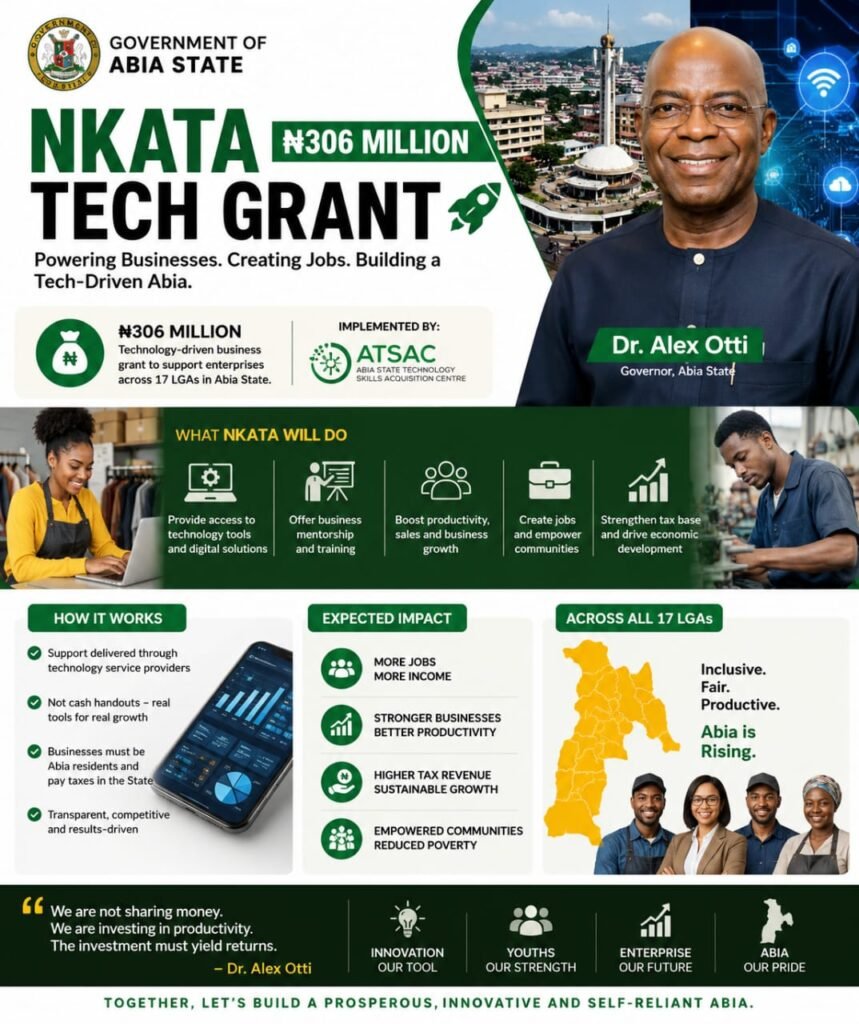
The announcement by the Abia State Government of a ₦306 million technology-driven business grant, known as NKATA, is not merely another government empowerment programme. Properly implemented, it is a carefully targeted macroeconomic intervention capable of raising business productivity, strengthening local enterprises, widening the tax base, creating employment and accelerating the emergence of a technology-enabled economy across the 17 local government areas of Abia State.
According to reports, Governor Alex Otti unveiled the programme while receiving the management team of the Abia State Technology Skills Acquisition Centre, ATSAC. The programme is designed to support qualified businesses operating across Abia, with a strong emphasis on youths, small businesses, entrepreneurship, innovation and digital transformation.
The most significant aspect of NKATA is not even the amount involved. Its deeper economic meaning lies in the structure of the intervention. The programme is not designed as an indiscriminate cash-distribution exercise in which beneficiaries simply receive money that may immediately disappear into pressing household consumption. Rather, ATSAC has explained that support will be channelled through technology service providers, software companies, hardware suppliers, internet service providers and business mentors who will help selected businesses acquire practical tools capable of improving operations, efficiency, competitiveness and growth.
That difference is fundamental.
In macroeconomics, there is a major difference between public spending that is immediately consumed and public spending that expands productive capacity. Money given out purely for consumption may provide temporary relief, which has social value, particularly in difficult economic times. However, once the food is eaten, the transport fare is spent or emergency needs are settled, the productive effect may quickly disappear.
Investment in technology, skills, automation, digital bookkeeping, internet access, customer-management systems, inventory tools, online marketing capacity and business mentorship can leave behind productive assets. Such investment can help a business produce more, reduce waste, reach new customers, employ additional workers, generate higher income and pay legitimate taxes into the economy over time.
This is why Governor Otti’s position that public intervention must yield value, rather than simply finance consumption, is economically important. He is essentially arguing for a shift from temporary political gratification to productive economic empowerment. He is stating that public money should not merely circulate once and disappear; it should be invested in a way that allows it to generate output, jobs, incomes, tax revenue and future economic opportunities.
That is the right philosophy for a state whose commercial history has been built on enterprise, craftsmanship, trading strength, manufacturing talent and the creative energy of its people.
ABIA’S ENTREPRENEURIAL ECONOMY NEEDS TECHNOLOGY, NOT JUST PRAISE
Abia State, particularly Aba, is widely known for commerce, leatherworks, footwear, garments, fabrication, small-scale manufacturing, trade, repair services, creative enterprise and indigenous business ingenuity. For decades, Abia entrepreneurs have demonstrated the ability to produce, improvise and survive in difficult operating conditions.
But survival is not the same thing as growth.
A small business can remain busy every day and yet remain trapped at a very low level of income. A producer may have customers but lack accurate records. A shoe manufacturer may be highly skilled but unable to display products digitally to buyers outside Aba. A fashion designer may be competent but limited to customers who physically enter the shop. A trader may make daily sales but have no inventory system, no financial record and no platform through which the business can qualify for credit or wider opportunities.
That is where technology becomes economically transformative.
A footwear producer in Aba who gains access to a digital catalogue, reliable online sales channel, bookkeeping support and customer-delivery system is no longer confined to buyers who physically visit the market. Such a producer can serve customers in Lagos, Abuja, Port Harcourt, Kano, Accra, London or within the Nigerian diaspora.
A garment producer who begins to use digital order management, online marketing, electronic payments and basic production tracking can reduce errors, improve customer trust, track turnover and expand output. A food processor who receives appropriate digital tools can better manage suppliers, stock, packaging, delivery and payment records. A small retailer who adopts inventory-management software can reduce shortages, losses and unnecessary capital tied down in unsold products.
This is not abstract economics. It is how productive economies are built: one enterprise at a time, one technological improvement at a time, one additional worker at a time and one new market at a time.
The underlying macroeconomic argument is simple. When businesses become more efficient, the same amount of labour, time and capital can produce more output. Economists describe this as an improvement in productivity. When productivity rises across many businesses, incomes can grow, employment can expand, prices can become more competitive and the economy can become more resilient.
NKATA therefore speaks directly to the most important question in Abia’s development journey: how can the state transform the natural entrepreneurial energy of its people into scalable, measurable and sustainable economic growth?
WHY SUPPORTING SMALL BUSINESSES IS A MACROECONOMIC NECESSITY
Supporting small and medium enterprises is not a marginal social policy. It is a central economic necessity.
PwC Nigeria’s MSME Survey 2024, drawing on the NBS and SMEDAN MSME survey, reports that micro, small and medium enterprises contribute 46.32 per cent of Nigeria’s Gross Domestic Product, account for 96.9 per cent of businesses and provide 87.9 per cent of employment.
These numbers are extremely important.
They mean that the future of employment in Nigeria does not lie only in large companies, federal ministries or multinational corporations. It lies substantially in the small producer, the local processor, the trader, the artisan, the technology start-up, the fashion designer, the shoemaker, the food vendor, the service provider and the thousands of small businesses whose daily activities keep households and communities alive.
In Abia, this reality is even more compelling because enterprise is not an imported concept. It is already part of the state’s identity. The problem has never been the absence of hard work or creativity. The difficulty has been that many businesses remain poorly financed, weakly organised, technologically limited, energy-constrained and disconnected from larger markets.
This is why NKATA deserves serious attention. It is not attempting to invent entrepreneurship in Abia. Entrepreneurship already exists in abundance. Rather, it is attempting to equip existing enterprise with modern productive tools capable of moving businesses from mere survival to genuine expansion.
The strategic question is no longer whether Abians can produce. They can. The strategic question is whether public policy can now help them produce more efficiently, sell more widely, document their transactions more professionally, hire more workers and enter larger markets with confidence.
THE ₦306 MILLION FUND IS SMALL IN THE BUDGET, BUT LARGE IN ITS POSSIBLE SIGNAL
It is important to place the amount of the NKATA intervention within the wider financial position of the state.
Abia’s 2026 budget was presented at approximately ₦1.016 trillion. Of this amount, about ₦811.8 billion, representing approximately 80 per cent of the proposed expenditure, was allocated to capital projects. The state government also projected internally generated revenue of approximately ₦223.4 billion.
Against a budget size of ₦1.016 trillion, the ₦306 million NKATA intervention represents only about 0.03 per cent of the total budget. Compared with the state’s proposed capital expenditure of ₦811.8 billion, the grant accounts for roughly 0.038 per cent. Compared with projected internally generated revenue of ₦223.4 billion, it represents only about 0.137 per cent.
These percentages are revealing.
They show, first, that NKATA is not a reckless fiscal burden. It is not a project that threatens the state’s finances or crowds out the major infrastructure, education, health and development responsibilities of government. In fiscal terms, it is relatively modest.
However, these same percentages also issue a warning. Because the amount is small relative to the overall size of the Abia economy and the number of businesses requiring support, the programme cannot afford waste, political patronage, duplication, inflated procurement or weak supervision. Every naira must be carefully directed towards businesses and technology solutions capable of producing measurable economic results.
If the programme is well targeted, ₦306 million can become more than a grant fund. It can become a demonstration project showing that public investment in technology-enabled businesses can produce jobs, income, tax revenue and enterprise expansion. It can build a case for scaling up similar interventions in future years.
But if it is badly managed, distributed politically or reduced to the ceremonial presentation of support packages, its effect on the wider economy will be insignificant.
Therefore, the value of NKATA will not be determined by how loudly it is announced. It will be determined by how many businesses it improves, how many workers it helps to employ, how much turnover it enables beneficiaries to generate, how much productivity it creates and how transparently the results are disclosed to Abians.
Across the 17 local government areas, a simple equal division of ₦306 million would amount to an average of about ₦18 million per local government area. However, economic allocation should not be based solely on arithmetic equality. Every LGA should be fairly represented, but assistance should also reflect business viability, employment potential, sectoral importance, digital need and the likelihood that public support will generate wider value.
Fairness is not merely giving everybody exactly the same amount. Fairness also means ensuring that public money achieves real results for the entire population.
FROM CASH DISTRIBUTION TO PRODUCTIVE EMPOWERMENT
One of the strongest features of NKATA is its apparent rejection of the traditional cash-handout model.
Nigeria has had many empowerment programmes in which money was distributed to beneficiaries, celebrated politically and quickly forgotten. Such programmes may create momentary excitement, but they often leave no lasting productive evidence. A beneficiary may collect money today, meet immediate needs tomorrow and return to the same economic difficulty shortly afterwards.
That model does not substantially change productivity. It does not necessarily create employment. It may not build business records, customer networks, access to credit or new markets. It provides relief, but it does not always create expansion.
NKATA is potentially different because it seeks to provide businesses with relevant technology solutions through service providers and mentors. Rather than merely handing a business owner money, the state appears to be saying: identify what technology will improve your enterprise, support access to that technology, provide professional guidance and require measurable business results.
For a small trader, the relevant support may be digital bookkeeping, electronic payment integration, online advertising and inventory control. For a shoemaker, it may be digital branding, customer ordering platforms, improved production tools and access to national markets. For an agro-processor, it may be packaging support, distribution technology, supplier tracking and online customer systems. For a service provider, it may be software, internet support, payment records and business-management mentoring.
Such assistance can become embedded in the business itself.
However, the non-cash structure must not be romanticised. It creates its own risks. A programme routed through service providers can become vulnerable to inflated pricing, unsuitable equipment, favouritism in vendor selection or the supply of technologies that beneficiaries do not actually need or understand.
Therefore, the non-cash model is economically superior only where it is accompanied by transparency, competitive selection of technology providers, proper diagnosis of each business need, independent monitoring, user training and public accountability.
A business should not receive technology simply because government wants to announce that technology has been delivered. It should receive technology because that tool can solve a specific business problem and produce measurable economic value.
PRODUCTIVITY: THE REAL HEART OF THE NKATA PROJECT
The strongest economic case for NKATA is productivity.
Every economy becomes richer when its people can produce more useful goods and services with the resources available to them. A business that spends less time correcting avoidable mistakes, loses less stock, reaches more customers, receives payment more reliably and manages information more accurately is a more productive business.
Technology can help achieve this.
A handwritten record system can be replaced with digital bookkeeping that tracks sales, costs and profits. A trader guessing which items are selling can use an inventory system to know what to restock. A producer waiting for physical customers can use online platforms to display goods and receive orders. A small enterprise struggling with poor documentation can begin to maintain financial histories needed for credit assessment. A service provider confined to one town can use digital visibility to attract customers from across Nigeria.
The productive benefit is not merely that businesses become more modern in appearance. The important issue is that they become capable of making better decisions, reducing losses, increasing sales and planning expansion.
For Abia, this matters immensely. The state already possesses clusters of businesses that can potentially grow if connected to modern tools. Aba’s manufacturers, designers, artisans and traders do not necessarily need government to run their businesses for them. What many need are reliable enabling systems: accessible technology, business training, market connections, power solutions, infrastructure and predictable public policy.
NKATA can address part of this challenge by lowering the cost of adopting useful technology.
Where such technology results in higher output, more reliable business records, wider market access and increased customer demand, government will not merely have supported individual beneficiaries. It will have helped raise the productive capacity of the state economy itself.
JOB CREATION: THE STANDARD BY WHICH THE PROGRAMME MUST BE MEASURED
Governor Otti was right to state that the programme must be judged not merely in monetary terms but through job creation, poverty reduction and empowerment.
Government expenditure becomes genuinely developmental when it improves the lives of ordinary people. In a state with young people seeking work, families managing economic pressure and businesses struggling with operating costs, an empowerment scheme must ultimately produce employment or improved income.
NKATA can generate employment in several ways.
First, the implementation of the project can directly create economic opportunities for technology firms, software developers, hardware suppliers, internet providers, trainers, technicians and mentors engaged in delivering solutions to beneficiary businesses. This stimulates activity within the technology and professional-service sector.
Second, supported businesses that begin to produce more or sell more may require additional workers. A growing fashion business may require more tailors, marketers or delivery staff. A footwear producer gaining online orders may need more artisans and sales assistants. A food processor with expanded demand may hire additional production and packaging workers. A trader with stronger turnover may add shop assistants or distribution support.
Third, employment may be created indirectly as beneficiary incomes rise. A worker or entrepreneur earning additional income spends part of it on food, transport, rent, communications, school needs, clothing and local services. These expenditures become income for other people. This is how a productive intervention moves beyond the original beneficiary and stimulates economic activity in the community.
However, technology adoption must be managed carefully. Some technologies can replace routine labour rather than expand employment. A successful Abia programme should therefore favour technologies that enable businesses to grow their markets and expand output, rather than merely tools that eliminate workers without creating additional economic value.
The best outcome is not machines replacing people. The best outcome is technology enabling people to become more productive, businesses to become more profitable and enterprises to employ more people because they are serving larger markets.
THE MULTIPLIER EFFECT: HOW ₦306 MILLION CAN GENERATE MORE THAN ₦306 MILLION IN ECONOMIC ACTIVITY
One of the key concepts in macroeconomics is the multiplier effect. When government spends money productively, the initial expenditure can trigger further rounds of income and spending within the economy.
For example, when a technology provider in Abia is paid to support a business, that service provider may employ workers, purchase materials, rent office facilities, engage technicians and spend income locally. When the supported business begins to sell more products, it may purchase more inputs, employ more staff and distribute more goods. The workers and suppliers who receive income then spend part of that money within the local economy.
In that way, the original public expenditure circulates and produces economic activity greater than its initial amount.
It is not yet possible to state the actual multiplier effect of NKATA because detailed information about beneficiaries, technology packages, vendor locations, local procurement, import dependence, business performance and spending behaviour has not yet been publicly established.
Nevertheless, the possible range of outcomes can be illustrated clearly.
If the ₦306 million investment generates a modest multiplier of 1.2, it could stimulate approximately ₦367.2 million in wider economic activity. If it achieves a multiplier of 1.5, it could support approximately ₦459 million in economic activity. If it performs strongly enough to achieve a multiplier of 2.0, the value of economic activity triggered could reach about ₦612 million. In an exceptionally successful scenario where local business expansion, local sourcing and job creation are strong enough to produce a multiplier of 2.5, the economic activity associated with the intervention could rise to approximately ₦765 million.
These figures are not predictions or confirmed outcomes. They are analytical illustrations of what becomes possible when public resources are invested productively rather than merely consumed.
The final multiplier will depend heavily on whether the spending remains within Abia. If competent Abia technology providers are engaged, local workers are employed, local businesses purchase more inputs and beneficiary firms expand their operations within the state, a larger share of the value will circulate locally.
On the other hand, if most technology services, equipment subscriptions or procurement payments immediately flow outside Abia without corresponding local enterprise growth, the economic multiplier will be weakened.
This is why local capacity building is important. NKATA should not only provide technology to existing businesses. Where competence exists, it should also deepen Abia’s own ecosystem of software providers, digital trainers, technical support firms, internet businesses, equipment maintenance firms and innovation professionals.
The project should create beneficiaries on both sides: businesses that receive useful technology and local technology enterprises that gain opportunities to serve a growing market.
FORMALISATION, TAX COMPLIANCE AND THE GROWTH OF INTERNALLY GENERATED REVENUE
Another economically intelligent feature of the project is the reported requirement that beneficiaries must be residents who operate businesses and pay taxes within Abia State.
This requirement should not be interpreted as government merely seeking to collect taxes from small businesses. Rather, it provides the foundation for a more sustainable relationship between government and enterprise.
A state does not build a durable revenue base by continuously imposing heavier burdens on struggling taxpayers. It builds a durable revenue base by helping more businesses become viable, profitable, traceable and capable of paying reasonable taxes without collapsing.
Technology adoption supports that process.
A digitally enabled business is more likely to maintain sales records, track payments, prepare accounts, use banking channels, demonstrate transaction history and establish a verifiable operating identity. Such a business is easier to support, easier to assess for credit, easier to link with larger markets and easier to incorporate into a fair tax system.
This produces a virtuous development cycle.
Government invests in business capability. Business productivity improves. Turnover increases. Employment expands. More transactions become documented. The business becomes more formal and financially visible. The tax base becomes wider and more legitimate. The state receives additional internally generated revenue. Government then possesses stronger capacity to fund infrastructure, education, healthcare, business support and further productive investment.
This is the superior approach to revenue mobilisation. It does not treat entrepreneurs merely as targets for collection. It treats them first as economic partners whose growth will eventually strengthen government finances.
For a state that projected approximately ₦223.4 billion in internally generated revenue for 2026, this is particularly relevant. The long-term route to stronger IGR is not only improved collection. It is the creation of a larger, more productive and more formal private economy from which legitimate revenues can sustainably arise.
NKATA can therefore become part of a wider revenue strategy: not taxation before growth, but strategic support that allows growth, formalisation and taxation to reinforce one another.
INCLUSIVE DEVELOPMENT ACROSS ALL 17 LOCAL GOVERNMENT AREAS
One of the politically and economically important dimensions of NKATA is its statewide coverage. The programme is intended to reach businesses across all 17 local government areas of Abia State.
This matters because development must not be confined only to major commercial centres. Aba is undoubtedly central to Abia’s enterprise identity, and Umuahia remains critical as the administrative capital. But the wider state economy also includes businesses operating in agriculture, agro-processing, trade, hospitality, local crafts, services, transportation, retailing and small manufacturing across other communities and local governments.
A state development programme must avoid creating a situation where opportunities repeatedly circulate only within the most visible business centres while rural and semi-urban enterprises remain outside the network of technology, finance and market access.
However, statewide inclusion must be intelligently designed. Merely allocating exactly the same amount to every local government would appear fair on the surface, but it may not produce the highest economic impact. Business concentration, enterprise needs, sectoral strengths, infrastructure conditions, population size and youth unemployment pressures differ across LGAs.
Therefore, NKATA should guarantee that every local government is represented, while also rewarding viable businesses capable of growth and employment. It should include businesses owned by youths and women. It should ensure that rural and semi-urban enterprises are not neglected. It should support productive sectors with strong local linkages. It should allow performing beneficiaries to qualify for further assistance after demonstrating results.
In simple terms, the programme must combine inclusion with economic discipline. Nobody should be excluded merely because of location, but no business should be selected merely for political convenience.
When public funds are scarce, the state must be compassionate in coverage but rigorous in selection.
POVERTY REDUCTION THROUGH PRODUCTIVE INCOME, NOT TEMPORARY RELIEF
The project’s poverty reduction potential deserves careful attention.
Poverty is not sustainably defeated merely by transferring small amounts of money to people once. Temporary support may provide immediate relief, but lasting poverty reduction depends on productive income: individuals and families earning more regularly because businesses are growing, employment is being created and economic opportunities are expanding.
A small business that becomes more profitable can support the household of its owner. If it hires additional workers, it supports additional families. If those workers spend more in their communities, other small businesses benefit. If the business purchases supplies from local producers, income spreads further along the economic chain.
This is how enterprise support can become social development.
The important point is that NKATA must not treat poverty reduction as a slogan. It must be measured. Government should be able to state after six months and after one year whether supported firms increased their sales, whether they hired additional workers, whether owner incomes improved, whether beneficiaries remained in operation, whether businesses entered new markets and whether any increase in taxable activity occurred.
Without measurement, poverty reduction becomes a public-relations claim. With measurement, it becomes evidence of economic performance.
RISKS THAT COULD UNDERMINE THE PROGRAMME
As promising as NKATA appears, the initiative will only succeed if the government confronts the risks honestly.
The first risk is political allocation. If beneficiaries are chosen on the basis of party loyalty, friendship, influence or patronage rather than business seriousness and economic potential, the programme will lose credibility and public value.
The second risk is technology without supporting infrastructure. A digital business cannot operate effectively without power, connectivity and basic training. Technology packages that ignore electricity challenges or internet affordability may look impressive at launch but remain unused afterwards.
The third risk is the danger of imposing unsuitable technology on businesses. A shoemaker, a market trader, an agro-processor, a pharmacy, a fashion designer and a small transport operator do not require exactly the same tools. The programme must diagnose actual needs rather than distribute generic packages for ceremonial purposes.
The fourth risk is vendor capture. Since support will be delivered through technology providers, there must be safeguards against overpricing, favouritism, poor-quality service and inflated invoices. Procurement must be competitive and publicly defensible.
The fifth risk is weak mentoring. Technology alone does not guarantee growth. A beneficiary may receive software but lack the training to use it. A business may acquire a digital platform but fail to attract customers. Mentoring must therefore be practical, continuing and focused on measurable results.
The sixth risk is economic leakage. If most resources are spent on external suppliers without building local skills, employing local professionals or expanding local businesses, the immediate economic benefit retained within Abia will be reduced.
The seventh risk is the absence of transparent impact reporting. No government should measure the success of this programme simply by announcing the number of people selected or the value of equipment supplied. Distribution is not impact. The genuine test is whether output increased, sales improved, employment expanded, businesses survived, taxes grew and poverty was reduced.
A TRANSPARENT ECONOMIC SCORECARD IS NON-NEGOTIABLE
For NKATA to retain public trust, ATSAC and the Abia State Government should publish a performance scorecard.
The government should disclose the number of beneficiaries selected in each local government area and the sectors in which they operate. It should disclose the categories of technology support delivered, the total amount committed, the amount actually utilised, the average support provided per beneficiary and the process used in selecting service providers.
It should also provide information on inclusion: the number of youth-owned businesses supported, women-owned businesses supported, rural businesses included and the distribution of assistance across sectors such as manufacturing, trade, agro-processing, services, creative enterprise and technology.
More importantly, the government should track economic results. Before a business receives support, its baseline condition should be documented. Its approximate employment level, monthly sales range, digital capability, output level and major business constraints should be recorded. Six months after support and again after twelve months, the same indicators should be reviewed.
How many supported businesses increased monthly turnover?
How many created at least one additional job?
How many entered new digital markets?
How many began keeping reliable financial records?
How many moved from informality into better documented operations?
How many remained active after one year?
How many generated increased tax payments without being overburdened?
How much additional local procurement and economic activity was created?
Those are the questions that will determine whether NKATA was productive public policy or merely an attractive announcement.
Accountability will not weaken the government’s achievement. If the programme succeeds, transparency will magnify its credibility. It will enable Abians to see exactly how public investment is creating value. It will also provide evidence for expanding the programme and attracting partners, investors, development organisations and diaspora professionals interested in supporting enterprise transformation in the state.
FROM AN EMPOWERMENT PROGRAMME TO A NEW ABIA ECONOMIC MODEL
The greatest importance of NKATA may ultimately lie beyond the first ₦306 million.
The project has the potential to introduce a different philosophy of government intervention in Abia. Instead of empowerment being understood as sharing money, government can begin to define empowerment as raising productive capacity. Instead of measuring success by the number of people gathered at a distribution ceremony, success can be measured by businesses expanded, technologies adopted, jobs created, markets accessed and incomes increased.
That is a major shift.
An economy becomes stronger when citizens are equipped to produce. A state becomes richer when enterprises can move from informal survival to sustainable growth. A government becomes more credible when its expenditure can be connected visibly to output, employment and improved living standards.
This philosophy is particularly appropriate for Abia. The state possesses a powerful entrepreneurial culture. Its people are already making products, creating designs, trading goods, providing services and solving problems. What is needed is not endless rhetoric about the ingenuity of Aba or the resilience of Abians. What is needed is a deliberate policy architecture that gives businesses infrastructure, technology, market access, investment support and institutional confidence.
NKATA cannot carry that responsibility alone. It must be complemented by power improvements, road infrastructure, market renewal, security, access to finance, reliable broadband, business-friendly taxation, vocational skills, industrial support and wider economic reforms.
But it can become an important pillar within that larger strategy. It can provide the proof that when government supports enterprise intelligently, the result is not dependence but productivity.
THE POLITICAL ECONOMY MESSAGE: PUBLIC MONEY MUST CREATE PUBLIC VALUE
There is also a significant political economy lesson in this intervention.
Citizens increasingly demand that government spending should be tied to visible results. It is no longer enough for officials to announce funds, projects or beneficiaries. People want to know whether expenditure has improved their economic lives.
The NKATA programme provides Governor Otti’s administration with an opportunity to demonstrate that public money can be directed towards creating productive citizens rather than political clients. It offers the possibility of showing that government intervention can be disciplined, measurable and economically defensible.
But that opportunity comes with responsibility. Since the administration has stated that the investment must produce results, it must be prepared to publish those results clearly, whether positive or disappointing. A government confident in the economic logic of its programme should welcome measurement.
The administration should not merely report that ₦306 million was approved or that beneficiaries received support. It should return to Abians with the evidence: the businesses before support, the technology provided, the businesses after support, the jobs created, the sales expanded, the new markets reached and the taxes generated.
That is how a programme becomes an economic achievement rather than a newspaper announcement.
CONCLUSION: A BEAUTIFUL IDEA THAT MUST NOW BECOME MEASURABLE PROGRESS
The NKATA technology-enabling business grant is a sound macroeconomic intervention in principle. It recognises that the growth of Abia will not come only from government construction projects or public employment, but also from thousands of private businesses becoming more productive, digitally connected, financially organised and capable of employing more people.
Its ₦306 million value may be small compared with Abia’s over ₦1 trillion 2026 budget, but its potential meaning is substantial. It can become the seed of a new enterprise-development model: one that replaces temporary handouts with productive investment, replaces political sharing with technology-backed business growth and replaces vague empowerment claims with measurable economic outcomes.
The intervention can help traders keep better records. It can help manufacturers reach wider markets. It can help artisans adopt modern systems. It can help technology providers expand their services. It can help businesses become more formal. It can help young people gain employment. It can help households receive more dependable incomes. It can help government gradually broaden its tax base through enterprise growth rather than excessive pressure.
But none of these outcomes should be assumed simply because the project has been launched.
The real verdict will come later.
The verdict will be determined by whether the right businesses were selected. It will be determined by whether the technologies supplied were truly useful. It will be determined by whether service providers delivered value for money. It will be determined by whether beneficiaries increased production and turnover. It will be determined by whether young people found jobs. It will be determined by whether household incomes improved. It will be determined by whether the economic benefits reached communities beyond the major cities. It will be determined by whether government publicly discloses measurable results.
Governor Alex Otti has set the correct standard: the fund must yield results in job creation, poverty reduction and genuine empowerment.
That standard must now become the test.
Abians should not measure NKATA by the amount announced. They should measure it by the productive businesses strengthened.
They should not measure it by ceremonial photographs. They should measure it by additional jobs created.
They should not measure it by promises of technology. They should measure it by businesses that actually increased sales, entered new markets and improved output.
They should not measure it by the excitement of launch day. They should measure it by the evidence available six months and one year later.
If NKATA achieves those outcomes, then Abia will have demonstrated something profoundly important: that a state can use carefully targeted public investment to convert entrepreneurship into productivity, productivity into jobs, jobs into household income, household income into reduced poverty and expanding enterprise into stronger public revenue.
In that event, ₦306 million would no longer be remembered merely as a government grant.
It would be remembered as productive capital: a deliberate investment in the businesses, skills, technology and economic future of Abia State.
SOURCES FOR VERIFICATION AND FURTHER READING
The Guardian Nigeria, “Abia unveils ₦306m tech grant to boost businesses across 17 LGAs,” 26 May 2026:
https://guardian.ng/news/abia-unveils-%E2%82%A6306m-tech-grant-to-boost-businesses-across-17-lgas/
Abia State 2026 Budget Presentation, published on the official platform of Governor Alex Otti:
https://www.alexotti.com/gov-otti-presents-2026-budget-estimate-to-abia-state-house-of-assembly/
PwC Nigeria, MSME Survey 2024:
https://www.pwc.com/ng/en/publications/strategies-for-msme-success.html