
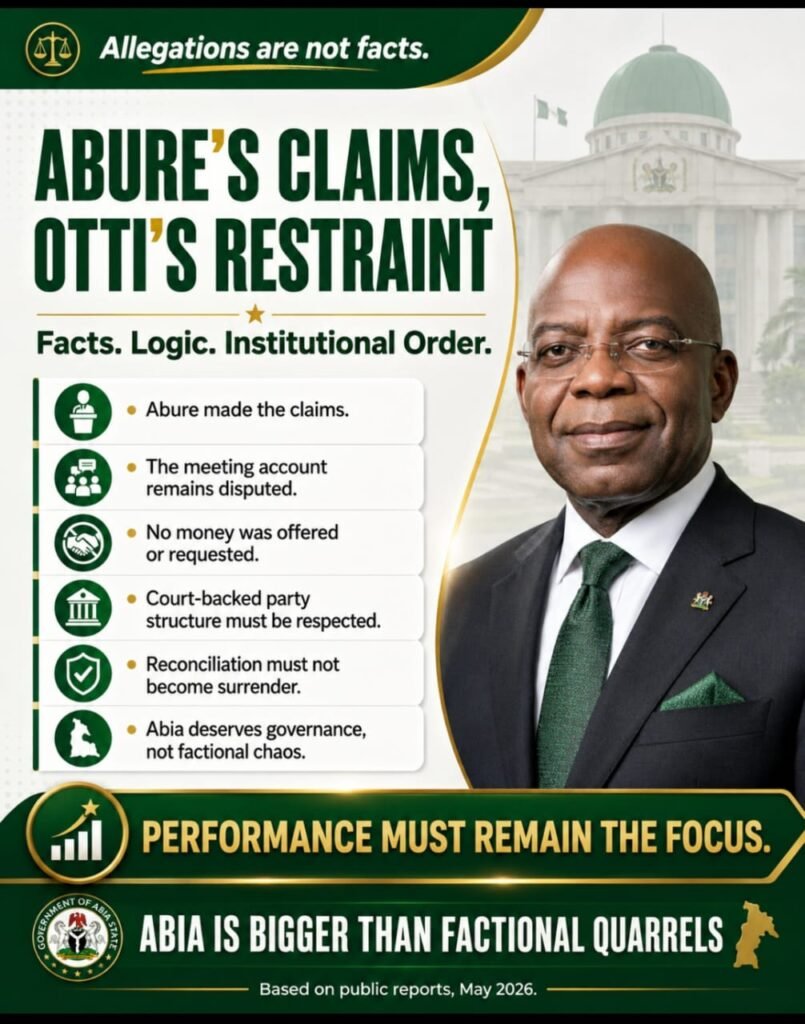
ABURE’S CLAIMS, OTTI’S RESTRAINT AND THE DIFFERENCE BETWEEN RECONCILIATION AND SURRENDER
There is a simple rule in serious public reasoning: an allegation is not automatically a fact merely because it is repeated in a headline.
What has been reported is that Mr. Julius Abure claimed that, during a reconciliation discussion with Governor Alex Otti, proposals were presented concerning positions within the Labour Party and elective opportunities in Abia and elsewhere. He also claimed that Governor Otti declined those proposals and allegedly mentioned positions within the Board of Trustees.
That is Abure’s narration of a private meeting. It deserves to be reported as his claim. It should not be presented as a finally established truth unless the other participants confirm it or credible evidence independently proves it.
But even if one accepts Abure’s account exactly as he presented it, the logic of the matter raises serious questions.
According to the account reported by PUNCH, Abure said that his group proposed sharing positions in the National Working Committee, allowing Governor Otti to take the governorship ticket and determine candidates for the Abia State House of Assembly, House of Representatives and Senate, as well as candidates in other states where the Governor might have interests.
This immediately exposes a deeper problem.
Is a political party supposed to be rebuilt through a private allocation of offices and tickets among powerful individuals? Are legislative tickets items to be transferred during reconciliation meetings? What becomes of party members, congresses, aspirants, internal democracy and the electorate if candidature is negotiated as part of a settlement among competing factions?
If Governor Otti rejected such proposals, that rejection is not evidence of arrogance. It can logically be understood as a refusal to transform reconciliation into political trading.
Reconciliation is not the same as surrender. Peace is not achieved by discarding rules. Unity cannot be built by rewarding every dispute with positions and candidate-producing privileges.
There is also a vital fact that must not be hidden from the public. This crisis did not begin with the alleged meeting. On 21 January 2026, the Federal High Court in Abuja removed Julius Abure as National Chairman of the Labour Party and directed INEC to recognise the Senator Nenadi Usman-led caretaker committee as the valid authority representing the party pending a national convention. That judgment relied on the Supreme Court decision of 4 April 2025 concerning the leadership dispute.
Therefore, Governor Otti was not dealing with a blank sheet of paper. He was responding within an environment already shaped by court decisions, party processes and INEC recognition.
No reasonable person can expect a leader to ignore an existing legally recognised structure merely because a faction demands positions as the price for reconciliation.
The philosophical issue is straightforward: institutions become meaningless when rules are suspended whenever influential people are dissatisfied. A party that wants to govern a state or a country must first show that it can submit itself to procedure, law and orderly succession.
Governor Otti was elected to govern Abia State, not to mortgage the future of the Labour Party in order to satisfy every internal pressure group. If his position was that reconciliation must happen within the recognised structure of the party, then that is not political wickedness. It is institutional discipline.
There is another important admission in Abure’s account. He expressly stated that money was neither requested nor offered during the meeting. That clarification should end irresponsible attempts to invent financial scandals around a discussion that, by his own account, centred on political structure and positions.
The dispute is therefore not about some proven financial wrongdoing by Governor Otti. It is about whether reconciliation should mean restoring individuals through negotiated privileges or requiring everyone to operate within a lawful party framework.
In philosophy, justice is not the act of giving every dissatisfied person what he demands. Justice is the application of fair rules, even when the outcome displeases powerful individuals.
In logic, a man who rejects demands to distribute offices and political tickets cannot simultaneously be condemned for refusing to protect private interests. If anything, the allegation unintentionally presents Governor Otti as someone unwilling to buy temporary peace with the institutional future of the party.
In practical governance, Governor Otti’s primary judgment will not be determined by the anger of rival factions. It will be determined by the people of Abia State, who will assess his administration through roads, transportation, healthcare, public infrastructure, accountability and the quality of life they experience.
Political parties matter. Internal reconciliation matters. But no political quarrel should be allowed to distract Abians from the central issue before them: whether their state is moving forward under the present administration.
Mr. Abure is entitled to state his case. Governor Otti and the recognised Labour Party leadership are equally entitled to insist on law, procedure and institutional order.
The facts presently available do not establish that Governor Otti committed any wrongdoing. What they establish is that reconciliation talks reportedly occurred, demands or proposals were reportedly made, Governor Otti reportedly did not accept them, and the Labour Party leadership dispute remains entangled in legal and political contestation.
Let the argument therefore be conducted honestly.
No manufactured scandal.
No conversion of allegations into facts.
No demand that Governor Otti must trade away institutional order to purchase factional peace.
A leader who accepts everyone at every price is not necessarily wise. Sometimes leadership means opening the door to peace while refusing to remove the foundation of the house.
Governor Alex Otti is focused.
Abia is bigger than factional quarrels.
Performance is stronger than propaganda.
And the people will ultimately judge.
SOURCES
PUNCH report on Abure’s account of the reconciliation meeting, 20 May 2026:
https://punchng.com/otti-abure-truce-crumbles-amid-lp-crisis/
Voice of Nigeria report on the Federal High Court judgment recognising the Nenadi Usman-led caretaker leadership, 21 January 2026:
https://von.gov.ng/court-sacks-abure-as-labour-party-chairman-recognises-nenadi-usman/
The Guardian report on Governor Otti’s position that reconciliation must take place within the recognised Labour Party structure, 1 February 2026:
https://guardian.ng/politics/otti-draws-red-line-for-abure-as-lp-begins-post-court-reset/
Labour Party statement published on its official X handle, 18 May 2026:
https://x.com/NgLabour/status/2056368182848311576