
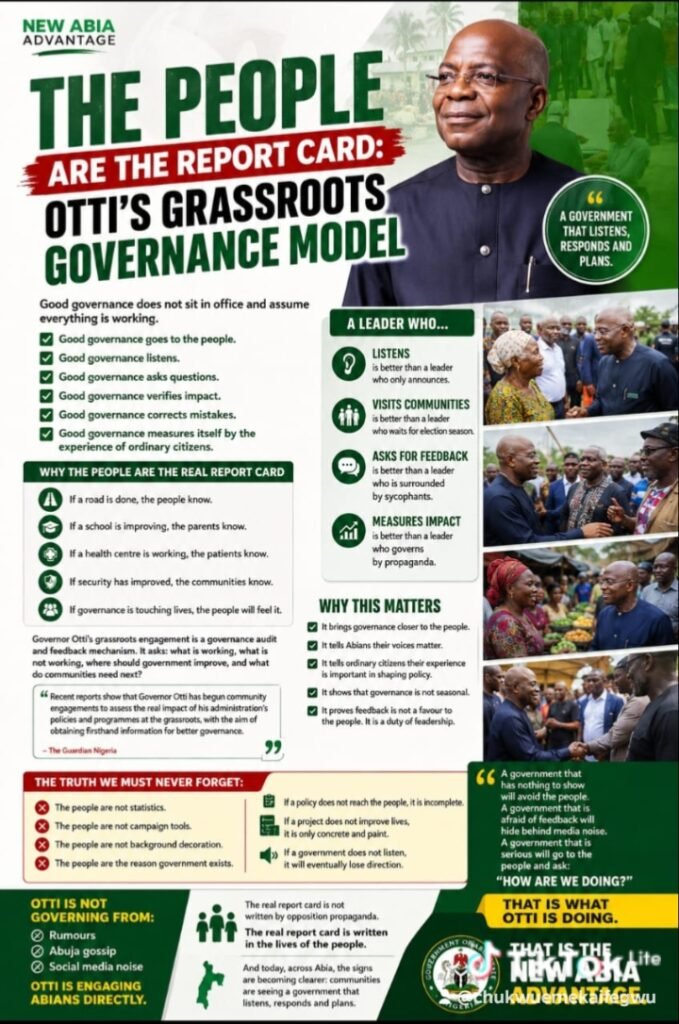
THE PEOPLE ARE THE REPORT CARD: OTTI’S GRASSROOTS GOVERNANCE MODEL
Good governance does not sit in office and assume everything is working.
Good governance goes to the people.
Good governance listens.
Good governance asks questions.
Good governance verifies impact.
Good governance corrects mistakes.
Good governance measures itself by the experience of ordinary citizens.
This is why Governor Alex Otti’s grassroots engagement approach is important.
A serious government should not depend only on files, memos, praise singers and official reports. A serious government must listen to the market woman, the youth, the teacher, the farmer, the artisan, the transporter, the community leader, the civil servant, the student and the elderly.
Why? Because the people are the real report card.
If a road is done, the people know.
If a school is improving, the parents know.
If a health centre is working, the patients know.
If security has improved, the communities know.
If governance is touching lives, the people will feel it.
This is why Otti’s community engagement initiative must be understood as more than politics. It is a governance audit. It is a feedback mechanism. It is a way of asking: what is working, what is not working, where should government improve, and what do communities need next?
Recent reports show that Governor Otti has begun community engagements to assess the real impact of his administration’s policies and programmes at the grassroots, with the aim of obtaining firsthand information for better governance. �
The Guardian Nigeria +2
That is how modern government should behave.
A leader who listens is better than a leader who only announces.
A leader who visits communities is better than a leader who waits for election season.
A leader who asks for feedback is better than a leader who is surrounded by sycophants.
A leader who measures impact is better than a leader who governs by propaganda.
The beauty of Otti’s approach is that it brings governance closer to the people. It tells Abians that government is not a distant institution. It tells communities that their voices matter. It tells ordinary citizens that their experience is important in shaping policy.
That is people-centred governance.
And let us be honest: many politicians only remember the grassroots when they need votes. They remember villages during campaigns. They remember communities when they need endorsement. They remember market women when cameras are present. But after elections, the people disappear from their agenda.
Otti is changing that.
By going back to the communities before the heat of the campaign season, he is showing that governance is not seasonal. Development is not a campaign trick. Feedback is not a favour to the people. It is a duty of leadership.
This is the message we must push:
The people are not statistics.
The people are not campaign tools.
The people are not background decoration.
The people are the reason government exists.
If a policy does not reach the people, it is incomplete.
If a project does not improve lives, it is only concrete and paint.
If a government does not listen, it will eventually lose direction.
Governor Otti’s grassroots engagement is therefore a mark of confidence. A government that has nothing to show will avoid the people. A government that is afraid of feedback will hide behind media noise. A government that is serious will go to the people and ask: “How are we doing?”
That is what Otti is doing.
Let the message be clear:
Otti is not governing from rumours.
Otti is not governing from Abuja gossip.
Otti is not governing from social media noise.
Otti is engaging Abians directly.
The real report card is not written by opposition propaganda.
The real report card is written in the lives of the people.
And today, across Abia, the signs are becoming clearer: communities are seeing a government that listens, responds and plans.
That is the New Abia advantage.