

ABA HAS SHOWN THE FUTURE: WHY ABIA’S PRIVATE-SECTOR POWER MODEL IS MORE EFFICIENT, MORE PRACTICAL AND MORE SUSTAINABLE
Let us begin with fairness.
Governor Peter Mbah of Enugu State deserves commendation. His plan for a 660MW coal-fired power plant, an AI Institute, a technology incubation centre, improved security architecture, one-stop investment shop and stronger private-sector engagement shows ambition.
No serious person should mock a governor for thinking big.
So, yes:
Hail Mbah for ambition.
Hail Mbah for seeing that electricity is the foundation of industrialisation.
Hail Mbah for understanding that no state can grow without power.
But after giving Enugu its flowers, we must now compare the models properly.
And when we compare properly, Abia State stands taller.
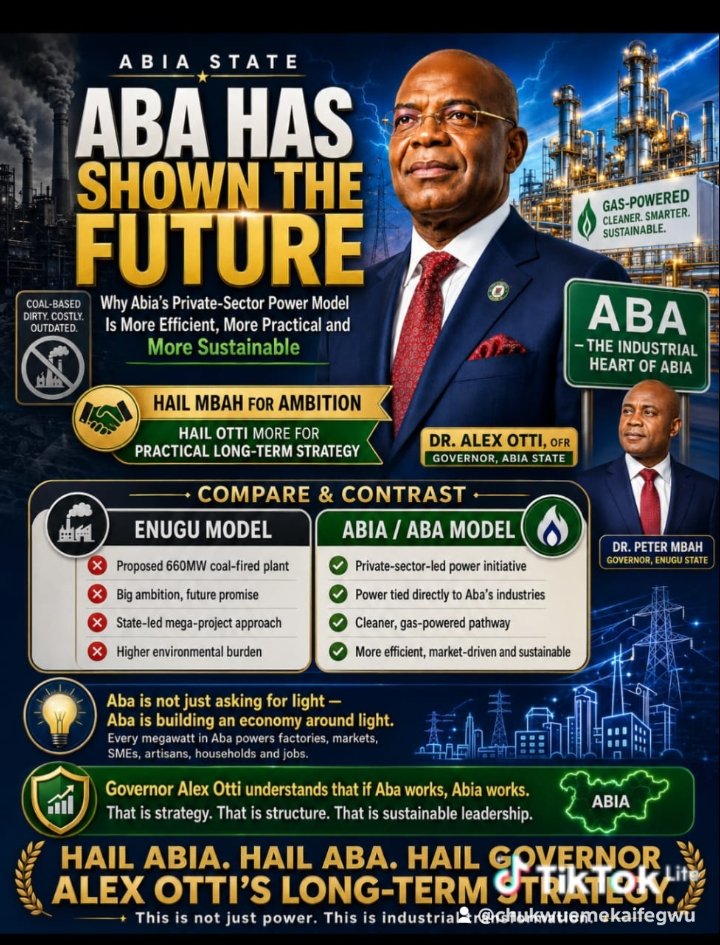
The Abia model, especially the Aba private-sector power initiative, is more efficient, more sustainable, more commercially realistic and more directly tied to production than Enugu’s proposed coal-fired model.
The Aba power model is not just about megawatts. It is about industrial usefulness.
It is not merely about announcing a big number. It is about delivering power to a real productive economy.
Aba is not an ordinary city. Aba is an industrial republic of its own. Aba has manufacturers, artisans, leather producers, garment makers, fabricators, welders, traders, SMEs, exporters, transporters, markets and small factories that have been surviving for decades despite poor electricity.
So, when power enters Aba, it does not enter emptiness.
It enters machines.
It enters workshops.
It enters markets.
It enters production lines.
It enters jobs.
It enters the pocket of the ordinary man.
That is why the Aba power model is superior.
Enugu is proposing a 660MW coal-fired power plant. That is big and commendable. But it is still a future promise. It is still at the level of groundbreaking, planning, financing, construction, environmental management, fuel logistics, transmission, distribution and regulatory execution.
Abia, on the other hand, has a working private-sector-led power initiative in Aba. The Aba model is already structured around generation, distribution and industrial consumption. It is not just power generation in isolation. It is an integrated electricity ecosystem.
That is the difference.
Enugu is talking about future power.
Abia is building productive power.
Enugu is proposing a coal plant.
Abia is advancing a private-sector gas-powered industrial model.
Enugu is planning a large state-backed electricity project.
Abia is demonstrating a commercially disciplined, private-sector-driven model.
That is why Governor Alex Otti deserves serious praise.
Otti is not merely chasing applause. He is thinking long term. He understands that the real economic heart of Abia is Aba. He understands that if Aba works, Abia works. He understands that power, roads, security, markets, investment confidence and governance discipline must come together.
That is strategy.
That is structure.
That is sustainable leadership.
Aba’s model is more efficient because it is demand-driven. Every megawatt in Aba has a waiting customer. Every improvement in power supply has an immediate economic use. Aba does not need to first create demand for power. The demand has existed for decades.
The shoemaker needs power.
The garment producer needs power.
The welder needs power.
The cold-room operator needs power.
The hotel needs power.
The printer needs power.
The factory needs power.
The market needs power.
The household needs power.
The student needs power.
The hospital needs power.
This is why Abia’s model is economically intelligent. It starts from where production already exists and then strengthens it.
Enugu’s coal-fired model may eventually provide large electricity output, but coal comes with serious questions. Even if the coal is described as low-sulfur and high quality, coal remains coal. Coal power carries environmental burdens: emissions, ash disposal, land disturbance, air-quality risks, water use, climate-finance concerns and future sustainability pressure.
Gas is not perfect, but it is cleaner and more realistic as a transition fuel for an industrial economy like Aba. It gives Abia a more modern and flexible pathway. It is easier to defend environmentally than coal. It is more acceptable in today’s global investment climate. It aligns better with the future of cleaner industrialisation.
So the comparison is not just Abia versus Enugu.
It is also:
Private-sector discipline versus government mega-project risk.
Gas transition model versus coal dependency.
Industrial demand-led electricity versus politically announced megawatts.
Practical execution versus future promise.
Productive power versus projected power.
This is why Abia deserves praise.
The Aba private-sector power initiative is not only about lighting bulbs. It is about reducing the cost of doing business. It is about cutting dependence on diesel and petrol generators. It is about helping small businesses survive. It is about making Made-in-Aba products cheaper, stronger and more competitive. It is about turning the ingenuity of Aba people into real industrial output.
That is development.
That is the kind of power that changes society.
Power that enters a factory is better than power that remains in a speech.
Power that enters a market is better than power that remains in a press release.
Power that strengthens production is better than power that only sounds good as a headline.
Governor Otti’s long-term strategy is clear. He is not trying to build Abia from the roof. He is building from the foundation. Roads first. Security. Investor confidence. Aba renewal. Support for enterprise. Private-sector partnership. Better infrastructure. Institutional seriousness.
That is why his approach is sustainable.
A state government cannot carry the economy alone. The wiser strategy is to create an environment where private capital can invest, produce, employ and expand. That is what Abia is doing. Government is enabling. Private sector is producing. The people are benefiting.
This is the true meaning of development partnership.
And that is why Abia’s model should be studied.
Abia is saying: let us power where people are already producing.
Abia is saying: let us support the industrial spirit of Aba.
Abia is saying: let government provide the enabling environment while private-sector discipline drives growth.
Abia is saying: let electricity become an economic weapon, not just a political slogan.
That is why the Abia model is more sustainable.
Now, nobody should misunderstand the argument. Enugu’s ambition is good. Mbah’s vision deserves respect. His effort to attract the organised private sector is commendable. His focus on AI, technology, security and investment is forward-looking.
Again:
Hail Mbah for ambition.
But when it comes to practical industrial power strategy, Otti’s Abia is ahead.
Because Abia is not only thinking of power supply. Abia is thinking of what power will do.
Power must produce.
Power must employ.
Power must expand businesses.
Power must reduce poverty.
Power must grow SMEs.
Power must strengthen manufacturing.
Power must increase competitiveness.
Power must help ordinary people.
That is the Aba logic.
That is the Otti strategy.
And that is why it is long term.
In Aba, electricity is not just infrastructure. It is economic oxygen. It is the difference between a tailor working for five hours and a tailor working for fifteen hours. It is the difference between a factory running on expensive diesel and a factory producing at lower cost. It is the difference between survival and expansion.
So, while Enugu is planning a massive coal-fired plant, Abia is backing a model that directly touches the productive class.
That is the superior model.
Aba does not need power for decoration.
Aba needs power for production.
Aba does not need electricity for political grammar.
Aba needs electricity for industry.
And Governor Alex Otti understands this clearly.
That is why his long-term strategy must be praised. He is not just trying to win headlines. He is trying to reposition Abia as a serious industrial economy. He is aligning governance with the natural strength of the state. He is using Aba as the engine room of Abia’s future.
This is how to govern.
This is how to build.
This is how to think beyond one tenure.
This is how to plan for generations.
At the end of the day, Enugu’s 660MW coal plan may be bold, but Abia’s Aba power model is more efficient, more sustainable and more immediately useful.
Enugu is proposing power.
Abia is industrialising with power.
Enugu is chasing capacity.
Abia is chasing productivity.
Enugu is banking on coal.
Abia is leveraging private-sector energy for enterprise.
Enugu’s plan is a promise of what may come.
Abia’s model is a foundation for what is already happening.
So let us praise Mbah for ambition.
But let us praise Otti more for practical wisdom.
Let us praise Otti for long-term thinking.
Let us praise Otti for understanding Aba.
Let us praise Otti for placing private-sector initiative at the centre of development.
Let us praise Otti for seeing that the true wealth of Abia is not in noise, but in production.
Abia is not just promising light.
Abia is building an economy around light.
And that is why the Aba private-sector power model remains one of the smartest, most efficient and most sustainable subnational development strategies in Nigeria today.
Hail Abia.
Hail Aba.
Hail Governor Alex Otti’s long-term strategy.
This is not just power.
This is industrial transformation.