
Demystifying the “₦97bn Schools / 57% Enrolment” Debate: Understanding the Abia Education Reform Conversation
The current debate about Abia’s education sector has become a clash between dramatic photographs and fiscal interpretation. On one side are circulating images of dilapidated schools used to argue that nothing has changed. On the other side are government statements about increased enrolment and ongoing school rehabilitation. The responsible position lies somewhere between these extremes: separating verifiable records from exaggerated claims.
- The ₦97 Billion Claim: A Question of Classification
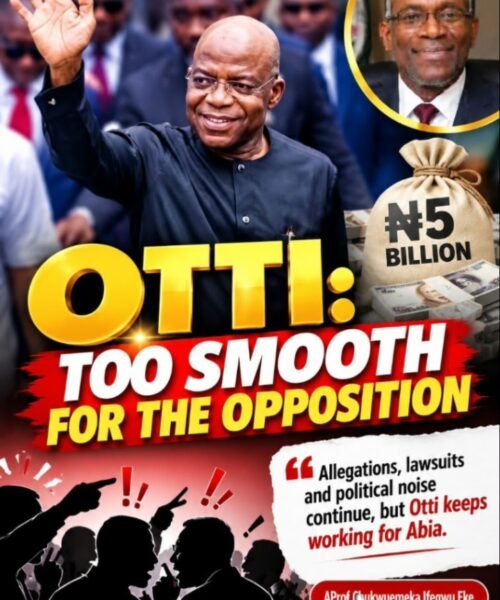
One of the loudest accusations is that ₦97 billion has been spent on building or rehabilitating schools in Abia since 2023 with nothing to show for it. Yet this figure is frequently quoted without referencing the exact table, programme classification, or quarter of the budget implementation reports from which it supposedly originates.
Public reporting has actually focused on a different and smaller controversy — about ₦54 billion allegedly tied to school renovation and retrofitting programmes. The issue reported in national media was not an established ₦97bn expenditure, but a political dispute over the scale and transparency of school renovation spending.
This distinction matters. Government budgets often group basic education, secondary education, administrative support, teacher development, infrastructure rehabilitation, furniture, and counterpart funding under the broad “education” umbrella. When these categories are lumped together and presented as “schools built,” the result is a misleading headline figure.
Thus, the core debate is not whether ₦97bn has been verifiably spent on completed schools — the documents cited in public discussions do not clearly establish that. The real debate is how much has been allocated to education interventions and how transparently those interventions are being implemented. - “No Schools Have Been Completed” – A Sweeping Claim
Another recurring statement is that no public schools anywhere in Abia have been renovated or completed since 2023. That assertion is far too absolute to stand as a proven fact.
Government officials have publicly maintained that numerous school renovation and retrofitting projects are ongoing, and they have shared photographic evidence of reconstruction works across several locations. While photographs alone are not sufficient proof of project completion or value for money, they do contradict the claim that absolutely nothing is happening anywhere.
A balanced assessment must therefore acknowledge two realities:
- Some schools remain in poor condition after decades of neglect.
- Some renovation and retrofitting works appear to be ongoing.
Both can exist simultaneously.

- The Enrolment Increase Debate
Another point of contention is the claim that public school enrolment has increased significantly — sometimes cited as about 57 percent.
What can be fairly stated is that government officials have publicly claimed a sharp rise in enrolment, attributing it to education policy reforms and improved access to public schooling.
However, the exact percentage requires independent verification. For a claim of this magnitude to be confirmed, analysts would typically rely on:
- SUBEB administrative enrolment data
- UBEC data series
- school-by-school enrolment registers
- independent audit sampling
Until such datasets are independently reviewed, the enrolment figures should be understood as government-reported outcomes rather than independently validated statistics.
- The Teacher Employment Narrative
Another frequently repeated narrative is that the current administration dismissed about 5,000 teachers employed by the previous government and replaced them with another 5,000.
Available public discussions confirm that teacher recruitment and workforce restructuring have occurred, but the specific claim that exactly 5,000 teachers were sacked from the previous administration is less clearly documented in publicly verifiable records.
Without formal disengagement lists, union statements, or court filings supporting that number, the claim remains an allegation rather than a confirmed statistic. - Photographs vs. Statewide Reality
One widely circulated image showing the poor condition of a school near Nvosi has been used as evidence that the entire education reform narrative is false.
But a photograph proves the condition of a particular school at a particular moment — not the status of an entire statewide programme.
To properly evaluate the education sector, the debate should move from isolated images to structured data, including:
- a comprehensive list of renovated schools
- project locations by LGA
- contractors and contract values
- timelines and completion status
- before-and-after documentation
This approach would replace speculation with verifiable evidence.
- The Real Issue: Transparency and Reform Pace
Abia’s education system suffered decades of deterioration before the current administration. Reversing that backlog cannot realistically occur in a single budget cycle.
The real question therefore is not whether problems remain — they clearly do — but whether systematic reforms and infrastructure upgrades are underway and whether they are being communicated transparently enough for the public to verify them.
The present administration has positioned itself as a reform-driven government attempting to rebuild institutions that had long been neglected. Critics have an important role in demanding accountability, but that accountability should be based on accurate interpretation of fiscal data rather than exaggerated figures or absolute claims.
Conclusion
When stripped of political rhetoric, the Abia education debate comes down to four practical points:
- The widely circulated ₦97bn figure is not clearly anchored in the cited fiscal tables.
- The documented controversy reported publicly relates more directly to about ₦54bn in school renovation claims.
- The claim that no schools have been renovated anywhere is too absolute and not conclusively proven.
- The 57% enrolment increase remains a government-reported claim that requires independent verification.
What Abia needs now is not louder accusations or louder celebrations, but structured disclosure: a transparent list of projects, locations, contractors, and timelines.
When that information becomes fully accessible, citizens will no longer rely on political narratives — they will rely on evidence.
AProf Chukwuemeka Ifegwu Eke