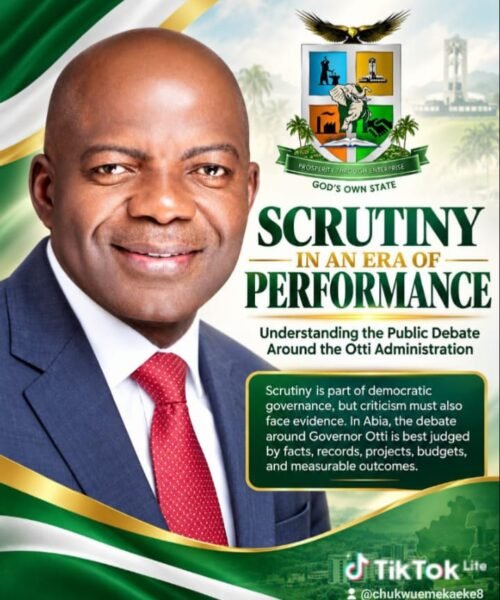


ALEX OTTI: POLITICAL HISTORY, PHILOSOPHICAL ROOTS, AND THE LOGIC OF HIS CHOICES
- Political History: From Technocracy to Reform Politics.
Governor Alex C. Otti did not emerge from Nigeria’s traditional political apprenticeship of patronage, godfatherism, or rent distribution. His political entry point was technocratic, not transactional.
Before elective politics, Otti’s public profile was shaped by:
Banking sector leadership,
Corporate governance,
Institutional reform,
And systems-based decision-making.
This background explains why his political style often clashes with Nigeria’s dominant political culture. He approaches governance as a management problem, not a reward system.
His repeated electoral contests before eventual victory in 2023 reflect a long-horizon strategy, not opportunism. He stayed the course, refined messaging, and built a reform coalition rather than shopping for shortcuts.
This persistence is itself evidence of ideological consistency.
- Philosophical Stance: Institutionalism Over Populism.
At the core of Otti’s philosophy is a simple but disruptive idea:
The state must be governed as an institution, not as a charity.
This places him firmly within the institutionalist school of political thought, traceable to:
Max Weber’s theory of rational-legal authority,
New Public Management (NPM),
And modern developmental-state models (East Asia, Rwanda, Singapore).
Key features of this philosophy in practice:
Rejection of “stomach infrastructure”,
Emphasis on systems (healthcare staffing, power regulation, digitisation),
Preference for rules, processes, and metrics over symbolism.
This is why critics who demand cash distribution, optics, or instant spectacles often interpret his governance as “cold” or “elitist”. In reality, it is structural.
- Labour Party Alignment: Ideological, Not Accidental
Otti’s affiliation with the Labour Party (LP) is best understood ideologically, not tactically.
The Labour Party’s core ideas—social investment, state responsibility for welfare, and productive governance—align naturally with:
His emphasis on healthcare reform,
Human capital recruitment,
Infrastructure over consumption.
His public reaffirmation of loyalty to LP, while acknowledging political uncertainty (“nobody knows tomorrow”), reflects political realism, not disloyalty. It is a statement rooted in the classical realist understanding of politics: circumstances evolve, but current commitments matter.
Crucially, he has:
Rejected opportunistic defection narratives,
Ruled out opposition coalitions driven purely by anti-incumbency,
Described LP as “a coalition of its own”.
This signals identity politics of ideas, not convenience.
- Relationship with Predecessors: Reform vs. Continuity
The much-publicised “gang-up” by former governors is not historically unusual. Reform leaders often face resistance from beneficiaries of old orders.
In political history, this pattern is consistent:
Obasanjo vs. old military networks,
Awolowo vs. establishment coalitions,
Reformist governors vs. patronage elites.
The conflict is structural, not personal.
Otti’s reforms—particularly in finance discipline, LGA controls, power regulation, and administrative restructuring—inevitably threaten:
Informal revenue channels,
Discretionary spending habits,
And opaque governance cultures.
Resistance, therefore, becomes predictable, even necessary, in reform cycles.
- On 2027 and Alliances: Strategy, Not Sentiment
Otti’s refusal to frame 2027 politics around opposition coalitions against the federal government reflects a governance-first posture.
Philosophically, this aligns with:
Pragmatic federalism,
Cooperative governance,
Avoidance of populist antagonism.
Rather than positioning himself as an anti-federal crusader, he positions Abia as a state focused on internal reform, regardless of who controls the centre.
This is a state-building mindset, not a campaign mindset.
AProf Chukwuemeka Ifegwu Eke