
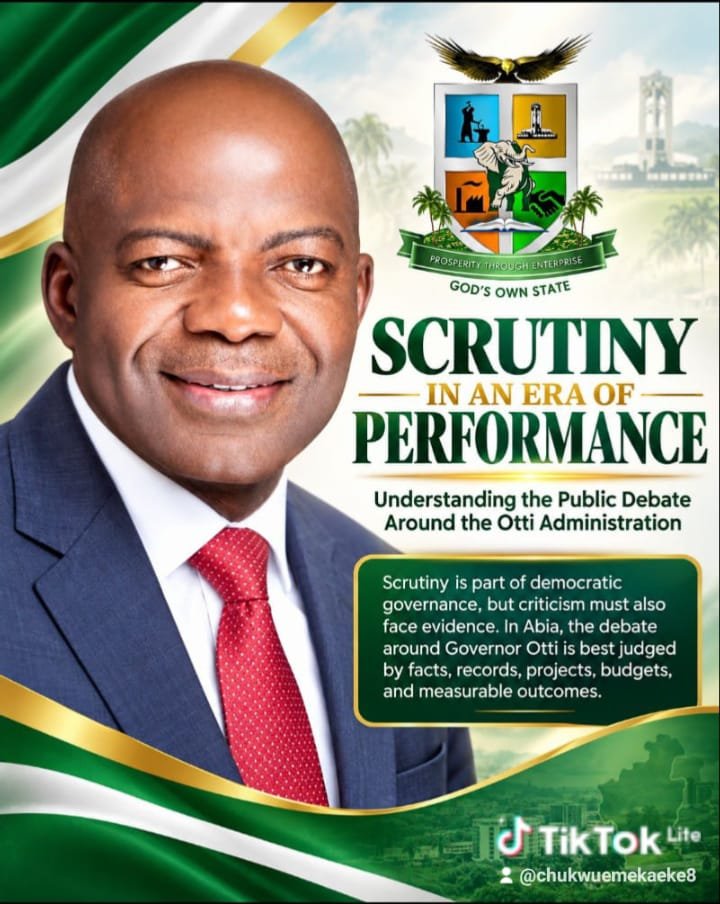
SCRUTINY IN AN ERA OF PERFORMANCE: UNDERSTANDING THE PUBLIC DEBATE AROUND THE OTTI ADMINISTRATION
Scrutiny is part of democratic governance. A government that spends public funds, makes policy choices and exercises executive authority must expect journalists, opposition parties, civil-society organisations and citizens to ask difficult questions. But scrutiny also has obligations: claims should be properly sourced, criticism should distinguish facts from interpretation, and political commentary should be tested against the record it seeks to challenge.
The administration of Governor Alex Otti of Abia State has, particularly in 2026, become the subject of an expanding public debate involving journalists, columnists, opposition politicians, activists and several national and digital media platforms. Much of that debate has revolved around transparency, economic outcomes, public expenditure, infrastructure and the governor’s relationship with critical voices.
What is striking, however, is that several of the strongest criticisms have arisen during a period in which the administration has also been reporting substantial activity in roads, education, healthcare and public investment. This makes the Abia conversation more complicated than a simple contest between government praise and opposition criticism. It is better understood as a debate over how performance should be measured, communicated and independently verified.
CHIKA NWABUEZE AND THE FEBRUARY 27, 2026 MEDIA CHAT
One of the defining moments came on 27 February 2026, during Governor Otti’s monthly media engagement in Umuahia. Chika Nwabueze of Don Media Group asked the governor to provide verifiable data demonstrating how his policies had directly improved the economic circumstances and living conditions of ordinary Abians beyond road construction and other visible infrastructure.
The substance of the question was legitimate. Public policy should ultimately be capable of measurement.
Governor Otti responded by challenging both the assumptions behind the question and the journalist’s preparation. He referred to improved roads, free education initiatives, primary healthcare facilities, public transportation and shorter travelling times, while insisting that some benefits of governance were already visible to residents.
During the exchange, however, he used expressions that included the words “stupid” and “irresponsible.” TheCable reported the encounter on 28 February 2026, and video footage also circulated through ABN TV and social-media platforms.
The weakness in the subsequent debate is that the controversy over the governor’s language quickly became mixed up with the entirely different question of whether the administration had measurable achievements.
Those are not the same issue.
A governor’s choice of words can be criticised without automatically establishing that his administration has failed to produce measurable outcomes. Conversely, roads and health facilities do not remove the obligation to answer questions about economic welfare.
The more useful test is therefore empirical.
By May 2026, Governor Otti stated that his administration had completed 414 road projects covering about 864 kilometres, while further road projects were underway. Premium Times separately reported that claim following the governor’s May media briefing.
Abia government records also reported extensive interventions in primary healthcare and education. At the administration’s third-anniversary event, the government stated that more than 277 primary healthcare centres had been retrofitted or functionalised, nearly 1,000 healthcare professionals recruited, and 5,394 teachers recruited in an earlier exercise, with another 4,000 being recruited.
These remain government-reported figures and should be independently tested, but they are measurable propositions rather than vague political slogans.
Sources:
www.thecable.ng
www.abntv.com.ng
www.premiumtimesng.com
www.abiastate.gov.ng
BAYO OLUPOHUNDA AND THECABLE
On 2 March 2026, columnist Bayo Olupohunda published an article in TheCable titled “When Alex Otti Chose Insult Over Accountability.”
Olupohunda argued that the governor should have answered Nwabueze with statistics showing changes in poverty, infrastructure, healthcare, education and living conditions rather than responding angrily. He also argued that journalists must remain free to interrogate elected leaders.
Yet one aspect of Olupohunda’s own article is important to the wider debate: he acknowledged that Otti had been widely praised for performance in Abia and suggested that providing additional data would have strengthened the governor’s case.
That distinction matters.
The article was principally persuasive as a criticism of the manner of response. It did not, by itself, establish that there was no underlying performance record.
The challenge for a more balanced assessment is therefore to examine available data rather than infer administrative failure from a single confrontation.
For example, Abia’s approved 2026 budget is ₦1.016 trillion, with approximately ₦811.8 billion, or 80 per cent, allocated to capital expenditure and roughly 20 per cent to recurrent expenditure.
A large capital allocation is not proof that every project has been completed. But neither can a serious fiscal analysis ignore the actual structure of the budget.
Sources:
www.thecable.ng
www.abiastate.gov.ng
LANRE AROGUNDADE AND THE INTERNATIONAL PRESS CENTRE
On 3 March 2026, the International Press Centre, through its Executive Director, Lanre Arogundade, criticised the governor’s treatment of Chika Nwabueze.
Arogundade’s position was that a journalist was entitled to ask an elected official for measurable evidence of performance and that a media chat necessarily exposes government to scrutiny. The IPC consequently called on Governor Otti to apologise.
On press freedom, that argument raises a legitimate democratic principle. Journalists should be free to interrogate public officials.
But the limitation of extending that incident into a general assessment of governance is equally clear: a dispute about treatment of a journalist is not, by itself, an audit of the Abia government’s developmental record.
If the debate concerns performance, then the proper evidence should include projects delivered, expenditure actually incurred, educational outcomes, healthcare access, transportation improvements, internally generated revenue, employment and other measurable indicators.
The IPC’s intervention therefore contributes importantly to the press-freedom conversation, but it cannot substitute for a comprehensive evaluation of the administration’s record.
Source:
www.guardian.ng
PRINCE PAUL IKONNE AND THE APC CRITIQUE
Prince Paul Ikonne, an APC chieftain in Abia State, entered the controversy on 1 March 2026.
He described the governor’s reaction as a “dictatorial outburst,” demanded an apology and asked questions touching on taxation, employment, primary healthcare and the economic effects of the administration’s policies. Vanguard and TheCable reported his intervention.
Some of Ikonne’s questions are capable of empirical testing and should be treated accordingly.
For example, he questioned the administration’s claim concerning health centres. That is precisely the type of assertion that should be checked against project locations, completion status, staffing, equipment and utilisation.
But another weakness appears when political rhetoric advances beyond what the available evidence establishes. Descriptions such as “dictatorial” are political characterisations, not independently proven measurements of fiscal performance or infrastructure delivery.
Likewise, asking “where are the health centres?” does not itself demonstrate that they do not exist.
The government’s position, meanwhile, is that hundreds of primary healthcare facilities have undergone rehabilitation or functionalisation, alongside recruitment of healthcare workers. The appropriate response to that claim is verification, not either automatic acceptance or automatic dismissal.
Sources:
www.vanguardngr.com
www.thecable.ng
www.abiastate.gov.ng
ELDER ABRAHAM AMAH AND THE ABIA PDP
The Abia State PDP, through its chairman Elder Abraham Amah, also criticised Governor Otti following the February media exchange.
On 1 March 2026, Vanguard reported the PDP’s argument that there was nothing improper about requesting empirical evidence concerning the effect of government policy on ordinary citizens. The Guardian subsequently reported the same controversy.
Again, the underlying demand for evidence is legitimate.
But the weakness in transforming the incident into a comprehensive verdict on the administration is that economic welfare is multidimensional.
Economic effects can arise through improved road connectivity, reduced travel time, access to schools, public health services, transport costs, business activity, security and private investment. They may not all immediately appear in a single poverty statistic.
That does not excuse government from producing more granular socioeconomic indicators. It simply means the absence of one requested number at a press conference cannot logically establish the absence of economic effects.
Sources:
www.vanguardngr.com
www.guardian.ng
OBINNA ORIAKU AND THE FISCAL ARGUMENT
A different and more technical line of criticism has come from former Abia State Commissioner for Finance Obinna Oriaku.
Oriaku has repeatedly questioned Abia’s budget size, revenue projections, expenditure classifications and budget-performance figures.
In an article published on 1 December 2025, he challenged the credibility of the administration’s proposed 2026 budget and argued that the state’s revenue performance did not justify a budget exceeding ₦1 trillion.
He had earlier published another critique concerning Abia’s Q2 2025 financial report, questioning particular expenditure figures and government explanations.
Unlike purely rhetorical criticism, Oriaku’s interventions frequently contain numbers. They therefore deserve examination against the official budget documents.
That comparison produces a more nuanced picture.
The enacted 2026 budget stands at ₦1,016,228,072,651.99, while the approved estimates show ₦811.8 billion for capital expenditure.
The official budget also records previous-year performance figures, meaning the administration’s projections can be measured against execution rather than accepted as promises.
There have also been instances in which specific budget entries generated controversy. In February 2026, for example, criticism arose over what was reported as a ₦210 million photocopier allocation.
The state government responded that the apparent entry resulted from a presentation or typographical issue and stated that the money was actually allocated for rehabilitation and repair of residential buildings and staff quarters at the Lagos Liaison Office. Punch reported both the criticism and government’s explanation.
That episode illustrates why scrutiny is useful, but also why scrutiny must follow an allegation through to the documentary explanation rather than stopping at the most dramatic headline.
Sources:
www.abiastate.gov.ng
www.punchng.com
www.mouthpiecengr.com
“PROFESSOR ENI” AND THE THISDAY INTERVENTION
Another strand of criticism came through an article published by THISDAY on 8 January 2026, under the title “Alex Otti Should Desist From Attacking Kalu and Tinubu.”
The article was attributed simply to “Professor Eni,” writing from Abuja.
It alleged insufficient transparency surrounding project costs and contracting processes, criticised what it regarded as intolerance of political opposition and argued that the governor should avoid confrontation with President Bola Tinubu and Senator Orji Uzor Kalu.
There are two weaknesses that should be noted when evaluating such an intervention.
First, a political commentary does not become an established factual finding merely because it appears in a national newspaper.
Second, where claims concern procurement secrecy or contract irregularities, those claims require documentary evidence: tender records, procurement notices, contract documents, audit findings or investigations.
The article raises issues that may legitimately be investigated. But allegations and proof remain different categories.
Source:
www.thisdaylive.com
THE NATION AND THE WIDER MEDIA COMMENTARY
The Nation also entered the debate. In an article titled “Otti, off the handle,” published on 6 March 2026, its Hardball column criticised the governor’s response to Nwabueze and treated the incident as raising questions about tolerance of scrutiny.
That criticism again rests principally on the February exchange.
Its weakness as a wider assessment of governance is the same: a communication failure, even where established, is not identical to a developmental failure.
An administration can simultaneously be criticised for an unnecessarily combative response to a journalist and credited, where evidence supports it, for infrastructure or social-sector interventions.
Public debate becomes distorted when either side insists that only one of those propositions can be true.
Source:
www.thenationonlineng.net
VANGUARD AS A PLATFORM FOR THE OPPOSITION RESPONSES
Vanguard became one of the significant platforms carrying the political reactions.
It reported both Prince Paul Ikonne’s APC criticism and Abraham Amah’s PDP response on 1 March 2026.
This is important because it demonstrates how a single February 27 encounter quickly became a multi-day national story.
But repetition across newspapers should not be confused with multiple independent findings of administrative failure.
Several reports concerned the same original incident and reproduced reactions arising from it.
In analytical terms, that means ten reports about one confrontation are still largely evidence about one confrontation.
They are not automatically ten separate pieces of evidence about roads, education, healthcare or fiscal management.
Source:
www.vanguardngr.com
FACEBOOK, X AND THE AMPLIFICATION OF POLITICAL NARRATIVES
The controversy also travelled extensively through Facebook and X, where edited video clips, commentary, partisan responses and political memes amplified the discussion.
This is where the distinction between visibility and verification becomes especially important.
A viral post can establish that a controversy is popular. It cannot establish that an allegation contained within the post is correct.
Similarly, slogans used either in support of or against the administration provide evidence of political messaging, not evidence of policy outcomes.
The correct response is not to suppress digital criticism. It is to subject it to documentary scrutiny.
WHAT THE PERFORMANCE RECORD ADDS TO THE DEBATE
Any article about scrutiny of the Otti administration that omits the administration’s measurable claims would present only half of the argument.
According to government figures subsequently reported by independent media, the administration stated by May 2026 that it had completed 414 road projects totalling approximately 864 kilometres.
The government has also reported more than 277 primary healthcare centres rehabilitated or functionalised, recruitment of nearly 1,000 health professionals, and thousands of newly recruited teachers.
The state’s 2026 budget of ₦1.016 trillion commits approximately 80 per cent to capital expenditure.
Education received approximately 20 per cent of the 2026 budget, according to both the governor and published budget reporting.
These statistics do not mean criticism should stop.
They mean criticism should become more sophisticated.
Instead of asking only whether roads have been built, the next questions should include their costs, procurement processes, geographical distribution, quality and economic effects.
Instead of merely counting health centres, scrutiny should examine staffing, drugs, utilisation and patient outcomes.
Instead of celebrating education allocations, scrutiny should compare allocations with actual releases, expenditure and learning outcomes.
That is accountability at its strongest.
SCRUTINY SHOULD BE AS RIGOROUS AS THE PERFORMANCE IT QUESTIONS
There is nothing inherently hostile about scrutinising Governor Alex Otti.
Chika Nwabueze was entitled to ask his question.
Bayo Olupohunda was entitled to criticise the governor’s response.
Lanre Arogundade and the International Press Centre were entitled to defend the professional space of journalists.
Prince Paul Ikonne and Elder Abraham Amah are entitled, as opposition political actors, to challenge the administration.
Obinna Oriaku is entitled to interrogate budget documents and expenditure.
Newspapers such as TheCable, Vanguard, The Nation, The Guardian, THISDAY and others are entitled to publish criticism and commentary.
But none of those interventions should be treated as self-proving simply because it is critical.
The same evidentiary standard applied to government should be applied to the critic.
When an allegation concerns expenditure, examine the financial records.
When it concerns an abandoned project, identify the project.
When it concerns revenue, produce the figures.
When it concerns contracting, provide the procurement evidence.
When government claims hundreds of roads, identify and inspect them.
When government claims improved healthcare, measure actual access and outcomes.
That is how a democratic society distinguishes scrutiny from propaganda, accountability from partisan messaging, and evidence from assertion.
The emerging Abia debate therefore need not be framed as Alex Otti versus his critics.
A more useful formulation is claim versus evidence.
And in an era in which the administration is asserting significant performance in infrastructure, health, education and public investment, that higher standard of scrutiny is not a favour to Governor Otti.
It is what the people of Abia deserve.
KEY SOURCE PLATFORMS