
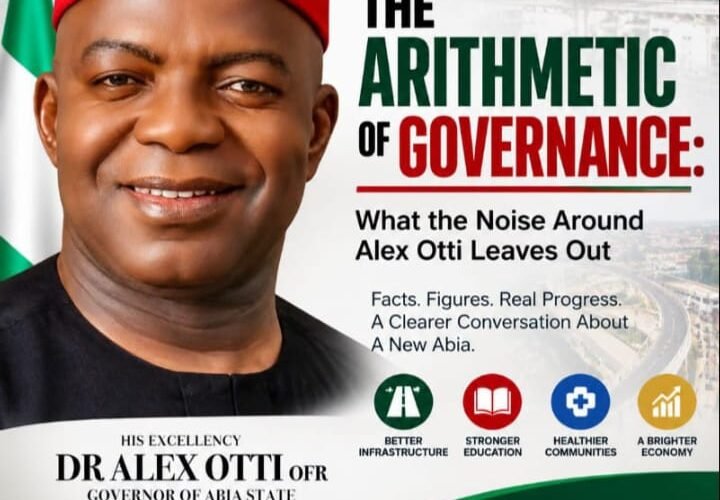

THE ARITHMETIC OF GOVERNANCE: WHAT THE NOISE AROUND ALEX OTTI LEAVES OUT
There is a curious arithmetic developing around the governance of Abia State: every allegation is amplified as fact, every controversy is treated as a verdict, while the visible evidence of reconstruction, reform and institutional renewal is too often relegated to the footnotes.
That arithmetic is defective.
Governor Alex Otti’s administration does not ask journalists, commentators or political opponents to abandon scrutiny. Scrutiny is indispensable to democracy. But scrutiny must also submit itself to the discipline it demands from government: facts, context, balance and evidence.
WHAT HAS BEEN WRITTEN?
On January 8, 2026, THISDAY published “Alex Otti Should Desist From Attacking Kalu and Tinubu,” written by Kalu Eni, who was identified by the newspaper as Professor Eni, writing from Abuja.
The article alleged, among other things, inadequate transparency in project costs and contract processes, political intolerance and unnecessary confrontation with federal political figures.
These are serious assertions. But an opinion article is precisely that—an opinion. Its publication does not automatically transform its allegations into established facts.
On March 2, 2026, TheCable published “When Alex Otti Chose Insult Over Accountability,” written by Bayo Olupohunda.
His commentary arose from Governor Otti’s exchange with journalist Chika Nwabueze during a media interaction. Olupohunda strongly criticised the Governor’s response and argued that the administration should provide measurable evidence of its impact on poverty, infrastructure, education and citizens’ welfare.
There is an important point even within that critical article that should not disappear beneath the provocative headline: the writer himself acknowledged that Governor Otti has received praise for his performance.
That is precisely why Abia must now move the conversation from adjectives to arithmetic.
THE ₦54 BILLION QUESTION
The Punch has also carried reports concerning allegations surrounding education expenditure.
On August 17, 2025, The Punch published “Otti fumes over N54bn missing fund,” written by Imoleayo Oyedeyi.
The report recorded Governor Otti’s response that the figure being circulated represented budgetary provisions and should not automatically be interpreted as proof that ₦54 billion in public funds had disappeared or been misappropriated.
Then, on September 3, 2025, The Punch published “Otti dismisses EFCC petition over N54bn education fund,” written by Abdulrahman Zakariyau.
The report concerned allegations made by APC chieftain Eze Chikamnayo and petitions reportedly submitted to anti-corruption agencies. The same report also carried the government’s rebuttal, maintaining that school construction, renovation and equipping projects were visible across the state.
That distinction matters enormously.
A petition is not a conviction.
An allegation is not an audit finding.
A budgetary provision is not automatically equivalent to money stolen.
And a newspaper headline is not a judicial verdict.
Democratic accountability demands that these categories must never be carelessly collapsed into one another.
SO, LET US DO THE ARITHMETIC
The proper question is not whether Alex Otti has critics. Every consequential government has critics.
The proper questions are measurable.
How many roads have been reconstructed?
How many communities previously disconnected have become accessible?
What is happening in public schools?
What investments are being made in healthcare?
How has Aba’s commercial environment changed?
What reforms have been introduced in public finance, pensions and the civil service?
What has happened to investor confidence?
And ultimately, is Abia today moving forward or backward?
That is the arithmetic that matters.
Government welcomes interrogation of those numbers.
It welcomes independent verification.
It welcomes journalists visiting project sites, interrogating budget-performance documents, questioning commissioners and comparing promises with delivery.
What it rejects is the conversion of political accusations into presumed guilt before evidence has spoken.
ALEX OTTI DOES NOT REQUIRE A MEDIA SHIELD
The Governor does not need to be protected from legitimate questions. His administration must answer them.
But accountability is a two-way street.
Those who demand evidence from government must equally provide evidence for their accusations.
Those who insist on transparency must distinguish between expenditure, appropriation, releases, commitments and completed projects.
And those who invoke anti-corruption agencies must remember that submitting a petition merely initiates scrutiny; it does not prove the allegation contained in that petition.
Abia should therefore welcome the debate—but elevate it.
Let the critics bring their figures.
Let government bring its records.
Let journalists inspect the projects.
Let citizens interrogate both sides.
And then let evidence, rather than political volume, decide the argument.
THE REAL STORY OF ABIA WILL NOT BE WRITTEN BY NOISE
History rarely remembers who shouted loudest during a period of transformation.
It remembers what was built.
It remembers what institutions were repaired.
It remembers what lives improved.
It remembers what inheritance was left behind.
Governor Alex Otti should therefore be assessed rigorously.
But let that assessment be based on the arithmetic of governance—not the arithmetic of outrage.
Because ultimately, roads can be counted.
Schools can be inspected.
Hospitals can be visited.
Budgets can be audited.
Investments can be measured.
And citizens can judge whether their state has changed.
That is where this debate should go.
Facts against claims.
Evidence against conjecture.
Performance against politics.
THE ARITHMETIC OF GOVERNANCE HAS ONLY ONE FINAL ANSWER: RESULTS.