
OTTI LISTENS: WHY WHISTLEBLOWERS, CRITICAL VOICES AND SURGICAL ANALYSIS MATTER IN GOVERNANCE
There is an important democratic lesson emerging from the recent developments surrounding Abia State University, Uturu. It goes beyond the strike. It goes beyond salaries, allowances, promotions and administrative bottlenecks. It is about the usefulness of dissent, the value of whistleblowers and, ultimately, the character of a government that is prepared to listen when uncomfortable issues are placed before it.
Governor Alex Otti’s public apology to the Academic Staff Union of Universities, Abia State University branch, deserves attention for precisely this reason. At the Abia@35 celebration, the Governor admitted that the industrial action was avoidable. More importantly, he stated that the demands of the lecturers had been approved as far back as April 2026, but that implementation was frustrated by administrative delays. He did not pretend that nothing had happened. He did not simply blame ASUU. He acknowledged a failure within government and warned officials against frustrating approved directives. That admission matters.
But another group also deserves recognition: the people who raised the alarm when the situation was uncomfortable to discuss. Professor Nnamdi Nwaeze, the lecturer whose public interventions eventually became part of a much wider controversy and who was subsequently suspended pending investigation, must be acknowledged within this conversation. One does not have to accept every figure, every interpretation or every allegation attributed to him in order to recognise the democratic importance of speaking up about staff welfare.
That distinction is essential. A whistleblower does not have to be infallible before the underlying issue he raises deserves investigation. Responsible public discourse requires that claims be tested, figures interrogated and exaggerations corrected where necessary. But it would be equally wrong to dismiss every uncomfortable intervention simply because the messenger speaks forcefully. In this case, the central issue was real: lecturers had unresolved welfare concerns. ASUU eventually embarked on an indefinite strike. The Governor has now acknowledged that the strike should not have occurred because approvals had already been given and implementation was delayed.
That brings us to the second group that should be celebrated: those who subjected the controversy to serious, concise and surgical analysis. Not every contribution to public debate came in the form of shouting. Some people asked uncomfortable but necessary questions. What exactly had government approved? When was it approved? Where did implementation break down? Were the figures being circulated gross salaries or net salaries? What were the actual components of the salary structure? What happened to promotions, earned academic allowances, omitted salaries and check-off dues? Who was responsible for moving approved decisions through the administrative machinery?
Those analyses were useful precisely because they refused two lazy extremes. They refused the temptation to declare that everything in Abia had failed merely because ABSU lecturers had genuine grievances. But they equally refused the temptation to pretend that massive investment in roads, hospitals, schools and university infrastructure automatically cancelled the legitimate welfare concerns of academics. That is what good analysis should do. It separates propaganda from evidence without silencing criticism.
Governor Otti himself has now supplied an important piece of the puzzle. If government had approved the demands months earlier but implementation did not follow, then the problem was not necessarily an absence of policy intention. It was a breakdown between decision and execution. And that is precisely why whistleblowers, investigative commentators, academics, journalists and citizens who interrogate government actions are valuable. They help expose that gap.
A Governor may approve something in Government House and reasonably believe that implementation is proceeding. Somewhere between approval, memorandum, committee, payroll, accounting, governing council and bureaucracy, the instruction may become trapped. The person at the top may not immediately know. This is where a vibrant public sphere becomes an unofficial feedback mechanism. The lecturer complains. ASUU writes. Journalists report. Analysts interrogate. Citizens debate. Supporters defend. Critics attack. Researchers check the numbers. Eventually, the issue becomes impossible for the system to ignore.
There is therefore nothing inherently anti-government about constructive criticism. In fact, the government that understands this principle can turn criticism into an instrument of better administration. This episode also offers a lesson to political supporters. Supporting Governor Otti should never mean suppressing every voice that identifies a weakness in his administration. The strongest defence of a performing government is not denial. It is the ability to distinguish between malicious propaganda and legitimate criticism.
Where the criticism is false, answer it with evidence. Where the figures are wrong, correct them. Where context has been omitted, supply it. But where government has genuinely fallen short, say so and correct it. That appears to be what Governor Otti has now done. His apology to ASUU was not a sign of weakness. A leader does not become smaller by saying that an avoidable failure occurred under his watch. On the contrary, accountability becomes meaningful when leaders can acknowledge problems without pretending that every admission is a political defeat.
There is also a message here for public officials working beneath elected leaders. A Governor’s approval is meaningless if bureaucratic inertia prevents it from reaching the citizen. An administration may have excellent intentions, but the public experiences government at the point of delivery, not at the point where a file was minuted. If salaries are not adjusted, allowances are unpaid, promotions remain unimplemented or directives become stranded in committees, the lecturer does not experience the Governor’s approval. He experiences the failure. That is why Governor Otti’s warning about officials frustrating directives should be taken seriously.
We should therefore celebrate those who spoke. Celebrate the lecturer who raised uncomfortable questions. Celebrate ASUU members who persisted through institutional channels. Celebrate journalists who reported developments. Celebrate those who produced careful analyses rather than partisan noise. Celebrate commentators who were willing to defend the government where the evidence supported it while still insisting that legitimate academic welfare concerns be addressed. And celebrate citizens who refused to “oppositionize” every fact merely because acknowledging progress might appear politically inconvenient.
The real victory is not that one side has defeated another. The victory is that an issue was raised, interrogated, debated and has now reached the highest level of political attention. That is how democratic accountability should work. It is not always neat. It is not always comfortable. It is often noisy. But when criticism leads to examination, examination leads to admission and admission leads to correction, the system has done something useful.
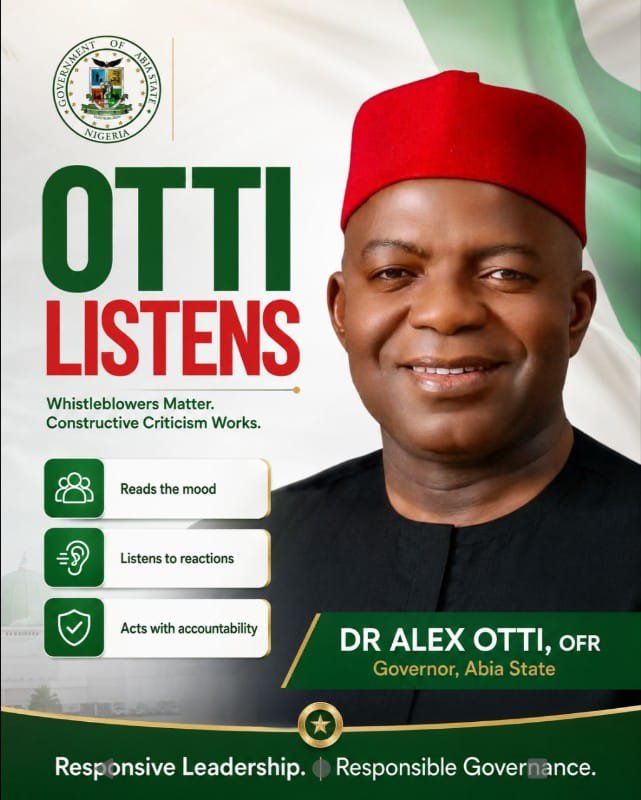
Perhaps the most important lesson from the entire episode is one that politicians, appointees, supporters, critics, academics and ordinary citizens should understand: Alex Otti is listening. He is reading. He is watching. He is following the reactions. He is evidently conscious of the arguments, criticisms, commentaries and treatises circulating around his government.
That does not mean every social-media post determines government policy. Nor should it. Serious government cannot be run by trending hashtags. But a responsive leader keeps his ears open. He reads criticism. He watches public reaction. He separates propaganda from legitimate grievance. He examines the evidence. And when something requires correction, he acts.
That is why the whistleblower should not automatically be regarded as an enemy. That is why the analyst should not be dismissed because his conclusion is uncomfortable. That is why every serious government needs people outside the official information bubble who are prepared to say, “Governor, something is wrong here.”
The ABSU episode may ultimately prove something larger about the Otti administration. You can criticise it. You can interrogate it. You can write a surgical analysis of its shortcomings. You can raise an alarm. And somewhere inside Government House, somebody may actually be reading.
That is not a weakness of democracy. That is democracy working.