

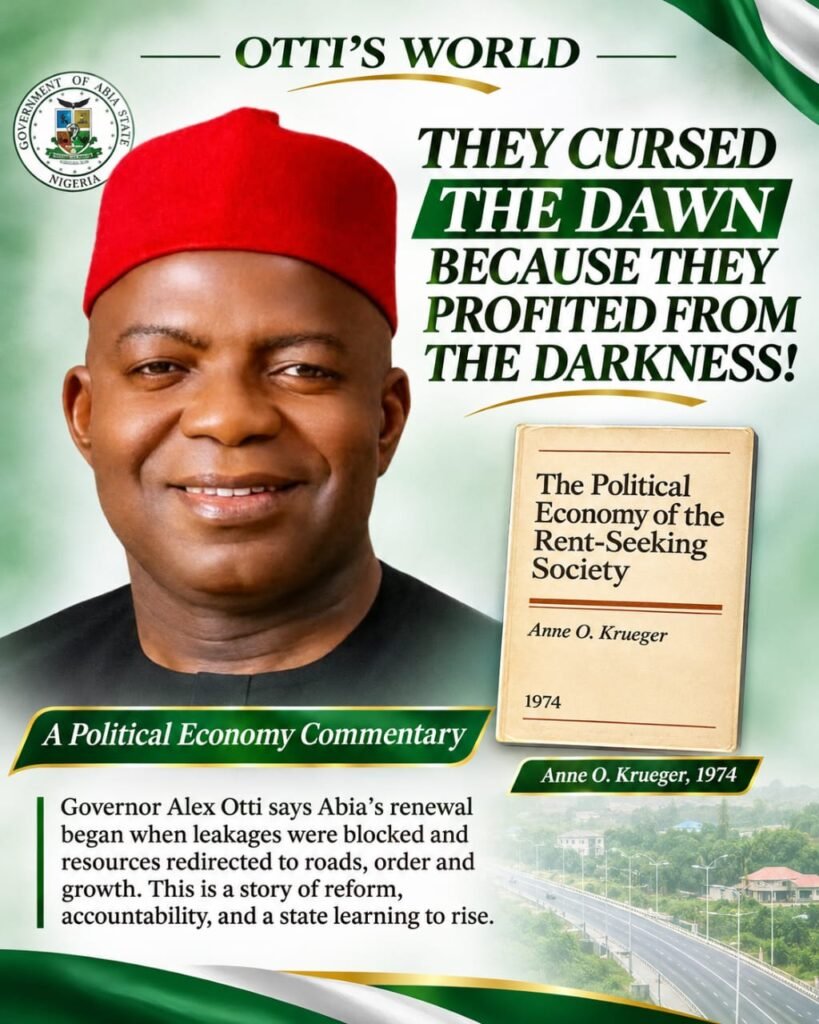
OTTI’S WORLD
THEY CURSED THE DAWN BECAUSE THEY PROFITED FROM THE DARKNESS!
17 NOVEMBER 2026
By AProf Chukwuemeka Ifegwu Eke
There is something profoundly unsettling about the arrival of daylight in a house where darkness has become an economic institution. The dawn does not merely illuminate the furniture; it exposes the occupants, their activities and the arrangements they would rather conceal.
And so, when the sun rises, not everybody celebrates.
Some welcome the morning. Others mourn the disappearance of the night.
THE STATEMENT THAT REOPENED AN OLD CONVERSATION
On Sunday, 15 November 2026, Governor Alex Chioma Otti, OFR, attended a two-day crusade organised by the Lord’s Chosen Charismatic Renewal Ministries at Ogbonnaya Onu Polytechnic, Aba.
It was a religious gathering. But something politically significant happened.
The governor spoke about the resistance his administration has encountered since assuming office on 29 May 2023. He attributed some of that resistance to his government’s decision to block channels allegedly used to divert public resources.
He described those channels through a metaphor that immediately captured national attention: the political feeding bottle.
By Monday, 16 November 2026, the statement had become a prominent political story.
Steve Oko of Vanguard reported the governor’s declaration that his administration had blocked channels allegedly used to siphon Abia’s resources.
Daniel Chibuike of Daily Post reported his remarks about removing feeding bottles from politicians’ mouths.
Uche Nwosu of Independent examined the governor’s argument that preventing financial leakages had contributed to Abia’s ongoing transformation.
The governor was making a political claim about why some individuals opposed his administration. The newspapers documented the statement, although their reports did not independently establish wrongdoing by particular critics.
I was particularly interested in the economic significance of that declaration.
For years, political discussions about Abia have revolved around familiar questions. Why did important commercial roads deteriorate? Why was public infrastructure unable to keep pace with the state’s entrepreneurial potential? Why did successive development promises fail to produce the desired transformation?
Otti’s statement offered one explanation: the diversion and mismanagement of public resources.
But I am interested in something beyond the accusation.
I am interested in what happens when a government demonstrates its commitment to development through identifiable projects, recorded expenditure and institutional decisions.
That is where I begin my examination.
THE ECONOMICS OF THE FEEDING BOTTLE
I regard the feeding-bottle metaphor as an invitation to examine one of the oldest problems in political economy: the struggle between public welfare and the private appropriation of public resources.
In 1974, Anne Krueger published her influential work on the political economy of the rent-seeking society.
The central argument remains relevant today.
Economic resources can be consumed not only through productive activity but also through the pursuit of privileged access to government-controlled opportunities.
Where public contracts, discretionary allocations and administrative decisions become instruments of private enrichment, the economic consequences can be substantial.
Let me illustrate.
Suppose a government has ₦10 billion available for road infrastructure.
If ₦2 billion is lost through inflated costs, fraudulent claims or payments for undelivered work, only ₦8 billion remains available for the intended investment.
The immediate fiscal loss is ₦2 billion.
But the economic consequences may be considerably larger.
The missing expenditure could represent kilometres of roads, drainage systems, employment opportunities and transportation savings that never materialise.
This is the economic logic underlying the governor’s argument.
I do not need to establish that every political opponent previously benefited from improper payments to recognise the importance of blocking financial leakages.
What matters is whether government institutions prevent waste, improve procurement and convert public expenditure into tangible development.
In Abia, there are identifiable infrastructure projects against which this proposition can be examined.
FROM THE FEEDING BOTTLE TO THE CONSTRUCTION SITE
Let me begin with Port Harcourt Road, Aba.
For many years, this commercially important road represented one of the infrastructure challenges confronting the Enyimba City.
Aba is an industrial and commercial centre whose productive activities depend heavily on efficient transportation networks.
Its manufacturers, transporters, traders, artisans and distributors depend on roads that permit the reliable movement of goods and services.
On 13 October 2023, Governor Otti commenced the reconstruction of Port Harcourt Road.
The project was undertaken by Julius Berger Nigeria Plc.
On 3 October 2025, President Bola Ahmed Tinubu, represented by the Minister of Works, David Umahi, commissioned the reconstructed 6.7-kilometre road alongside other completed infrastructure projects in Aba.
The reconstructed corridor was reported as a six-lane dual carriageway.
These are not merely announcements of future intentions.
They are documented stages of project implementation: commencement, reconstruction and commissioning.
The Guardian, The Punch, Premium Times and Nigerian Tribune reported the commissioning.
Here is the argument I consider economically significant.
When a government rehabilitates a major commercial road, it invests in productive infrastructure.
Improved transport infrastructure can reduce vehicle operating costs, shorten travel times, improve access to markets and lower distribution difficulties.
These benefits are especially important for small and medium-scale enterprises operating with limited capital.
The complete economic gains from Port Harcourt Road would require detailed before-and-after measurements. Nevertheless, the existence of the reconstructed road provides a concrete basis for evaluating the government’s infrastructure programme.
I consider that more compelling evidence than political declarations alone.
THE ROADS ARE SPEAKING: AND THE RECORDS HAVE ADDRESSES
Port Harcourt Road was not the only infrastructure project commissioned on 3 October 2025.
The commissioning programme also covered roads including Ohanku Road, Ndoki Road, Ajiwe Street, Umuatako Road, Chief Nkoro Street and Gabriel Nwosu Street.
The Abia State Government’s official announcement identified the projects ahead of the presidential commissioning exercise.
National newspapers subsequently reported the event.
These details are important because development claims become more credible when the projects can be identified by name, location, implementing authority and delivery date.
I find the federal acknowledgment particularly interesting.
President Tinubu belongs to the All Progressives Congress, while Governor Otti was elected on the Labour Party platform.
Yet the Federal Government participated in the commissioning of these state infrastructure projects.
Through Minister Umahi, the President publicly commended the road reconstruction programme.
The Nigerian Tribune, reporting on 4 October 2025, documented the commendation and the commissioning of the reconstructed road network.
I regard such intergovernmental recognition as relevant evidence, particularly when assessing the political argument that the administration has produced no meaningful development.
It does not establish that every government project is successful. It does, however, provide confirmation of specific infrastructure delivery beyond the administration’s own announcements.
WHAT DO THE NUMBERS SAY?
I now turn to the public accounts.
This is where political argument must encounter financial evidence.
Governor Otti presented a proposed 2025 budget of approximately ₦750.28 billion, with ₦611.67 billion, representing 82%, allocated to capital expenditure.
That allocation indicated a major emphasis on development spending.
However, budget allocations are statements of intention. Actual expenditure provides a different measure.
The Abia State Accountant-General’s financial statements for the year ended 31 December 2025 contain the following figures:
Financial indicator| 2024 actual| 2025 actual
Capital expenditure| ₦215.46bn| ₦319.91bn
Total expenditure| ₦317.90bn| ₦458.95bn
Source: Abia State Accountant-General, 2025 Financial Statements.
The figures reveal that reported capital expenditure increased by approximately ₦104.45 billion, representing a nominal increase of about 48.5% between 2024 and 2025.
Total expenditure also increased, by approximately ₦141.04 billion.
These are significant changes in the scale of recorded government expenditure.
The capital figures deserve particular attention because public investment is central to the provision of infrastructure and other long-lived government assets.
I would not describe the increase as evidence of real growth without adjusting for inflation. Nor would I attribute the entire increase to savings from blocked leakages without a documented reconciliation.
Nevertheless, I regard the reported expansion of capital expenditure as an important part of the administration’s development record.
It provides a financial basis for discussing the government’s stated commitment to infrastructure renewal.
THE 2026 BUDGET: AN ECONOMIC STATEMENT OF INTENTION
On 29 December 2025, Governor Otti signed Abia State’s 2026 budget of approximately ₦1.016 trillion.
Of this amount, approximately ₦811.81 billion was allocated to capital expenditure.
That represented approximately 80% of the total budget.
The remaining 20% was allocated to recurrent expenditure.
The administration also identified ₦169.3 billion for road construction, reconstruction, rehabilitation and maintenance in the 2026 budget proposals.
These allocations are documented in official government materials and contemporary national reporting.
From my perspective as an economist, the significance of these figures lies in the administration’s declared expenditure structure.
A government that devotes four-fifths of its proposed spending to capital development is making an ambitious fiscal statement.
The question of implementation remains important.
According to the state’s third-quarter 2026 Budget Implementation Report, actual capital expenditure from January to September stood at approximately ₦175.07 billion, representing 21.6% of the annual capital allocation.
The report is a reminder that large appropriations must be accompanied by effective execution.
But I also recognise the distinction between a delayed annual expenditure programme and the physical projects already delivered.
The correct analytical approach is to examine both.
I can recognise completed roads while demanding continued progress on the capital programme.
I can acknowledge higher recorded investment while examining whether the allocations translate into completed projects.
That is how fiscal accountability strengthens, rather than diminishes, a development argument.
HISTORY HAS A LONG MEMORY
Abia State was created on 27 August 1991.
Its economic potential has always been considerable.
Aba developed into one of Nigeria’s most recognisable centres of indigenous commerce and manufacturing.
Umuahia became the administrative centre of the state.
Across Abia North, Abia Central and Abia South, agricultural production, trade, manufacturing and services have provided foundations for economic activity.
Yet the existence of entrepreneurial talent does not automatically produce industrial prosperity.
Industry depends on infrastructure.
An entrepreneur cannot eliminate the cost of a damaged highway through personal ingenuity.
A manufacturer cannot independently construct an entire urban drainage network.
A trader cannot overcome every consequence of inadequate public transportation infrastructure through private investment.
This is why the state has an essential economic function.
The provision of public infrastructure reduces costs that individual businesses cannot efficiently address on their own.
When these infrastructure investments are properly designed and maintained, their benefits can extend beyond individual firms to the wider economy.
I therefore consider the reconstruction of major commercial roads a meaningful intervention in the economic history of Abia.
It represents an effort to address longstanding constraints on productive activity.
The proper test of that effort will be the durability of the infrastructure and the economic outcomes that follow.
WHY THE DAWN DISTURBS THE DARKNESS
The history of public-sector reform teaches an important lesson.
Changes that benefit the wider population may impose concentrated losses on individuals who previously enjoyed privileged access to public resources.
This creates a political economy problem.
The benefits of reform may be distributed across thousands of households and businesses.
The costs of losing privileges may be concentrated among a relatively small number of beneficiaries.
Those with concentrated interests can have powerful incentives to resist institutional change.
That is the theoretical significance of the governor’s feeding-bottle statement.
His argument is that certain forms of opposition are connected to the loss of previous financial advantages.
Whether this explanation applies to any particular individual requires evidence of the alleged transactions.
But I find the broader economic proposition persuasive: a government that seeks to improve public financial management must be prepared to confront the institutional interests that benefit from inefficient expenditure.
That confrontation should be conducted through lawful procurement, transparent financial reporting, effective auditing and the enforcement of applicable rules.
It is not enough to announce that the channels of waste have been blocked.
The results must be evident in the accounts and in the delivery of public services.
This is why the reconstruction of infrastructure and the publication of financial records are so important to the administration’s argument.
They provide material against which the public can evaluate claims of reform.
THE QUESTION OF TRANSPARENCY: LET THE RECORDS SPEAK
I also consider the publication of financial information an essential component of the government’s development narrative.
Abia State has made its 2025 financial statements and third-quarter 2026 budget implementation report available through official government sources.
These documents contain revenue figures, expenditure classifications, budget allocations and implementation records.
Their availability permits a more informed evaluation of state finances.
The published reports also reveal implementation challenges that deserve attention.
To me, that is precisely the purpose of financial disclosure.
Transparency is most valuable when it allows citizens to examine both the achievements and the outstanding obligations of government.
In a system where financial information is available for scrutiny, public debate can move beyond speculation towards evidence.
The existence of an official record is not a substitute for independent auditing, but it provides an essential starting point.
I consider this approach particularly important for a state undertaking an ambitious infrastructure programme.
The greater the public investment, the stronger the need for procurement accountability, project documentation and transparent expenditure reporting.
THE POLITICAL ECONOMY OF AN UNCOMFORTABLE TRANSITION
There is a wider lesson in the events of 15 November 2026.
Governor Otti’s remarks brought renewed attention to the relationship between political power and the allocation of public resources.
His administration’s documented road projects and capital expenditure provide a substantive basis for examining its development programme.
The evidence does not require me to imagine achievements.
I can identify Port Harcourt Road.
I can identify Ohanku Road and other commissioned projects.
I can examine the Accountant-General’s financial statements.
I can compare annual capital expenditure.
I can assess budget allocations against actual implementation.
This is the advantage of grounding public commentary in documented evidence.
It allows me to recognise the administration’s achievements without depending entirely on the political language used to describe them.
And it allows the debate to focus on something more enduring than accusations between competing political groups.
It focuses attention on public value.
MY FINAL WORD
I return to the metaphor with which I began.
The dawn is not important merely because it announces the end of darkness.
It is important because of what becomes visible when daylight arrives.
In Abia State, I see a development record that includes the reconstruction and commissioning of major commercial roads, a substantial reported increase in capital expenditure between 2024 and 2025, and an ambitious programme of further infrastructure investment.
These are matters capable of documentary examination.
They are not dependent on whether one admires or dislikes the governor.
The central challenge for the administration is to translate its development ambitions into sustained, measurable improvements across the state.
That includes completing planned investments, maintaining existing infrastructure, ensuring financial accountability and demonstrating economic benefits for residents and businesses.
Governor Otti’s statement about the political feeding bottle has introduced a forceful explanation for some of the resistance his administration encounters.
The explanation deserves examination, and allegations of improper financial benefits must ultimately be established through evidence.
But the administration’s infrastructure achievements deserve examination too.
I refuse to treat an identifiable, commissioned road as though it were merely a political slogan.
I refuse to disregard published financial statements when evaluating public expenditure.
And I refuse to mistake the noise of political controversy for a complete account of the state’s development.
For me, the proper judgment of any administration begins with what it promised, what it financed, what it delivered and what its actions changed.
In the end, history will not be satisfied with the volume of political argument.
It will examine the projects.
It will examine the accounts.
It will examine the institutions.
And it will ask whether the resources entrusted to government created enduring public value.
THEY CURSED THE DAWN BECAUSE THEY PROFITED FROM THE DARKNESS!
The phrase captures the political conflict that Governor Otti has described. The documented achievements of his administration provide the foundation upon which his broader argument about reform and development can be examined.
OTTI’S WORLD
A Political Economy Commentary
AProf Chukwuemeka Ifegwu Eke
Department of Economics
University of Abuja