
FAAC, FISCAL RESPONSIBILITY AND THE ABIA EXCEPTION
Why the Evidence Requires Abia and Governor Alex Otti to Be Assessed Differently
The debate generated by reports of sharply increased Federation Account Allocation Committee receipts since the removal of petrol subsidy is legitimate. State governments must account for the additional fiscal resources available to them.
But the scientifically appropriate question is not simply: “How much FAAC did a state receive?”
The better question is:
What measurable public assets, services and improvements did the state produce with the resources available to it?
When that test is applied specifically to Abia State, there is substantial published evidence that Governor Alex Otti’s administration should not casually be lumped together with states accused of converting increased allocations principally into recurrent consumption.
- ABIA ACTUALLY LED THE COUNTRY IN CAPITAL-EXPENDITURE PRIORITISATION
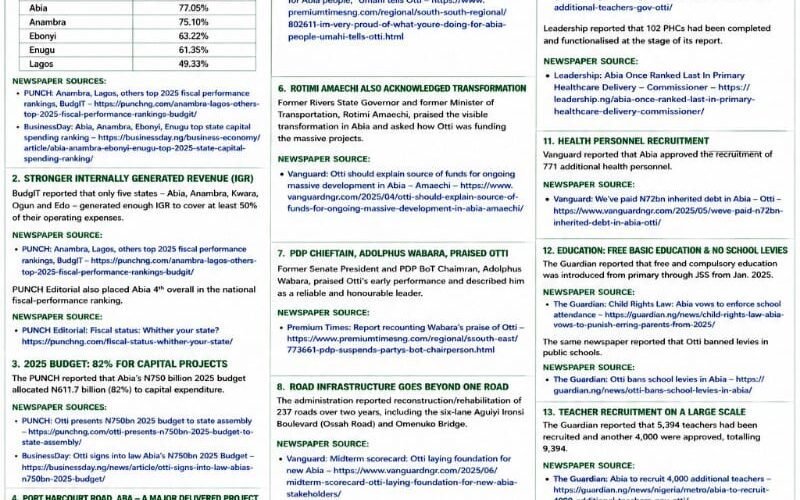
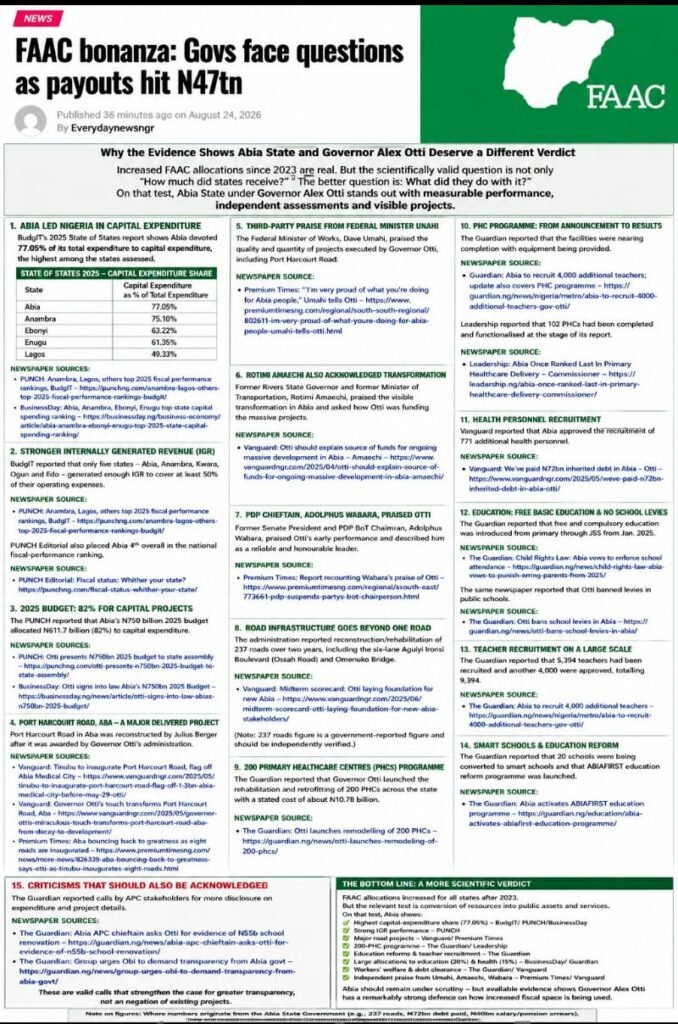
According to BudgIT’s 2025 State of States fiscal assessment, Abia devoted approximately 77.05 per cent of its total expenditure to capital expenditure, the highest proportion among the states assessed.
This was independently reported by The PUNCH, which stated that Abia led the country with 77.05 per cent of total expenditure devoted to capital projects.
Newspaper links:
“PUNCH — Anambra, Lagos, others top 2025 fiscal performance rankings, BudgIT” (https://reference-url-citation.invalid/1)
“PUNCH — Over 30 Nigerian states rely on federal allocation: Report” (https://reference-url-citation.invalid/2)
BusinessDay independently reported the same result, noting that Abia topped the capital-expenditure ranking and describing Abia, Anambra, Ebonyi and Enugu as states prioritising long-term investment over operating expenditure.
“BusinessDay — Abia, Anambra, Ebonyi, Enugu top state capital spending ranking” (https://reference-url-citation.invalid/4)
This evidence is especially important because the central criticism in the FAAC debate is that additional revenue has not always been translated into infrastructure and public services.
For Abia, the expenditure composition provides evidence of a government unusually weighted towards capital formation rather than recurrent consumption.
- ABIA WAS ALSO AMONG THE STRONGER STATES ON INTERNALLY GENERATED REVENUE
The PUNCH reported that only five states—Abia, Anambra, Kwara, Ogun and Edo—generated enough internally generated revenue to cover at least 50 per cent of their operating expenses in the period assessed by BudgIT.
“PUNCH — Fiscal performance and IGR findings” (https://reference-url-citation.invalid/6)
A subsequent PUNCH editorial placed Abia fourth nationally in BudgIT’s broader fiscal-performance ranking, behind Anambra, Lagos and Kwara, and identified Abia among the states with comparatively stronger prospects for fiscal sustainability.
“PUNCH Editorial — Fiscal status: Whither your state?” (https://reference-url-citation.invalid/8)
This matters because a state improving its own-source revenue while simultaneously devoting a large proportion of expenditure to capital investment is exhibiting two desirable fiscal characteristics:
revenue mobilisation and development-oriented expenditure.
- THE 2025 BUDGET CONTINUED THE CAPITAL-INVESTMENT MODEL
When Governor Otti presented Abia’s ₦750 billion 2025 budget, The PUNCH reported that ₦611.7 billion—approximately 82 per cent—was allocated to capital expenditure, leaving approximately 18 per cent for recurrent expenditure.
“PUNCH — Otti presents N750bn 2025 budget to state assembly” (https://reference-url-citation.invalid/10)
BusinessDay also reported the 82 per cent capital provision when the budget was signed into law.
“BusinessDay — Otti signs into law Abia’s N750bn 2025 Budget” (https://reference-url-citation.invalid/12)
The distinction is important.
The 82 per cent figure is the budgetary intention for 2025.
The 77.05 per cent figure reported by BudgIT relates to actual expenditure assessed for the preceding fiscal period.
The two figures therefore should not be confused.
- PORT HARCOURT ROAD, ABA, IS NOT AN ABSTRACT BUDGET LINE
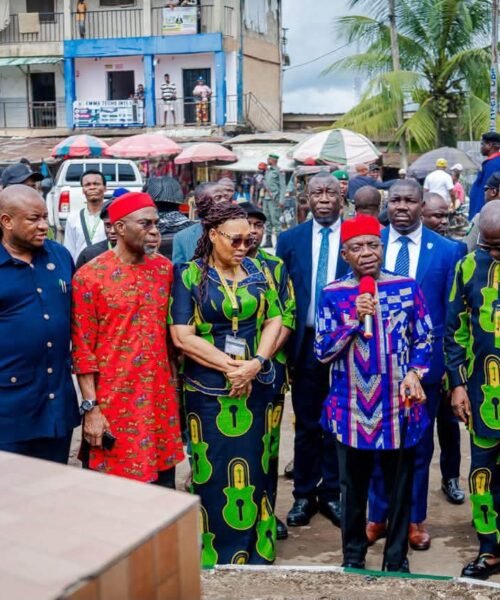
One of the clearest physical manifestations of Abia’s capital-spending programme is Port Harcourt Road in Aba.
Vanguard reported that the strategic road was reconstructed by Julius Berger, following the award by Governor Otti’s administration after he assumed office in 2023.
“Vanguard — Tinubu to inaugurate Port Harcourt Road, flag off Abia Medical City” (https://reference-url-citation.invalid/14)
Vanguard subsequently reported the reconstruction as completed and highlighted the transformation of what had previously been a severely deteriorated commercial corridor.
“Vanguard — Governor Otti’s touch transforms Port Harcourt Road, Aba” (https://reference-url-citation.invalid/16)
In October 2025, Premium Times reported that the reconstructed 6.7-kilometre Port Harcourt Road was among eight roads inaugurated, describing it as a formerly collapsed road reconstructed into a three-lane carriageway by the Otti administration.
“Premium Times — Aba bouncing back as eight roads are inaugurated” (https://reference-url-citation.invalid/18)
This is therefore a particularly useful response to the argument that increased FAAC receipts cannot be seen in physical infrastructure.
In Aba, one can literally drive on part of the answer.
- THERE IS THIRD-PARTY PRAISE FOR THE QUALITY OF THE ROAD WORK
This point is particularly significant because the praise did not come only from Governor Otti’s administration.
In June 2025, Premium Times reported that the Federal Minister of Works, Dave Umahi, praised the quantity and quality of projects executed by Otti and specifically highlighted Port Harcourt Road.
“Premium Times — “I’m very proud of what you’re doing for Abia people,” Umahi tells Otti” (https://reference-url-citation.invalid/20)
This is politically noteworthy because Umahi is a minister in an APC-led Federal Government, whereas Otti was elected on the Labour Party platform.
Therefore, this particular commendation carries evidentiary value beyond normal partisan self-assessment.
- ROTIMI AMAECHI ALSO PUBLICLY ACKNOWLEDGED THE TRANSFORMATION
Former Rivers State governor and former Minister of Transportation Rotimi Amaechi publicly praised the visible transformation he encountered in Abia.
Vanguard reported Amaechi as saying that during an earlier visit the environment had been littered with refuse and damaged by severe gullies, but that the transformation he subsequently observed was commendable.
“Vanguard — Amaechi praises Abia development and asks how Otti is funding it” (https://reference-url-citation.invalid/22)
Amaechi also praised the quality of work and Otti’s use of reputable contractors such as Julius Berger.
The irony is striking.
The question Amaechi reportedly asked was essentially:
How is Otti finding the money to execute all these projects when many governors complain about inadequate resources?
That is almost the reverse of the accusation that increased allocations have produced nothing visible in Abia.
- EVEN A SENIOR PDP FIGURE PRAISED OTTI’S PERFORMANCE
Another useful independent political observation came from former Senate President and PDP Board of Trustees Chairman Adolphus Wabara.
Premium Times reported that Wabara praised Otti during the 2023 Port Harcourt Road reconstruction flag-off, describing him as reliable and a man of honour and arguing that his early performance had already strengthened his prospects for another term.
“Premium Times — Report recounting Wabara’s praise of Otti” (https://reference-url-citation.invalid/25)
Again, this comment is significant precisely because Wabara was a leading member of the PDP, not Otti’s Labour Party.
- ABIA’S ROAD PROGRAMME EXTENDS BEYOND ONE ROAD
It would be misleading to construct the infrastructure defence exclusively around Port Harcourt Road.
In a midterm review, Vanguard reported that major projects included the expansion of Ossah Road into the six-lane Aguiyi Ironsi Boulevard, Port Harcourt Road in Aba, and the ongoing Omenuko Bridge project.
The same report quoted the administration as saying that 237 roads had been constructed, reconstructed or rehabilitated over its first two years. Because this figure originates from the governor’s scorecard, it should properly be identified as a government-reported figure, rather than an independently audited number.
“Vanguard — Midterm scorecard: Otti laying foundation for new Abia” (https://reference-url-citation.invalid/28)
That distinction increases rather than diminishes the credibility of the defence: claims originating with government should be labelled as such.
- HEALTH: THE 200-PHC PROGRAMME IS DOCUMENTED IN THE NATIONAL PRESS
The claim that the Otti administration launched a programme to renovate and retrofit 200 Primary Healthcare Centres is independently documented.
The Guardian reported in January 2025 that Otti launched the rehabilitation and retrofitting of 200 PHCs, with the project intended to reach communities across Abia.
“The Guardian — Otti launches remodelling of 200 PHCs” (https://reference-url-citation.invalid/30)
The newspaper reported a stated project cost of approximately ₦10.78 billion, citing the Abia Commissioner for Health.
The project was structured not merely around renovating buildings but also around equipping the centres and providing health personnel.
- THERE IS SUBSEQUENT EVIDENCE THAT THE PHC PROGRAMME MOVED BEYOND ANNOUNCEMENT
The Guardian subsequently reported in June 2025 that many of the 200 facilities were nearing completion and that equipment was being provided for them.
“The Guardian — Abia to recruit additional teachers; update also covers PHC programme” (https://reference-url-citation.invalid/34)
Leadership later reported that, at the stage covered by its report, 102 PHCs had been completed, with a batch of functionalised centres being inaugurated.
“Leadership — Abia Once Ranked Last In Primary Healthcare Delivery – Commissioner” (https://reference-url-citation.invalid/36)
That progression is analytically important.
It establishes:
announcement → construction/retrofitting → equipping → functionalisation.
It does not yet by itself prove improvements in mortality or morbidity outcomes, but it provides evidence of tangible healthcare-capacity expansion.
- ABIA HAS ALSO BEEN RECRUITING HEALTH PERSONNEL
Vanguard reported that the Otti administration approved the recruitment of 771 additional health personnel, alongside work on general hospitals and other health infrastructure.
“Vanguard — We’ve paid N72bn inherited debt in Abia — Otti” (https://reference-url-citation.invalid/38)
This matters because hospitals without doctors, nurses and other professionals do not constitute functioning health systems.
The personnel dimension therefore strengthens the infrastructure argument.
- EDUCATION: FREE BASIC EDUCATION WAS INTRODUCED
The Guardian reported that the Abia Government introduced free and compulsory education from primary school through junior secondary level beginning in January 2025.
“The Guardian — Child Rights Law: Abia vows to enforce school attendance” (https://reference-url-citation.invalid/40)
The Guardian also reported that Otti prohibited school officials from imposing levies on pupils in public primary and secondary schools.
“The Guardian — Otti bans school levies in Abia” (https://reference-url-citation.invalid/42)
These policies are not road projects, but in development economics they are potentially just as important because they affect human-capital accumulation.
- THOUSANDS OF TEACHERS HAVE BEEN RECRUITED OR APPROVED FOR RECRUITMENT
The Guardian reported in June 2025 that 5,394 teachers had already been recruited, with the government announcing plans for another 4,000, which would raise the number to 9,394.
“The Guardian — Abia to recruit 4,000 additional teachers” (https://reference-url-citation.invalid/44)
The same report stated that the recruitment was intended partly to respond to increased school enrolment following the free-education policy.
This provides a concrete example of additional public spending being directed towards service delivery rather than simply physical structures.
- SMART SCHOOLS AND EDUCATION REFORM ARE ALSO UNDERWAY
The Guardian reported that 20 existing schools were being converted into smart schools and that renovation of other educational institutions was continuing.
The newspaper also reported the launch of AbiaFIRST — Abia Fostering Innovation and Reform for School Transformation, covering basic education, secondary education, vocational training, digital learning and teacher development.
“The Guardian — Abia activates ABIAFIRST education programme” (https://reference-url-citation.invalid/48)
Again, one should distinguish policies and outputs from eventual learning outcomes.
But it would be inaccurate to claim that no significant education intervention has accompanied the state’s increased fiscal resources.
- EDUCATION AND HEALTH HAVE RECEIVED LARGE BUDGETARY SHARES
Independent newspaper reporting confirms that Otti’s fiscal model has placed unusually large emphasis on education and health.
A BusinessDay report on the state’s budget recorded allocations of over 20 per cent to education and about 15 per cent to healthcare.
“BusinessDay — Report on Abia budget priorities” (https://reference-url-citation.invalid/50)
The Guardian later reported Otti’s continued commitment to a 20 per cent education allocation, alongside the smart-school programme and teacher recruitment.
“The Guardian — Otti outlines education and worker-welfare interventions” (https://reference-url-citation.invalid/52)
- WORKERS’ WELFARE ALSO FITS THE POSITIVE QUALIFICATION IN THE FAAC ARTICLE
The original FAAC article itself acknowledges that some governors have directed increased resources towards workers’ welfare.
In Abia’s case, The Guardian reported Governor Otti’s statement that his administration had spent more than ₦40 billion on salary and pension arrears over two years. Because this amount originates from the governor, it should be presented transparently as an administration-reported figure.
“The Guardian — Otti says over ₦40bn spent on salary and pension arrears” (https://reference-url-citation.invalid/54)
Vanguard separately reported Otti’s claim that his administration had paid ₦72 billion in inherited debt obligations. Again, this is properly described as a statement by the governor pending independent reconciliation with audited accounts.
“Vanguard — We’ve paid N72bn inherited debt in Abia — Otti” (https://reference-url-citation.invalid/56)
- THE CRITICAL CLAIMS SHOULD ALSO BE ACKNOWLEDGED
A credible defence should not suppress contrary evidence.
For example, The Guardian reported in August 2025 that an APC chieftain challenged the administration to provide evidence concerning reported expenditure on school renovation.
“The Guardian — APC chieftain asks Otti for evidence of school-renovation expenditure” (https://reference-url-citation.invalid/58)
The Guardian also reported calls from another political group for greater disclosure of project locations, contractors and expenditure details.
“The Guardian — Group urges greater transparency from Abia government” (https://reference-url-citation.invalid/60)
These criticisms should not be hidden.
They strengthen the case for:
- publication of project-level expenditure;
- contractor names;
- bills of quantities where permissible;
- procurement documentation;
- quarterly budget-performance reports; and
- independently auditable completion data.
But allegations of insufficient disclosure are analytically different from evidence that no projects exist.
The physical road projects, PHC programme, teacher recruitment and fiscal-performance results are separately documented by national newspapers.
- THE POSITIVE PASSAGE IN THE FAAC ARTICLE FITS ABIA PARTICULARLY WELL
The original FAAC article acknowledges that some governors have linked increased allocations to:
road construction, bridges, healthcare, education, workers’ welfare and other projects.
If one subjects that sentence to empirical verification, Abia provides examples in virtually every category mentioned.
Roads
Port Harcourt Road and other infrastructure have been reported by Vanguard and Premium Times.
Bridges
Vanguard has reported work on Omenuko Bridge.
Healthcare
The Guardian and Leadership have documented the 200-PHC programme.
Education
The Guardian has documented free basic education, teacher recruitment and smart-school interventions.
Workers’ welfare
The Guardian has reported the administration’s payments relating to salary and pension arrears.
Capital investment
PUNCH and BusinessDay independently report Abia’s 77.05 per cent capital-expenditure ratio.
This is why the positive qualification buried inside the wider FAAC article could reasonably have had Alex Otti and Abia State written beside it.
- THE MOST POWERFUL DEFENCE IS NOT THAT OTTI RECEIVED LITTLE MONEY
That argument should be avoided.
FAAC receipts clearly increased nationally after the 2023 reforms.
The stronger defence is:
Yes, more nominal resources became available. The issue is what individual governments did with them.
And the comparative evidence shows that Abia:
- ranked at or near the top of national fiscal-performance assessments;
- devoted the country’s highest reported proportion of expenditure to capital projects in the BudgIT assessment;
- substantially reconstructed major road infrastructure;
- launched and implemented a 200-PHC rehabilitation programme;
- expanded teacher recruitment;
- implemented free basic education;
- increased investment in schools and healthcare; and
- attracted public praise from political figures outside Otti’s own political camp.
Those are propositions for which newspaper evidence exists.
- THE SCIENTIFIC CONCLUSION
The existence of increased FAAC receipts cannot logically prove good governance.
But neither can it logically prove poor governance.
The proper causal chain is:
Revenue → Expenditure → Public Assets → Public Services → Socio-economic Outcomes.
FAAC tells us principally about the first variable.
To judge Governor Otti fairly, we must examine the remaining four.
The evidence from BudgIT, as independently reported by PUNCH and BusinessDay, shows an unusually high conversion of expenditure towards capital formation.
The physical evidence reported by Premium Times, Vanguard, The Guardian and Leadership shows roads, healthcare facilities and educational interventions.
The external assessments reported by Premium Times and Vanguard include unusually positive remarks from figures such as Dave Umahi, Rotimi Amaechi and Adolphus Wabara.
Abia should therefore remain subject to scrutiny.
Its expenditure should remain open to audit.
Its contracts should remain open to legitimate questions.
Its development outcomes must ultimately be measured statistically.
But the available evidence makes one conclusion increasingly difficult to sustain:
that Abia under Alex Otti is simply another state where increased FAAC revenue disappeared without visible developmental conversion.
The evidence does not support such a sweeping conclusion.
The more defensible proposition is this:
Abia received increased fiscal resources, as did other states; what distinguishes the Otti administration is the unusually high proportion of those resources committed to capital investment and the growing stock of independently reported physical and social-sector outputs.
That is not propaganda.
It is an empirically testable proposition.
And on the evidence presently available in Nigeria’s national press, it is a proposition for which Governor Alex Otti has a remarkably strong case.