
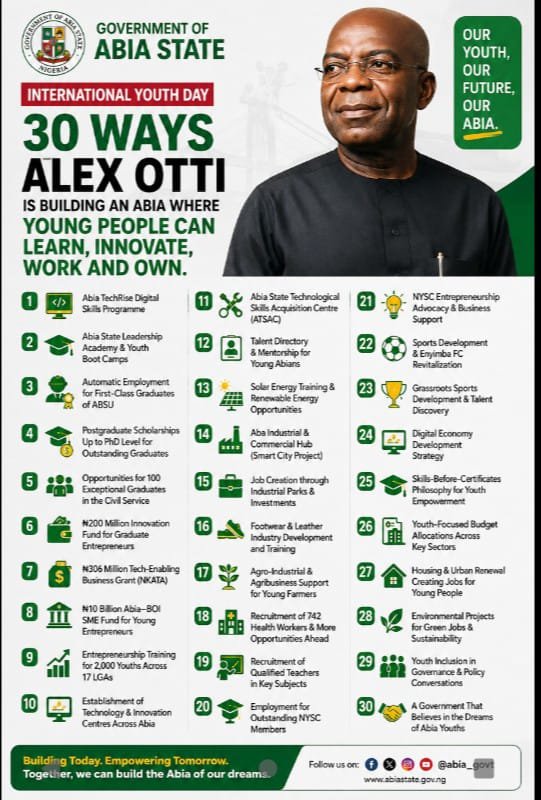
International Youth Day: 30 Ways Alex Otti Is Building an Abia Where Young People Can Learn, Innovate, Work and Own
Beyond the Ritual of Youth Empowerment
For decades, the Nigerian political vocabulary has contained one particularly overworked expression: youth empowerment. It has been invoked at rallies, printed on banners and attached to programmes that sometimes ended with the distribution of motorcycles, sewing machines, wheelbarrows or envelopes. The young person was often treated as somebody to be pacified rather than prepared; a political foot soldier rather than an economic agent.
As the world marks the season of International Youth Day, Abia State offers an interesting departure from that old conception. Under Governor Alex Otti, what is gradually emerging is a different proposition: that the most enduring way to empower a young person is not merely to give him something to consume today, but to give him the knowledge, technology, financing, institutional environment and opportunity to produce tomorrow.
That distinction is important.
International Youth Day is observed globally on August 12. For Abia, however, the more interesting question goes beyond ceremonial messages to young people. It is whether public policy is actually changing their economic possibilities. On this score, a number of programmes of the Otti administration deserve attention—not because every problem confronting Abia’s youths has disappeared, but because a discernible policy architecture is beginning to emerge.
TechRise and the New Language of Empowerment
Perhaps the clearest illustration is Abia TechRise.
In May 2026, Otti launched the third cohort of the programme in Aba, with 850 young Abians selected for intensive digital-skills training. The emphasis is striking. These are skills associated with the economy young people are entering—not the economy their parents entered.
The programme has focused on practical digital and problem-solving capabilities intended to equip participants for technology-driven employment and enterprise. PREMIUM TIMES reported that Otti used the inauguration to challenge participants to acquire practical skills capable of competing in the modern economy.
This is more than semantics.
A young Abian who can develop software, analyse data, secure computer networks, build digital platforms or provide technology services is no longer restricted by the employment capacity of Umuahia or Aba. His market can be Lagos, Nairobi, London, Toronto or California while his laptop remains in Abia.
That is one of the quiet revolutions of digital economics: geography becomes less decisive.
And therein lies one of the strongest arguments for TechRise. The programme is potentially transforming youth development from the distribution of physical objects into the acquisition of portable intellectual capital.
From Learning to Leadership
But technical competence without character and leadership can itself become incomplete development.
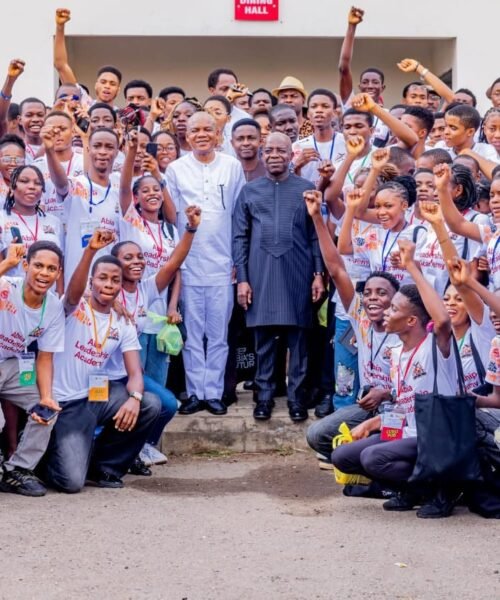
That may explain the establishment of the Abia State Leadership Academy, another intervention aimed directly at younger citizens. The Academy states that it was established by the Otti administration to deepen the ideals of service, value creation and excellence among young people, public servants and business owners.
Its 2026 Youth Leadership Boot Camp specifically targets young people between 16 and 20 years old.
This is significant because leadership development in Nigeria ordinarily begins too late.
Political parties suddenly discover people as “youth leaders” after they have entered adulthood, often without any sustained process of civic formation. The Abia Leadership Academy attempts the opposite: catch them earlier.
Imagine the cumulative effect if a 17-year-old is exposed to public ethics, entrepreneurship, critical thinking, leadership, service and problem solving before entering university. That intervention may not immediately produce a headline-grabbing kilometre of asphalt, but human infrastructure is infrastructure nonetheless.
Indeed, roads can be rebuilt in months. Institutions and values take generations.
A State Beginning to Reward Excellence
There is another cultural message embedded in some of Otti’s interventions: excellence should have economic consequences.
In March 2026, the governor announced opportunities for first-class graduates of Abia State University, including automatic employment pathways and postgraduate scholarship opportunities extending to doctoral studies under stipulated conditions. Reports also indicated plans to identify vacancies for another group of exceptional graduates in areas relevant to the state.
The importance goes beyond the beneficiaries.
Societies communicate their values through what they reward.
When political connections are rewarded more visibly than intellectual achievement, young people learn very quickly what matters. When academic distinction, innovation, competence and enterprise attract public recognition and opportunity, the incentive structure begins to change.
The message to an undergraduate becomes simple: excellence can open a door.
That may ultimately be more important than the cost of the scholarship itself.
Innovation Must Eventually Meet Capital
Skills are useful. Ideas are useful. But entrepreneurship eventually runs into one stubborn economic variable: capital.
This is why the administration’s growing emphasis on enterprise financing deserves inclusion in any serious assessment of its youth programme.
Abia’s economic future cannot rest primarily on government recruitment. No state payroll can absorb the army of graduates, artisans and school-leavers produced annually. The sustainable route is to increase the number of people who create economic value, build businesses and eventually employ other people.
That makes interventions around enterprise support, innovation funding and SME financing particularly relevant to young Abians.
The administration has also promoted technology-enabled business support and broader SME financing mechanisms. This matters because the journey from “I have an idea” to “I own a functioning business” is where many Nigerian dreams collapse.
A government that trains young people without thinking about access to finance has solved only half the problem.
Building Owners, Not Permanent Applicants
There is consequently a philosophical thread connecting these interventions.
The objective appears increasingly to be moving the Abia youth through four stages: learn, innovate, work and own.
The final word is perhaps the most important.
Own.
The ambition of youth policy should not end with producing another generation of applicants carrying certificates from office to office. Some must become employers. Some must own digital companies. Some must build manufacturing businesses. Some must become farmers operating sophisticated agribusinesses. Some must own intellectual property. Some must build export businesses from Aba. Some must become investors.
This is where the celebrated entrepreneurial character of Aba becomes strategically important.
Aba has never lacked enterprise. What it has historically lacked is the infrastructure, technology, financing and governmental organisation required to convert enormous informal ingenuity into globally competitive production.
If public policy can connect the traditional creativity of Aba with technology, industrial infrastructure, digital commerce, financing and modern skills, the result could be transformational for an entire generation.
The Technology Centre as Infrastructure for the Mind
The development of technology centres and skills-acquisition structures across Abia therefore deserves to be understood beyond the physical buildings themselves.
In January 2026, for example, the governor commissioned the Nkporo Unity and Technology Centre, an intervention explicitly associated with equipping young people with capabilities relevant to the digital economy.
There is also the broader institutional role of technology and vocational-skills platforms across the state.
These investments recognise an economic reality Nigeria has resisted for too long: university education is not the only route to productive citizenship.
The future also belongs to highly skilled technicians, renewable-energy installers, digital creators, programmers, machinists, fabricators, designers and artisans who combine craftsmanship with technology.
Germany understood this through its apprenticeship system. Asian economies built enormous manufacturing capacities partly through technical human capital. Abia cannot become an industrial hub by producing only administrators and degree holders.
It must also produce people who can make things.
Education as Youth Policy
Youth development also begins long before somebody turns 18.
That makes Otti’s education reforms part of the youth story.
The administration declared an emergency in the education sector and subsequently reorganised its administrative structure, including separate institutions for basic/secondary and tertiary education. Abia’s Ministry of Basic and Secondary Education has also deployed a digital Education Management Information System intended to improve data and administration across schools.
This may sound bureaucratic, but data matters.
A state that does not know accurately how many schools it has, where its teachers are, how students are performing and where infrastructure gaps exist cannot intelligently plan education.
And every failure in education eventually becomes a youth-employment problem several years later.
Sports Must Also Become an Economy
Youth policy cannot be limited to classrooms and computers.
Abia possesses enormous sporting potential, and the Ministry of Sports and Youth Development publicly defines its mandate around talent development, innovation, entrepreneurship, sporting excellence and opportunities for young people.
The next frontier should be treating sport not merely as recreation but as an economy.
Football alone creates opportunities in playing, coaching, medicine, analytics, media, photography, marketing, facility management, merchandising, broadcasting and sports technology.
A properly developed Enyimba ecosystem, combined with grassroots talent identification, could therefore become an employment chain rather than simply a football project.
That is how modern economies think about sport.
The Real Test Is Scale
None of these observations means the job is finished.
It is not.
The greatest challenge before the Otti administration is scale.
Eight hundred and fifty young people trained through a digital programme is commendable, but Abia has hundreds of thousands of young people. A leadership academy for teenagers is admirable, but its impact will ultimately depend on whether successive cohorts reach communities across the 17 local government areas.
Innovation funds must become sustainable rather than episodic. Training must increasingly be connected to measurable employment, contracts, start-ups and income growth. Technical centres must remain equipped after commissioning ceremonies have ended. Entrepreneurship programmes must be transparent enough that talented young people without political connections can access them.
These are the standards against which the programmes should ultimately be judged.
The relevant question is no longer how many youths attended an empowerment ceremony.
It is: How many are earning more because of the intervention? How many businesses survived after two years? How many trainees secured jobs? How many are exporting services? How many have employed someone else?
That is the difference between political empowerment and economic transformation.
From Political Youths to Economic Citizens
For too long, Nigerian politics has measured youth participation by the number of young people who attend rallies, defend politicians on social media or belong to support groups.
A more ambitious government should ask a different set of questions.
How many young people can code?
How many can manufacture?
How many can obtain global remote jobs?
How many can build a company?
How many understand artificial intelligence?
How many can install renewable-energy systems?
How many can transform agricultural products into exportable goods?
How many can lead institutions with competence and integrity?
Those are questions that determine whether a society becomes richer.
Abia’s emerging youth-development architecture suggests that the Otti administration increasingly understands this distinction. TechRise addresses digital capability. The Leadership Academy addresses character and leadership. Education reform addresses human-capital foundations. Enterprise interventions attack the financing constraint. Technical skills initiatives recognise the dignity and economic value of vocational competence. Industrial and technology investments attempt to create the ecosystem in which these skills can be converted into income.
Individually, none is sufficient.
Together, however, they begin to resemble a strategy.
The Abia Youth Otti Must Ultimately Produce
The ultimate success of the programme will not be measured by press releases.
It will be visible in the type of young Abian produced over the next decade.
That young person should not merely know how to demand empowerment from government. He should possess something the market wants.
She should be capable of moving from classroom to enterprise.
He should be able to live in Umuahia and sell a service in Europe.
She should be able to manufacture in Aba and find customers across Africa.
He should understand that political participation is important, but economic independence makes citizenship stronger.
And she should increasingly see government not as the employer of first and last resort, but as the builder of the environment within which talent can flourish.
That is a much more profound conception of youth empowerment.
So, as International Youth Day is commemorated, the interesting story from Abia is not that Alex Otti has discovered young people. Every politician discovers young people before elections.
The more consequential possibility is that his administration is gradually changing what government believes a young person should become.
Not a recipient.
Not a permanent political follower.
Not another name on an empowerment register.
But a learner.
An innovator.
A worker.
A creator.
And ultimately, an owner.
If that philosophy is expanded, institutionalised and sustained, Otti may leave Abia something more valuable than another collection of youth programmes.
He may help create a generation that no longer waits for the future to be handed to it.
A generation equipped to own it.