

IN PURSUIT OF HAPPINESS: NINE VOICES, THREE CITIES AND THE COUNTDOWN TO ABIA’S OKADA BAN
Voice of the People | Metro Policy Review | Okada Ban Effective June 29, 2025
The clock was ticking.
Across Aba, Umuahia and Ohafia, one date continued to appear in conversations, motor parks, markets, offices and roadside shops:
June 29, 2025.
For many residents, it was not merely another date on the calendar. It represented the day movement, commerce and everyday survival could change dramatically following the enforcement of the state government’s ban on commercial motorcycles, popularly known as Okada.
Would the policy bring greater order and security?
Would commuters be stranded?
Would transport fares rise beyond the reach of ordinary citizens?
Would traders, students, workers and elderly residents be protected from unintended hardship?
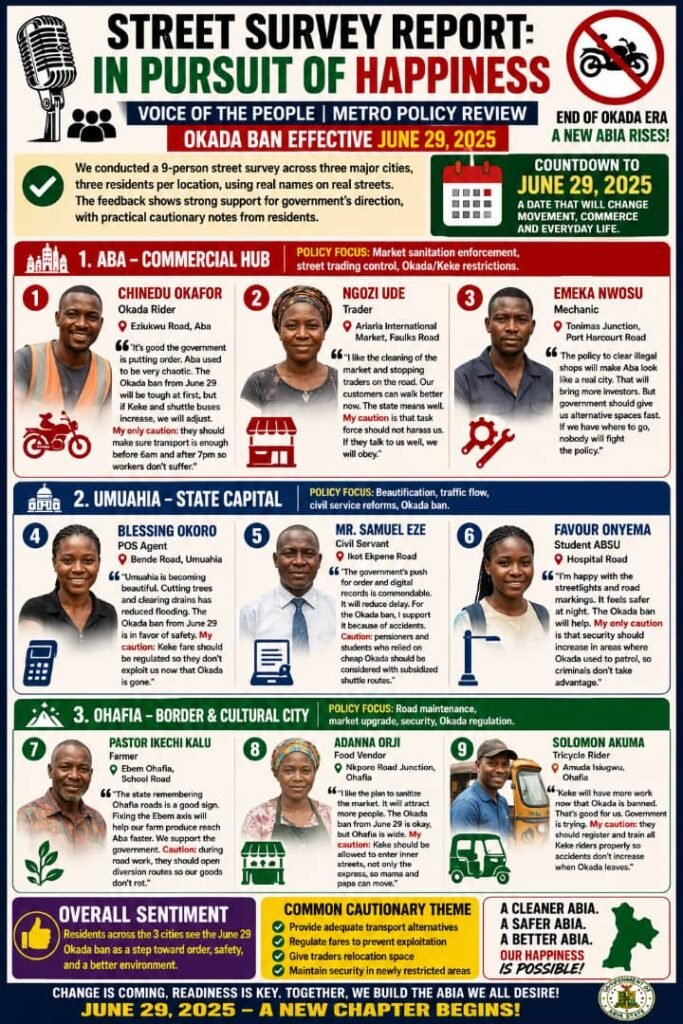
To understand what people were really thinking beyond political speeches and social-media arguments, a street survey was conducted across three major Abia cities: Aba, Umuahia and Ohafia.
Nine residents were interviewed—three from each location—on real streets where the consequences of government policy would be felt directly.
What emerged was surprising.
There was no widespread rebellion against the government’s direction. Instead, the dominant feeling was one of cautious optimism.
The people appeared ready for change.
But they also had warnings.
ABA: ORDER RETURNS—BUT AT WHAT COST?
Aba is not merely a city. It is a living marketplace.
From Eziukwu Road to Ariaria International Market and Port Harcourt Road, thousands of people wake up every morning determined to manufacture, repair, trade, transport and survive.
Here, mobility is not a luxury. It is the heartbeat of commerce.
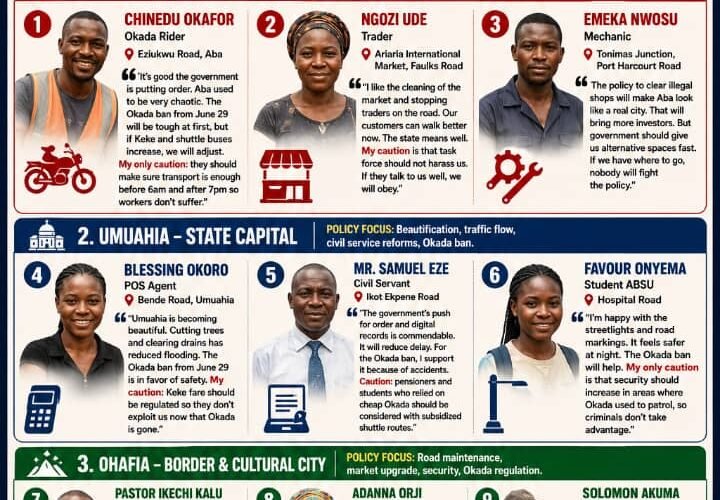
At Eziukwu Road, Chinedu Okafor, an Okada rider, spoke with the calmness of a man whose livelihood was approaching an uncertain crossroads.
“It’s good the government is putting order. Aba used to be very chaotic,” he said.
His support for restoring order was unmistakable. Yet behind his words was an obvious concern: what would happen to workers who depended on motorcycles during the early hours of the morning and late at night?
“The Okada ban from June 29 will be tough at first, but if Keke and shuttle buses increase, we will adjust. My only caution is that they should make sure transport is enough before 6am and after 7pm so workers don’t suffer.”
It was not a rejection of the policy.
It was a plea for preparation.
At Ariaria International Market along Faulks Road, trader Ngozi Ude had noticed the visible changes brought by sanitation enforcement and efforts to remove roadside obstructions.
“I like the cleaning of the market and stopping traders on the road. Our customers can walk better now. The state means well,” she explained.
But her expression changed when the discussion moved to enforcement.
“My caution is that the task force should not harass us. If they talk to us well, we will obey.”
Her message was simple: residents may accept discipline, but discipline must not become intimidation.
At Tonimas Junction on Port Harcourt Road, mechanic Emeka Nwosu welcomed the clearing of illegal structures.
“The policy to clear illegal shops will make Aba look like a real city. That will bring more investors,” he said.
Then came the condition.
“Government should give us alternative spaces fast. If we have where to go, nobody will fight the policy.”
That sentence captured the dilemma confronting the government.
People want a cleaner and more organised city—but they do not want beautification to become economic displacement.
Aba was prepared for order.
The question was whether government had prepared enough alternatives.
UMUAHIA: A BEAUTIFUL CAPITAL FACES A TRANSPORT TEST
In Umuahia, the atmosphere was different.
The roads appeared calmer. Streetlights and road markings had improved visibility. Drain clearing and beautification projects were beginning to reshape the state capital.
Yet beneath the calm was another question:
What would happen when Okada disappeared?
At Bende Road, Blessing Okoro, a POS agent, praised the changing appearance of the city.
“Umuahia is becoming beautiful. Cutting trees and clearing drains has reduced flooding,” she said.
She supported the motorcycle restriction on safety grounds, but feared that tricycle operators might take advantage of reduced competition.
“The Okada ban from June 29 is in favour of safety. My caution is that Keke fares should be regulated so they don’t exploit us now that Okada is gone.”
Her fear was shared by many low-income residents.
Whenever one transport option disappears, the remaining operators gain greater control over prices.
Would regulation come before exploitation—or after public complaints?
Along Ikot Ekpene Road, civil servant Mr Samuel Eze spoke approvingly about the government’s efforts to improve administrative efficiency.
“The government’s push for order and digital records is commendable. It will reduce delay,” he said.
He also supported the ban because of the number of motorcycle accidents witnessed over the years.
But he quickly raised the plight of vulnerable commuters.
“Pensioners and students who relied on cheap Okada should be considered with subsidised shuttle routes.”
That proposal introduced another dimension to the debate.
A transport policy may improve safety, but can it be called successful if students miss lectures and pensioners cannot afford to travel?
At Hospital Road, Favour Onyema, an ABSU student, pointed to another concern rarely mentioned in public discussions.
“I’m happy with the streetlights and road markings. It feels safer at night. The Okada ban will help,” she said.
Then came the warning:
“My only caution is that security should increase in areas where Okada used to patrol, so criminals don’t take advantage.”
The concern was striking.
In some neighbourhoods, motorcycle riders were not merely transport providers. Their constant movement created an informal presence on roads and inner streets.
Once they disappeared, would criminals move into the silence?
Umuahia wanted safety.
But safety would require more than removing motorcycles.
OHAFIA: WHEN ONE POLICY MEETS A WIDE COMMUNITY
Ohafia presented perhaps the most complicated picture.
Unlike the tightly packed commercial streets of Aba or the structured roads of Umuahia, Ohafia stretches across communities where residents may travel considerable distances before reaching farms, markets, schools or health facilities.
Here, a policy designed for metropolitan order could produce unexpected difficulties.
At Ebem Ohafia, along School Road, Pastor Ikechi Kalu, a farmer, welcomed the government’s attention to roads.
“The state remembering Ohafia roads is a good sign. Fixing the Ebem axis will help our farm produce reach Aba faster,” he said.
But road construction could also temporarily trap farmers and their goods.
“During road work, they should open diversion routes so our goods don’t rot.”
For the farmer, development was not merely about completing roads. It was about ensuring that livelihoods survived while the roads were being built.
At Nkporo Road Junction, food vendor Adanna Orji supported plans to improve market sanitation.
“I like the plan to sanitise the market. It will attract more people,” she said.
She was not opposed to the Okada ban, but she reminded policymakers that Ohafia was geographically different.
“Ohafia is wide. My caution is that Keke should be allowed to enter inner streets, not only the express, so mama and papa can move.”
Her reference to “mama and papa” brought the human impact into sharp focus.
What happens to an elderly woman living far from the major road?
What happens when a sick resident needs urgent transport from an inner community?
A successful policy must account for those who live beyond the expressway.
At Amuda Isiugwu, tricycle rider Solomon Akuma saw an opportunity.
“Keke will have more work now that Okada is banned. That’s good for us. Government is trying,” he said.
But even he recognised that increased business could create another danger.
“They should register and train all Keke riders properly so accidents don’t increase when Okada leaves.”
In other words, removing one transport risk must not produce another.
THE SURPRISING VERDICT
After nine conversations across three cities, a pattern became unmistakable.
The residents were not demanding that government abandon its policies.
They were not rejecting sanitation, traffic control, market organisation, road construction or the Okada ban.
On the contrary, many believed that Abia was moving towards greater order, safety and modernisation.
But their support came with four urgent conditions:
Provide enough transport alternatives.
Prevent arbitrary fare increases.
Relocate affected traders and artisans humanely.
Increase security in areas where motorcycles will no longer operate.
These were not hostile demands.
They were the practical voices of people who wanted reform to succeed.
THE FINAL COUNTDOWN
As June 29 approached, the real test was no longer whether the government had the authority to enforce the ban.
The deeper test was whether implementation would reflect the lived realities of the people.
Would shuttle buses appear before commuters became stranded?
Would fares be monitored before exploitation began?
Would task-force officials enforce the law without humiliation and harassment?
Would inner communities remain accessible?
Would displaced traders receive alternative spaces?
Would security operatives fill the vacuum left by motorcycles?
The residents had spoken.
They wanted cleaner cities.
They wanted safer roads.
They wanted organised markets.
They wanted investment and development.
But above all, they wanted government policy to improve their lives—not merely rearrange their difficulties.
That is the true meaning of development.
It is not simply the removal of Okada from the road.
It is the careful movement of ordinary people from uncertainty to security, from disorder to opportunity and from hardship to happiness.
The countdown had begun.
And when June 29 finally arrived, the people of Aba, Umuahia and Ohafia would not judge the policy by the number of motorcycles removed from the streets.
They would judge it by one powerful question:
Did life become safer, easier and better for the ordinary Abian?
That answer would determine whether the policy became a historic reform—or merely another government announcement.
IN PURSUIT OF HAPPINESS: THE PEOPLE SUPPORT ORDER, BUT THEY ARE WATCHING HOW IT IS DELIVERED.