
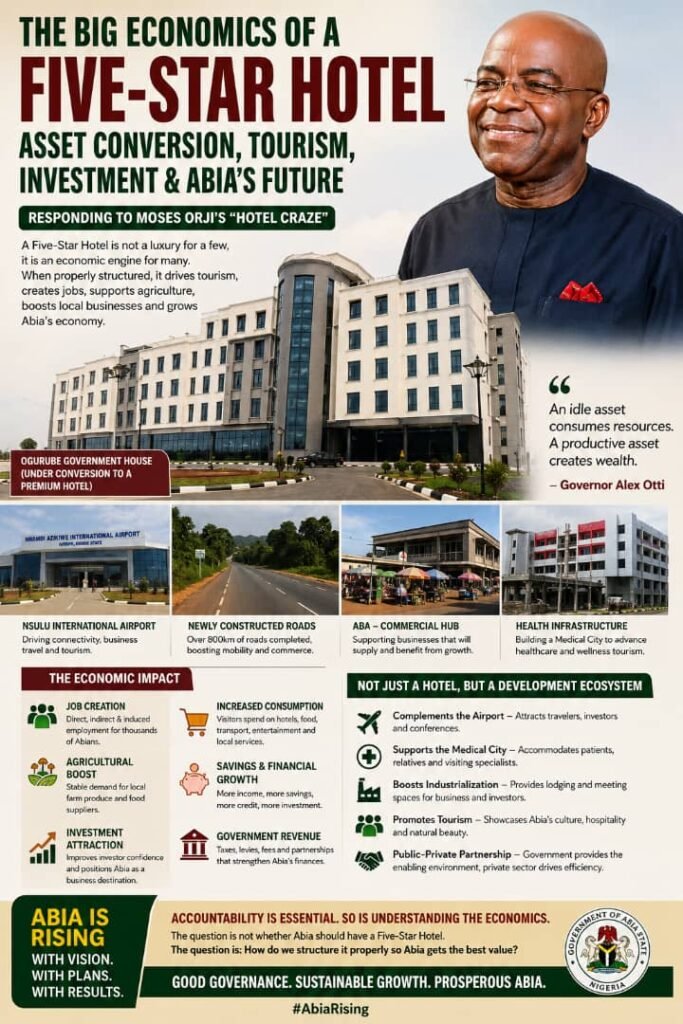
THE BIG ECONOMICS OF A FIVE-STAR HOTEL: MOSES ORJI’S “HOTEL CRAZE” AND THE DELIBERATE MISREPRESENTATION OF PRODUCTIVE ASSET CONVERSION
A Response to Mr Moses Ayodele Orji, Writer, and Mr Eric, Poster
By Pastor Prof. Chukwuemeka Ifegwu Eke
Mr Eric recently circulated an article written by Mr Moses Ayodele Orji under the dramatic title, “What’s This Craze About Five-Star Hotels?”
The article is lengthy, angry, insulting and politically theatrical. It portrays Governor Alex Otti as a leader wandering around Abia State, acquiring land and erecting luxury hotels wherever he finds an empty space.
According to this curious narrative, an airport district must not have a hotel. A medical city must not provide accommodation. An industrial complex must not have conference or hospitality facilities. A tourism and golf development must apparently send visitors to sleep in their vehicles. Even an unfinished public building that can be commercially repurposed must remain an expensive monument to political vanity.
What Mr Orji calls a “five-star hotel craze” may, under a properly structured arrangement, represent something entirely different: the conversion of idle assets into productive capital, the attraction of private investment, the expansion of tourism, the creation of employment and the construction of an interconnected economic ecosystem.
The fundamental weakness in the article is that its author sees buildings but does not see linkages.
He sees hotel rooms but not tourism.
He sees beds but not employment.
He sees restaurants but not agricultural supply chains.
He sees conference halls but not business tourism.
He sees premium branding but not destination marketing.
He sees consumption but not the income, savings and investment generated by that consumption.
This is precisely where politics ends and economics begins.
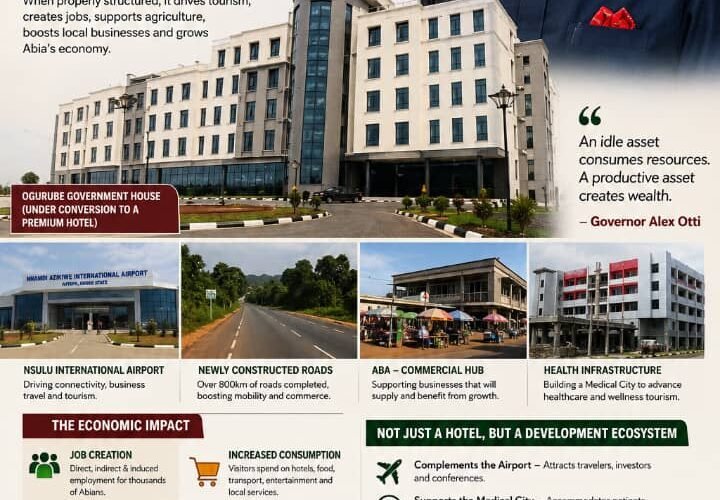
THE GOVERNMENT HOUSE QUESTION: SHOULD A STRANDED ASSET REMAIN STRANDED?
The public controversy surrounding the proposed conversion of the structure at Ogurube Layout cannot be intelligently discussed without first asking what condition the building was in and whether it ever became a fully functional seat of government.
The structure was hurriedly commissioned at the end of the previous administration. The present government subsequently maintained that major sections were incomplete and that the building lacked essential facilities required for a functioning Government House.
The sensible economic question is therefore not:
“Why is Governor Otti turning a perfectly functioning Government House into a hotel?”
The real questions are:
Was the building complete and fully operational?
How much additional public money would be required to make it functional?
Does Abia need two expensive government complexes?
What would it cost to secure, maintain and rehabilitate an unused structure?
Could the building be converted into a commercially productive asset?
What value would accrue to Abia under the proposed arrangement?
An abandoned public building does not become valuable merely because politicians attach the title “Government House” to it.
If it remains unused, it still consumes public resources through security, maintenance, deterioration, insurance, utilities and opportunity cost.
Its concrete walls may remain standing, but economically, it is sleeping capital.
A prudent government should not preserve a stranded asset as a shrine to political ego. It should examine whether that asset can be converted into a source of revenue, employment, investment and urban renewal.
That is not evidence of a hotel obsession.
It is the economics of asset optimisation.
However, the government must publish the financing, valuation, ownership and concession arrangements when they are concluded. Transparency is not optional. Abians must know what the state contributes, what the private operator contributes, who bears the commercial risk, how long the concession lasts and what returns accrue to the public.
Accountability strengthens the economic case. It does not destroy it.
A BRANDED HOTEL DOES NOT NECESSARILY MEAN A GOVERNMENT-BUILT HOTEL
Mr Orji repeatedly presents every hotel component mentioned in relation to an Abia development project as though Governor Otti intends to use public money to build and manage a chain of state-owned luxury hotels.
That conclusion does not automatically follow.
In modern project development, government may provide land, infrastructure, regulation or an existing asset while a private developer finances, equips and operates the commercial facility.
A reputable international brand may provide management, reservations, marketing, service standards and access to a global customer network without owning the property outright.
One can own a building and lease it to an operator.
One can develop a property and enter into a management agreement with an international brand.
One can grant a concession while retaining public ownership of the underlying asset.
One can structure a public-private partnership in which commercial and operational risks are allocated between the parties.
Therefore, mentioning a hotel brand does not prove that the Abia State Government is personally becoming a hotelier.
Before shouting “recklessness,” critics should establish the actual transaction:
Who owns the land?
Who owns the building?
Who finances the conversion?
Who purchases the equipment?
Who operates the hotel?
Who bears the risk if occupancy is poor?
What annual payment or revenue share comes to the state?
What happens to the asset when the concession expires?
These are serious questions.
Collecting every proposed hospitality component in Abia and presenting the total as a list of government-funded hotels is not serious economic analysis. It is political addition without institutional context.
THE BIG ECONOMICS OF HOSPITALITY
A five-star hotel is not merely a bedroom with expensive curtains.
A properly located and professionally managed premium hotel is a production centre that sells accommodation, food, beverages, conferences, recreation, security, telecommunications, logistics and destination experiences.
It sits at the intersection of tourism, agriculture, manufacturing, construction, finance, transportation, entertainment, digital services and real estate.
The National Bureau of Statistics recognises accommodation and food services as productive economic activities contributing to national output. In the first quarter of 2025, the sector accounted for approximately 1.25 per cent of Nigeria’s nominal gross domestic product.
That contribution does not include every secondary transaction generated through transport, agriculture, retail, entertainment, construction and professional services.
The economics is therefore much wider than what appears on the hotel’s financial statement.
TOURISM IS AN EXPORT CONSUMED AT HOME
When a visitor travels from Lagos, Abuja, London, Johannesburg or New York to Abia and spends money on accommodation, food, transportation, clothing, entertainment and professional services, Abia has effectively exported services.
The hotel does not travel to the foreign customer.
The customer travels to the hotel.
The visitor consumes the service in Abia and leaves the money behind.
This is one of tourism’s most powerful economic characteristics: it is a place-based export.
Abia can export hospitality, culture, medical services, conferences, creative products and commercial experiences without loading them onto a ship.
The state therefore earns from the movement of people in much the same way that a manufacturer earns from the movement of goods.
A premium hotel can help Abia attract and retain that expenditure.
Without adequate accommodation, many conferences, weddings, corporate meetings, investment visits and professional events are transferred to Enugu, Port Harcourt, Owerri, Abuja or Lagos.
Whenever that happens, Abia loses more than a room booking.
It loses expenditure on transportation, catering, entertainment, clothing, decoration, photography, printing, security and local shopping.
This is called economic leakage.
Quality hospitality infrastructure helps to plug that leakage.
THE TOURISM MULTIPLIER
Suppose a business visitor spends ₦300,000 during a trip to Umuahia.
Part of that money goes to the hotel.
The hotel pays salaries, food suppliers, laundry operators, maintenance companies, entertainers, security providers and utility firms.
The vegetable supplier pays farm workers.
The farm workers buy clothing and household goods.
The clothing trader purchases products from Aba manufacturers.
The manufacturer pays employees and transporters.
Those employees patronise markets, schools, salons, pharmacies and restaurants.
The original expenditure therefore moves through several rounds of the economy.
This process is known as the multiplier effect.
The economic impact of the hotel consists of:
Direct effects from the hotel’s own employment and expenditure;
Indirect effects from purchases made throughout its supply chain; and
Induced effects generated when workers and suppliers spend the incomes they have earned.
The World Bank identifies tourism as having a jobs multiplier because each direct job can support additional jobs in supply chains and related services.
That is why the economic footprint of a hotel cannot be measured merely by counting receptionists and cleaners.
CONSUMPTION DOES NOT AUTOMATICALLY DESTROY SAVINGS
Mr Orji’s article treats hospitality development as though consumption were inherently wasteful.
That is poor macroeconomics.
Consumption is one person’s expenditure and another person’s income.
When a visitor pays for a hotel room, the payment becomes revenue to the business.
That revenue pays wages, suppliers, taxes, maintenance costs and investors.
Workers and suppliers consume part of their additional income and save another part.
The savings enter banks, cooperatives, pension funds and other financial institutions.
Those institutions can transform deposits into credit for agriculture, housing, commerce, manufacturing and transportation.
The sequence is straightforward:
Visitor spending creates business revenue.
Business revenue creates household income.
Household income supports consumption and savings.
Savings provide deposits.
Deposits support lending.
Lending finances investment.
The relationship between tourism and savings is therefore not antagonistic.
Additional economic activity generates the income from which sustainable savings can be made.
A person without employment cannot save by merely receiving a lecture on financial discipline.
Production creates income, income supports saving, and saving supports investment.
INVESTMENT AND CAPITAL FORMATION
The development or conversion of a premium hotel requires substantial investment in construction, fittings, furniture, kitchens, conference facilities, water systems, electricity, internet connectivity, security, landscaping and waste management.
This creates demand for architects, engineers, quantity surveyors, builders, electricians, plumbers, technicians, interior designers and artisans.
Once the facility becomes operational, investment continues through maintenance, renovation, equipment replacement, staff development and service expansion.
Where the project is privately financed, the state may attract capital without carrying the entire commercial burden.
A dormant building is thereby transformed into productive fixed capital.
The critical requirement is that the transaction must be structured so that the state does not socialise the risks while private interests monopolise the rewards.
A sound arrangement should contain:
credible independent valuation;
competitive procurement or partner selection;
clear performance obligations;
measurable investment commitments;
appropriate risk allocation;
fair concession or lease payments;
local employment requirements;
maintenance standards;
termination provisions; and
transparent public reporting.
The case for a hotel does not absolve government of the duty to negotiate intelligently.
Indeed, the better the economic opportunity, the stronger the need to protect the public interest.
EMPLOYMENT: DIRECT, INDIRECT AND INDUCED
A premium hotel employs people directly as:
managers, accountants, chefs, waiters, receptionists, housekeepers, cleaners, engineers, technicians, drivers, security officers, gardeners, marketers and information-technology specialists.
It creates indirect employment for:
farmers, food processors, transporters, laundry operators, furniture makers, tailors, beverage distributors, florists, entertainers, printers, photographers, decorators, maintenance firms and event planners.
It creates induced employment when those workers spend their earnings elsewhere.
The World Bank’s work on African hospitality investment has found that hotel projects can retain and create direct jobs while producing additional indirect and induced employment throughout the tourism value chain.
Therefore, counting only the individuals wearing hotel uniforms radically understates the employment effect.
THE AGRICULTURAL ECONOMICS
Hotels purchase food continuously.
They require vegetables, fruits, poultry, eggs, fish, beef, grains, tubers, spices, dairy products, beverages and processed foods.
With a properly enforced local-procurement strategy, farmers and agro-processors in Abia can obtain predictable institutional demand.
Predictable demand allows a farmer to increase output, hire labour, improve storage, adopt better production methods and negotiate financing.
The connection is practical:
The hotel publishes quality and quantity requirements.
Farmers organise production.
Aggregators coordinate collection.
Transporters move the produce.
Processors add value.
The hotel purchases the final output.
Agriculture becomes commercially linked to tourism.
The hotel room may be in Umuahia, but part of its value chain can begin on a farm in Bende, Ikwuano, Umunneochi, Isiala Ngwa, Ukwa, Ohafia or Arochukwu.
That is how hospitality becomes rural economic policy.
THE “MADE IN ABA” OPPORTUNITY
A premium hotel can also become a showroom for Aba’s manufacturing economy.
Hotels require:
bedsheets, towels, uniforms, footwear, furniture, leather products, bags, interior decorations, cleaning materials, packaged food, printing and branded merchandise.
A deliberate local-content programme can integrate capable Aba producers into these supply chains.
The objective should not be to force the hotel to purchase substandard products merely because they are local.
The better strategy is to help local producers achieve the quality, volume, consistency and certification required by major hospitality brands.
Imagine an international visitor sleeping on linen produced in Aba, sitting on locally manufactured furniture, using locally produced leather accessories and purchasing Abia-made products from a hotel retail gallery.
That visitor is not merely occupying a room.
The visitor is experiencing Abia’s productive economy.
This is industrial promotion through hospitality.
THE ECONOMICS OF BUSINESS TOURISM
A premium hotel with conference facilities can attract:
annual general meetings;
professional conferences;
corporate retreats;
government and development-partner workshops;
trade exhibitions;
medical conferences;
weddings;
diaspora events; and
investment summits.
Business travellers often spend more per trip than ordinary leisure visitors because their expenditure includes accommodation, conference registration, transportation, meals, communications, entertainment and professional support services.
A conference that brings 500 participants to Abia may create demand across hotels, taxis, restaurants, printing firms, fashion businesses, caterers, event planners and retail outlets.
The conference hall is therefore not merely a decorated room.
It is a platform for importing expenditure into the state.
AIRPORTS, MEDICAL CITIES, INDUSTRIAL PARKS AND HOTELS ARE COMPLEMENTARY
Mr Orji mocks the inclusion of hotels in multiple development proposals as though each hotel existed in isolation.
But modern economic infrastructure works through complementarity.
An airport creates passenger flows.
A hotel accommodates passengers, airline crews, investors and visitors.
Roads move them.
Restaurants feed them.
Banks process their transactions.
Retailers sell to them.
Conference centres host their meetings.
Manufacturers supply the facilities they use.
An industrial park requires accommodation for engineers, executives, consultants, contractors and visiting investors.
A medical city requires accommodation for patients’ relatives, visiting specialists, researchers and conference participants.
A tourism or golf development requires lodging because visitors cannot enjoy a destination adequately without somewhere suitable to stay.
These are not unrelated monuments.
They can be components of integrated economic clusters.
The airport makes the hotel more viable.
The hotel makes the airport and conference economy more attractive.
The medical city creates demand for accommodation.
The industrial park generates corporate travel.
This is the economics of complementarity.
URBAN RENEWAL AND AGGLOMERATION
A professionally managed hotel can stimulate improvements in roads, street lighting, security, sanitation, telecommunications and public spaces around its location.
Restaurants, offices, shops, entertainment businesses and residential developments may cluster nearby.
As commercial activity increases, surrounding property values and land utilisation may improve.
Economists describe part of this process as agglomeration: firms and workers gain advantages by locating near one another, near infrastructure and near concentrations of customers.
A stranded public structure can therefore become an anchor around which a wider commercial district develops.
The building itself is only the centre.
The surrounding economy is the larger story.
FISCAL BENEFITS
A successful hotel and its associated businesses can generate public revenue through lawful taxes, levies, permits, employee income taxes, land charges, concession payments and commercial activity.
The objective is not for the state government to run every restaurant or wash every bedsheet.
The objective is to create an enabling environment in which businesses produce, employ, invest and contribute to the tax base.
Abia cannot achieve sustainable fiscal independence by waiting permanently for monthly allocations from Abuja.
It must expand the number, size and productivity of economic activities taking place within the state.
Hospitality is one component of that diversification.
DESTINATION BRANDING AND INVESTOR CONFIDENCE
Investors do not evaluate a location solely by reading government brochures.
They ask practical questions:
Can executives reach the location safely?
Is there reliable accommodation?
Are there secure meeting facilities?
Can international partners be hosted professionally?
Is broadband available?
Can conferences and negotiations be held in a suitable environment?
Premium hospitality is part of the soft infrastructure of investment.
A state seeking manufacturers, financiers, medical professionals, diaspora capital and multinational partners must be able to receive them properly.
A five-star hotel will not by itself industrialise Abia.
But the absence of suitable business infrastructure can discourage the very investors the state wants to attract.
THE CLAIM THAT NIGERIA HAS ONLY ONE FIVE-STAR HOTEL
Mr Orji asserts that Nigeria has only one five-star hotel and treats that statement as a conclusive economic argument against premium hospitality development in Abia.
The claim is problematic.
Nigeria does not operate one perfectly uniform and universally enforced hotel-star classification that produces an uncontested list accepted by every operator, tourism authority and booking platform.
Several establishments in Lagos, Abuja and other locations are routinely marketed or classified as five-star or luxury hotels.
But even if Nigeria had only one five-star hotel, how would scarcity become an argument against new investment?
If a country lacks quality hospitals, should no state build one?
If a region lacks industrial parks, should a governor avoid establishing one?
If quality accommodation is scarce, that may indicate an infrastructure gap—not an economic prohibition.
The proper question is whether sufficient demand exists and whether the project can be commercially sustained.
THE RISKS MUST NOT BE IGNORED
A balanced economic analysis must acknowledge that a branded hotel is not automatically successful.
The project can fail if:
occupancy remains low;
construction costs are inflated;
debt is excessive;
energy and maintenance expenses become unsustainable;
the location is poorly connected;
the operator is weak;
the asset is politically interfered with;
local supply chains are ignored; or
the commercial agreement is unfavourable to the state.
There is also a danger of creating an enclave that imports most supplies, employs too few local people and sends most profits outside the state.
These risks must be addressed through feasibility studies, transparent contracting, proper demand analysis, local-content obligations, professional management and continuous performance monitoring.
Supporting the economic logic of hospitality does not mean supporting every hotel proposal blindly.
Economics requires that expected social and commercial benefits exceed the opportunity cost.
The state must demonstrate value for money.
ACCOUNTABILITY IS DIFFERENT FROM ABUSE
Moses Orji is entitled to ask questions.
He may demand the valuation report.
He may request the concession details.
He may interrogate land acquisition.
He may ask whether host communities were fairly treated.
He may question the financing structure, expected occupancy, environmental impact and projected returns.
Those are legitimate democratic interventions.
But repeatedly calling the governor irrational, arrogant, unprepared and reckless does not establish that any particular transaction is economically defective.
Adjectives are not evidence.
Anyone alleging waste should identify:
the specific approved expenditure;
the funding source;
the contractual obligation;
the amount already paid;
the private investor’s contribution;
the ownership arrangement; and
the financial loss allegedly suffered by Abia.
Without such evidence, the article remains a political accusation wearing an economist’s coat.
THE BROADER ABIA DEVELOPMENT QUESTION
It is also inaccurate to pretend that Abia’s entire development agenda consists of hotels.
The state is simultaneously addressing roads, urban renewal, healthcare, education, transportation, power, investment promotion and abandoned public infrastructure.
A pedestrian crossing does not cancel a road programme.
A hotel does not cancel an industrial policy.
A conference facility does not cancel healthcare investment.
A state is not required to complete one sector before touching another.
Government manages multiple needs simultaneously.
The economically relevant issue is whether the portfolio of projects is coherent, affordable, properly sequenced and connected to a wider development strategy.
THE QUESTIONS MR ERIC AND MOSES ORJI SHOULD ANSWER
Would they prefer that the Ogurube structure remain unused and deteriorating indefinitely?
Should Abia maintain two costly government complexes merely to satisfy political symbolism?
Should visitors to an airport district be denied nearby accommodation?
Should a medical city lack facilities for patients’ relatives and visiting specialists?
Should industrial investors lodge outside the state?
Should major conferences continue taking their expenditure to neighbouring states?
Should Aba manufacturers be denied access to hospitality supply chains?
Should farmers be denied the predictable demand created by institutional food purchases?
Should private capital be rejected merely because its investment includes a hotel?
Criticism must present a superior alternative.
“Leave the building empty” is not an economic development strategy.
“Do not build hotels anywhere” is not industrial policy.
“Premium hospitality is wasteful” is not macroeconomics.
THE ECONOMIC VERDICT
A five-star hotel is not a magic wand.
It cannot substitute for good roads, reliable electricity, security, schools, hospitals, agriculture or manufacturing.
But neither is it an ornamental irrelevance.
When properly financed, located and managed, it can:
attract tourism and business visitors;
retain expenditure within Abia;
create direct, indirect and induced employment;
expand markets for farmers and processors;
support Aba manufacturers;
stimulate household income and savings;
attract private investment;
generate government revenue;
strengthen conferences and medical tourism;
improve destination branding;
support airport and industrial activity;
promote urban renewal; and
convert an idle public asset into productive capital.
The true policy test is therefore not whether the words “five-star hotel” appear in several development proposals.
The real tests are:
Who pays?
Who owns?
Who operates?
Who bears the risk?
What does Abia earn?
How many jobs are created?
How much is purchased locally?
What other investment does it unlock?
What happens to the asset at the end of the agreement?
Mr Moses Ayodele Orji wrote an angry letter.
Mr Eric posted it.
But anger cannot replace feasibility analysis.
Mockery cannot replace public-sector economics.
And the repetition of “five-star hotel” cannot transform a commercially rational asset-conversion proposal into madness.
Governor Alex Otti must be held accountable. Every agreement should be transparent, every public asset properly valued and every promise measured against actual results.
But accountability must be built on facts.
The choice is not between hotels and development.
The intelligent choice is between an idle building that consumes public resources and a productive asset that generates economic activity.
An abandoned asset sleeps.
A well-structured investment works.
That is the big economics of the five-star hotel.