
From Elusive Growth to Deliberate Reform: Otti Through Easterly’s Lens

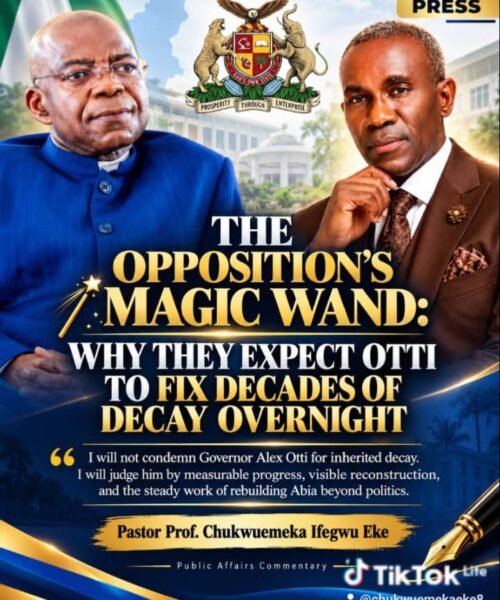
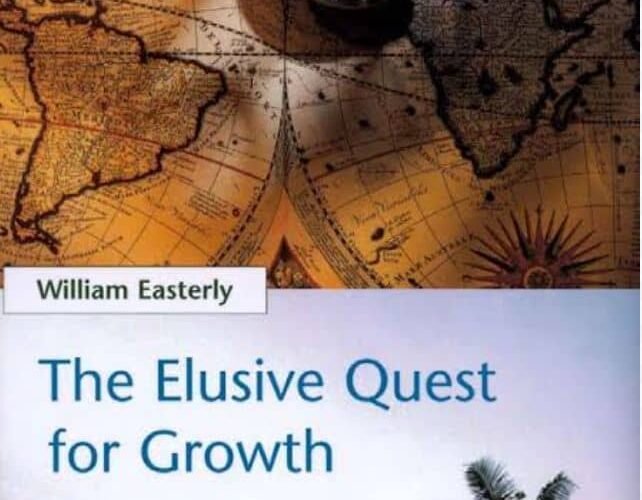
William Easterly’s central argument in The Elusive Quest for Growth is that underdevelopment persists not because leaders fail to dream, but because economies operate on the wrong incentives. Growth does not emerge from declarations, committees or applause; it emerges when the rules of a society reward productivity, innovation and accountability rather than rent-seeking. Viewed through this lens, Abia State under Governor Alex Otti represents a deliberate attempt to reverse decades of distorted incentives and institutional decay. What makes the Otti moment particularly significant is that he is not merely increasing spending or announcing plans; he is consciously re-wiring the incentive structure that shapes economic behaviour within Abia’s public and private sectors.
Incentives, Not Intentions
Easterly repeatedly warns that development fails when incentives reward inefficiency or corruption. In many developing regions, new funds often create more room for mismanagement rather than more output. This critique is critical for understanding the reforms unfolding in Abia. Instead of relying solely on higher allocations, the administration began by restructuring the conditions under which revenue is collected, monitored and deployed. The introduction of a digital tax system for transporters and traders, the harmonisation of revenue enforcement, and the shift to Treasury Single Account mechanisms represent a break from a long-standing economy of leakages, tout extortion and informal collectors who operated as parallel governments. Under an Easterly interpretation, these reforms are not administrative tidying—they are fundamental incentive shifts. They make corruption more difficult, raise the cost of diversion and reward those who comply with predictable systems rather than those who exploit discretionary gaps.
Capital Spending and the Easterly Warning
Easterly is famously sceptical of the “financing gap” logic that dominated global development debates for decades. In his view, pouring money into poor economies without strong institutions leads to white elephants rather than progress. Abia’s heavy investment in capital expenditure therefore demands a nuanced reading. The 2024, 2025 and 2026 budgets are unapologetically capital-driven, with infrastructure, education, health and agro-industrial corridors receiving the largest allocations. The critical question is not the size of the spending but whether the institutions and incentives surrounding that spending are aligned with real productivity gains. Early signs suggest that Otti’s approach is not the typical prestige-project strategy; it is a targeted attempt to reduce transaction costs, improve access to markets, and create industrial enclaves where manufacturers, farmers and service providers can operate with lower risk and higher certainty. If these roads, processing zones and public facilities translate into lower costs, faster logistics and new private investments, then the capital budgets pass Easterly’s test. If they merely produce structures without function, they become the very failures Easterly critiques.
Digital Transformation as Institutional Reform
A major theme in Easterly’s work is the power of knowledge, technology and transparent rules to unlock productivity. When information is costly or manipulated, economies stagnate. Abia’s digital transformation programme, launched to reposition the economy for the knowledge-driven era, aligns closely with this insight. By digitising public records, revenue systems, civil-service processes and entrepreneurial support frameworks, the administration is embedding transparency into the architecture of governance. This is not digitalisation for convenience; it is a shift toward rule-based administration in which data—not political proximity—determines outcomes. For Easterly, such institutional change is more central to development than any physical project, because it rewrites the rules under which people make economic decisions. When information becomes reliable and the cost of manipulation rises, productivity becomes more profitable than rent-seeking.
The Long Game of Institutions
Easterly argues that economic progress is slow, cumulative and vulnerable to reversal if institutions are weak. The real test of reform is whether it can survive political cycles. This is also the challenge before Abia. While Otti’s reforms in revenue, budgeting, procurement and citizen monitoring mark a decisive shift from past governance models, their durability depends on how deeply they become embedded in law, bureaucracy and public expectation. Institutionalised transparency tools, predictable tax systems, contract enforcement and digital governance mechanisms must become part of Abia’s administrative DNA. If they remain tied to one administration’s energy rather than the state’s operating culture, the gains will be fragile. Easterly teaches that development succeeds only when incentives and institutions align over long periods, not when reforms appear impressive but temporary.
An Easterly Scorecard for Abia’s Future
Applying Easterly to Abia reveals that the Otti administration is pursuing development through the precise channels Easterly describes as effective: strengthening incentives, disciplining public finance, investing in productivity-enhancing infrastructure, promoting transparency and embedding knowledge-driven systems. Whether these reforms will translate into self-sustaining growth depends on continuity, institutional reinforcement and measurable improvements in private investment, job creation and productivity. If Abia continues on this path—where incentives favour enterprise rather than exploitation—then the state may indeed escape the cycle Easterly calls the “elusive quest,” replacing it with a model of development grounded in rational rules, open institutions and long-term economic transformation.
AProf Chukwuemeka Ifegwu Eke