
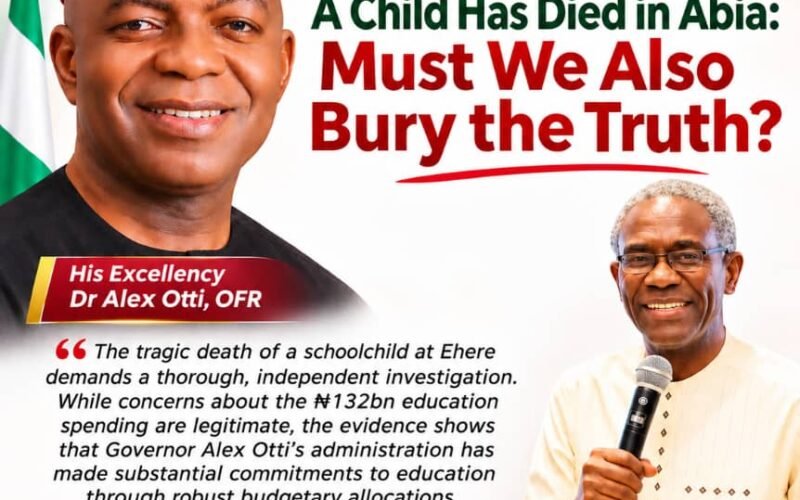
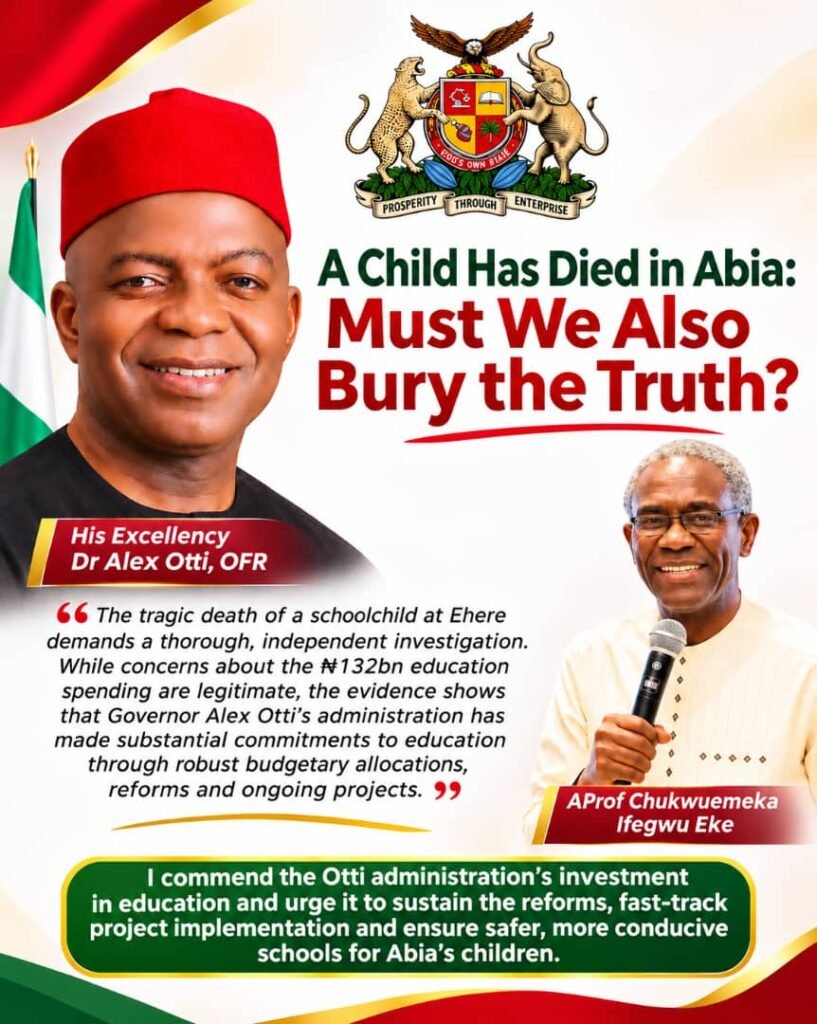
A CHILD HAS DIED IN ABIA, BUT MUST WE ALSO BURY THE TRUTH? MY RESPONSE TO THE APC’S ₦132 BILLION EDUCATION ALLEGATION
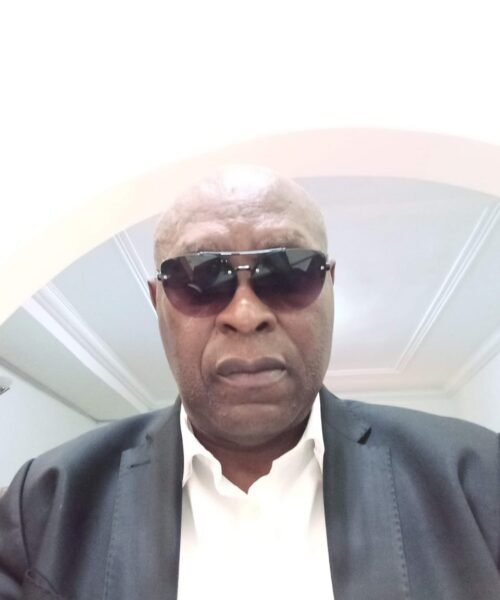
By AProf Chukwuemeka Ifegwu Eke
Department of Economics, University of Abuja
21 November 2026
THE DEATH OF A CHILD IS A TRAGEDY. THE EXPLOITATION OF THAT DEATH IS ANOTHER.
I read with considerable sadness the report published by Consort News on 21 November 2026 concerning the death of a Primary Two pupil following the collapse of a classroom building at Ehere Community Comprehensive School in Abia State. I subsequently read the political statement attributed to the Abia State chapter of the All Progressives Congress (APC), signed by its Publicity Secretary, Uche Aguoru.
My initial reaction was not political. It was human.
I am a father, an educator and a university scholar who has spent a substantial part of his adult life in classrooms, lecture theatres and academic environments. I understand, perhaps more intimately than many of those making political statements, what it means to entrust a child to an educational institution.
A parent does not send a seven-year-old child to school to confront structural danger. A parent sends that child to acquire knowledge, develop character and prepare for a future that may ultimately become more rewarding than the circumstances of birth.
When a child dies in a classroom, something fundamental has gone wrong.
I therefore join other concerned Nigerians in mourning this painful loss. I expect the Abia State Government to ensure an independent investigation, provide appropriate support to the bereaved family and establish whether negligence contributed to the tragedy.
But having said that, I must address another issue that troubles me almost as deeply: the apparent willingness of politicians to turn a grieving family’s tragedy into a convenient instrument of electoral warfare.
I have examined the APC’s reported allegations, particularly its reference to ₦132 billion supposedly committed to educational infrastructure, and I find serious weaknesses in the economic reasoning.
I cannot, in good conscience, allow those weaknesses to pass unchallenged.
THE ₦132 BILLION CLAIM: WHEN DID APPROPRIATION BECOME EXPENDITURE?
I have taught economics long enough to recognise the danger of building conclusions on figures that have not been properly defined.
One of the first principles I insist upon in economic analysis is that a number has little explanatory value until its meaning, source, period and method of measurement have been established.
The APC’s central accusation concerns ₦132 billion allegedly allocated to smart schools, school reconstruction and rehabilitation.
My question is straightforward.
Are we discussing ₦132 billion appropriated, ₦132 billion released, ₦132 billion actually expended, or ₦132 billion worth of completed projects?
These are not interchangeable accounting categories.
As an economist, I find it disturbing that a major political party would raise such an enormous financial allegation without presenting, in the reported statement, a reconciliation of these distinctions.
Consider the official Abia State Third-Quarter 2026 Budget Implementation Report.
Under the State Universal Basic Education Board, the report identifies an allocation of approximately ₦13.178 billion for reconstruction and retrofitting of dilapidated primary schools and related facilities across the seventeen local government education authorities.
By the end of September 2026, recorded expenditure on that particular budget line stood at approximately ₦4.145 billion.
The implementation rate was approximately 31.5%.
Now, this is precisely where economic literacy becomes indispensable.
The government had approved approximately ₦13.178 billion, but the recorded expenditure against that allocation was approximately ₦4.145 billion.
The two figures measure different things.
I would certainly demand an explanation for the relatively low implementation rate. I would equally want to know which schools benefited, which contractors received payments and whether the completed work represented value for money.
Those are serious questions.
But I would not irresponsibly announce that the entire ₦13.178 billion had disappeared merely because the budget contained that amount.
Yet this is the kind of accounting confusion the APC risks promoting when it introduces ₦132 billion without adequately distinguishing budgetary intentions from actual disbursements.
I challenge the party to publish the precise expenditure schedules supporting its allegation.
If the figure represents appropriations across several years, let it say so.
If it represents actual payments, let it identify the relevant transactions.
If it represents contracts awarded, let it provide the contract schedules.
I have no difficulty interrogating government expenditure. What I find objectionable is interrogating it with arithmetic that cannot survive elementary financial scrutiny.
Source: Abia State Government, Third-Quarter 2026 Budget Implementation Report.
THE SCHOOL THAT COLLAPSED: WHAT WAS ITS HISTORY?
There is another question I consider indispensable.
How old was the collapsed building?
When was it constructed?
Which administration built it?
When was it last renovated?
Were structural defects previously reported?
Was the building included in any rehabilitation programme?
Did anyone recommend that pupils should stop using it?
These are the questions I would expect a serious investigation to answer.
I have lived long enough in Nigeria to know that public infrastructure does not deteriorate overnight.
A classroom does not ordinarily move from sound structural condition to catastrophic failure simply because a new governor has entered Government House.
Where buildings have suffered years of inadequate maintenance, their eventual condition reflects an accumulation of historical decisions and omissions.
However, inherited deterioration cannot become a permanent excuse for a serving administration. Once dangerous infrastructure is identified, the responsibility to protect its users becomes immediate.
That is why I insist on an independent engineering investigation rather than a political conclusion reached before the facts are established.
I find it intellectually dishonest to discuss a collapsed school building without attempting to establish its construction and maintenance history.
If the building predates Governor Alex Otti’s administration, that history matters. If his administration received warnings and failed to act, that evidence matters equally.
What I refuse to accept is the replacement of investigation with political insinuation.
THE APC’S 70% DILAPIDATION CLAIM: I WANT TO SEE THE DATA
The APC reportedly asserted that more than 70% of school buildings in Abia State are dilapidated.
I have supervised academic research, examined empirical arguments and spent years insisting that students substantiate their claims.
If one of my postgraduate students submitted a dissertation containing such a statistic without identifying the underlying survey, I would return the work for correction.
Seventy per cent of what?
Of all school buildings?
Of public primary schools?
Of public primary and secondary schools combined?
Of classrooms inspected in selected local government areas?
What constitutes dilapidation?
Was the assessment based on leaking roofs, damaged walls, structural instability or complete unfitness for occupation?
When was the survey conducted?
Who conducted it?
These questions are not academic gymnastics. They determine whether the statistic has any meaning.
If the APC possesses a credible statewide infrastructure assessment, I encourage it to publish the report immediately. Such information could help prevent another tragedy.
But if the figure was merely inserted into a political statement to create an impression of widespread governmental failure, then we have a serious problem.
I cannot teach young Nigerians the importance of evidence in public policy and then applaud politicians who appear unwilling to subject their own statistics to the same discipline.
LET US NOT PRETEND THAT NOTHING IS HAPPENING IN ABIA’S EDUCATION SECTOR
I have studied the government’s education commitments, and I believe intellectual fairness requires me to acknowledge what the records establish.
Abia State’s 2026 budget provided approximately ₦203.25 billion for education, representing about 19.93% of the state’s approximately ₦1.016 trillion budget.
That allocation is substantial.
It has also been independently reported in comparative analyses of education budgets across the South-East.
The administration has announced programmes involving model schools, technical colleges, educational technology, teacher recruitment and rehabilitation of existing facilities.
The Ministry of Basic and Secondary Education has also reported the recruitment and training of thousands of teachers.
I recognise the difference between an announcement and an achievement.
I would not count an uncompleted school as a completed school, nor would I present a recruitment announcement as proof that every classroom has received a qualified teacher.
Nevertheless, I cannot accept the suggestion that the administration has made no meaningful commitment to education when the published records demonstrate considerable fiscal and administrative activity.
The appropriate scholarly question is whether these commitments are translating into measurable educational improvements.
Are more qualified teachers entering classrooms?
Are deteriorating buildings being rehabilitated?
Are pupils learning under safer conditions?
Are public schools becoming more attractive to families?
These are the outcomes I would examine.
The APC is entitled to disagree with the government.
But disagreement does not authorise the erasure of documented policy commitments.
Sources:
Premium Times, comparative analysis of South-East education budgets:
Abia State Ministry of Basic and Secondary Education:
I HAVE SEEN WHAT EDUCATIONAL DEPRIVATION DOES TO CHILDREN
Perhaps my sensitivity to this matter comes from my own involvement with education beyond the university environment.
I have had the opportunity to engage with children growing up in communities where educational opportunities cannot be taken for granted.
I have seen how a seemingly modest intervention can change a child’s confidence, attendance and prospects.
I have also seen the consequences of inadequate learning facilities and the burden placed on families who possess little economic security.
These experiences have reinforced something my professional training already taught me: education is not simply another expenditure item in a government budget.
It is an investment in human capital.
Its returns extend beyond the individual beneficiary to households, communities, labour productivity, social mobility and the wider economy.
That is why I take the reported death at Ehere so seriously.
It represents more than the loss of one pupil. It represents the destruction of a future whose possibilities can never be fully measured.
But that same conviction prevents me from accepting the transformation of the tragedy into an unsupported financial verdict against an entire administration.
I want the truth about the building.
I want the truth about the government’s expenditure.
And I want the truth about the condition of public schools across Abia.
I do not want a political substitute for any of these.
THE GOVERNMENT HAS PUBLISHED FINANCIAL RECORDS. LET US EXAMINE THEM.
The APC has raised concerns about transparency.
I support transparency without reservation.
Indeed, I believe that public financial information should be accessible enough for citizens, journalists, researchers and civil society organisations to examine without unnecessary difficulty.
Abia State has published its Third-Quarter 2026 Budget Implementation Report and its 2025 Accountant-General’s Report.
These documents contain financial information that can form the basis of serious expenditure analysis.
The 2025 Accountant-General’s Report, for example, records approximately ₦9.423 billion in actual expenditure classified under primary education.
That amount is not the same as total education expenditure. Neither should it be automatically equated with school construction expenditure.
The distinction matters.
I would welcome a comprehensive reconciliation of education-sector appropriations, releases, payments, commitments and verified projects from May 2023 onward.
Such an exercise would be far more illuminating than political exchanges built around a single aggregate figure.
I would also welcome independent scrutiny of procurement procedures and physical project implementation.
But I object to any narrative suggesting that financial records are entirely unavailable when official reports have been published.
If those records are incomplete, identify what is missing.
If there are inconsistencies, expose them.
If particular payments cannot be reconciled with projects, demand explanations.
That is how a credible opposition holds government accountable. It is not achieved by replacing financial analysis with suspicion.
Official sources:
WHAT TROUBLED ME MOST WAS THE APPEAL FOR VOTES IN 2027
I found one aspect of the reported APC statement particularly unsettling.
After discussing the death of a child, questioning education expenditure and alleging widespread infrastructural deterioration, the party reportedly appealed to Abians to support it in the 2027 general elections.
I read that conclusion more than once.
I wondered whether the tragedy had become inseparable from the party’s electoral calculations.
I understand politics. I understand opposition. I understand the legitimate desire of political parties to win elections.
But surely there must be moments when humanity takes precedence over electoral advantage.
A grieving family should not have to watch the death of its child become material for political competition before the circumstances of that death have even been independently established.
I would have expected the strongest immediate emphasis to be on securing other potentially dangerous classrooms, obtaining an independent structural assessment and ensuring that the family receives appropriate support.
Instead, the reported statement ultimately arrived at the 2027 elections.
I consider that juxtaposition deeply unfortunate.
There is something profoundly troubling about placing a child’s death and an electoral appeal within the same political argument.
I say this without suggesting that the APC has no right to criticise Governor Otti.
Criticism is indispensable to democracy.
But criticism should be proportionate, evidence-based and sensitive to the human circumstances surrounding it.
MY POSITION ON GOVERNOR ALEX OTTI IS GROUNDED IN EVIDENCE, NOT SENTIMENT
I have no interest in defending every administrative decision simply because it comes from Governor Alex Otti.
That would contradict the intellectual independence expected of someone in my profession.
What interests me is whether public resources are being committed to productive purposes and whether those commitments are producing identifiable public benefits.
In assessing an administration, I examine its inherited challenges, fiscal choices, institutional reforms and measurable outcomes.
I also distinguish intentions from implementation.
By that standard, I recognise that the Otti administration has made substantial budgetary commitments to education.
I recognise that teacher recruitment and infrastructure programmes have been initiated.
I equally recognise that a significant part of the planned educational infrastructure expenditure had not been implemented by the end of September 2026.
These facts can coexist.
Government progress does not mean that every problem has been solved.
The existence of an unsafe classroom does not, by itself, establish that every education investment has failed.
Nor does a substantial education budget establish that every school is safe.
I believe the administration should be judged on the full weight of the evidence rather than selected incidents or politically convenient statistics.
That is the standard I apply in economic analysis, and I see no reason to abandon it in public affairs.
MY FINAL QUESTIONS TO THE ABIA APC
I have five questions for those making these allegations.
First, what is the documentary basis of the ₦132 billion figure, and how much of it represents actual expenditure rather than budgetary allocation?
Second, where is the statewide survey establishing that more than 70% of school buildings are dilapidated?
Third, what is the construction and maintenance history of the classroom building that reportedly collapsed at Ehere?
Fourth, what evidence connects that particular building to any specific contract, payment, inspection failure or rehabilitation decision under the present administration?
Fifth, why was an appeal for support in the 2027 elections considered appropriate within a statement responding to the death of a schoolchild?
I welcome answers supported by verifiable documentation.
I would examine such evidence fairly, regardless of the political party presenting it.
But until the relevant facts are established, I will resist attempts to turn suspicion into proof.
A FINAL WORD
I return to the family that has lost a child.
Long after the political statements have disappeared from newspaper headlines, that family will continue to live with an absence that no public argument can repair.
I want the government to investigate what happened.
I want every school building presenting an immediate danger to pupils identified and secured.
I want the bereaved family treated with dignity.
And I want the education budget subjected to rigorous public scrutiny.
None of these demands contradicts my recognition of the educational reforms being pursued under Governor Alex Otti.
Indeed, effective reform requires precisely that kind of scrutiny.
But I must insist that criticism should proceed from established facts.
I will not describe an appropriation as a payment. I will not present an unverified percentage as a scientific finding. I will not assign responsibility for a structural collapse before an investigation establishes the relevant facts.
These are not favours I extend to any government.
They are obligations imposed by scholarship, professional integrity and elementary fairness.
If the APC has evidence of wrongdoing, let it publish that evidence.
If the government has failed in its duty, let it answer for that failure.
But let us not pretend that political accusations become established facts merely because they are expressed with sufficient anger.
A child has died. That is tragic enough. We must not compound the tragedy by allowing the truth to become another casualty.
AProf Chukwuemeka Ifegwu Eke
Department of Economics
University of Abuja
21 November 2026
Reference article: Consort News, 21 November 2026.