


ATTNEWS EXCLUSIVE
ABIA 2027: THE ROADS, THE MONEY, THE DEBTS AND THE LIES WE TELL OURSELVES — PROFESSOR’S FIVE-VOLUME RESEARCH PUTS OTTI’S GOVERNMENT UNDER THE MICROSCOPE
SPECIAL REPORT | UMUAHIA | 20 NOVEMBER 2026
Estimated broadcast duration: 18 minutes, including pauses and transitions.
ABIA’S POLITICAL ARGUMENT HAS ENTERED A NEW PHASE
For more than three decades, Abia State has been a theatre of political promises, economic expectations, abandoned opportunities and recurring arguments about the management of public resources.
But as the 2027 elections approach, a different question has emerged.
What happens when political arguments are confronted with history, government records, economic analysis and physical evidence?
That question occupied the centre of discussions surrounding Abia Then, Abia Now, a five-volume scholarly publication presented at a World Press Conference in Umuahia on Thursday, November 19, 2026.
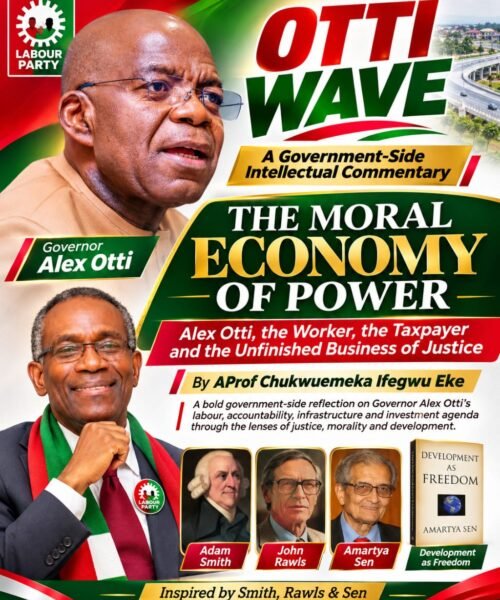
The publication, coordinated by Associate Professor Chukwuemeka Ifegwu Eke of the University of Abuja, examined Abia’s historical development, public administration, infrastructure, fiscal management and economic transformation.
Unlike the familiar political exchanges that have dominated discussions about Governor Alex Chioma Otti, the research placed contemporary governance within the longer history of Abia State.
The timing was particularly significant.
On the same day, Governor Otti presented a proposed ₦1.23 trillion budget for 2027, setting out an expenditure programme that directed approximately 80 per cent of the state’s proposed spending towards capital projects.
For a state whose history has been marked by concerns over deteriorating public infrastructure, the scale of that proposed investment was politically significant.
But the bigger question was no longer simply how much money the government intended to spend.
It was what the money was expected to accomplish.
THE ₦1.23 TRILLION QUESTION
Governor Otti’s proposed 2027 budget placed approximately ₦960 billion within the capital expenditure envelope.
The remaining 20 per cent was reserved for recurrent expenditure.
Education was allocated 20 per cent of the proposed budget, while healthcare received 15 per cent.
Together, the two sectors accounted for 35 per cent of planned expenditure.
These were not insignificant figures.
For economists, however, budgetary allocations represent policy intentions. Actual development depends on revenue mobilisation, expenditure releases, project execution, institutional capacity and the productivity of completed investments.
An appropriation does not automatically become a constructed road.
A healthcare allocation does not automatically become a functioning hospital.
An education budget does not automatically produce better learning outcomes.
Nevertheless, the structure of the proposed expenditure revealed an administration attempting to place capital formation and human development at the centre of its fiscal priorities.
The economic argument was straightforward.
Roads reduce transport costs. Reliable electricity reduces production expenses. Education improves workforce capabilities. Healthcare protects labour productivity.
Together, these investments can create the foundation for sustained economic expansion.
The challenge facing the Otti administration was to translate these priorities into measurable outcomes.
That was precisely the kind of distinction between government intentions and development results that gave the new scholarly compendium contemporary relevance.
ABIA’S DEBT CONTROVERSY: WHAT DO THE NUMBERS ACTUALLY SAY?
One of the most contentious political issues in Abia has been public borrowing.
Opposition figures and other commentators have questioned the administration’s borrowing arrangements, particularly in light of increased federal allocations to state governments.
The questions are legitimate matters of public finance.
How much does Abia owe?
What forms of borrowing have occurred?
What projects are being financed?
And what is the relationship between debt accumulation and the value of public assets being created?
Governor Otti recently stated that Abia’s debt stock declined from approximately ₦147.2 billion in the second quarter of 2023 to ₦48.6 billion in the corresponding period of 2026.
On those figures, the reduction amounted to approximately ₦98.6 billion, representing about 67 per cent of the earlier reported stock.
That was a substantial claim.
But debt analysis requires careful examination of domestic obligations, external liabilities, exchange-rate movements, loan disbursements and reporting dates.
A foreign loan agreement is not necessarily equivalent to money already disbursed.
A borrowing approval is not automatically an outstanding debt.
Similarly, the fact that a government receives more revenue does not, by itself, establish whether borrowing for a productive investment is economically justified.
The critical considerations include debt sustainability, financing costs, project returns and the government’s capacity to meet future obligations.
The wider debate therefore goes beyond the political slogan that borrowing is either inherently good or inherently bad.
Productive borrowing can finance infrastructure whose economic benefits extend over decades.
Poorly structured borrowing can impose costs on future generations without creating corresponding public assets.
The central issue is the quality of the investment and the transparency of the financing.
For Abia, that distinction has become increasingly important.
THE ROAD QUESTION: WHY INFRASTRUCTURE MATTERS MORE THAN POLITICAL NOISE
Few issues illustrate Abia’s historical difficulties more clearly than the condition of its roads.
For decades, the deterioration of strategic transport corridors affected commercial movement, industrial productivity and everyday life.
Aba, widely recognised for its indigenous manufacturing capabilities, faced particularly serious infrastructural difficulties.
Bad roads increased vehicle maintenance costs.
Flooded commercial streets disrupted trading activities.
Unreliable access routes complicated the movement of raw materials and finished goods.
For small businesses operating on narrow profit margins, these difficulties imposed costs that were often difficult to absorb.
Governor Otti’s administration made road construction and rehabilitation a central policy priority.
In his November 2026 budget presentation, the governor said his administration had constructed more than 1,000 kilometres of roads across the state’s 17 local government areas, with additional projects ongoing.
Those figures represented the administration’s account of its performance and remained appropriate subjects for independent verification.
Yet the economics of road investment extends beyond the number of kilometres constructed.
A five-kilometre road connecting a major industrial cluster to an important market may generate greater commercial benefits than a considerably longer road carrying limited economic activity.
The relevant indicators include traffic volume, travel-time savings, transport costs, market accessibility, maintenance requirements and changes in business activity.
This explains why the location of public infrastructure is as important as its physical dimensions.
The debate about roads in Abia therefore requires something more substantial than competing political photographs.
It requires evidence about where roads have been constructed, what they cost, how they are maintained and the economic activities they support.
ABA: THE INDUSTRIAL CITY THAT COULD NOT AFFORD TO FAIL
There is perhaps no better illustration of Abia’s economic potential than Aba.
Long before the current political administration, Aba had established itself as one of Nigeria’s most important centres of indigenous enterprise.
Footwear production, garment manufacturing, leather processing, metal fabrication and commercial distribution helped sustain a large network of small and medium-sized businesses.
The city’s economic strength was built substantially on private initiative.
Yet the productivity of private enterprise depends heavily on public infrastructure.
A shoemaker may possess the skills, equipment and customers necessary to expand production.
But when electricity is unreliable, access roads are damaged and distribution costs are excessive, business growth becomes difficult.
Aba’s longstanding infrastructural problems were therefore not merely environmental or aesthetic concerns.
They represented constraints on economic productivity.
Improvements in electricity supply and transport infrastructure have the potential to reduce those constraints.
The development of the Aba electricity supply arrangements and the state’s renewed road investment programme consequently featured prominently in discussions about the region’s economic prospects.
The wider lesson is that public infrastructure and private enterprise are complementary.
Government does not need to manufacture every shoe produced in Aba.
It needs to help create the conditions under which manufacturers can operate competitively.
For a state seeking increased employment, industrial growth and internally generated revenue, this distinction is fundamental.
THE 2027 ELECTIONS: CAN HISTORY BECOME EVIDENCE?
With the next general elections approaching, political arguments in Abia have become increasingly intense.
Questions surrounding public borrowing, expenditure priorities, infrastructural distribution and government accountability have featured in public discussions.
Supporters of the administration point to road reconstruction, institutional reforms and improvements in public services.
Critics question financing arrangements, project distribution and the pace of development in some communities.
These competing perspectives deserve examination.
But the existence of political disagreement does not eliminate the possibility of establishing facts.
A road either exists or does not exist.
A contract either has a documented value or it does not.
A public institution either provides a specified service or it does not.
A government financial report either records an expenditure or it does not.
The more difficult questions concern quality, causation, value for money and the distribution of benefits.
These are questions that require systematic research rather than partisan certainty.
Abia Then, Abia Now entered this environment as an attempt to organise the state’s historical and contemporary development experience into a scholarly framework.
Its five-volume structure permitted examination of developments across Abia North, Abia Central and Abia South, followed by a statewide synthesis.
Such an approach matters because Abia is not economically or geographically uniform.
The challenges facing an industrial entrepreneur in Aba differ from those confronting a farmer in Arochukwu or a trader in Ohafia.
Similarly, public investments must be evaluated in relation to the economic characteristics and developmental needs of their locations.
A statewide development record therefore needs to accommodate regional differences rather than reduce the entire state to a handful of prominent urban projects.
WHERE IS THE MONEY GOING?
Public financial management remains one of the central issues in the debate about Abia’s development.
The state’s budget documents contain information about approved expenditure, revenue projections and reported implementation.
But these categories must not be confused.
An approved budget establishes spending authority.
Actual expenditure records payments made.
Physical project completion indicates what has been delivered.
Economic impact concerns the benefits generated by those investments.
A government may record substantial expenditure without achieving the intended development outcome.
Conversely, efficient investment may generate benefits greater than the initial public expenditure.
The distinction is particularly important when assessing infrastructure projects financed through borrowing.
The publication of budget performance reports also forms part of the accountability process.
Abia’s third-quarter 2026 budget performance report provides a basis for examining recorded expenditure against approved appropriations.
But financial transparency becomes most useful when published figures can be connected to identifiable projects, locations, implementation milestones and results.
The central objective is to establish what public funds have produced.
That is the difference between counting money and measuring development.
EDUCATION AND HEALTH: THE ECONOMICS OF HUMAN CAPITAL
One of the most important features of the proposed 2027 budget was the administration’s continued emphasis on education and healthcare.
Together, the two sectors received 35 per cent of the proposed spending envelope.
From an economic perspective, this emphasis reflects the importance of human capital.
A healthy population is more productive.
An educated workforce is better positioned to adopt technology, develop enterprises and participate in higher-value economic activities.
Improvements in public schools can increase educational opportunities for children from low-income households.
Stronger healthcare services can reduce the financial burden of preventable illness.
These investments may not generate immediate political visibility comparable to major road projects.
Nevertheless, their long-term economic effects can be substantial.
A state that constructs roads without improving education and healthcare risks limiting the productive benefits of those investments.
The challenge is therefore to combine physical infrastructure with improvements in human capability.
For Abia, the proposed 2027 expenditure structure suggested that the administration recognised the importance of both.
Whether these intentions translate into measurable improvements will depend on actual implementation and service delivery.
THE BIGGER STORY: ABIA BEFORE OTTI AND ABIA UNDER OTTI
One important feature of the newly presented compendium was its historical scope.
Abia State was created in 1991.
Since then, successive administrations have operated within changing national economic circumstances, including fiscal constraints, inflationary pressures, currency instability and fluctuations in federal revenue.
The state’s development trajectory cannot be properly understood without considering those circumstances.
At the same time, historical constraints do not eliminate the responsibility of individual administrations for their policy choices.
Public officials make decisions about expenditure priorities, infrastructure maintenance, institutional management and economic development.
Those decisions influence the opportunities available to citizens.
A serious historical evaluation must therefore examine both inherited conditions and the consequences of subsequent policies.
This is where the scholarly approach differs from ordinary political commentary.
Instead of treating every contemporary development as though history began in May 2023, it establishes a longer timeline against which changes can be assessed.
It also permits the identification of unfinished development challenges.
Progress in one sector does not imply that every problem has been resolved.
Similarly, the persistence of particular difficulties does not establish that no progress has occurred.
Both propositions require evidence.
FIVE VOLUMES, THREE SENATORIAL DISTRICTS, ONE STATE
The publication was organised to reflect the geographical and administrative diversity of Abia State.
The regional volumes examined the state’s three senatorial districts.
A fourth volume provided a statewide synthesis, while the consolidated compendium brought the major components together.
The project involved approximately nine months of research, documentary investigation and editorial work.
Associate Professor Chukwuemeka Ifegwu Eke served as Chief Editor and Lead Consultant.
The publication sought to preserve a historical record while providing a framework for examining contemporary development policies.
Its significance extended beyond the immediate political contest.
Government projects eventually become part of institutional history.
Budgets become archival documents.
Roads, schools and hospitals become assets whose value can be assessed over time.
And the decisions taken by today’s public officials eventually become evidence for tomorrow’s researchers.
The preservation of these records is consequently important for scholarship, public administration and democratic accountability.
THE FINAL QUESTION: WHAT WILL ABIA LOOK LIKE AFTER 2027?
The central political question in Abia is often framed around who will occupy Government House after the next election.
But there is an equally important economic question.
What productive assets, institutional improvements and development opportunities will the state possess?
Will Aba’s industrial enterprises operate with lower production costs?
Will rural communities enjoy improved market access?
Will schools produce better educational outcomes?
Will healthcare facilities become more accessible and effective?
Will public borrowing translate into durable infrastructure and future economic benefits?
Will financial reporting become sufficiently comprehensive to permit independent assessment of government performance?
These questions extend beyond individual political personalities.
They concern the development capacity of Abia State itself.
The presentation of Abia Then, Abia Now therefore came at a significant moment in the state’s political and economic history.
The publication placed historical records, regional development experiences and contemporary policy choices within a common analytical framework.
For Governor Alex Otti, whose administration has prioritised infrastructure and public-sector reforms, the approaching election will provide a political test.
For researchers and citizens, the longer test will concern the lasting economic consequences of those policies.
Political slogans may dominate an election season.
But roads, institutions, financial records and economic outcomes provide a more enduring basis for evaluating governance.
Because long after the campaign posters have disappeared, Abia’s development record will remain.
And history will ask not merely who won the political argument, but what was actually built, what it cost, who benefited and what endured.
ATTNEWS SPECIAL REPORT.
UMUAHIA, ABIA STATE.