
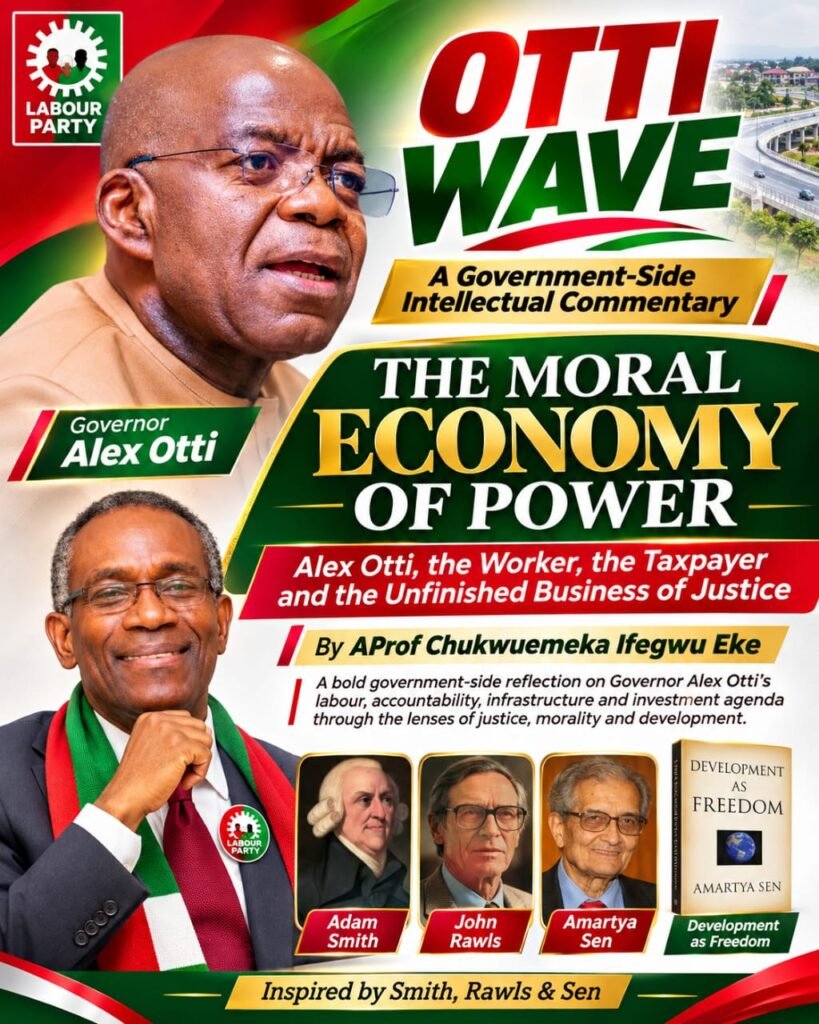
THE MORAL ECONOMY OF POWER: ALEX OTTI, THE WORKER, THE TAXPAYER AND THE UNFINISHED BUSINESS OF JUSTICE
By AProf Chukwuemeka Ifegwu Eke
Department of Economics, University of Abuja
Sunday, 15 November 2026
There is a fundamental distinction between exercising political authority and administering public power for the collective benefit of society. The former may be acquired through electoral competition; the latter must be demonstrated through public institutions, economic decisions and the treatment of citizens. I consider this distinction indispensable to understanding the philosophy of governance articulated by the administration of Governor Alex Chioma Otti of Abia State.
On Saturday, 14 November 2026, several newspapers and electronic media organisations published reports concerning the governor and his administration. Individually, the stories addressed infrastructure, workers’ welfare, local government accountability, international investment, security, traditional institutions, sporting activities and the 2027 governorship election. Collectively, they provided an opportunity to examine the economic principles behind the government’s publicly stated policies.
I intend to address those reports from the standpoint of the administration’s policy objectives, drawing upon Adam Smith’s moral philosophy, John Rawls’s theory of justice and Amartya Sen’s conception of development as freedom.
These thinkers offer three complementary questions. What moral obligations accompany economic power? How should the benefits and burdens of public institutions be distributed? And how can government expand the practical opportunities available to citizens?
For me, these questions provide a more useful basis for explaining the administration’s development agenda than a succession of political declarations.
THE WORKER IS NOT AN EXPENDITURE ITEM
In his report published in Vanguard on Saturday, 14 November, Steve Oko documented the tribute organised by the Abia State Government for the late Emmanuel Okechukwu Ugboaja, former Secretary-General of the Nigeria Labour Congress.
Governor Otti participated in the memorial held in Umuahia the previous evening. He described Ugboaja’s death as painful and acknowledged the enduring significance of his contributions to organised labour.
The President of the Nigeria Labour Congress, Joe Ajaero, also paid tribute to the deceased labour leader.
I find an important connection between this occasion and the philosophy of Adam Smith.
In The Theory of Moral Sentiments, Smith (1759) examined the importance of sympathy, conscience and moral judgment in human relationships. His account challenges the assumption that economic decisions can be separated entirely from ethical responsibilities.
Applied to public finance, this means that workers cannot be understood merely as recurrent expenditure.
A civil servant receives a salary, but that salary also sustains household consumption, pays school fees, supports healthcare expenditure and circulates through local markets.
When salaries are delayed, the economic consequences extend beyond the individual worker. Traders lose customers, landlords face payment difficulties, household savings deteriorate and consumption contracts.
It is within this broader economic relationship that I understand the Otti administration’s emphasis on public-sector remuneration and its reported efforts to address inherited obligations.
The administration presents regular payment of salaries and pensions as an important component of its governance programme. In his 14 November analysis in THISDAY, Boniface Okoro discussed these claims alongside criticisms concerning employment conditions and outstanding obligations.
I regard that distinction as necessary. The government’s commitment to remuneration is a policy position; its full implementation must be assessed through payroll records, payment histories and the experience of affected workers.
Nevertheless, the economic rationale is clear.
Regular remuneration supports household planning, consumption stability and confidence in public institutions. It also recognises the worker as a participant in economic development rather than merely a cost to be contained.
That is how I connect the administration’s labour policies to Smith’s moral philosophy.
WHY THE GOVERNMENT IS BUILDING ROADS
On the same Saturday, Premium Times published an article by Ferdinand Ekeoma, Special Adviser on Media and Publicity to Governor Otti.
Titled In Obingwa, Good Governance Campaigned for Gov Alex Otti, the article discussed the governor’s recent commissioning of two roads in Obingwa.
Ekeoma identified the Ohanze–Ntighauzo–Obete–Akirika Obu Road and the Oberete–Umuokpara Road among the infrastructure interventions undertaken by the administration.
He also referred to healthcare facilities, schools and other public-service investments.
Because Ekeoma speaks from within the governor’s communications team, I read his article as an explanation of the administration’s development priorities.
The argument deserves examination in economic terms.
A road is a productive public asset. Its significance extends beyond the physical construction because transport infrastructure influences the location of economic activity, the movement of goods and the accessibility of essential services.
Consider a rural farmer transporting produce to a major market. Poor road conditions can increase vehicle maintenance expenses, travel time, transport charges and post-harvest losses.
When road conditions improve, the potential benefits include lower distribution costs, wider market access and stronger connections between rural producers and urban consumers.
This is why I would explain the administration’s emphasis on road construction as part of a wider attempt to address economic constraints.
John Rawls provides a useful philosophical framework.
In A Theory of Justice, Rawls (1971) argues that social and economic institutions should be organised according to principles of fairness, including fair equality of opportunity and the difference principle.
For infrastructure policy, the implication is that access matters as much as construction.
A road serving a previously isolated settlement may expand economic opportunity for households that have historically faced disadvantages arising from poor connectivity.
The same reasoning applies to schools and healthcare facilities.
Ekeoma’s report states that the administration has undertaken healthcare and educational interventions in Obingwa. From the government’s policy perspective, these investments can be understood as attempts to address inequalities in access to essential services.
Their actual distributional effects remain matters for measurement.
I would examine reductions in travel times, changes in transport costs, healthcare utilisation, school attendance and market participation.
These are the indicators through which the administration’s infrastructure programme can demonstrate its economic contribution.
PUBLIC MONEY MUST PRODUCE PUBLIC RESULTS
Two newspapers addressed another important dimension of the administration’s programme.
In The Sun, Okey Sampson reported that the Abia State Government had warned the mayors of its 17 local government areas against diversion of public funds.
In New Telegraph, Igbeaku Orji reported the government’s collaboration with the Independent Corrupt Practices and Other Related Offences Commission in a programme designed to strengthen financial transparency.
Both reports were published on Saturday, 14 November.
The Commissioner for Local Government and Chieftaincy Affairs, Dr. Uzor Nwachukwu, explained that the administration expected discipline, transparent procedures and measurable results from local government officials.
I consider these statements important because they reveal how the government says it intends public finance to operate.
In public economics, government expenditure is justified not by the mere movement of money from the treasury but by the public purposes achieved through that expenditure.
A local government allocation should finance identifiable public functions.
A procurement process should deliver goods or services of appropriate quality.
An infrastructure budget should result in properly executed projects.
A healthcare allocation should support the delivery of accessible health services.
The government’s collaboration with the ICPC therefore raises issues extending beyond conventional anti-corruption messaging.
It concerns the institutional conditions under which public resources are converted into public benefits.
I understand the administration’s stated position to be that local governments must function as development institutions rather than merely as channels for administrative expenditure.
That principle is consistent with Adam Smith’s recognition of the importance of justice and effective institutions, and with Rawls’s insistence that the basic structure of society matters for the distribution of economic advantages.
However, financial accountability requires practical mechanisms.
Transparent procurement, proper record-keeping, timely financial reporting, effective supervision and independent oversight are essential.
The government has publicly identified these responsibilities. Their consistent enforcement will determine the long-term value of the initiative.
I would particularly emphasise that financial accountability protects the taxpayer and the beneficiary of public services simultaneously.
When public resources are properly managed, the state is better positioned to provide roads, healthcare, education, sanitation and other services.
That is the economic relationship the administration is seeking to strengthen.
FROM INTERNATIONAL CONFERENCES TO PRODUCTIVE INDUSTRY
In The Guardian of Saturday, 14 November, Gordi Udeajah reported preparations for the AFRICANDO 2026 U.S.–Africa Trade and Investment Conference, scheduled to begin in Umuahia on 17 November.
The report followed a press briefing conducted on Friday, 13 November, by organisers led by Pastor Caleb Ajagba, Chief of Staff to Governor Otti.
Fred Oladeinde, President of the Foundation for Democracy in Africa, discussed the prospects for increased commercial cooperation, investment and integration into international supply chains.
Dr. Okey Agbara, Chairman of the Abia State Diaspora Commission, described the proposal for an African Trade Development Centre.
James Ogbuka Umekwe, Chairman of the Abia Global Chamber of Commerce, commended the governor’s support for the investment initiative.
I regard this development as an expression of the administration’s economic ambition.
Abia possesses a substantial tradition of manufacturing, trading and entrepreneurship, particularly in Aba.
However, the expansion of productive activity requires more than entrepreneurial initiative.
It requires access to finance, reliable infrastructure, productive skills, wider markets and business relationships capable of supporting investment.
The administration’s involvement in AFRICANDO can be understood as an attempt to connect local economic activity with international commercial opportunities.
Amartya Sen’s Development as Freedom (1999) is especially relevant here.
Sen argues that development involves expanding the substantive capabilities and freedoms through which people pursue lives they have reason to value.
Economic growth is important, but its significance ultimately depends on what it enables people to achieve.
I would apply that principle directly to the proposed investment initiatives.
A trade conference becomes economically significant when businesses obtain useful market connections.
A training centre becomes developmentally significant when participants acquire marketable skills.
An investment partnership becomes productive when it contributes to business expansion, technological improvement or employment.
The proposed African Trade Development Centre should therefore be evaluated according to its eventual services and economic results.
The government and conference organisers have outlined the opportunities they intend to pursue. Those opportunities should not be confused with investments already realised.
Nevertheless, the economic reasoning behind the initiative is identifiable: stronger trade relationships can expand the productive opportunities available to Abia’s enterprises.
SECURITY IS AN ECONOMIC INSTITUTION
Abia Radio News also published a report on Saturday concerning the visit of Inspector-General of Police Olatunji Disu to Governor Otti.
The IGP warned politicians against exploiting young people for electoral violence.
He described measures being undertaken by the Nigeria Police Force to discourage political intimidation and maintain public order.
In his response, Governor Otti commended the IGP’s professionalism and acknowledged the support provided by the police to Abia State.
The governor also spoke about the importance of competence, national unity and public service over ethnic or regional considerations.
I consider these remarks relevant to the administration’s economic programme.
Security influences investment decisions, business continuity, transport activity and the movement of people.
Where insecurity is persistent, enterprises may face higher operating costs, disrupted supply chains and reduced access to markets.
Households may also experience restrictions on mobility and economic participation.
From the standpoint of Sen’s capability approach, security supports the freedom to travel, work, trade and participate in society.
From Rawls’s perspective, public institutions must protect basic liberties.
The administration’s engagement with police authorities can therefore be understood as part of the institutional environment required for economic and social activity.
The essential requirement is that security measures remain lawful, accountable and consistent with citizens’ rights.
I would also draw attention to the governor’s emphasis on national service and competence.
Public institutions function more effectively when appointments and professional responsibilities are guided by relevant qualifications and institutional obligations.
That principle applies not only to security agencies but to public administration generally.
THE MEANING OF THE OHAFIA RECEPTION
Vincent Kalu, writing in The Sun on 14 November, reported the remarks of Chief Onwuka Ukwa, a founding figure of the All Progressives Grand Alliance.
Ukwa congratulated Governor Otti in connection with his reception by the Ohafia Ancient Kingdom.
He praised the administration’s activities in infrastructure, education, healthcare and economic development.
He also appealed to traditional institutions in Ohafia to recognise the governor’s relationship with the community.
I understand the importance of this development within Abia’s political and cultural environment.
Traditional institutions remain influential in community affairs and can provide channels through which public policies are discussed, explained and implemented.
Recognition by community leaders may reflect their assessments of an administration and its relationship with the people.
At the same time, I distinguish expressions of appreciation from independent evaluations of development performance.
Chief Ukwa’s statements represent his assessment of Governor Otti’s record.
The administration’s reported projects and programmes provide the substantive subjects to which such assessments can be related.
The enduring question is how public policy affects the communities concerned.
SPORTS AND THE EXPANSION OF HUMAN CAPABILITIES
Abia Radio News reported on 14 November that the National Volleyball Division 1 and 2 League finals had commenced in Umuahia.
The competition brought together teams from different parts of Nigeria.
Abia’s Director of Sports, Obioma George, acknowledged Governor Otti’s support for sporting activities and national unity.
I see a connection between this report and the wider development programme.
Sport provides opportunities for recreation, skills development, social interaction and, in some cases, professional advancement.
Hosting sporting competitions can also create demand for accommodation, transportation, food services and other local commercial activities.
These are potential economic effects, not automatic outcomes.
Their significance depends on participation, expenditure, organisation and the resources committed.
Sen’s capability approach helps explain why sport can form part of a broader development agenda.
Human welfare includes opportunities for physical activity, social participation and the development of talents.
Government support for sporting institutions can contribute to these opportunities when programmes are accessible and sustainably organised.
THE GOVERNMENT’S RECORD AND THE 2027 DEBATE
Boniface Okoro’s article in THISDAY, published on Saturday, 14 November, examined the candidates contesting the 2027 Abia governorship election.
The article discussed Governor Otti’s record, the positions of opposition candidates and disagreements concerning public expenditure, employment, infrastructure and the geographical distribution of development.
The administration’s account of its performance includes road construction, education and healthcare interventions, payment of salaries and pensions, and public-sector reforms.
The report also presented criticisms involving project costs, the treatment of some workers and the distribution of infrastructure investments.
I consider it important to respond to these issues through the principles already examined.
Where the government reports infrastructure delivery, the relevant evidence includes project completion, cost, procurement procedures, quality and economic usefulness.
Where the government reports payment of salaries or pensions, the relevant evidence includes payment records, coverage and outstanding liabilities.
Where questions arise concerning regional distribution, the appropriate examination involves the location of projects, levels of need and the distribution of public investment.
Where allegations concern public expenditure, documentary records and applicable audit procedures are essential.
The administration’s stated emphasis on transparency and measurable results provides a basis for addressing these questions.
In my view, the economic discussion should focus on identifiable policies, documented expenditure and observable outcomes rather than treating political claims, whether favourable or critical, as self-proving.
That is particularly important because the 2027 contest concerns different proposals for the future management of Abia’s public resources.
The electorate is entitled to examine those proposals against the evidence.
THE MORAL ECONOMY OF POWER
The reports of Saturday, 14 November 2026, reveal several dimensions of the programme Governor Otti’s administration says it is pursuing.
The engagement with organised labour concerns the dignity and economic security of workers.
The infrastructure programme concerns connectivity, productivity and access to services.
The collaboration with the ICPC concerns financial integrity and the responsible use of public resources.
The AFRICANDO initiative concerns investment, industrial development and international market access.
The engagement with security institutions concerns public safety and the conditions necessary for economic activity.
Community relations and sporting programmes concern social participation and institutional cooperation.
I do not regard these subjects as disconnected.
Together, they describe the range of economic and administrative responsibilities undertaken by a state government.
Adam Smith reminds me that economic relationships carry moral obligations.
John Rawls requires attention to fairness, rights and the distribution of opportunities.
Amartya Sen directs attention to the capabilities that public policies make available to citizens.
These ideas provide a coherent intellectual explanation for the policy objectives communicated by the Otti administration.
They also provide standards for continuing assessment.
I would therefore describe the administration’s publicly stated approach as one that places infrastructure, financial discipline, public services and economic opportunity within a common development agenda.
Its long-term significance will depend upon implementation, the strength of public institutions and improvements in the lives of citizens.
For me, that is the proper meaning of the moral economy of power.
Political authority confers responsibility over public resources. Economic policy determines how those resources are deployed. Public institutions determine whether the resulting benefits can be sustained.
The administration has identified its priorities. The reports published on 14 November offer a record of how those priorities are being communicated and pursued.
The continuing task is to translate them into durable institutions, productive opportunities and demonstrable public benefits.
That is the relationship between political power and economic justice that I believe deserves sustained attention in Abia State.
AProf Chukwuemeka Ifegwu Eke
Department of Economics
University of Abuja
REFERENCES
Ekeoma, F. (2026, November 14). In Obingwa, good governance campaigned for Gov Alex Otti. Premium Times.
Kalu, V. (2026, November 14). Ex-APGA founding father, Onwuka felicitates Otti as Ohafia receives gov. The Sun.
Okoro, B. (2026, November 14). Abia 2027: 14 men, one woman, one Government House. THISDAY.
Oko, S. (2026, November 14). Otti, Ajaero, others pay tributes to late NLC scribe, Ugboaja. Vanguard.
Orji, I. (2026, November 14). Abia Govt, ICPC drill LG mayors on financial transparency. New Telegraph.
Rawls, J. (1971). A theory of justice. Harvard University Press.
Sampson, O. (2026, November 14). Abia warns LG mayors against diversion of public funds. The Sun.
Sen, A. (1999). Development as freedom. Alfred A. Knopf.
Smith, A. (1759). The theory of moral sentiments. A. Millar; A. Kincaid & J. Bell.
Smith, A. (1776). An inquiry into the nature and causes of the wealth of nations. W. Strahan & T. Cadell.
Udeajah, G. (2026, November 14). Abia targets foreign investment as AfrICANDO trade conference begins Tuesday. The Guardian.