

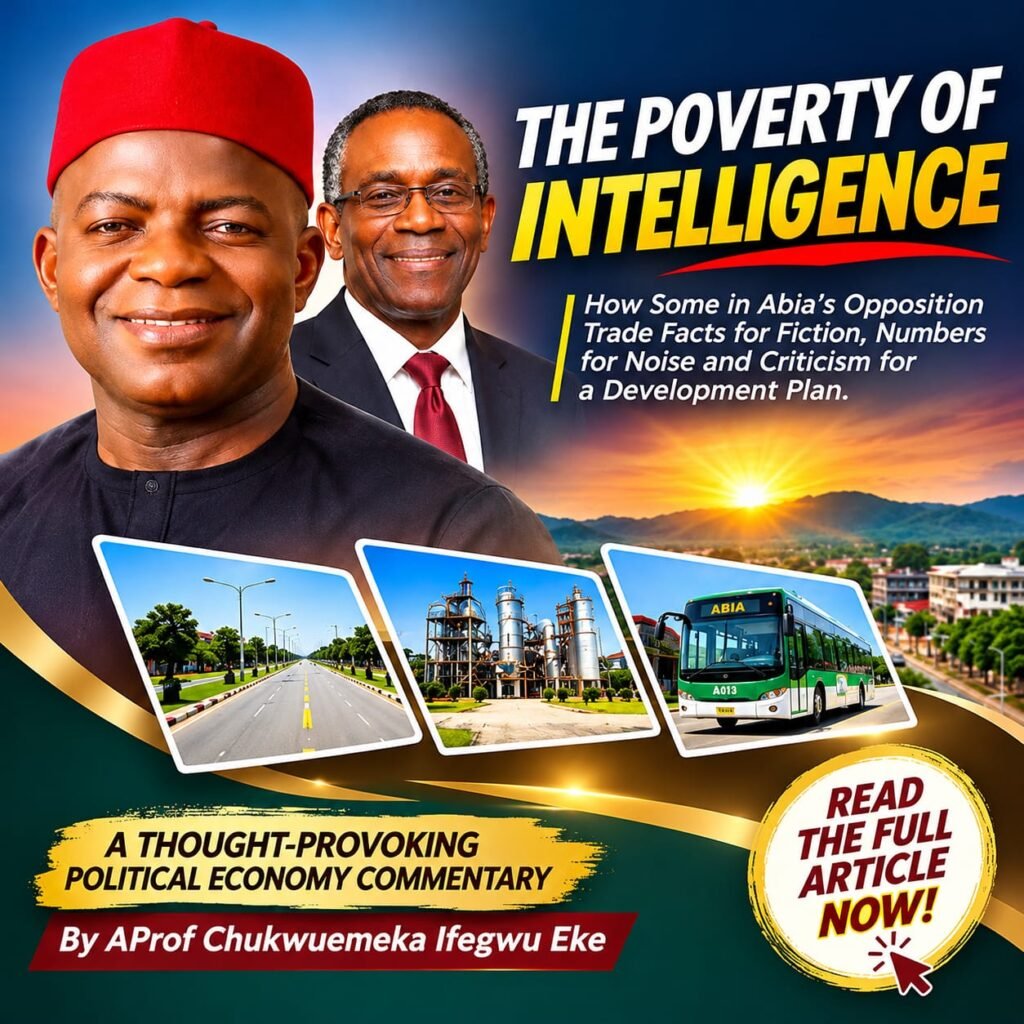
THE POVERTY OF INTELLIGENCE
When Political Opposition Mistakes Noise for Knowledge, Propaganda for Wisdom, and Criticism for an Alternative Vision
By AProf Chukwuemeka Ifegwu Eke
Department of Economics
University of Abuja, Nigeria
THE PECULIAR PARADOX OF POLITICAL INTELLECTUALISM
In my years of studying economics, public policy and institutional development, I have encountered several manifestations of poverty. There is income poverty, consumption poverty, multidimensional deprivation and the particularly debilitating condition of opportunity poverty.
Yet contemporary political discourse in Abia State has directed my attention towards another phenomenon: the progressive impoverishment of public reasoning.
I call it the poverty of intelligence.
Let me immediately dispense with a possible misunderstanding. I am not interested in determining anyone’s innate intellectual capacity. That would require a different discipline and an entirely different methodology.
My subject is the intellectual quality of public arguments.
A distinguished professional may advance an argument that lacks evidentiary foundation. An experienced politician may offer a proposition that does not survive historical comparison. An accomplished commentator may confuse personal observation with representative data.
These are deficiencies of reasoning, not necessarily deficiencies of intelligence.
My concern is that Abia’s political conversation has become an increasingly fascinating theatre in which assertions are frequently presented with the confidence of mathematical theorems, although their supporting evidence remains rather less impressive.
I shall examine some examples.
EKE O. AKO: THE INVENTION OF THE FAMILY-HOLIDAY DEVELOPMENT INDEX
Engr. Eke O. Ako has featured prominently in my earlier commentaries concerning Abia’s development.
His observations about electricity, water supply, roads and educational infrastructure raised important questions about the lived experiences of citizens.
However, his account of a family visit to Nigeria also presented an interesting methodological challenge.
Can observations from a limited number of communities sustain conclusions about the development performance of an entire state?
As an economist, I would answer that question by examining the representativeness of the observations.
A family may visit a community and encounter poor electricity supply.
That experience is real.
But it does not automatically establish the condition of electricity infrastructure across all 17 local government areas.
Similarly, the absence of functional pipe-borne water in one community does not, without additional evidence, establish the absence of water infrastructure throughout Abia.
The methodological distinction is elementary.
An anecdote may identify a problem worthy of investigation. It does not necessarily establish the magnitude, geographical distribution or causes of that problem.
I have therefore found it useful to describe this form of argument, somewhat humorously, as the family-holiday development index.
Its principal attraction appears to be administrative simplicity.
There is no expensive survey.
No sampling frame.
No statistical software.
No confidence interval.
The researcher visits home, observes some deficiencies and produces a conclusion.
Unfortunately, the convenience of a methodology does not establish its validity.
Engr. Ako also raised comparisons involving infrastructure conditions in Scotland and Nigeria.
International comparisons can be enlightening. But they require historical and institutional context.
Comparing the present infrastructure of Scotland with that of an Abia community without controlling for accumulated investment, income differences and institutional development risks producing an analytically incomplete picture.
The appropriate research question is whether measurable improvements have occurred over a defined period, relative to available resources and inherited conditions.
That is a question an engineer and an economist should both appreciate.
OBINNA ORIAKU: WHEN PUBLIC DEBT BECOMES AN ACCOUNTING LABYRINTH
Chief Obinna Oriaku, former Commissioner for Finance in Abia State, has been another important participant in the public-finance discussions I previously examined.
Our earlier exchange covered domestic debt, foreign debt, gratuities, pension obligations, outstanding contractor liabilities and security expenditure.
I found the discussion particularly instructive because fiscal terminology is frequently used in political arguments without adequate attention to accounting distinctions.
Consider domestic debt.
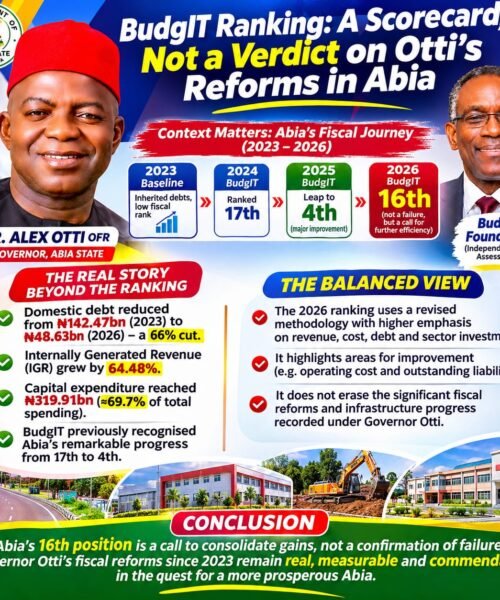
The Debt Management Office reported Abia’s domestic debt stock at approximately ₦48.50 billion as of September 30, 2025.
My earlier discussion with Chief Oriaku examined this figure against a substantially higher debt position reported for June 2023.
A reduction in reported debt stock is an observable financial development.
Determining precisely how it occurred requires examining repayments, reconciliations and other adjustments.
This distinction is important because categorical claims about whether loans have or have not been repaid must be supported by reconciled financial records.
The controversy over gratuities presents another example.
Gratuity liabilities, pension arrears and domestic borrowing are related aspects of public finance, but they are not interchangeable accounting categories.
The fact that a government owes gratuities does not automatically mean that those obligations should be added to DMO-recorded domestic loans and described as bank borrowing.
Nor does the exclusion of gratuities from a particular debt classification extinguish the underlying obligation.
Accounting requires classification before aggregation.
Otherwise, one may eventually add outstanding contractor payments, pension obligations, salaries, security expenditure and every other fiscal item into one magnificent figure and announce the discovery of a new national debt.
The arithmetic may be impressive.
The accounting would be less so.
My earlier examination also addressed an allegation concerning approximately ₦26 billion in security-related expenditure.
Here, too, terminology matters.
Security expenditure is not necessarily identical to a security vote.
The relevant budget classification must be established before a definitive conclusion is reached.
The central lesson from my exchange with Chief Oriaku is that public-finance arguments cannot acquire credibility merely through the dramatic presentation of large figures.
They require consistent definitions, appropriate comparisons and documentary reconciliation.
ORJI UZOR KALU: THE HISTORICAL ACCOUNTABILITY QUESTION
Senator Orji Uzor Kalu governed Abia State between 1999 and 2007.
On January 9, 2026, he participated in a meeting involving former Abia political officeholders who announced the formation of a political grouping known as The Team.
At the gathering, Kalu defended the contributions of previous administrations and characterised leadership as a succession in which one administration hands responsibility to another.
The group also articulated the objective of challenging Governor Alex Otti’s administration in the 2027 election.
The continuity argument is interesting.
I agree that development is cumulative.
Nevertheless, when successive administrations are presented as participants in a continuous historical project, their collective performance becomes an appropriate subject for empirical examination.
What infrastructure was delivered?
What institutional reforms were undertaken?
What measurable improvements occurred in education, healthcare and household welfare?
How efficiently were public resources deployed?
What obligations were transferred to succeeding administrations?
These questions cannot be resolved through political recollection alone.
The historical evaluation must also distinguish nominal expenditure from real expenditure.
A naira spent in 2001 cannot be meaningfully compared with a naira spent in 2026 without considering inflation and changes in purchasing power.
The same principle applies to public revenues.
I would therefore welcome historical comparisons that identify their data sources, price adjustments and development indicators.
Political experience is valuable, but it does not eliminate the need for empirical verification.
THEODORE ORJI: THE BURDEN OF INSTITUTIONAL HISTORY
Senator Theodore Ahamefule Orji governed Abia between 2007 and 2015.
His participation in the 2026 political gathering adds another dimension to the debate over the record of successive administrations.
A serious examination of his tenure would consider institutional development, infrastructure, public financial management and the condition of essential services.
It would also distinguish inherited obligations from liabilities arising during the period.
The interesting issue is the extent to which a political alliance involving former administrations can present a coherent assessment of their collective historical contributions.
Where those administrations claim cumulative achievements, the relevant indicators should be identified.
Where they acknowledge inherited difficulties, the chronology of those difficulties should be established.
One cannot construct a satisfactory historical account by remembering every achievement and forgetting every liability.
That would amount to an extraordinarily selective form of institutional memory.
It might make for agreeable political conversation, but it would not constitute a reliable development history.
OKEZIE IKPEAZU: THE IMMEDIATE HISTORICAL BASELINE
Dr. Okezie Ikpeazu governed Abia State between 2015 and May 2023.
His tenure provides the immediate historical reference point for examining the administrative and economic conditions inherited by the Otti administration.
A rigorous comparison should examine the transition records for public debt, outstanding obligations, completed infrastructure, contractual commitments and service-delivery capacity.
In March 2026, reports indicated that political figures associated with the administrations of Kalu, Theodore Orji and Ikpeazu inaugurated a technical committee to develop a political blueprint.
The announcement raises an important distinction between political organisation and economic planning.
A committee may possess considerable administrative experience.
However, the analytical quality of its programme depends upon the substance of its proposals.
What are its expenditure priorities?
What revenue assumptions underpin its commitments?
What institutional reforms does it recommend?
How would its policies affect productivity, employment and household welfare?
These are the questions through which an economic blueprint acquires meaning.
The establishment of a committee is an organisational achievement.
The formulation of a credible development strategy is a separate intellectual undertaking.
KELECHI ANOSIKE: INFRASTRUCTURE AND SOCIAL WELFARE
Dr. Kelechi Anosike has raised concerns about the relationship between infrastructure development and other public priorities, including pensions, cottage industries and workers’ welfare.
His argument concerns a recognisable question in public economics: whether expenditure allocations appropriately balance immediate social needs with long-term productive investment.
The distinction matters because infrastructure and welfare expenditure are not necessarily mutually exclusive.
A road connecting rural producers to markets may improve household income.
Electricity infrastructure may lower production costs.
Healthcare investment may strengthen labour productivity.
Educational expenditure may increase human capital formation.
However, the benefits of these investments depend upon project quality, implementation and their relationship with other public priorities.
Accordingly, a useful evaluation should examine sectoral spending, actual delivery and measurable outcomes.
A general statement that infrastructure investment has displaced welfare spending requires evidence demonstrating the displacement.
Likewise, the existence of infrastructure projects does not, by itself, resolve every welfare concern.
The economic question concerns resource allocation and its consequences.
Political language may simplify this relationship, but simplification should not become distortion.
CHINEDUM ORJI: POLITICAL MOBILISATION IS NOT POLICY FORMULATION
Chinedum Orji, former Speaker of the Abia State House of Assembly, participated in the January 2026 meeting of former political officeholders.
Reports identify him as the person who moved the motion to expand the membership of The Team.
This intervention concerned political organisation.
Political mobilisation is a legitimate democratic activity.
But it should be distinguished from the formulation of a substantive economic programme.
An alliance of experienced politicians may possess valuable institutional knowledge.
Its policy contribution must nevertheless be established through its proposals.
The number of participants does not automatically determine the quality of the resulting economic analysis.
Otherwise, every reunion of former officeholders would qualify as an international conference on development economics.
Academic conferences, unfortunately, tend to demand papers.
CHUKWUEMEKA OBINNA AND JOE NKORO: THE REPRESENTATION QUESTION
Chukwuemeka Obinna and Engr. Joe Nkoro featured in the controversy concerning an endorsement of Governor Otti by a Ngwa diaspora organisation.
The objection raised by the coalition associated with them concerned the authority of one organisation to speak for a wider ethnic community.
The relevant issue is representative mandate.
An association may express a political preference under its governing rules.
However, the existence of that preference does not necessarily establish unanimous support throughout the community.
Similarly, a group challenging an endorsement must distinguish its own membership from the wider population whose interests it discusses.
The appropriate analytical questions concern membership, authorisation and the scope of representation.
A political declaration becomes more informative when its authors specify precisely whom they represent.
This is especially important where communal identity intersects with political disagreement.
CHARLES OGBONNA: THE PROBLEM OF ATTRIBUTED SPEECH
The controversy involving Charles Ogbonna concerned remarks allegedly attributed to Governor Otti about Ndi Ngwa.
My earlier fact-checking materials examined whether authenticated recordings, transcripts or other primary evidence established the attributed quotation.
Those materials did not establish the quotation through an authenticated primary record.
That distinction is essential.
An allegation that a public official made a particular statement must be assessed against reliable evidence.
The same principle applies to claims that another person’s remarks represent the official position of the governor.
Attribution requires proof.
An unverified statement does not become established fact merely because it has circulated repeatedly.
Nor does the number of people repeating an allegation determine its accuracy.
Were repetition a substitute for verification, the most persistent rumours in political history would qualify for inclusion in encyclopaedias.
Thankfully, serious scholarship requires more.
THE INTELLECTUAL COST OF POLITICAL NOISE
The controversies examined above share several methodological characteristics.
They involve historical comparison, financial classification, representative evidence, political organisation and the attribution of statements.
These questions are legitimate subjects of public debate.
Their treatment, however, determines whether the discussion contributes to knowledge or merely generates attention.
A public argument should identify its factual foundations.
Where financial data are used, the relevant accounting categories should be specified.
Where historical comparisons are made, the appropriate periods and adjustment factors should be disclosed.
Where claims concern an entire population, the basis of representation should be established.
Where allegations are attributed to individuals, the underlying evidence should be examined.
These are not extraordinary demands.
They are elementary requirements of disciplined reasoning.
Unfortunately, political communication frequently rewards the certainty of presentation rather than the quality of demonstration.
A dramatic assertion may command public attention even when the supporting evidence remains incomplete.
A carefully qualified explanation may attract less enthusiasm precisely because it acknowledges complexity.
This creates a peculiar intellectual incentive.
The person who speaks most confidently may be mistaken for the person who has investigated most carefully.
Yet confidence and correctness are different variables.
Their correlation should never be assumed.
THE DISTINCTION BETWEEN CRITICISM AND AN ALTERNATIVE VISION
One final question deserves attention.
What distinguishes a political criticism from a comprehensive alternative development programme?
Criticism may identify a weakness in an existing policy.
An alternative programme must go further by specifying a different course of action.
It must address financing, implementation, institutional capacity and likely consequences.
For example, an objection to infrastructure expenditure becomes more useful when accompanied by an alternative allocation framework.
A criticism of debt management becomes more substantive when it identifies the desired borrowing strategy and its implications.
A complaint about public-sector obligations can be developed into proposals concerning revenue mobilisation, expenditure prioritisation and liability management.
These are the foundations of policy competition.
An allegation may initiate public discussion.
It does not automatically constitute an alternative economic programme.
Similarly, an opposition alliance may organise political participation without yet demonstrating how its proposed policies would affect employment, investment, productivity or public welfare.
The distinction should remain clear.
THE FINAL PARADOX
I began by identifying the poverty of intelligence as a condition in which the discipline of reasoning becomes subordinate to political convenience.
The examples examined in this article demonstrate why evidentiary standards matter.
Personal observations must be distinguished from representative research.
Debt stocks must be distinguished from other public liabilities.
Historical records must be assessed through comparable indicators.
Political alliances must be distinguished from substantive policy programmes.
Communal endorsements must be understood within the limits of representative authority.
And allegations concerning public statements must be examined against reliable evidence.
These distinctions are the intellectual infrastructure of responsible political discourse.
Without them, public arguments become increasingly susceptible to distortion.
With them, disagreement can become a productive instrument of democratic development.
I do not expect politics to resemble a doctoral seminar.
Indeed, the spectacle of political candidates defending their manifestoes before three external examiners might be entertaining, but I suspect the electoral calendar would become considerably longer.
Nevertheless, I believe those who participate prominently in public affairs should recognise the importance of intellectual consistency.
The public deserves arguments whose conclusions bear a reasonable relationship to their evidence.
The poverty of intelligence begins when the possession of an opinion is mistaken for the completion of an investigation.
It deepens when the repetition of a claim is substituted for its verification.
And it becomes particularly consequential when complex economic questions are reduced to assertions that conceal more than they explain.
In the end, development is measured through outcomes, not the volume of political commentary.
Economic progress depends upon productive activity, infrastructure, institutions, investment and human welfare.
These are realities that cannot be established—or dismissed—through rhetoric alone.
My concluding proposition is therefore straightforward:
An argument does not become profound because it is loudly proclaimed, repeatedly circulated or delivered by a prominent personality. Its intellectual value rests upon the evidence it presents and the reasoning through which its conclusions are reached.
That is the distinction between political noise and public knowledge.
And it is precisely the distinction that the poverty of intelligence threatens to erase.
AProf Chukwuemeka Ifegwu Eke
Department of Economics
University of Abuja, Nigeria
6 November 2026